

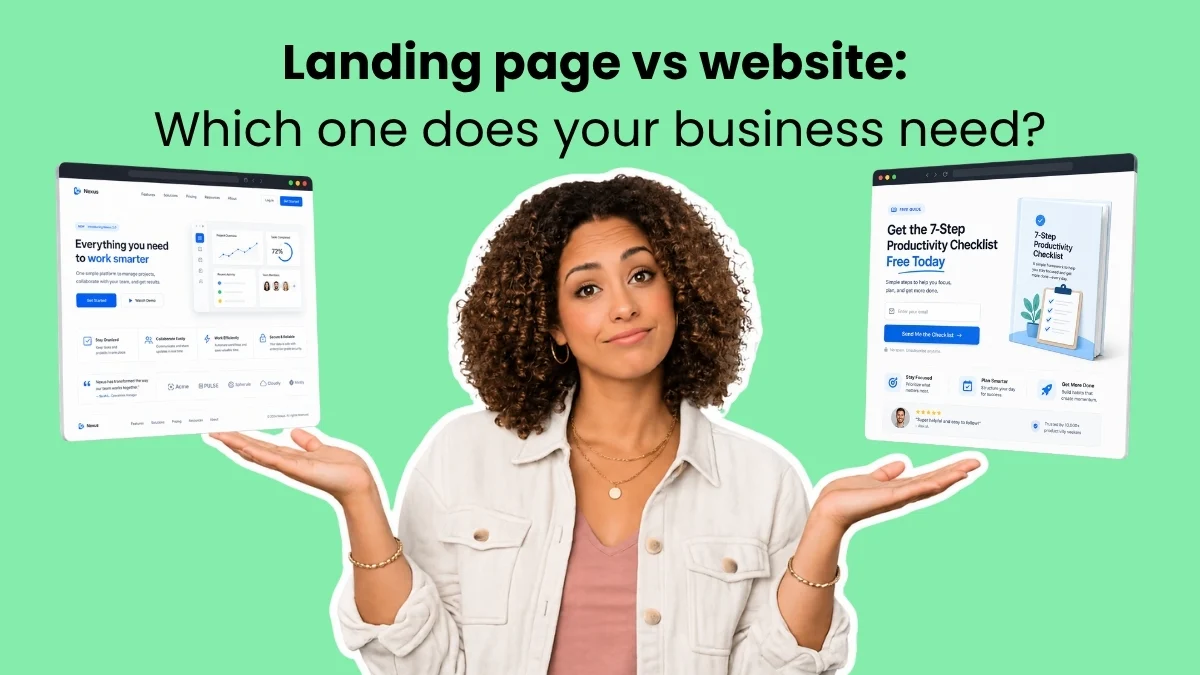
For countless entrepreneurs and burgeoning enterprises, the initial foray into the digital realm is often met with a fundamental question: Should I build a comprehensive website or focus on a streamlined landing page? This pivotal decision, central to establishing an effective online presence, dictates not only initial investment but also the trajectory of customer engagement, brand development, and conversion strategies. As the digital economy continues its rapid expansion, understanding the distinct roles and synergistic potential of websites and landing pages has become a critical skill for small businesses aiming for immediate success and sustainable growth.
The Digital Imperative: A Shifting Landscape
The imperative for businesses to establish a robust online presence has intensified dramatically over the past decade, a trend significantly accelerated by global events that pushed commerce and communication predominantly online. In this hyper-connected era, a business’s digital footprint is often its first, and sometimes only, point of contact with potential customers. This shift has democratized market access, allowing small businesses to compete on a global scale, but it has also introduced complexities regarding the optimal digital infrastructure. Early online ventures often defaulted to creating a website, viewing it as a digital storefront. However, with the maturation of digital marketing, the specialized utility of landing pages has gained prominence, prompting a re-evaluation of traditional strategies. Industry reports indicate that over 80% of consumers research products and services online before making a purchase, underscoring the non-negotiable need for a strategic digital presence.
Defining the Cornerstones of Online Presence
To make an informed decision, a clear understanding of what constitutes a website versus a landing page is essential. While both are web-based platforms, their design, purpose, and operational mechanics diverge significantly.
The Comprehensive Digital Hub: Websites
A website serves as the central digital headquarters for a business. Typically composed of five or more interconnected web pages, it is designed for extensive exploration and provides a holistic view of an organization. Key components often include a homepage, an "About Us" section detailing the company’s mission and history, dedicated pages for services or products, a blog for content marketing and thought leadership, and a "Contact Us" page for direct inquiries. For e-commerce businesses, product catalogs, shopping carts, and customer accounts are integral.
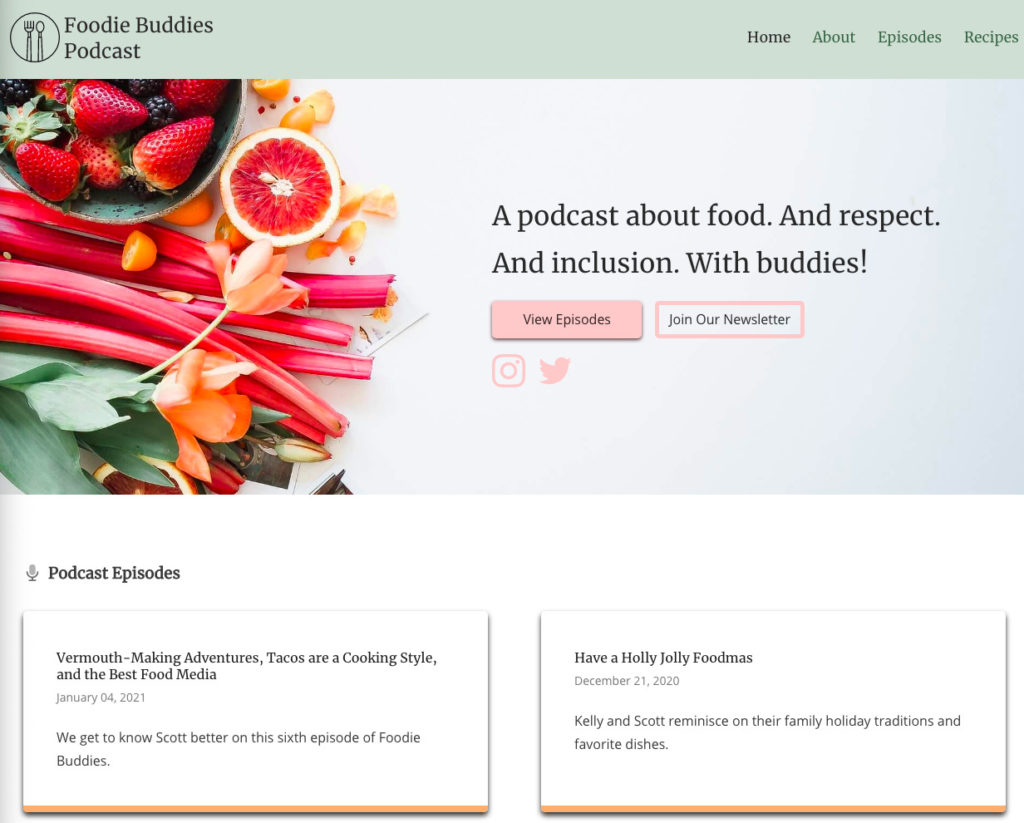
The primary goal of a website is education and brand building. Visitors are encouraged to browse, delve into various aspects of the business, find answers to a multitude of questions, and gradually build familiarity and trust over time. It functions as a comprehensive repository of information, reflecting the full scope of a company’s offerings and identity. This completeness, however, comes with inherent costs: websites demand significant investments in time for design and content creation, financial resources for development, hosting, and often ongoing maintenance and updates. A well-constructed website is a long-term asset, contributing to search engine optimization (SEO) and establishing digital authority. For instance, a hypothetical podcast like "Foodie Buddies" would utilize a website to host episode archives, share recipes, provide background on hosts, and foster a community, allowing listeners to navigate freely and deeply engage with diverse content.
The Focused Conversion Engine: Landing Pages
In stark contrast, a landing page is a standalone web page meticulously crafted with a singular objective and a solitary call to action (CTA). Its design is minimalistic, intentionally devoid of extensive navigation menus or multiple links that might divert a visitor’s attention. The user journey on a landing page is linear: a visitor arrives, absorbs the targeted message, and is presented with one clear choice – to take the intended action or to exit.
Common goals for landing pages are highly specific and conversion-oriented. These include generating leads through email sign-ups, promoting and selling a single product or service, registering attendees for a webinar or event, offering a free download (like an e-book or guide), or serving as a "link-in-bio" directory for social media profiles. Because every element on the page is optimized to guide the visitor towards this one action, landing pages typically boast significantly higher conversion rates compared to general browsing pages or homepages. The absence of navigational distractions ensures that the visitor’s focus remains entirely on the value proposition and the desired response. For "Foodie Buddies," while their main website provides an expansive experience, a dedicated landing page might be used to promote a new cooking course, collect email sign-ups for a newsletter, or provide a streamlined link directory from their social media profiles, effectively capturing specific user intent.
A Tale of Two Strategies: Key Differentiators
The fundamental differences between websites and landing pages are best understood through a comparative lens, highlighting how their structural and functional attributes cater to distinct business needs.
Scope and Structure: A website is analogous to a sprawling continent, with numerous interconnected territories (pages) that offer diverse landscapes of information. Conversely, a landing page is an isolated island, self-contained and focused entirely on a single, compelling feature. While a typical website encompasses five or more pages, a landing page strictly adheres to a one-page format.
Navigation and User Journey: The navigational experience is a critical distinction. Websites feature comprehensive menus, sidebars, and internal links, empowering visitors to explore content at their leisure, moving seamlessly between various sections like "Home," "Services," "Blog," and "Contact." This encourages discovery and self-directed learning. Landing pages, by design, severely limit or entirely eliminate navigation. The path is predetermined: arrive, read, act, or leave. This guided journey minimizes decision fatigue and maximizes focus on the conversion goal.
Primary Objectives and Calls to Action: The overarching goal of a website is broad: to educate, inform, build brand authority, and facilitate exploration. It may contain multiple calls to action spread across different pages, each serving a distinct purpose (e.g., "Learn More," "Browse Products," "Read Blog," "Contact Us"). A landing page, however, is laser-focused on one specific action. Its entire design, copy, and visual elements converge on a single, prominent call to action, such as "Sign Up Now," "Download Your Free Guide," or "Buy Now."
Resource Investment: Time and Cost: The resources required for development and maintenance vary considerably. Launching a full-fledged website can be a substantial undertaking, often requiring days to weeks for initial design, content creation, and technical setup. Costs are typically higher, encompassing expenses for professional design, development, content writing, hosting services, and ongoing maintenance. Landing pages, conversely, are agile. They can often be built and launched within minutes to a few hours, particularly with modern drag-and-drop builders. Their cost is generally lower, frequently bundled with email marketing platforms or available through specialized, more affordable landing page builders.
Optimal Use Cases: Websites are best suited for established businesses that possess a wealth of content, diverse product lines, extensive service offerings, or a robust content marketing strategy. They are ideal for cultivating long-term brand presence, improving SEO, and serving as a comprehensive information hub. Landing pages excel in targeted campaigns. They are the preferred tool for lead generation, promoting specific products or services, A/B testing marketing hypotheses, driving event registrations, or serving as dynamic entry points for paid advertising campaigns.
Strategic Deployment: When to Choose Which
The decision between a website and a landing page is not always an either/or proposition; often, the most effective strategy involves a synergistic approach.
Leveraging Landing Pages for Campaign Success: Landing pages are the go-to solution when a business requires absolute focus. For instance, if running a pay-per-click (PPC) advertising campaign, directing traffic to a highly relevant landing page dramatically increases conversion rates by eliminating distractions. Similarly, promoting a new lead magnet (e.g., an e-book, a free consultation) through email marketing finds its ideal destination in a landing page. Product launches for a single item, event registrations, or even simple "link-in-bio" solutions on social media platforms benefit immensely from the singular objective of a landing page. They are also invaluable for testing new ideas or offers quickly and cost-effectively. A startup, for example, can validate market interest for a new service by creating a simple landing page to gauge sign-ups before investing in a full website. This agility allows for rapid iteration and minimizes financial risk.
Building Enduring Digital Authority with Websites: A website becomes indispensable when a business possesses sufficient depth and breadth that cannot be adequately represented on a single page. This includes multiple product lines, an extensive portfolio, a comprehensive content library (blogs, case studies), or detailed "About Us" and "Team" pages. If visitors frequently require answers to diverse questions, a website provides dedicated spaces for each, enhancing user experience and reducing customer service inquiries. Furthermore, a website is crucial for building long-term search engine visibility. A regularly updated blog with valuable content can attract organic traffic month after month, establishing the business as an authority in its niche—an achievement rarely attainable with a standalone landing page. Businesses aiming for sustained brand recognition and a robust online presence will find a website to be a foundational investment.
The Synergistic Approach: Integrating Both for Maximum Impact: Critically, one does not replace the other; rather, they complement each other within a sophisticated digital marketing ecosystem. Even businesses with comprehensive websites leverage landing pages for specific, conversion-focused campaigns. For example, while the website serves as the brand’s home, specific marketing efforts—such as a holiday sale, a new product announcement, or a webinar promotion—should direct traffic to a dedicated landing page designed solely for that campaign. Sending paid ad traffic or email promotions to a generic homepage, which inherently has multiple exit points, often results in lower conversion rates. The homepage’s purpose is exploration; the landing page’s purpose is action.
The Evolving Ecosystem of Digital Tools
The proliferation of user-friendly website builders and landing page platforms has significantly lowered the barrier to entry for businesses. Modern tools offer drag-and-drop editors, pre-designed templates, and integrated functionalities like payment processing and email marketing automation. Platforms like AWeber, mentioned in the original source, exemplify this trend by offering bundled solutions that include landing page creation, hosting, SSL security, and AI-powered content assistance. This accessibility means that even solopreneurs or micro-businesses can establish a professional online presence without needing extensive technical skills or a large budget, often starting with a cost-effective landing page and scaling up to a full website as their business matures.
Addressing Common Queries: Expert Insights
The prevailing questions surrounding websites and landing pages reflect the ongoing strategic considerations for businesses.
- What is the core difference? Digital marketing experts consistently highlight that a landing page is a single-purpose, conversion-focused page with minimal navigation, designed to drive one specific action. A website, conversely, is a multi-page hub designed for broad exploration, education, and brand building, offering extensive navigation and multiple objectives.
- Microsite vs. Landing Page? Industry analysts differentiate a microsite as a small cluster of interconnected pages (typically 2-5) built for a specific, often temporary campaign, product, or event, often with its own domain. It offers more content than a landing page but is less comprehensive than a main website. A landing page remains a single page with a single CTA.
- Is a website essential if I have a landing page? Not necessarily for all businesses, especially those just starting or operating on a lean model. Many creators and solo entrepreneurs successfully run their entire operations—from lead generation to product sales—solely through a series of interconnected landing pages. The email list, nurtured through these landing pages, often becomes the primary communication and sales channel, effectively replacing many functions of a traditional website.
- Is a landing page more cost-effective? Generally, yes. Custom website development can incur significant costs for design, development, hosting, and ongoing maintenance, potentially running into thousands of dollars. Landing pages are often a more economical solution, frequently included as part of broader marketing automation or email service provider packages, thereby reducing the standalone investment.
- Can a landing page replace a homepage? For new or very niche businesses, a highly focused landing page can indeed serve as an effective homepage, particularly if the business offers a single core product or service. Its conversion-centric design can outperform a traditional homepage in driving specific actions. However, as a business expands its offerings and requires more extensive information dissemination, a traditional homepage with full navigation becomes more beneficial.
The Future of Online Business Presence
As the digital landscape continues to evolve, the distinction between websites and landing pages will remain a crucial strategic consideration. The trend points towards a more integrated approach, where businesses dynamically deploy both tools to optimize different aspects of their online strategy. Websites will continue to serve as the stable anchors for brand identity and broad information, while agile landing pages will act as the sharp spears of targeted campaigns, driving specific conversions and allowing for rapid testing and optimization. The ability to discern when and how to utilize each, or better yet, how to weave them into a cohesive digital ecosystem, will define the success of businesses navigating the increasingly complex, yet opportunity-rich, online world. Ultimately, strategic adaptability, coupled with an understanding of consumer behavior and technological capabilities, will empower businesses to build effective, scalable, and profitable digital presences.








