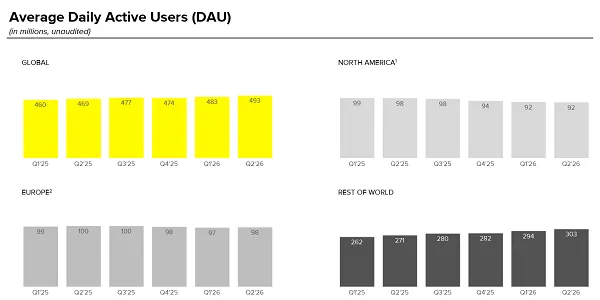
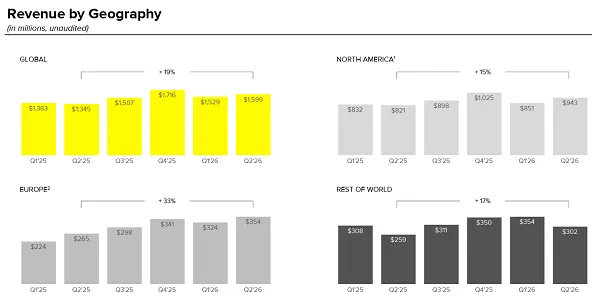
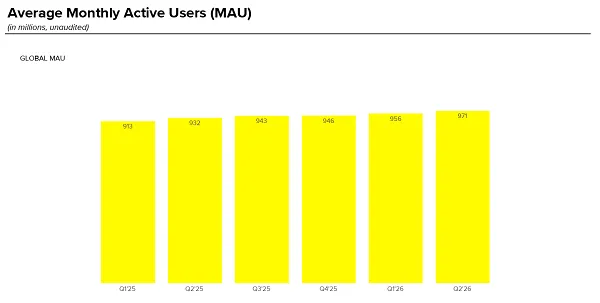
Snap Inc., the parent company of the popular social media platform Snapchat, reported its second-quarter 2026 financial results, revealing a complex picture of global user expansion coupled with persistent challenges in its most lucrative advertising markets. The company announced the addition of 10 million daily global active users (DAU) quarter-over-quarter, bringing its total to a robust figure nearing a billion monthly active users. This growth contributed to a 19% year-over-year increase in overall revenue, reaching approximately $1.6 billion for the quarter. However, a deeper dive into the numbers reveals a strategic tightrope walk for Snap, as it simultaneously strives to revitalize its core advertising business in mature markets while investing heavily in the ambitious, yet unproven, future of augmented reality with its AR-enabled Spectacles (Specs).
Detailed Q2 2026 Financial Performance: A Mixed Bag of Growth
Snap’s Q2 2026 results showcased a commendable 4% increase in revenue over the previous quarter and a significant 19% jump year-over-year, underscoring the company’s ability to generate revenue despite market fluctuations. A crucial component of this growth was the 9% year-over-year increase in advertising revenue, a testament to Snap’s efforts in rebuilding its monetization platform and enhancing its appeal to advertisers. CEO Evan Spiegel highlighted these improvements in his prepared remarks, noting the ongoing focus on optimizing ad products and delivery.
Beyond advertising, Snap’s "other revenue" streams experienced remarkable growth, soaring by 85% year-over-year to reach $316 million. This category, encompassing offerings like Snapchat+ subscriptions, Lens+ (a subscription for advanced AR and AI features), and expanded Memories storage, represents a concerted effort by Snap to diversify its income. The success in this segment suggests a growing willingness among a subset of Snapchat users to pay for premium features, offering a valuable alternative revenue source in an increasingly competitive digital landscape. However, it is important to contextualize this growth: fewer than 3% of Snapchat’s total monthly active users are currently paying subscribers, indicating that while promising, subscription revenue is not yet a viable replacement for the massive scale of ad-driven income. This ratio underscores the enduring importance of advertising as the primary financial engine for social media platforms.
Global User Expansion vs. Stagnation in Key Markets
The headline figure of 10 million new daily active users globally is undoubtedly a positive indicator of Snapchat’s continued reach. This expansion is predominantly fueled by growth in the "Rest of World" category, with markets like India showing particularly significant uptake. India, for instance, has witnessed a remarkable tenfold increase in advertisers on the platform over the past two years, signaling both user engagement and burgeoning monetization opportunities in this region. This geographic diversification is a strategic advantage, allowing Snap to tap into vast, underserved populations with high smartphone penetration.
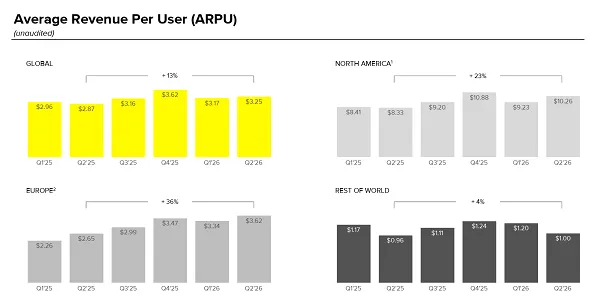
However, this global success is tempered by the stagnation observed in Snapchat’s historically crucial advertising markets: the United States and Europe. After experiencing a reduction in active users in both regions in Q1, Q2 saw these markets remain largely flat quarter-over-quarter. While stability after a decline might be seen as a minor victory, the lack of significant growth in the US and EU presents a considerable challenge. These regions typically yield a much higher Average Revenue Per User (ARPU) compared to emerging markets, due to factors such as more developed advertising ecosystems, higher consumer spending power, and greater brand marketing budgets. The disparity in ARPU means that while millions of new users in "Rest of World" contribute to overall DAU figures, their lower individual revenue generation requires a much larger volume to offset stagnant growth in high-ARPU territories. This dynamic puts pressure on Snap to either reignite user growth in the West or significantly enhance monetization strategies in its rapidly expanding non-Western markets.
Evolving Engagement and Demographic Shifts
Beyond raw user numbers, engagement metrics within Snapchat reveal interesting trends. The company’s TikTok-like short-form video feature, Spotlight, demonstrated robust growth. The number of people posting content to Spotlight increased by more than 115% year-over-year, while daily active viewers grew by over 20%. This success marks a strategic win for Snap, which has historically been on the receiving end of feature replication, most notably when Instagram famously adopted Snapchat’s "Stories" concept in 2016, a move that significantly impacted Snapchat’s early growth trajectory. Snap’s ability to successfully integrate and grow a competitor-inspired feature like Spotlight demonstrates its adaptability and willingness to compete in the fast-evolving short-form video landscape. This growth provides a new avenue for user engagement and, critically, for future advertising inventory.
Furthermore, Snapchat is observing a notable demographic shift: its audience of U.S. users aged over 35 is growing quarter-over-quarter. This expansion beyond its traditional youth demographic is highly significant for advertisers. A more diverse, and often wealthier, user base makes the platform more attractive to a broader range of brands and industries, potentially unlocking new revenue streams and increasing the overall value proposition for marketing partners. This broadening appeal could help mitigate the challenges posed by flat overall user growth in the US market, as the quality of the audience improves.
Strategic Pillars: AI, Advertising, and Subscription Models
Snap’s strategy moving forward hinges on a multi-pronged approach that integrates AI, refines its advertising platform, and expands its subscription offerings. CEO Evan Spiegel articulated this vision, stating, "Our objective now is to turn our scale into durable growth and stronger cash generation, while demonstrating the long-term value of our investment in SPECS. We are approaching this work with a more focused, AI-enabled operating model. AI is helping us improve our service faster, deepening engagement and improving outcomes for advertisers. That supports revenue growth, margin expansion, and free cash flow."
The role of Artificial Intelligence is central to Snap’s future. AI is being leveraged across various facets of the platform, from enhancing the user experience through personalized content recommendations in Spotlight and Discover, to improving the efficacy of its AR Lenses, which are already a hallmark of Snapchat. Crucially, AI is playing a significant role in the advertising ecosystem. By enabling more precise targeting, optimizing campaign performance, and providing better measurement tools, AI helps advertisers achieve superior return on investment, thereby strengthening Snap’s competitive position against digital advertising giants like Meta and Google. This investment in AI is designed to drive both engagement and monetization, creating a virtuous cycle.
The continued growth of subscription services like Snapchat+ reflects a broader industry trend where social platforms are exploring alternative revenue streams beyond advertising. While the current subscriber base remains a small fraction of its total users, the 85% year-over-year growth in "other revenue" demonstrates a clear demand for premium features. Snapchat+ offers exclusive, experimental, and pre-release features, catering to its most engaged users. Lens+ further capitalizes on Snap’s AR prowess, providing early access to advanced AR and AI capabilities. These subscription offerings not only contribute direct revenue but also foster a deeper sense of loyalty and engagement among a segment of the user base. However, the modest penetration rate across the broader user base confirms that for now, advertising remains the indispensable financial backbone.
The Augmented Reality Bet: Specs and the Future of Snap
Perhaps the most ambitious and potentially transformative aspect of Snap’s strategy is its persistent investment in augmented reality hardware, epitomized by its AR-enabled Spectacles, or Specs. This long-term bet positions Snap not just as a social media company, but as a pioneer in the future of spatial computing and wearable technology. The company officially opened Specs for pre-orders in June 2026, marking a significant milestone in its journey to bring advanced AR experiences to consumers.
However, the launch of the latest iteration of Specs was met with a rather lukewarm response, drawing particular attention to the design challenges inherent in powerful AR wearables. A widely circulated photo highlighted the considerable physical burden these "massive digital glasses" could inflict upon wearers’ ears, raising immediate concerns about comfort and practicality for everyday use. Priced at a premium of $2,195 for pre-order, Specs are clearly positioned as a developer tool and early adopter device rather than a mass-market consumer product. This high price point, combined with the form factor issues, suggests that Specs are unlikely to become a significant driver of revenue in the short to medium term.
The AR hardware market is also intensely competitive, with formidable rivals such as Meta and Apple pouring billions into their own augmented and virtual reality ecosystems. Meta, with its Quest line and the more recently launched Ray-Ban Meta Smart Glasses, is pursuing a broad metaverse vision. Apple, with its highly anticipated and premium-priced Vision Pro, is positioning itself at the high end of spatial computing. Snap’s Specs, while innovative in their focus on true AR overlay and developer access, face an uphill battle against these tech giants with their vast resources, established supply chains, and extensive consumer electronics experience. The historical performance of previous Spectacles iterations, which saw limited commercial success and significant inventory write-downs, serves as a cautionary tale.
Evan Spiegel acknowledged the financial implications of this ambitious undertaking, stating that Snap would "pace its investment in Specs over time in order to limit potential losses." This indicates a cautious, long-term approach, recognizing the substantial capital expenditure required for hardware development, manufacturing, and R&D. However, the project is undeniably driving up costs for the company, as evidenced by the financial charts. Without a commensurate surge in its core ad business, the continued investment in Specs represents a critical point of contention for investors and analysts alike. The risk of major financial upheaval looms if Specs fail to find a significant market fit or if the broader AR market develops slower than anticipated.
Broader Market Context and Analyst Perspectives
Snap’s Q2 2026 results must be viewed within the wider context of the digital advertising market and evolving social media landscape. The digital ad market remains highly competitive, with platforms like TikTok continuing to capture significant user attention and ad spend, alongside the enduring dominance of Meta and Google. Economic uncertainties can also lead to advertisers tightening their budgets, making platform differentiation and effective ad tools even more critical.
From an analyst’s perspective, Snap’s Q2 report likely presents a mixed bag. The strong global user growth and robust "other revenue" performance are positive signals, demonstrating the company’s ability to expand its reach and diversify its income. The resurgence of Spotlight and the growth in the 35+ demographic in the US are also encouraging signs of evolving engagement and broader market appeal. However, the flat user growth in high-ARPU markets like the US and Europe remains a significant concern for the sustainability of its primary revenue stream. The substantial investment in Specs, while strategically visionary, represents a high-risk, high-reward gamble that drains resources in the present with an uncertain payoff in the distant future. Many analysts would likely commend the long-term vision for AR but express apprehension about the short-term financial implications and the competitive landscape.
Outlook and Future Challenges

Looking ahead, Snap Inc. faces a delicate balancing act. The company must continue to innovate and sustain user growth in emerging markets while simultaneously finding ways to re-energize its presence and monetization in mature Western markets. The success of its AI-driven advertising platform and the expansion of its subscription services will be crucial in bolstering its financial foundation.
However, the ultimate trajectory of Snap Inc. in the coming years may well hinge on the fate of its AR-enabled Specs. The company is at a critical juncture where its identity as a leading social media platform converges with its aspirations to become a foundational player in the augmented reality space. The long-awaited launch of these fully-enabled digital glasses could indeed be a major turning point for the business, though the exact nature of that turning point—whether a triumphant leap into a new era or a costly misstep—remains to be seen. The Q2 2026 results underscore this ongoing identity challenge and the profound strategic decisions that will define Snap’s future.