The Bill and Melinda Gates Foundation launched the inaugural Goalkeepers report in 2017, a comprehensive data-driven initiative designed to track progress toward the United Nations Sustainable Development Goals (SDGs). By documenting the stories behind the data, the report seeks to accelerate the global fight against poverty and disease by diagnosing urgent problems, identifying scalable solutions, and interpreting key results for a global audience. Central to the 2017 findings is the critical issue of maternal mortality, a metric that serves as a primary indicator of a nation’s healthcare system’s efficacy and overall social stability. Through a combination of rigorous data visualization and on-the-ground case studies, the report highlights both the devastating impact of maternal death and the significant progress made in specific regions, most notably in Ethiopia.
The Goalkeepers Initiative and the Fight Against Global Poverty
The Goalkeepers report represents a strategic shift in how global health data is communicated to the public and policymakers. Established by Bill and Melinda Gates, the initiative is intended to be an annual scorecard that monitors 18 key indicators of the SDGs, including child mortality, HIV prevalence, and maternal health. The 2017 report, titled "The Stories Behind the Data," emphasizes that progress is possible but not inevitable. It argues that by highlighting "best practices" and using data to identify where interventions are succeeding, the international community can replicate these successes in struggling regions.
The foundation’s approach utilizes sophisticated information design, integrating text, images, video, and interactive charts to make complex datasets accessible. This method addresses a common hurdle in global development: the "data-action gap," where high-quality statistics exist but are not effectively used to drive policy changes or public awareness. By transforming raw data into a narrative-driven format, the Goalkeepers report provides a roadmap for non-governmental organizations (NGOs) and governments to prioritize resources.
Maternal Mortality: A Pillar of Community Stability
Maternal mortality is defined by the World Health Organization (WHO) as the death of a woman while pregnant or within 42 days of termination of pregnancy, from any cause related to or aggravated by the pregnancy or its management. In their 2017 analysis, Bill and Melinda Gates described maternal mortality as a uniquely destructive force, stating that if one were to invent a way to devastate a community and endanger children, it would be through the loss of mothers.
The ripple effects of a maternal death are profound. Beyond the immediate tragedy, the loss of a mother significantly decreases the survival rate of the newborn and affects the long-term health, education, and economic prospects of surviving children. In many developing nations, mothers are the primary caregivers and economic stabilizers within the family unit. When a mother dies, the household structure often collapses, leading to a cycle of poverty that can persist for generations.
According to UNICEF data, in 2015 alone, approximately 302,530 women died due to complications from pregnancy or childbirth. This equates to a global maternal mortality ratio (MMR) of roughly 216 deaths per 100,000 live births. While these figures remain high, they represent a significant decline from 1990 levels, when the global MMR was estimated at 385 per 100,000 live births.
Case Study: Ethiopia’s Strategic Healthcare Interventions
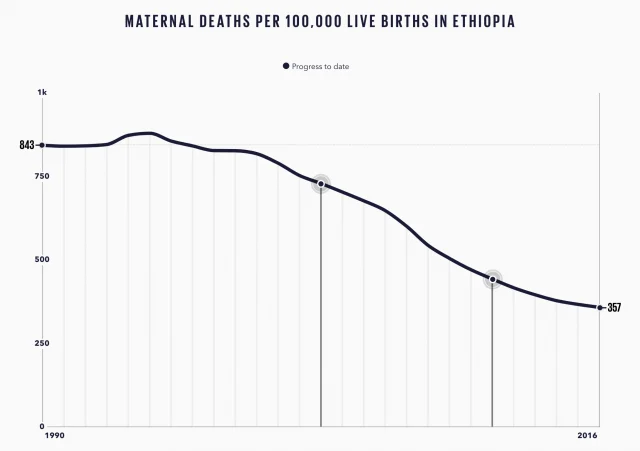
One of the most striking successes highlighted in the Goalkeepers 2017 report is the progress made by Ethiopia. Between 1990 and 2015, Ethiopia achieved a remarkable reduction in maternal mortality, with the ratio falling from 843 deaths per 100,000 live births to 357. This 57% decrease is attributed to a concentrated effort by the Ethiopian government to decentralize healthcare and invest in rural medical infrastructure.
A cornerstone of this success was the Health Extension Program (HEP), launched in 2003. This initiative involved the training and deployment of over 38,000 female health extension workers across the country. These workers were tasked with providing essential health services directly to rural communities, including prenatal care, immunizations, and education on safe delivery practices. By bringing healthcare to the "doorstep" of the population, Ethiopia was able to bridge the gap between urban hospitals and remote villages.
Furthermore, Ethiopia invested in the "Integrated Emergency Obstetric and Newborn Care" (IEONC) system, which upgraded local health centers to handle complications like hemorrhaging and obstructed labor—the leading causes of maternal death. The Goalkeepers report uses Ethiopia as a blueprint for other Sub-Saharan African nations, demonstrating that significant health gains are achievable even in resource-constrained environments when political will is aligned with data-driven strategies.
Global Chronology of Maternal Health Targets
The effort to reduce maternal mortality has been a focal point of international policy for nearly three decades. The chronology of these efforts is marked by two major frameworks:
- The Millennium Development Goals (2000–2015): Under MDG 5, the global community aimed to reduce the maternal mortality ratio by three-quarters. While the goal was not fully met globally, it sparked the most significant period of improvement in maternal health in history.
- The Sustainable Development Goals (2016–2030): Following the conclusion of the MDGs, the UN adopted the SDGs. Target 3.1 of the SDGs aims to reduce the global maternal mortality ratio to less than 70 per 100,000 live births by 2030.
- The Launch of Goalkeepers (2017): The Gates Foundation introduced Goalkeepers to ensure that the momentum generated during the MDG era did not wane. The 2017 report served as the first major assessment of the world’s standing at the start of the SDG era.
Comparative Analysis of UNICEF Data
To provide broader context to the Goalkeepers report, an analysis of the full UNICEF maternal mortality dataset reveals sharp regional disparities. While Western Europe and North America maintain MMRs in the single or low double digits (e.g., Sweden at 4 and the United States at 14 per 100,000 in 2015), Sub-Saharan Africa continues to bear the highest burden.
In 2015, the MMR in Sub-Saharan Africa was estimated at 546 per 100,000 live births. Countries such as Sierra Leone (1,360), Central African Republic (882), and Chad (856) faced the most extreme challenges. These figures highlight the necessity of the "best practices" mentioned in the Goalkeepers report. If the progress seen in Ethiopia—which faces similar geographic and economic hurdles—can be replicated in these neighboring nations, the global MMR would drop precipitously.
The data also indicates that the majority of maternal deaths are preventable. The WHO identifies five major complications that account for 75% of all maternal deaths: severe bleeding (mostly after childbirth), infections (usually after delivery), high blood pressure during pregnancy (pre-eclampsia and eclampsia), complications from delivery, and unsafe abortions. The UNICEF data suggests that increasing the proportion of births attended by skilled health personnel is the single most effective intervention to combat these issues.
Technical Implications: The Importance of Data Accessibility
The Goalkeepers report also serves as a catalyst for professional data analysts and health experts to utilize publicly available datasets. For instance, the UNICEF maternal mortality dataset is a public resource that allows for the creation of customized reports using tools like Google Data Studio. By transforming Excel-based statistics into interactive horizontal bar charts and geographical heat maps, analysts can uncover trends that are often obscured in static tables.
Effective data visualization allows stakeholders to:
- Identify outliers (nations that are performing significantly better or worse than their economic peers).
- Track year-over-year progress to determine if current interventions are yielding results.
- Advocate for funding by presenting "spotless" information design that clearly communicates the urgency of the problem.
The 2017 report’s use of data visualization is not merely an aesthetic choice; it is a functional necessity for modern advocacy. When data is formatted correctly and made transparent, it becomes a tool for accountability, ensuring that governments remain committed to their SDG promises.
Broader Impact and Future Outlook
The implications of the Goalkeepers 2017 report extend beyond health statistics; they touch upon the core of global equity. The report argues that where a person is born should not determine whether they live or die, or whether a mother survives childbirth. The "Goalkeepers" community, which includes world leaders, activists, and data scientists, continues to use this annual reporting cycle to keep the global spotlight on the most vulnerable populations.
As the world moves toward the 2030 deadline for the Sustainable Development Goals, the lessons from the 2017 report remain relevant. The success of Ethiopia proves that maternal mortality is a solvable problem. However, the UNICEF data serves as a sobering reminder of the work that remains. With over 300,000 deaths annually, the fight against maternal mortality requires sustained investment in healthcare infrastructure, the empowerment of female health workers, and the continued use of high-quality data to guide decision-making.
In conclusion, the Goalkeepers 2017 report and the supporting UNICEF datasets provide a comprehensive view of a global crisis and a roadmap for its resolution. By diagnosing problems through data and spreading the "best practices" of success stories like Ethiopia, the international community can work toward a future where maternal mortality is no longer a devastating reality for any community. The integration of data science and humanitarian effort represents the most promising path toward making the world a better, safer place for mothers and children alike.