Google Ads has quietly yet significantly updated its advertising nomenclature, transitioning from "Comparison Listing ads" to the newly designated "CSS Product Listing ads." This strategic shift, identified through updated support documentation and URL redirects, underscores Google’s ongoing commitment to refining its ad offerings and adhering to regulatory frameworks, particularly those stemming from European antitrust rulings concerning its shopping services. The change, while seemingly a rebrand, entails a substantial overhaul of explanatory content, providing clearer definitions and operational guidelines for advertisers navigating the competitive landscape of online retail.
The Transition: From Comparison Listings to CSS PLAs
The most immediate evidence of this transformation is the redirection of the previous support URL for Comparison Listing ads to a new page titled "About CSS Product Listing ads" (support.google.com/google-ads/answer/14645037). A side-by-side comparison of the new and archived support pages reveals that approximately 90% of the content has been revised, indicating more than just a simple name change. This comprehensive update suggests Google’s intent to provide a more precise and detailed framework for these ad types, reflecting their distinct role within the broader Google Ads ecosystem.
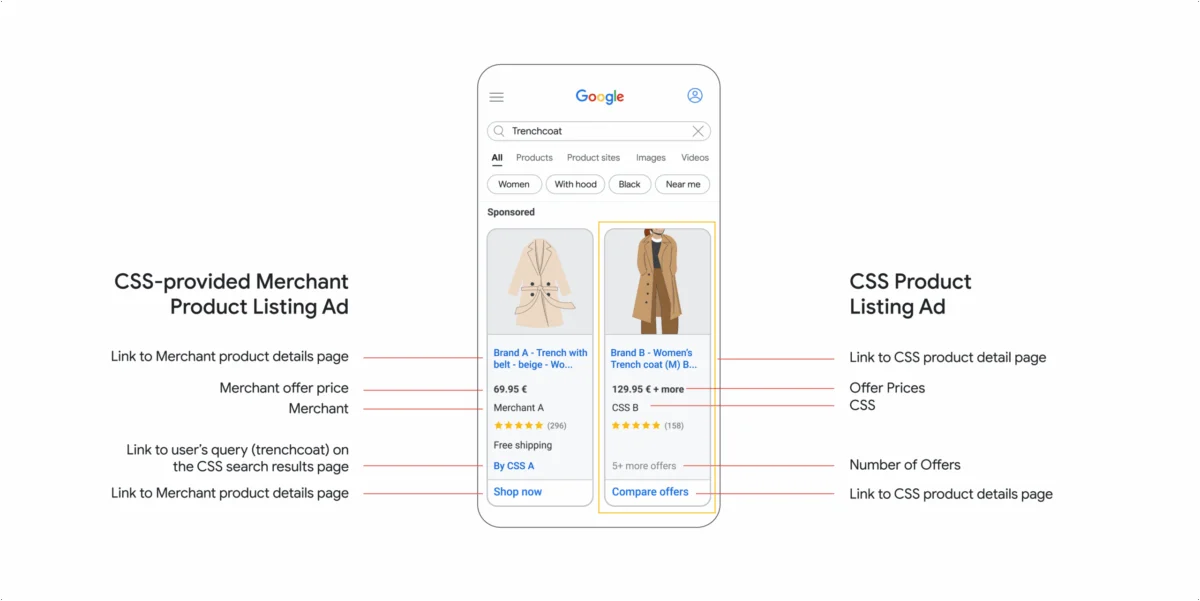
CSS Product Listing Ads are designed to appear "next to Merchant Product Listing ads, and CSSs will compete with merchants on a non-discriminatory basis in the existing PLA carousel," as stated in Google’s updated documentation. This explicit phrasing reinforces the principle of fair competition, a cornerstone requirement established by the European Commission. The policy further clarifies that "All CSSs participating in Google’s CSS program that meet the minimum requirements described in the later section can place these ads in countries that are part of the CSS program." This statement delineates the eligibility criteria and geographical scope, ensuring transparency for participating Comparison Shopping Services (CSSs).
Visually, these ads retain a familiar appearance, featuring a carousel of products on Google’s general search results pages. Each ad prominently displays the product image, title, offer price, and the number of offers available for a specific product. When a user engages with a CSS Product Listing ad, they are directed to a relevant product page on the CSS website, facilitating a direct pathway to purchase or further information. This mechanism ensures that CSSs play an active role in the user’s shopping journey, driving traffic to their platforms where multiple merchant offers can be presented.
Understanding CSS Product Listing Ads
CSS Product Listing Ads are a specific type of Product Listing Ad (PLA) that can only be placed by Comparison Shopping Services (CSSs) participating in Google’s CSS program. Unlike standard PLAs, which are typically run directly by individual merchants, CSS PLAs leverage the unique position of CSSs to aggregate and display offers from various retailers. This structure is a direct consequence of the regulatory environment in Europe.
At their core, CSS Product Listing Ads serve several critical functions:
- Visibility: They provide prominent placement for products in Google Search results, capturing user attention early in the shopping process.
- Information Richness: By displaying key product details like image, title, price, and offer count, they enable users to make informed decisions before clicking.
- Traffic Generation: They drive qualified traffic directly to CSS websites, where users can explore multiple merchant offers for the same product, fostering a competitive marketplace.
- Competitive Fairness: By allowing CSSs to compete on an equal footing with direct merchants in the PLA carousel, they aim to ensure a level playing field, particularly in regions under specific antitrust oversight.
A Deeper Dive: The Genesis of Comparison Shopping Services
The emergence and evolution of Comparison Shopping Services (CSSs) and their prominent role in Google’s advertising ecosystem are inextricably linked to a landmark antitrust ruling by the European Commission. Understanding this historical context is crucial for appreciating the significance of Google’s current rebranding effort.
Chronology of Google Shopping and the CSS Program:
- 2004: Google launched "Froogle," a free product search engine, later renamed Google Product Search.
- 2012: Google transitioned Google Product Search to a paid commercial model, rebranding it as Google Shopping. This move required merchants to pay to list their products, effectively transforming it into a comparison shopping service that charged for clicks.
- 2017 (June): The European Commission issued a €2.42 billion (approximately $2.7 billion at the time) fine against Google for abusing its dominant position as a search engine. The Commission found that Google had systematically favored its own comparison shopping service (Google Shopping) in its search results, giving it a significant advantage over rival comparison shopping services. Google was ordered to cease its illegal conduct.
- 2017 (September): In response to the ruling, Google introduced the Comparison Shopping Services (CSS) program in Europe. This program allowed independent comparison shopping websites to bid on Product Listing Ads on behalf of merchants, effectively enabling them to compete directly with Google Shopping itself. Google also implemented a mechanism where CSSs could receive a bidding advantage (often referred to as a "discount") on PLAs if they operated independently of Google.
- Post-2017: The CSS program expanded across various European Economic Area (EEA) countries, becoming an integral part of the e-commerce advertising landscape in the region. The goal was to foster a more competitive environment for product searches and advertising.
- Early 2024: The current rebrand from "Comparison Listing ads" to "CSS Product Listing ads" takes effect, consolidating terminology and refining documentation.
The European Commission’s ruling emphasized that Google had distorted competition by giving its own shopping comparison service a prominent position in its search results, while demoting rival services. This meant that when a user searched for a product, Google Shopping listings would appear at the top, often in visually appealing carousels, while rival services were relegated to less visible positions. The CSS program was Google’s structural remedy to this antitrust violation, designed to ensure that competing comparison shopping sites could also gain visibility for their merchants’ products through PLAs.
The Mechanics of Google’s CSS Program

Under the CSS program, a merchant can choose to advertise their products on Google Shopping either directly through Google Ads or indirectly through a CSS partner. When a merchant opts for a CSS partner, the CSS manages the merchant’s product feed and bids on PLAs on their behalf. This arrangement allows merchants to potentially benefit from the bidding advantages offered to CSSs, and it empowers CSSs to offer a comprehensive service that includes feed management, bid optimization, and analytics.
The "non-discriminatory basis" clause highlighted in the new documentation is key. It implies that Google must ensure its algorithms and ad auctions do not unfairly favor its own Google Shopping service over independent CSSs. This is achieved by allowing CSSs to participate directly in the PLA auction, presenting their aggregated merchant offers alongside those placed directly by merchants or by Google Shopping itself.
Implications for Advertisers and the Digital Marketing Landscape
The rebranding to "CSS Product Listing ads" carries several implications for various stakeholders in the digital advertising ecosystem.
For Comparison Shopping Services (CSSs):
- Enhanced Clarity and Recognition: The new terminology explicitly highlights the role of CSSs, potentially offering greater recognition for their unique function in the Google Ads landscape. This could simplify communication with merchants and improve understanding of their service offerings.
- Streamlined Operations: Clearer documentation can lead to more efficient ad campaign management and optimization, as the specific guidelines for CSS PLAs become more distinct.
- Continued Strategic Importance: The rebrand reaffirms the enduring significance of the CSS program, particularly in the European market, as a mechanism for fostering competition and providing choice to merchants. CSSs will continue to be vital intermediaries for many retailers.
For Merchants and Retailers:
- Understanding Ad Options: Merchants need to stay abreast of these changes to understand the various avenues available for advertising their products on Google. Distinguishing between direct PLAs and CSS PLAs becomes crucial for strategic decision-making.
- Strategic Partnership Decisions: The clarity around CSS PLAs might influence merchants’ decisions on whether to partner with a CSS, especially if they are operating in regions covered by the CSS program and seeking competitive advantages.
- Broader Reach and Competition: The existence of a robust CSS PLA system means merchants have more opportunities to get their products in front of potential customers, potentially leading to increased competition and more diverse offers for consumers.
For Google:
- Regulatory Compliance and Perception: The change underscores Google’s ongoing efforts to demonstrate compliance with antitrust rulings. By explicitly naming "CSS Product Listing ads," Google reinforces its commitment to supporting an independent CSS ecosystem and promoting fair competition.
- Product Simplification and Cohesion: While the underlying functionality may not have drastically changed, the unified terminology can contribute to a more coherent and understandable Google Ads product suite over time. This might be part of a broader strategy to simplify its vast array of ad formats.
- Market Share and Advertiser Trust: By fostering a competitive environment, Google can maintain advertiser trust and potentially increase the overall volume of ad spending on its platform, even if it means sharing the stage with CSS partners.
Maintaining Competitive Integrity
The emphasis on CSS Product Listing Ads appearing "next to Merchant Product Listing ads" and CSSs competing "on a non-discriminatory basis" is a direct echo of Google’s commitments following the European Commission’s 2017 ruling. This commitment is not merely rhetorical; it is backed by monitoring mechanisms and ongoing scrutiny from regulatory bodies. For instance, Google has invested significantly in ensuring that its comparison shopping unit operates as a distinct business unit, bidding for ad space in the same way independent CSSs do. This organizational separation is intended to prevent any internal favoritism.
The presence of "minimum requirements" for CSSs participating in the program also highlights the structured nature of this competitive framework. These requirements typically pertain to the quality of the CSS website, the clarity of merchant offers, and adherence to Google’s policies, all designed to ensure a positive user experience and fair play.
Looking Ahead: Streamlining and Clarity
While Google has not issued a formal press release regarding this specific rebranding, the thorough update of its support documentation speaks volumes. It indicates a strategic move towards greater clarity and perhaps a more streamlined approach to categorizing its diverse ad products. In an increasingly complex digital advertising landscape, clear terminology is invaluable for advertisers and agencies alike.
Industry observers might interpret this change as a proactive step by Google to consolidate its messaging around its CSS program, particularly as global regulatory scrutiny of large tech companies intensifies. By clearly delineating "CSS Product Listing ads," Google is not only refining its product catalog but also reinforcing its narrative around fostering a competitive and transparent advertising environment. This could also pave the way for future enhancements or integrations within the CSS framework, potentially leading to new features or optimization tools for participating services.
Ultimately, the shift from "Comparison Listing ads" to "CSS Product Listing ads" is more than a superficial name change. It reflects Google’s continued adaptation to regulatory pressures, its ongoing effort to refine its advertising products, and its commitment to providing a structured, albeit competitive, environment for merchants and Comparison Shopping Services to thrive in the dynamic world of online retail. The digital advertising community will undoubtedly monitor how this clarified terminology translates into practical impacts on campaign performance and market dynamics.