

Email authentication, once a specialized technical consideration, has rapidly evolved into a non-negotiable cornerstone of digital communication, directly impacting email deliverability, brand reputation, and overall cybersecurity. In an era dominated by sophisticated phishing attempts and rampant email spoofing, major mailbox providers (MBPs) like Gmail, Yahoo, and Microsoft have implemented stringent new requirements, effectively cementing email authentication as a fundamental prerequisite for any sender aiming to reach the inbox. This shift underscores a broader industry commitment to safeguarding users and fostering a more secure email ecosystem.
The essence of email authentication lies in its ability to digitally verify the legitimacy of an email’s origin and ensure its integrity during transit. As email expert Dela Quist explained on the "Email After Hours" podcast, it’s a digital security measure designed to confirm that each message originates from an authorized sender and has not been altered maliciously. This foundational verification process is critical for distinguishing legitimate communications from deceptive spam or phishing attempts, which frequently leverage impersonation to trick recipients.
The Evolving Landscape of Email Security: A Historical Perspective
The journey towards robust email authentication standards began decades ago, driven by the escalating challenge of unsolicited commercial email, commonly known as spam. In the early days of the internet, email protocols were largely open and trusting, making it easy for malicious actors to forge sender addresses (spoofing) and inundate inboxes with unwanted content. This vulnerability led to a collaborative effort among various groups, including the IETF’s Anti-Spam Research Group, Yahoo, and Cisco, to develop foundational policies. These efforts laid the groundwork for the core authentication technologies that safeguard email today.
The first major breakthrough came with the introduction of Sender Policy Framework (SPF) in 2004, followed by DomainKeys Identified Mail (DKIM) in 2007. While these technologies significantly improved the ability of receiving servers to verify sender identity and message integrity, they operated somewhat independently, often leading to ambiguous outcomes when one passed and the other failed. This gap led to the development of Domain-based Message Authentication, Reporting & Conformance (DMARC) in 2012, which unified SPF and DKIM under a comprehensive policy framework and introduced crucial reporting capabilities. More recently, Authenticated Received Chain (ARC) emerged to address specific forwarding challenges, and Brand Indicators for Message Identification (BIMI) provided a visual layer of trust and brand identity. This chronological progression highlights a continuous industry drive to build increasingly sophisticated defenses against email-borne threats.
The Mandate from Mailbox Providers: A New Era of Enforcement
The collective announcement by Gmail, Yahoo, and Microsoft in late 2023 marked a pivotal moment, transforming email authentication from a recommended best practice into an obligatory standard for bulk senders. These mandates, which began phased enforcement in February 2024 for Gmail and Yahoo, with Microsoft following a similar trajectory, represent a unified front against email abuse and a concerted effort to clean up the inbox experience for billions of users worldwide.
The requirements now expected of all senders, particularly those sending over 5,000 messages per day to Gmail or Yahoo accounts, include:
- Implementing SPF and DKIM: All senders must have properly configured SPF and DKIM records for their sending domains.
- Establishing a DMARC Policy: A DMARC record must be published, even if initially set to a monitoring-only policy (p=none).
- Maintaining a Low Spam Rate: Senders must keep their reported spam rate below 0.1% and ideally below 0.3%, as measured by Google Postmaster Tools and Yahoo Mail Feedback Loop. Exceeding these thresholds can lead to messages being blocked or routed directly to spam folders.
- Providing One-Click Unsubscribe: For marketing messages, a visible and functional one-click unsubscribe mechanism is now mandatory, simplifying the process for recipients to opt out of unwanted communications.
The implications of non-compliance are severe and increasingly immediate. As of April 2024, Gmail has been progressively rejecting non-compliant traffic, with temporary and permanent rejections escalating throughout the year and into 2025. Yahoo and Microsoft have adopted similarly firm stances, signaling that there is no circumventing these new rules for reputable senders who wish their emails to reach their intended recipients. Industry data reinforces the necessity of these measures: phishing attacks, often relying on domain spoofing, continue to be a leading cause of data breaches, costing businesses billions annually. By mandating authentication, MBPs aim to significantly diminish the effectiveness of these attacks and restore trust in email as a reliable communication channel.
Deep Dive into Core Authentication Technologies
Understanding each of the five core authentication methods is crucial for compliance and optimizing email program performance.

Sender Policy Framework (SPF): The Authorized Sender List
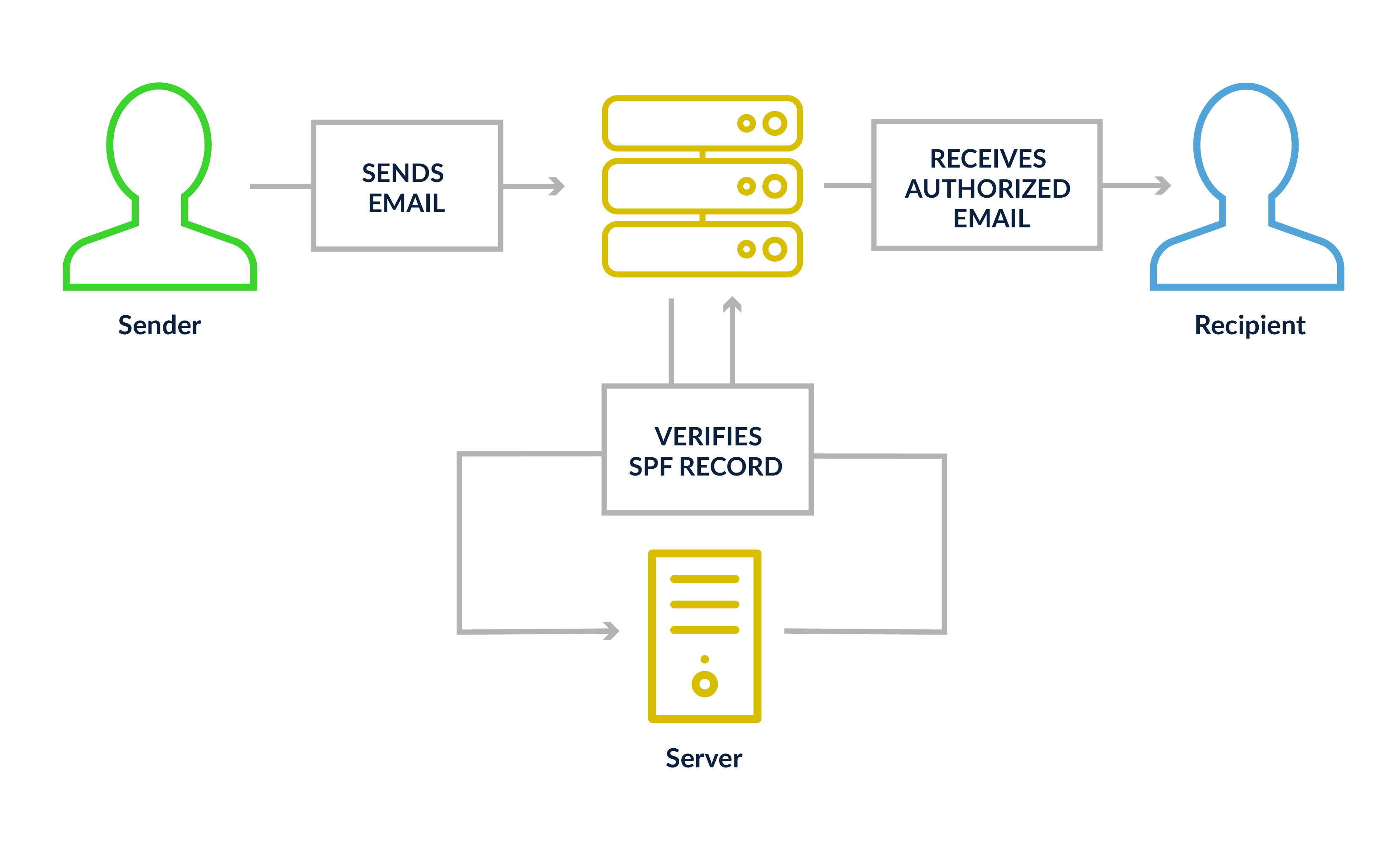
SPF acts as a digital guest list for your domain, specifying which mail servers are permitted to send email on your behalf. When a mail server attempts to deliver an email purporting to be from your domain, the recipient’s server consults your domain’s DNS record for its SPF policy. This record contains a list of authorized IP addresses or hostnames. If the sending server’s IP address is not on this list, the receiving server is alerted that something is amiss.
An SPF record is published as a TXT record in your domain’s DNS. It can include individual IP addresses, IP ranges, and include directives for third-party senders like Email Service Providers (ESPs). Senders can also define enforcement levels:
+all(Pass): Rarely used, as it means "all IPs are authorized."~all(SoftFail): Indicates that the message might be legitimate, but the sender is not explicitly authorized. Often routed to spam.-all(Fail): Explicitly states that any server not on the list is unauthorized, leading to rejection or strict quarantine.
A critical technical consideration with SPF is the "10 DNS lookup limit." Each include statement or a or mx mechanism in an SPF record that requires a DNS lookup counts towards this limit. Exceeding 10 lookups results in a "PermError," causing SPF to fail entirely and negating its protective benefits. Senders often manage this by consolidating third-party senders or using subdomains for different email streams.
DomainKeys Identified Mail (DKIM): The Tamper-Evident Seal
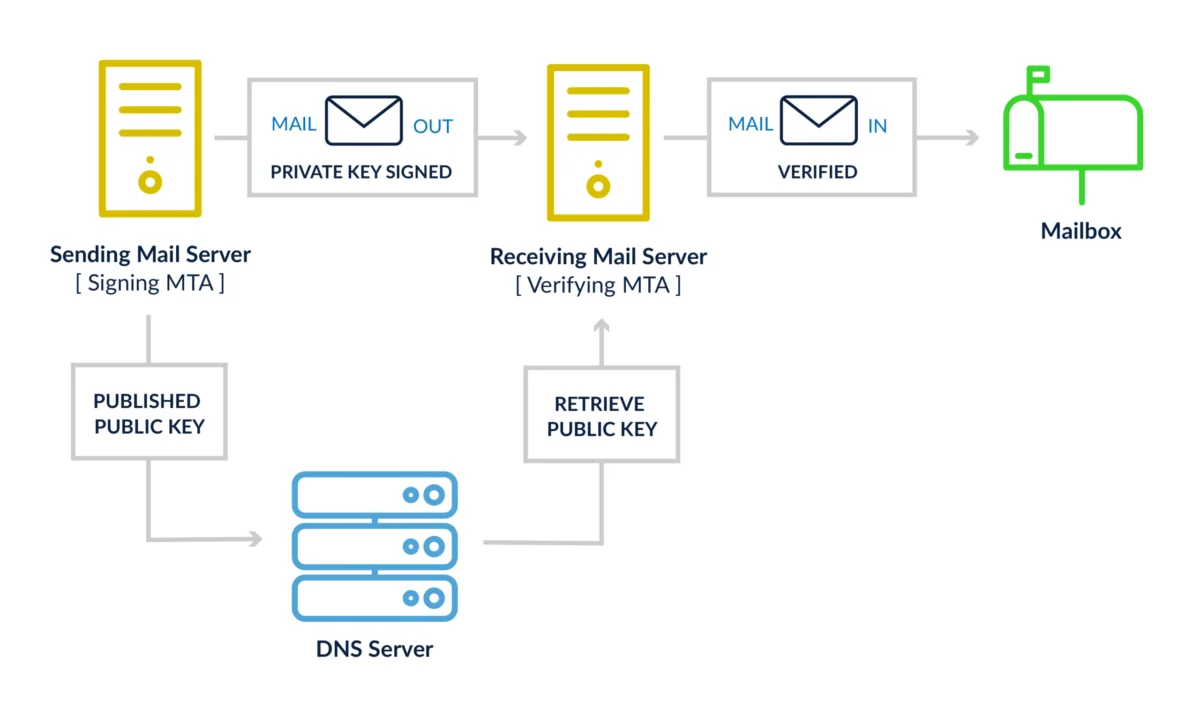
DKIM provides a cryptographic signature that acts as a tamper-evident seal on your email messages. When your mail server sends an email, it digitally signs specific parts of the message (headers and/or body) using a private key unique to your domain. A corresponding public key is published in your domain’s DNS records. Upon receiving the email, the recipient’s server retrieves the public key and uses it to verify the signature.
If any part of the signed message content has been altered in transit, the signature verification will fail, indicating that the email’s integrity has been compromised. This mechanism assures the recipient that the message originated from the claimed domain and has not been tampered with since it was signed. For robust security, DKIM keys should be at least 2048 bits long; older 1024-bit keys are no longer considered secure by major MBPs. Regular key rotation is also a recommended security practice, though many ESPs manage this automatically.
Domain-based Message Authentication, Reporting & Conformance (DMARC): The Policy Enforcer and Reporter
DMARC is the policy layer that brings SPF and DKIM together, dictating how receiving mail servers should handle messages that fail authentication checks. More importantly, DMARC introduces the concept of "alignment." For an email to pass DMARC, the domain in the visible "From" address (the header From) must align with the domain verified by SPF or DKIM. If SPF passes, the Return-Path domain must align with the From domain. If DKIM passes, the d= domain in the DKIM signature must align with the From domain. Without this alignment, DMARC fails, even if SPF or DKIM individually passed.
DMARC policies offer three levels of enforcement:
p=none: Monitor mode. Receiving servers collect data on authentication failures but take no action on the messages themselves. This is the minimum required by MBPs for bulk senders and is ideal for initial deployment and data gathering.p=quarantine: Messages that fail DMARC are typically moved to the recipient’s spam folder.p=reject: Messages that fail DMARC are blocked entirely and not delivered. This is the strongest enforcement level, offering maximum protection against spoofing.
A significant benefit of DMARC is its reporting mechanism. Senders can configure their DMARC record to receive daily aggregate reports (rua) and forensic reports (ruf). Aggregate reports provide valuable insights into authentication results, sending IPs, and alignment status, acting as an early warning system for unauthorized sending or configuration errors. Forensic reports offer more granular details for investigating specific failures, though privacy concerns often limit their widespread use. Progression from p=none to p=quarantine and eventually p=reject is the recommended strategy, allowing senders to gain confidence in their authentication setup while gradually increasing protection against domain abuse. Industry data indicates a steady increase in DMARC adoption, particularly among larger enterprises and government entities, recognizing its critical role in cybersecurity.
Authenticated Received Chain (ARC): Preserving Authentication in Complex Flows
ARC addresses a specific challenge in the email ecosystem: the legitimate modification of emails during transit. When an email is forwarded, processed by a mailing list server, or scanned by a security gateway, its content or headers may be altered. These changes can inadvertently break the original DKIM signature, leading to a DMARC failure even if the initial message was legitimate.
ARC functions as a "chain of custody" for email authentication results. Each intermediate server that processes and potentially alters an email will add its own ARC signature, preserving the authentication status it observed before making changes. When the email finally reaches the ultimate recipient’s server, that server can review the ARC chain. If the chain shows that the message was properly authenticated at its origin, the receiving server can override a subsequent DMARC failure caused by legitimate intermediate modifications, ensuring the email reaches the inbox. Unlike other standards, ARC is not something individual senders configure; it’s implemented by the mail servers that handle the email’s journey.
Brand Indicators for Message Identification (BIMI): Visual Trust and Brand Presence
BIMI provides a powerful visual trust signal by allowing a brand’s verified logo to be displayed directly in the recipient’s inbox, often next to the sender’s name, even before the email is opened. This immediate visual recognition helps recipients quickly identify legitimate emails from trusted brands, enhancing user experience and potentially boosting engagement metrics like open rates.
To implement BIMI, a sender must have robust email authentication in place, specifically SPF, DKIM, and a DMARC policy enforced at p=quarantine or p=reject. A p=none policy is insufficient for BIMI. Once these prerequisites are met, the brand publishes a BIMI DNS record that points to a properly formatted SVG version of its logo.
BIMI further distinguishes between two types of certificates for logo verification:
- Verified Mark Certificate (VMC): The original and most robust option, requiring the brand’s logo to be a registered trademark. VMCs are issued by authorized Certificate Authorities (e.g., DigiCert) and unlock full BIMI support, including the display of a blue checkmark in Gmail and logo display in Apple Mail, signifying a heightened level of authenticity.
- Common Mark Certificate (CMC): A newer, more accessible option introduced in 2024. CMCs do not require a registered trademark but demand proof that the logo has been publicly displayed for at least 12 months. Google now accepts CMCs, making BIMI available to a wider range of brands. However, CMC holders will see their logo displayed in Gmail but will not receive the coveted blue checkmark, which remains exclusive to VMC holders.
MBP support for BIMI is growing, with Gmail, Yahoo, and Apple Mail being prominent adopters, demonstrating the industry’s recognition of visual authentication as a valuable trust signal.
The Broader Implications: Beyond Deliverability
The push for universal email authentication extends far beyond simply ensuring messages land in the inbox; it fundamentally reshapes the landscape of digital communication with profound implications for businesses, cybersecurity, and consumer trust.
Enhanced Cybersecurity
Email remains the primary vector for cyberattacks, with phishing and Business Email Compromise (BEC) schemes accounting for a significant portion of data breaches and financial losses. Strong email authentication, particularly DMARC at an enforced policy, dramatically reduces the effectiveness of these attacks by making it nearly impossible for threat actors to spoof legitimate domains. This proactive defense mechanism safeguards organizations and their customers from fraud, malware, and identity theft.
Strengthened Brand Reputation and Trust
For businesses, email is a vital channel for marketing, customer service, and transactional communications. Unauthenticated or spoofed emails can severely damage a brand’s reputation, eroding customer trust and leading to lost business. By adopting robust authentication, brands signal their commitment to security and transparency, reassuring recipients that their communications are legitimate. BIMI further amplifies this, providing an immediate visual cue of authenticity that can foster stronger connections with subscribers. Studies suggest that emails displaying brand logos via BIMI can see increased open rates and higher brand recall.
Improved Marketing Effectiveness
Beyond mere inbox placement, proper authentication contributes to a healthier sender reputation. Mailbox providers are more likely to deliver authenticated mail to the primary inbox, leading to higher engagement rates, more accurate campaign analytics, and ultimately, a better return on investment for email marketing efforts. Conversely, non-compliance can lead to messages being quarantined or rejected, rendering marketing campaigns ineffective and wasting valuable resources.
Compliance and Regulatory Landscape
As governments and regulatory bodies increasingly focus on data privacy and consumer protection, robust email security measures may become integrated into broader compliance frameworks. Proactively implementing authentication standards positions organizations favorably against future regulatory changes and demonstrates due diligence in protecting customer data and communication channels.
Authentication: The Foundation, Not the Finish Line
Email authentication is a continuous process of configuration, monitoring, and adaptation, not a one-time setup. The recent mandates from Gmail, Yahoo, and Microsoft unequivocally establish SPF, DKIM, and DMARC as the indispensable foundation for any effective email program. Failing to meet these requirements will not only severely impair deliverability but will also significantly erode trust with the very audience organizations strive to reach.
For businesses, the journey begins with properly configuring SPF, DKIM, and DMARC. From this starting point, the strategic progression involves moving the DMARC policy towards p=quarantine or p=reject to maximize protection against spoofing. Concurrently, diligent monitoring of DMARC aggregate reports is essential for identifying unauthorized sending or configuration issues. Finally, embracing BIMI by obtaining a VMC or CMC represents the next step in building visual trust and enhancing brand recognition within the inbox.
While implementing and maintaining these authentication protocols requires technical coordination and ongoing attention, the benefits—in terms of enhanced deliverability, bolstered cybersecurity, and fortified brand trust—are substantial and increasingly critical in today’s digital environment. Organizations are encouraged to regularly audit their email infrastructure and leverage tools like those offered by Litmus for infrastructure checks to ensure every authentication acronym is meticulously in order. The future of reliable and secure email communication depends on this unwavering commitment to authentication.








