The landscape of online search is undergoing a profound transformation, with Artificial Intelligence (AI) no longer a nascent technology to observe but a rapidly adopted tool demanding strategic action. Recent data indicates a dramatic surge in consumer engagement with AI-powered search functionalities, signaling a fundamental shift that will redefine organic search strategies for businesses and content creators alike. The implications are far-reaching, impacting how consumers discover products, how search engines deliver information, and ultimately, how digital visibility is achieved.
Explosive Growth in AI Search Adoption
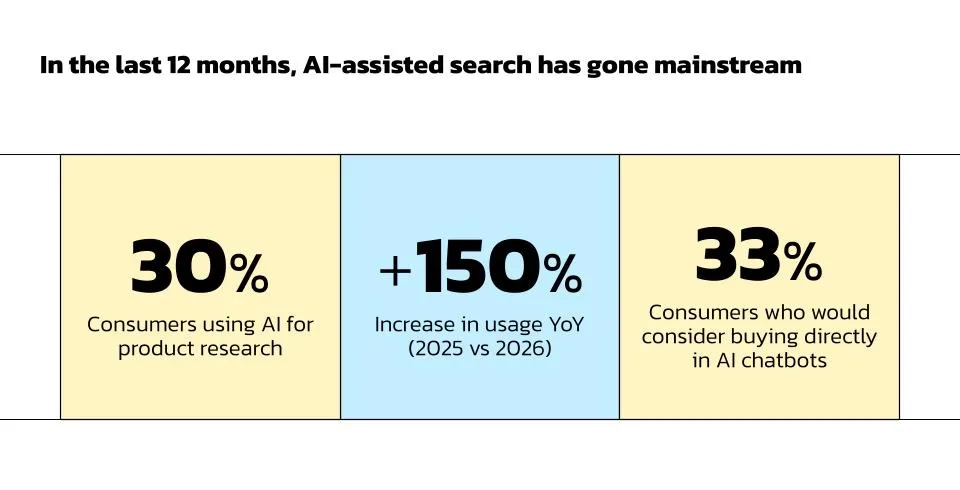
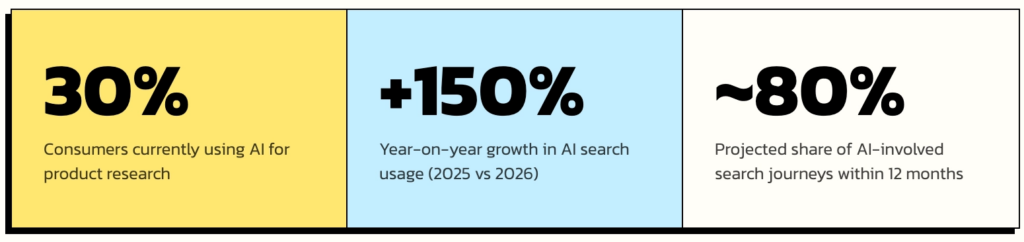
The statistics paint a compelling picture of AI’s escalating presence in the search journey. Currently, a significant 30% of consumers report using AI for product research, a figure that has more than doubled from just 12% a year ago. This meteoric rise is further amplified by the integration of AI-generated content directly into mainstream search results. Approximately 40% of Google searches now feature an "AI Overview," presenting users with AI-synthesized answers without requiring explicit selection.
When these two trends are combined – active AI search usage and passive exposure through AI Overviews – the proportion of search journeys involving AI in some capacity is already approaching 60%. Projections from industry analysts at Brainlabs suggest this figure could climb to an astonishing 80% within the next twelve months, assuming current growth trajectories hold. This rapid adoption curve necessitates a re-evaluation of virtually every aspect of traditional organic search optimization.
Brainlabs’ research categorizes consumers into three distinct groups based on their search behavior. "Traditionalists," comprising approximately 69% of users, continue to rely exclusively on established search engines. The burgeoning segment is the "Augmenters," accounting for around 30% of consumers. These users fluidly navigate between traditional search engines like Google and AI platforms within a single research journey. They are not abandoning familiar tools but are integrating AI as an additional layer of inquiry, particularly for complex queries. The "Dissenters," a minuscule fraction of less than 1%, exclusively utilize AI platforms for their search needs. The significant growth observed among Augmenters highlights a user base that values the enhanced capabilities AI brings to their information-gathering processes.
AI SEO: A Divergent Path from Traditional SEO
The notion that AI SEO is merely a rebrand of traditional SEO is increasingly untenable. While current AI search models share some foundational similarities with established search engine optimization (SEO) practices, the divergence is accelerating at a pace that many digital marketing teams are struggling to match. The complexity arises from the existence of multiple major AI search platforms, each with its own distinct models, operational guidelines, and unique relationship with search engine indexes.
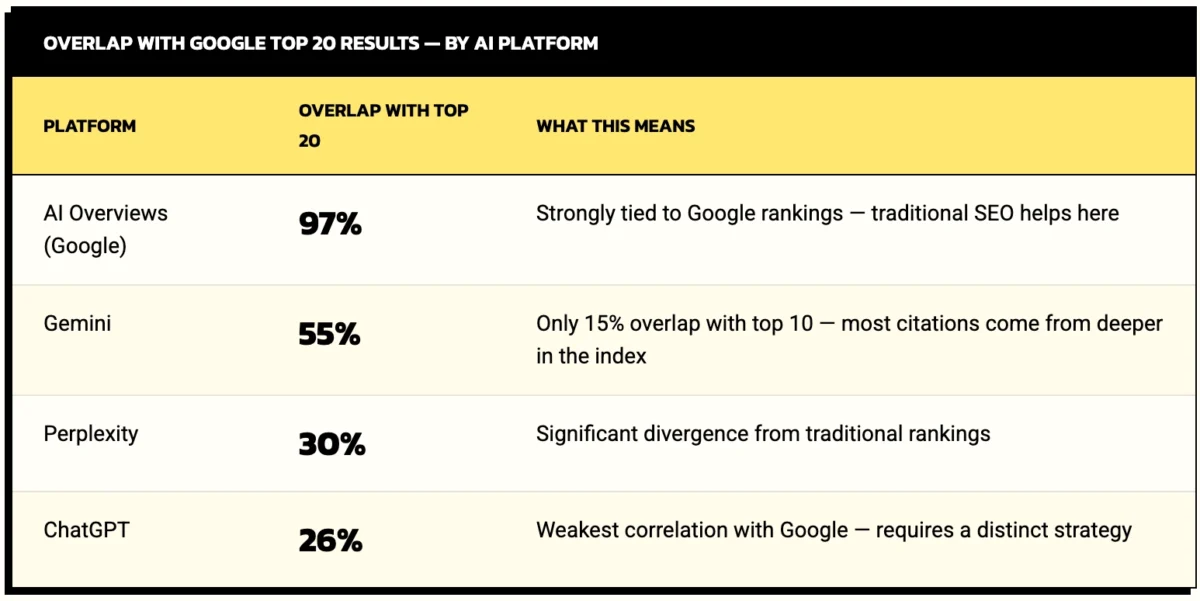
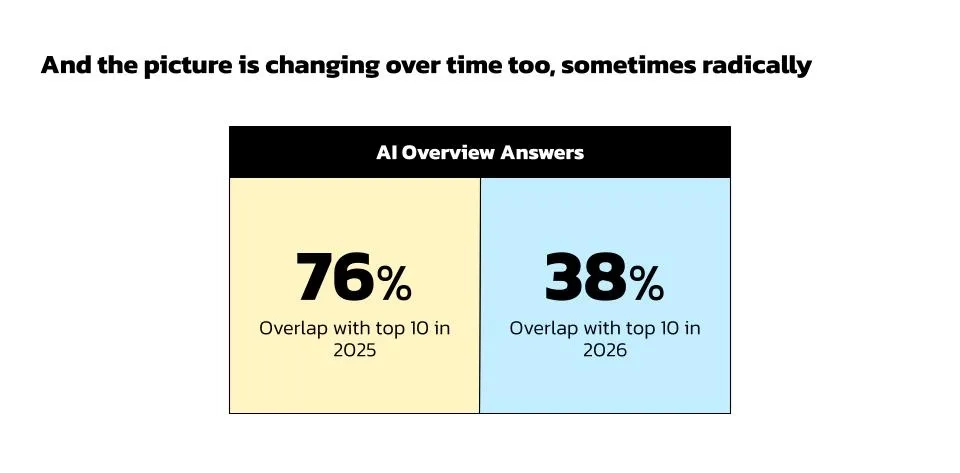
A particularly striking statistic from Brainlabs data pertains to Google’s Gemini, a proprietary AI product. Despite its integration with Google’s ecosystem, Gemini cites pages from Google’s top 10 search results only 15% of the time. This presents a critical challenge for SEO strategies heavily reliant on achieving top-10 rankings. An approach built solely around traditional top-ranking metrics proves largely ineffective for platforms like Gemini and ChatGPT. Furthermore, the overlap between AI Overviews and Google’s top 10 results has significantly diminished, falling from 76% to approximately half that figure in 2026, underscoring the evolving nature of AI’s information retrieval mechanisms.
Deconstructing LLM Citation Logic
Understanding why an obscure web page might be cited in an AI-generated answer while content from a prominent brand is overlooked requires a deep dive into the internal workings of Large Language Models (LLMs) and their distinct approach to information retrieval, which differs fundamentally from Google’s traditional ranking algorithms.
The process typically begins with "grounding." Upon receiving a user prompt, an LLM assesses whether it possesses sufficient internal knowledge or if it needs to access external data sources. For most product research queries, external data is indispensable.
This is followed by "query fan-out," where the LLM deconstructs the original prompt into dozens of related, granular micro-questions. For intricate queries, a multitude of these micro-questions can be processed simultaneously.
The LLM then executes a "deep index search." For each micro-query, it scours Google’s index, extending its reach beyond the conventional top 10 results to encompass the top 100 and even further. This broad search scope represents a significant departure from traditional SEO’s focus on the initial rankings.
"Content selection" is a crucial stage. The LLM prioritizes content that features direct answer blocks, headings that precisely match the micro-question, hard statistical data, and recency signals such as a recently updated timestamp.
Finally, "comparison and validation" occurs. Sources with low consensus relative to higher-authority references are filtered out. A web page that offers a direct and concise answer to a specific micro-question can effectively outrank higher-authority pages that bury their answers within extensive editorial prose.
Optimizing for AI Citations
Three distinct optimization approaches have consistently yielded positive results in enhancing AI citations. Firstly, understanding and catering to the "query fan-out" is paramount. The micro-questions generated by LLMs are predictable, and building FAQ sections that directly address these questions has been shown to significantly increase citation rates. Secondly, conducting "embedding similarity analyses" is crucial. This involves measuring how closely your content aligns with the semantic patterns of content that is currently being cited. This technique has resulted in an average 140% increase in AI citations across numerous client tests conducted by Brainlabs. Thirdly, treating "content freshness" as a technical imperative is essential, particularly for time-sensitive topics. Monthly refreshes of high-demand pages are now considered a minimum requirement.
The Measurement Conundrum in AI Search
Accurately measuring AI search performance presents a significant challenge due to the current limitations in data accessibility. While Google and Bing have begun to provide some AI performance data, it remains largely insufficient for informed optimization decisions. For instance, Google’s Search Console Generative AI report offers impression data but lacks the critical query and click-through information necessary to guide strategy. Impressions and page performance are valuable for establishing baseline metrics and identifying general trends, but they leave many fundamental questions unanswered: What are users actually searching for? What are their follow-up questions? And how does search behavior differ in standalone AI applications like Gemini? Consequently, a reliance on third-party measurement solutions persists.
The prevailing method involves converting keyword data into probable AI prompts, tracking these prompts through one of the over 30 available third-party AI tracking tools, and monitoring brand visibility as a proxy for real-world performance. However, this data is inherently noisy. Across different AI models, fewer than 23% of citations remain active after 14 days. There is only about a 45% agreement between platforms regarding which brand to recommend first. Furthermore, fewer than 5% of query sets demonstrate perfect consensus across all major AI platforms.
Practical Measurement Approaches for Today
Despite the measurement challenges, several practical approaches are proving effective:
- AI Referral Tracking in GA4: Implementing AI referral tracking within Google Analytics 4 (GA4) provides initial directional insights into traffic originating from AI search.
- Prompt-Based Tracking: Identifying and tracking a curated set of 50-100 relevant prompts within priority categories, even at low frequency, can offer valuable data on user search behavior and content visibility within AI responses.
- Third-Party Tools: Leveraging specialized AI tracking tools that simulate AI search behavior and monitor citation rates across various platforms remains a vital component of the measurement strategy.
- Content Performance Analysis: Analyzing the performance of specific content pieces within AI search results, particularly focusing on citation rates and the quality of the AI’s summarization, provides actionable feedback.
The Imminent Arrival of Agentic Search
The current paradigm, where AI functions as an additional layer atop existing search, is poised for another significant disruption with the emergence of "agentic search." Sundar Pichai, CEO of Google, has alluded to this future, suggesting that search will evolve into an "agent manager" by approximately 2027, where AI agents autonomously conduct research and make decisions on behalf of consumers.

In this emerging agentic model, AI agents will perform research in milliseconds, distill findings into recommendations, and facilitate transactions, all without requiring direct consumer intervention beyond the initial prompt. Platforms are already moving in this direction; ChatGPT has introduced "Instant Checkout," and Google is developing its "Universal Commerce Protocol."
While these agents will perform the heavy lifting of research, they will still require reliable information sources. The critical question then becomes: which content and data sources will these agents trust sufficiently to cite and act upon?
Preparing for the Agentic Future
Businesses can proactively prepare for the advent of agentic search by adopting several key strategies:
- Building Authoritative and Trustworthy Content: Focus on creating content that is not only informative but also demonstrably authoritative, transparent, and reliable. This includes clear sourcing, factual accuracy, and expert attribution.
- Structured Data and Semantic Markup: Implementing robust structured data and semantic markup will enable AI agents to more easily understand, extract, and utilize the information contained within your content.
- Demonstrating Real-World Impact and User Trust: Evidence of user trust, such as reviews, testimonials, and positive case studies, will likely play a significant role in an agent’s decision-making process when selecting sources.
- Establishing Direct Transaction Capabilities: Exploring and implementing mechanisms for direct transactions, such as secure checkout integrations or API connections, will align with the efficiency goals of agentic search.
Where to Begin Your AI Search Transformation
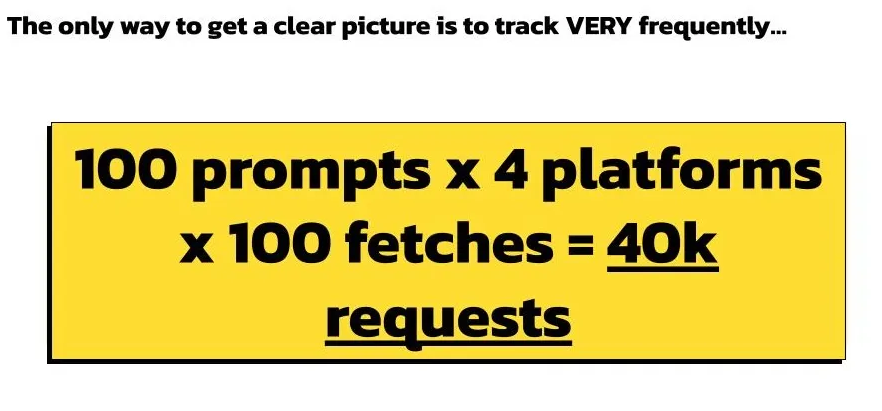
The journey into AI-powered search should commence with a foundational understanding of performance. Establishing AI referral tracking in GA4 and identifying two to three priority categories for focused analysis is a pragmatic first step. Beginning with a manageable set of 50 to 100 related prompts, tracked at a low frequency, will yield directional data, even if imperfect.
Concurrently, conduct a thorough audit of your priority content. Assess it against the signals that LLMs actively seek: the presence of freshness dates, the directness of answer formatting, the implementation of structured data, and the relevance of heading-level content to anticipated micro-questions. A targeted refresh of high-demand pages, incorporating these principles, will provide tangible evidence of whether these changes influence citation rates before scaling efforts.
Finally, begin building a strategic roadmap for divergence. The increasing disparity between traditional SEO and AI SEO necessitates foresight. The organizations best positioned to thrive in the coming years will be those that proactively invest in developing AI-centric capabilities today. The window of opportunity to gain a competitive advantage, rather than merely react to changes, is narrower than it may appear. The AI search revolution is not a distant prospect; it is a present reality demanding immediate strategic attention.