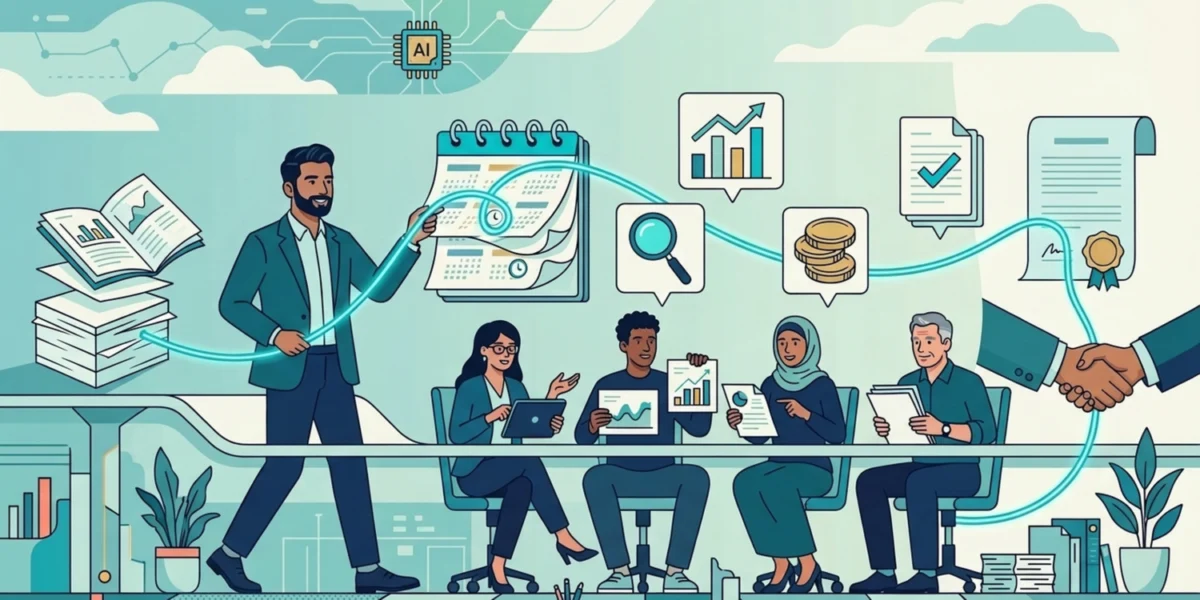
The integration of Artificial Intelligence (AI) agents into marketing organizations is often envisioned as a seismic shift, a disruption that will fundamentally alter team structures and job roles. However, real-world implementation, as experienced by Heinz Marketing and their diverse client base, paints a more nuanced picture. Rather than a complete overhaul of the organizational chart or the wholesale disappearance of jobs, AI agents are proving to be a powerful augmentation layer, unlocking significant new capacity and efficiency within existing frameworks. This deep dive explores the gap between initial expectations and tangible outcomes, offering a pragmatic guide for organizations navigating the evolving landscape of AI in marketing.
For months, the discourse surrounding AI in marketing has focused on its potential to revolutionize structures. Previous analyses by Heinz Marketing have delved into how AI agents can be incorporated into existing marketing departments, how to redesign organizational charts to accommodate them, and strategies for initiating AI adoption without dismantling established workflows. These foundational discussions, documented in a series of articles, laid the groundwork for understanding the theoretical integration of AI. This current report, however, shifts the focus to the practical realities observed through internal application at Heinz Marketing and their extensive work with clients across various industries and company sizes.
The initial anticipation of AI agent integration was largely colored by the potential for significant disruption. Many marketing leaders, including those at Heinz Marketing, expected that the introduction of AI would necessitate substantial structural modifications. There was a prevailing notion that human oversight would become a critical bottleneck, requiring the addition of new roles dedicated to managing and validating AI outputs. The fear of losing control over certain AI-generated content and the potential for an increased need for human "gatekeepers" were common concerns. This outlook suggested a future where the organizational chart might need a radical redesign, and certain existing job functions could become obsolete, replaced by autonomous AI systems.
However, the practical experience has revealed a different trajectory. The core responsibilities and accountabilities within marketing teams have largely remained intact. A demand generation manager, for instance, continues to be responsible for pipeline generation, a content strategist retains ownership of narrative and editorial direction, and marketing operations remains the steward of process and data integrity. What has changed is not who is accountable, but how these roles achieve their objectives.
AI agents have, in practice, served as sophisticated assistants, taking on the more time-consuming, repetitive, and research-intensive aspects of existing workflows. This allows human professionals to elevate their focus towards higher-value activities. The human role has evolved to emphasize strategic direction, critical review of AI-generated outputs, the application of nuanced judgment, and the ultimate ownership of strategic decisions that remain beyond the current capabilities of AI. This augmentation model has yielded remarkable efficiency gains.
The impact of this integration has been demonstrably significant, with measured time savings reaching as high as 83% in some workflows and averaging around 48% in others. This variance in results is not arbitrary; it offers crucial insights into where AI agents can deliver the most immediate and profound value. The highest time savings are consistently observed in workflows that are highly structured, characterized by high volumes of tasks, and possess clear inputs and repeatable outputs. These are tasks such as initial research and data analysis, where AI agents can efficiently generate a comprehensive first draft or analysis based on provided templates and structured output guidance. The human then steps in to refine and build upon this AI-generated foundation, rather than starting from scratch.
Conversely, areas requiring more subjective judgment, such as messaging strategy, campaign positioning, and audience targeting, have seen more modest initial time savings. While AI agents provide a tangible lift in these domains, achieving optimal outputs often requires more iterative refinement and human input. The process of guiding the agent to produce valuable results in these more complex areas is itself an investment of time, though still often less than a purely manual approach. Understanding this spectrum of AI efficacy is vital for strategic implementation. Expecting universal 80%+ time savings across all marketing functions could lead to unrealistic expectations and potential disappointment. Conversely, acknowledging these limitations allows for a more intelligent and phased rollout of AI agents, prioritizing areas with the highest potential for immediate return.
Beyond the expected efficiency gains, the integration of AI agents has also surfaced unforeseen challenges, most notably in the realm of governance and adoption.
The Unforeseen Governance Gap
A significant and consistently observed hurdle has been the emergence of a "governance gap." As AI agents become more integrated into daily operations, clear protocols for their use become paramount. Key questions arise: Who is responsible for reviewing AI outputs before they are disseminated? What level of autonomy can an AI agent possess before requiring human sign-off? And crucially, what are the procedures when an AI agent produces an erroneous or inappropriate output?
Organizations that proactively establish these guardrails and define clear decision-making frameworks for AI use are building trust and enabling smoother scaling. Conversely, teams that bypass this crucial governance step often encounter significant setbacks. A single misstep—an AI-generated piece of content that is factually incorrect or misaligned with brand messaging, for example—can quickly erode confidence in the entire AI initiative. Codifying these governance policies and redefining the roles of existing team members to incorporate oversight responsibilities is therefore critical for sustained AI success.
The Persistence of Human Habits: The Adoption Challenge

Perhaps the most surprising challenge encountered has been the issue of adoption. Even with AI agents developed, tested, and readily available, a consistent observation has been the need to actively remind team members to utilize them. The ingrained habits of performing tasks the "old way" often persist, especially during periods of high workload when the familiar, albeit less efficient, path feels more immediate.
This phenomenon is not unique to Heinz Marketing; it is a recurring theme observed with clients as well. Embedding AI agents into the fabric of a team’s daily operations requires deliberate reinforcement and a conscious effort to shift ingrained behaviors. While habits do evolve over time, this behavioral change can take longer and demand more focused attention than the technological implementation itself. When rolling out AI agents, organizations must anticipate this challenge and plan for ongoing encouragement and support to facilitate the transition from old routines to new, AI-augmented workflows. The technological hurdle is often more straightforward to overcome than the deeply rooted challenge of human behavior modification.
Variations in Organizational Adaptation
While the principle that "jobs don’t change" holds true across industries and organizational sizes, the manner of adaptation varies considerably.
-
Pace of Autonomy: Some organizations are comfortable rapidly advancing AI agents from assistive roles to more autonomous operations. Others prefer a more gradual approach, maintaining a collaborative model for an extended period. The optimal pace is intrinsically linked to an organization’s internal culture, its risk tolerance, and the specific nature of the tasks being automated.
-
Ownership of the AI Layer: The responsibility for managing the AI agent layer often falls to different departments or functions depending on the organizational structure. In some cases, marketing operations teams naturally assume this role. In others, a dedicated function or a newly created position might be established. The specific title is less important than ensuring clear accountability for calibrating, monitoring, and evolving the AI agents over time. Without this designated ownership, there is a risk of duplicated efforts, inconsistent agent performance, and a failure to keep AI tools up-to-date and aligned with evolving business objectives.
Navigating the Starting Point: A Strategic Approach
For organizations still grappling with where to begin their AI integration journey, the most effective starting point is not the organizational chart, but the actual work being done. A strategic approach involves:
-
Workflow Mapping: Begin by meticulously mapping the workflows within your highest-pressure functions. Identify areas where high-volume, repetitive tasks are consuming valuable capacity that could otherwise be directed towards strategic initiatives.
-
Targeted Implementation: This is where the AI agent layer should be introduced first. Focus on tasks that have clear inputs and predictable, repeatable outputs.
-
Quantifiable Measurement: Rigorously measure the time savings and efficiency gains achieved in these initial implementations. These concrete numbers serve as powerful evidence to build internal confidence and justify further expansion of AI adoption.
Heinz Marketing has extensive experience guiding organizations through this precise process, from identifying the optimal starting points and sequencing the rollout to establishing robust governance frameworks that enable responsible AI scaling. Their expertise suggests that a thoughtful, data-driven approach, grounded in the realities of operational efficiency and human behavior, is the most effective path to unlocking the transformative potential of AI agents in the marketing landscape. For companies seeking to navigate these complexities, collaboration and the sharing of best practices are essential.