In the rapidly evolving landscape of digital experimentation, the tension between the need for speed and the requirement for statistical accuracy has reached a critical juncture. For years, practitioners of A/B testing have grappled with the "peeking problem"—the statistical phenomenon where repeated monitoring of a live experiment artificially inflates the likelihood of a false positive. Addressing this industry-wide challenge, VWO has unveiled a sophisticated approach to Group Sequential Testing (GST) that prioritizes user interpretability without compromising the mathematical integrity of the results. By shifting the statistical correction from the decision boundary to the variance of the improvement distribution, the platform has established a new benchmark for how organizations balance real-time data accessibility with long-term decision-making confidence.
The Evolution of Experimentation and the Peeking Problem
The history of A/B testing is rooted in the "fixed-horizon" methodology, a legacy of traditional clinical trials where the sample size is determined before the test begins, and results are only analyzed once that threshold is met. However, the modern software-as-a-service (SaaS) and e-commerce environments operate on a different cadence. Stakeholders, driven by the desire for agility, frequently "peek" at results as they accumulate.
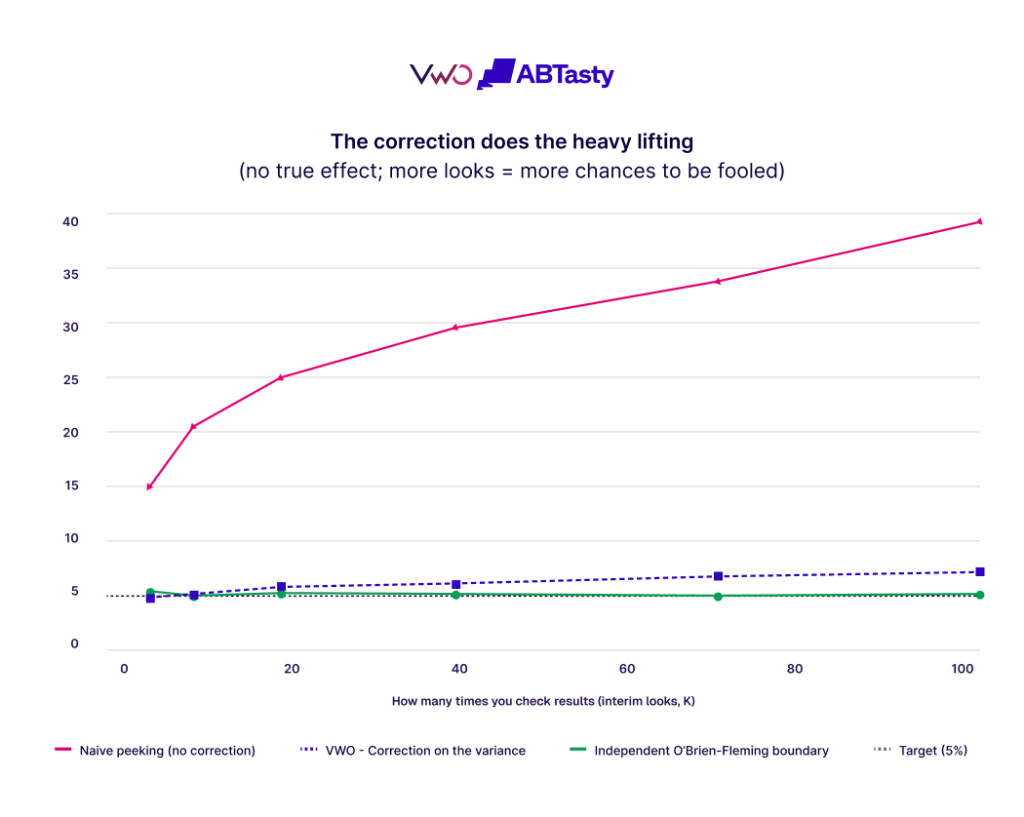
The danger of this behavior was famously highlighted by Spotify’s engineering team, which observed that a test designed with a standard 5% false-positive rate (alpha) could see that rate climb exponentially under repeated checks. If an experimenter stops a test the moment the "p-value" dips below 0.05, they are essentially rolling the dice multiple times and only reporting the winning roll. In a scenario with no real difference between variations, this "naive peeking" can lead to false-positive rates as high as 30% to 40%, leading companies to implement "winning" features that actually provide zero value or, worse, harm the user experience.
To combat this, the experimentation industry has moved toward sequential testing frameworks. These mathematical models allow for interim analyses while maintaining the overall probability of a Type I error (false positive) at the desired level. While many platforms have adopted these methods, the implementation strategies vary significantly, often forcing a trade-off between statistical rigour and ease of use.
The Traditional Approach: Moving Boundaries and Blind Spots
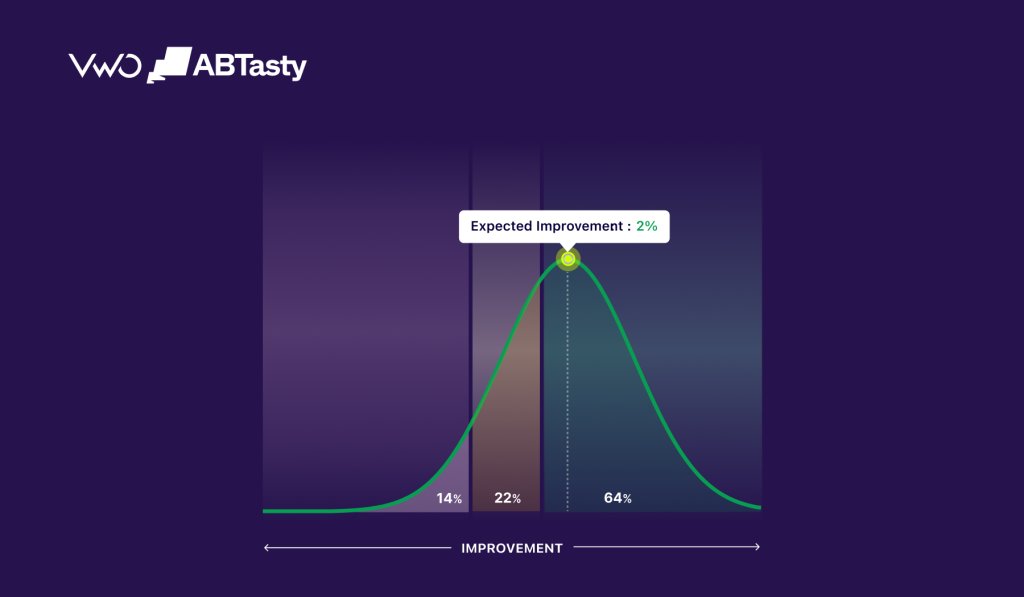
Standard sequential testing, often utilizing the O’Brien-Fleming or Pocock boundaries, relies on a concept known as "alpha spending." In this model, the bar for success is set extremely high at the beginning of the experiment when data is sparse. As the test progresses and more data is collected, the "decision boundary" or significance threshold gradually lowers toward the standard 95% confidence line.
While mathematically sound, this traditional approach presents two major hurdles for the average business user:
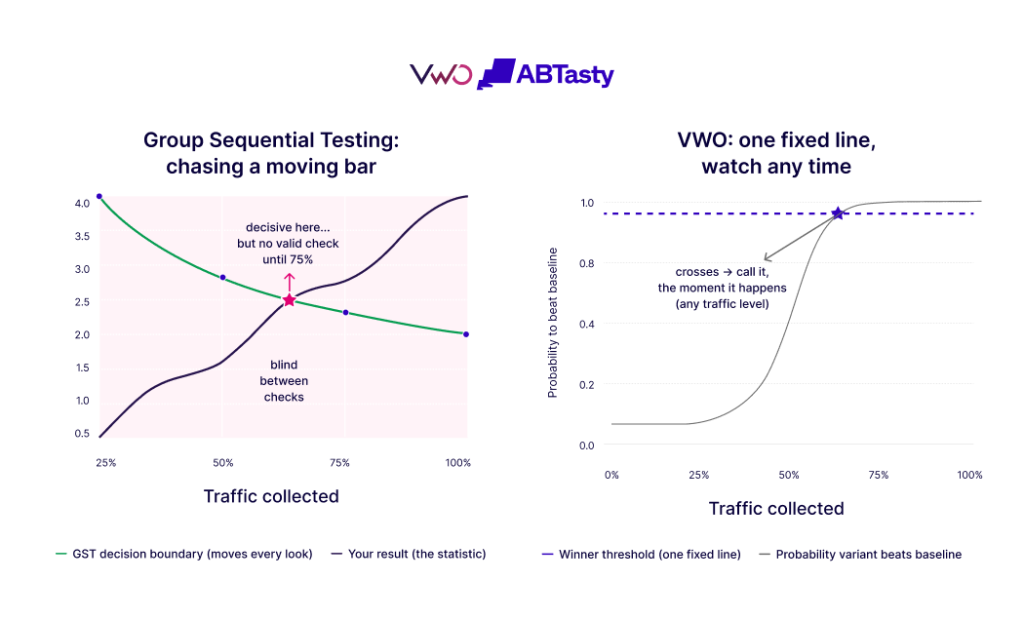
- The Chasing Target: Because the threshold moves at every planned check-in, the result that is considered significant this week might not have been significant last week, even if the conversion rates remained stable. This makes reports difficult to interpret for non-statisticians, as the "goalposts" appear to be in constant motion.
- The Interim Blind Spot: Traditional Group Sequential Testing is designed around pre-scheduled checkpoints (e.g., at 25%, 50%, and 75% of the total sample size). If a variation begins to cause a massive drop in revenue between these checkpoints, the statistical framework technically does not provide a valid "stop" signal until the next scheduled look. This leaves businesses vulnerable to "flying blind" during the intervals between checks.
VWO’s Innovation: Variance-Side Correction
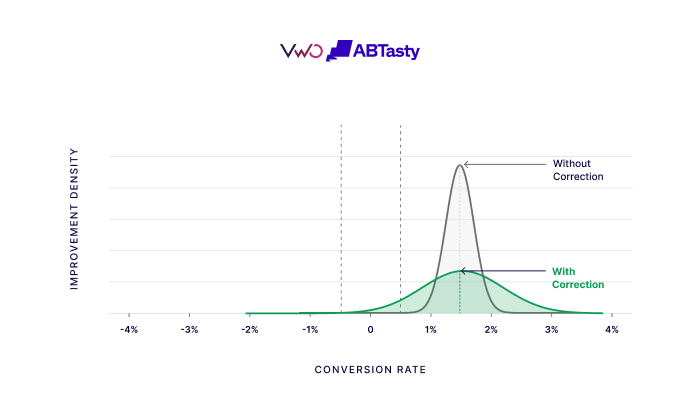
Recognizing these friction points, VWO’s engineering team spent over a decade refining a variant of Group Sequential Testing that aligns with the way human beings actually read reports. Instead of moving the decision boundary, VWO applies the statistical correction to the variance of the improvement distribution.
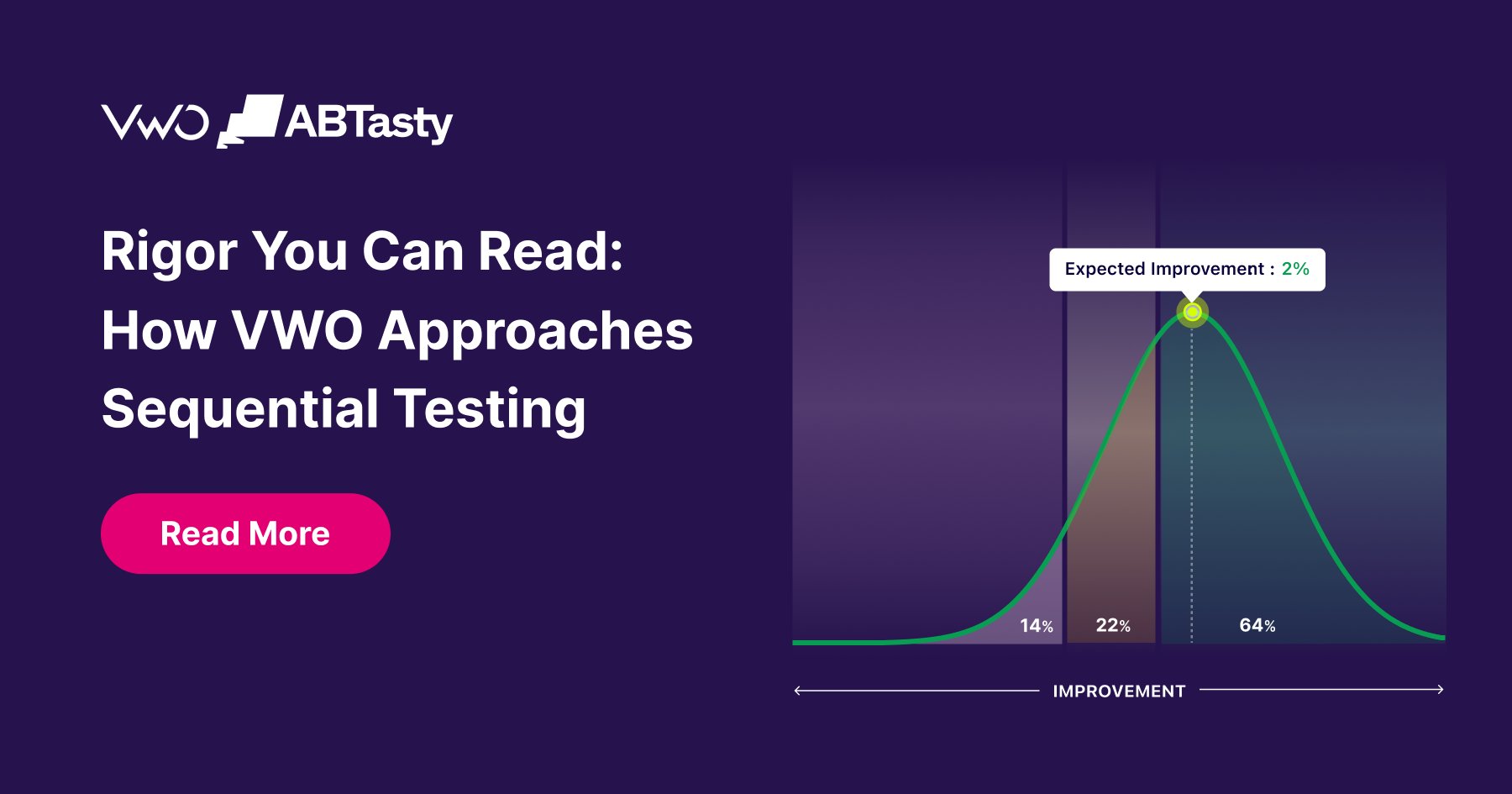
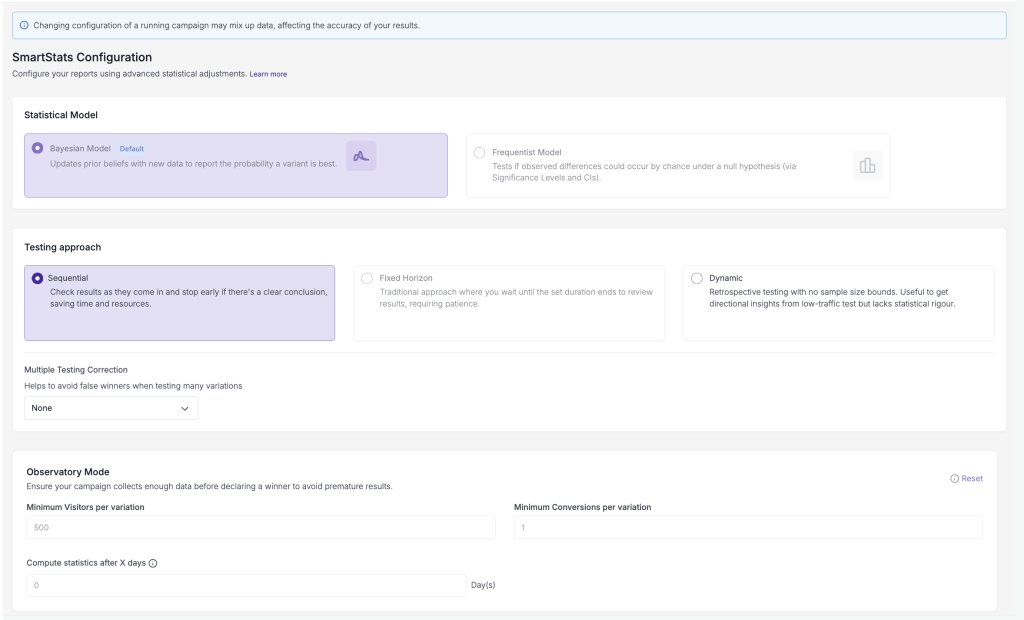
By widening the "uncertainty band" by the exact amount required to compensate for peeking, VWO is able to keep the decision threshold stationary. This means that a product manager or marketer can monitor a single, stable metric: the "Probability to be Better." When this number crosses the fixed threshold (e.g., 95%), the experiment can be concluded immediately.
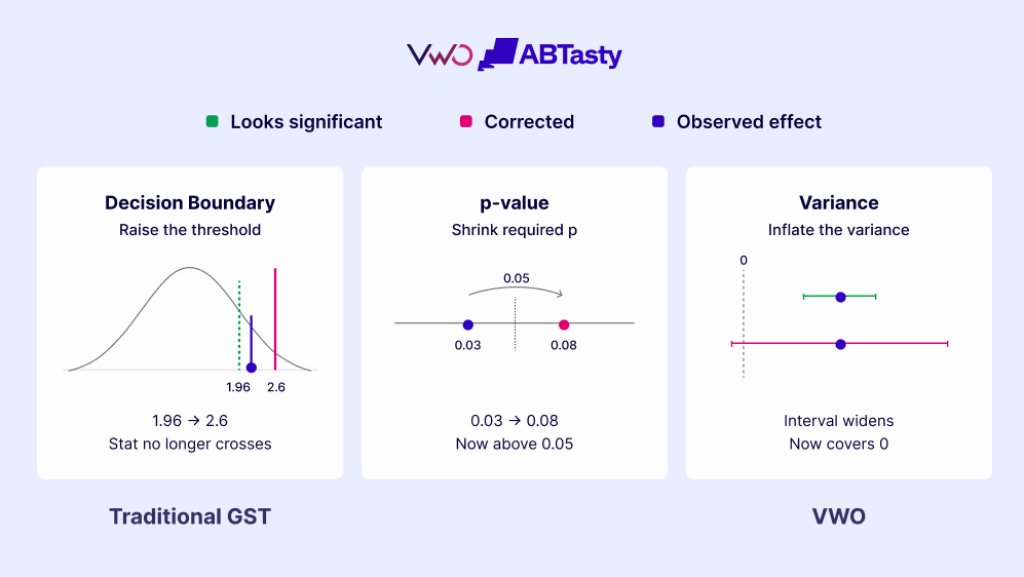
This methodology effectively bakes the correction into the data itself rather than the external rules of the test. The result is a reporting interface that remains consistent over time, allowing stakeholders from different departments to look at the same data and reach the same conclusion without requiring a background in advanced probability theory.
Comparative Performance: A Data-Driven Validation
To prove the efficacy of this approach, VWO conducted extensive simulations comparing its variance-side correction against textbook O’Brien-Fleming designs and naive testing (no correction). The results underscore the necessity of sequential frameworks in modern business.
In simulations where no real difference existed between the control and the variation:
- Naive Peeking: The false-positive rate escalated from 15% to nearly 40% as the frequency of looks increased.
- O’Brien-Fleming: Successfully held the false-positive rate at exactly 5%.
- VWO Correction: Maintained a false-positive rate near 5% for standard interim looks. Even under "relentless" continuous peeking (up to 100 looks), the rate only drifted modestly to approximately 7%.
Crucially, this protection does not come at the expense of "power"—the ability of a test to detect a real winner. In head-to-head simulations where a true effect was present, both the O’Brien-Fleming method and VWO’s correction reached the industry-standard 80% power target across all look counts. This confirms that VWO’s "readable" approach is just as capable of identifying successful variations as more complex, traditional models.
Frictionless Implementation and Flexible Frameworks
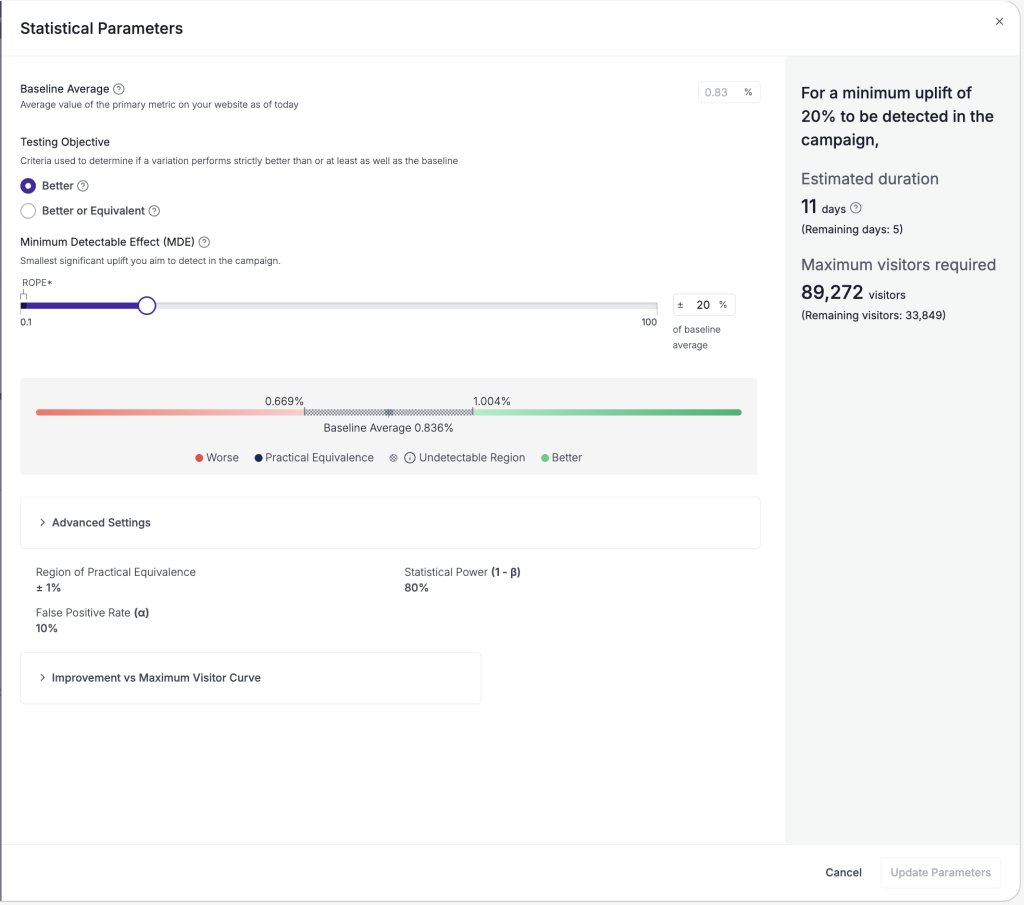
One of the primary barriers to adopting rigorous statistics in corporate environments is the "setup tax." Traditional GST often requires experimenters to specify the number of interim looks and the exact alpha-spending function before the test begins. Errors in these initial settings can invalidate the entire experiment.
VWO has eliminated this "statistics homework" by automating these inputs with sensible defaults based on real-world experimentation data. Furthermore, because the corrections are computed from the collected data rather than pre-committed at setup, users have the flexibility to adjust their reporting preferences mid-test.
This flexibility extends to the philosophical divide in statistics: Bayesian vs. Frequentist. While some teams prefer the probabilistic nature of Bayesian reports ("There is a 97% chance this is better"), others rely on the Frequentist confidence intervals and p-values required for regulatory or academic standards. VWO has integrated the same sequential correction into both reporting styles, ensuring that the choice of methodology remains a matter of preference while the rigour remains non-negotiable.
Advanced Safeguards: SRM and Segmented Opportunities
The application of sequential testing at VWO extends beyond the primary experiment results to include background integrity checks and granular data slicing.
Sample Ratio Mismatch (SRM)
Sample Ratio Mismatch occurs when the actual traffic distribution between variations deviates significantly from the intended split (e.g., a 50/50 test resulting in a 48/52 split). This is often an early indicator of technical bugs, such as tracking failures or redirect issues. VWO utilizes a chi-squared test to monitor for SRM continuously.
Interestingly, for SRM, VWO employs the traditional moving-boundary approach. Since SRM is a background safeguard intended to alert the user only when something breaks—rather than a metric that users actively "read" for progress—the drawback of a moving threshold is irrelevant. This allows for a continuous, highly sensitive check that maintains its false-positive guarantees throughout the experiment’s lifecycle.
Trustworthy Segment Analysis
A common pitfall in A/B testing is "data dredging," where experimenters slice data by segments (e.g., mobile users in France) until they find a significant result by chance. VWO’s "Opportunities" feature automatically surfaces segments where a variation is performing notably different from the baseline.
To ensure these findings are not just noise, VWO applies the same sequential correction to the "Probability to be Better" for every surfaced segment. This ensures that when a specific demographic is flagged as an opportunity, the result is statistically powered and corrected for the fact that the system is looking at multiple dimensions simultaneously.
Broader Implications for the Experimentation Industry
The shift toward interpretable sequential testing represents a broader trend in the tech industry: the "democratization of data." As organizations move away from centralized "centers of excellence" toward distributed experimentation models—where every product squad is encouraged to run their own tests—the need for "guardrail" statistics becomes paramount.
By absorbing the mathematical complexity into the platform’s backend, VWO is addressing the reality of human behavior in business. The "natural curiosity" to check on a live campaign is no longer a liability but a functional part of the workflow. This approach reduces the organizational friction typically associated with high-rigour testing, potentially increasing the overall velocity of experimentation within a company.
Furthermore, the stability of VWO’s reporting helps build a culture of trust. When a result is called a "winner," stakeholders can be confident that the designation isn’t an artifact of a moving boundary or a lucky peek. This reliability is essential for long-term digital transformation, where data-driven insights must consistently outperform intuition to maintain executive buy-in.
In conclusion, VWO’s approach to sequential testing suggests that the future of A/B testing lies not in forcing users to adapt to rigid statistical models, but in adapting those models to fit the needs of the modern business. By prioritizing "rigour you can read," the platform provides a blueprint for how data science can be made both accessible and unassailable, allowing teams to focus on what truly matters: building better experiences for their users.