A stark reevaluation of traditional business growth models is emerging within the e-commerce sector, challenging the long-held belief that scaling revenue necessitates a proportional increase in headcount and operational complexity. Instead, a growing body of evidence and anecdotal success stories points towards a more strategic approach: prioritizing operational leanness and tax efficiency as the primary drivers of sustainable profitability and reduced owner stress. This shift represents a departure from conventional wisdom, suggesting that focusing on minimizing overhead and optimizing financial structures can yield greater returns than solely chasing incremental revenue gains through aggressive marketing.

The prevailing narrative in business development has historically emphasized expansion through increased personnel and infrastructure. The idea that "more revenue means more people" has been a deeply ingrained assumption, leading many entrepreneurs to view headcount as a direct indicator of success and growth. However, a closer examination of high-performing e-commerce businesses reveals a counterintuitive truth: operational efficiency and strategic financial management often outperform aggressive marketing spend and large organizational structures in delivering robust profitability.
This paradigm shift is vividly illustrated by the experience of a well-known e-commerce store owner who, despite generating solid revenue, found his business consistently hampered by tighter-than-expected profit margins and chronic stress. Managing a team of 35 employees, while seemingly indicative of a thriving enterprise, proved to be an overwhelming burden. The demands of overseeing such a large workforce consumed significant time and energy, detracting from the core entrepreneurial activities that drive business success. The turning point came when this owner made a series of decisive, albeit difficult, operational adjustments. He transitioned to a remote work model, engaged a third-party logistics (3PL) provider for warehousing and fulfillment, and strategically replaced many full-time employees with freelancers and independent contractors. The result was a dramatic transformation: the business now operates with a significantly leaner core team of one employee supported by eight contractors. This restructuring has led to unprecedented profit levels and a substantial reduction in owner stress, demonstrating that a smaller, more agile operational footprint can be a powerful engine for profitability.

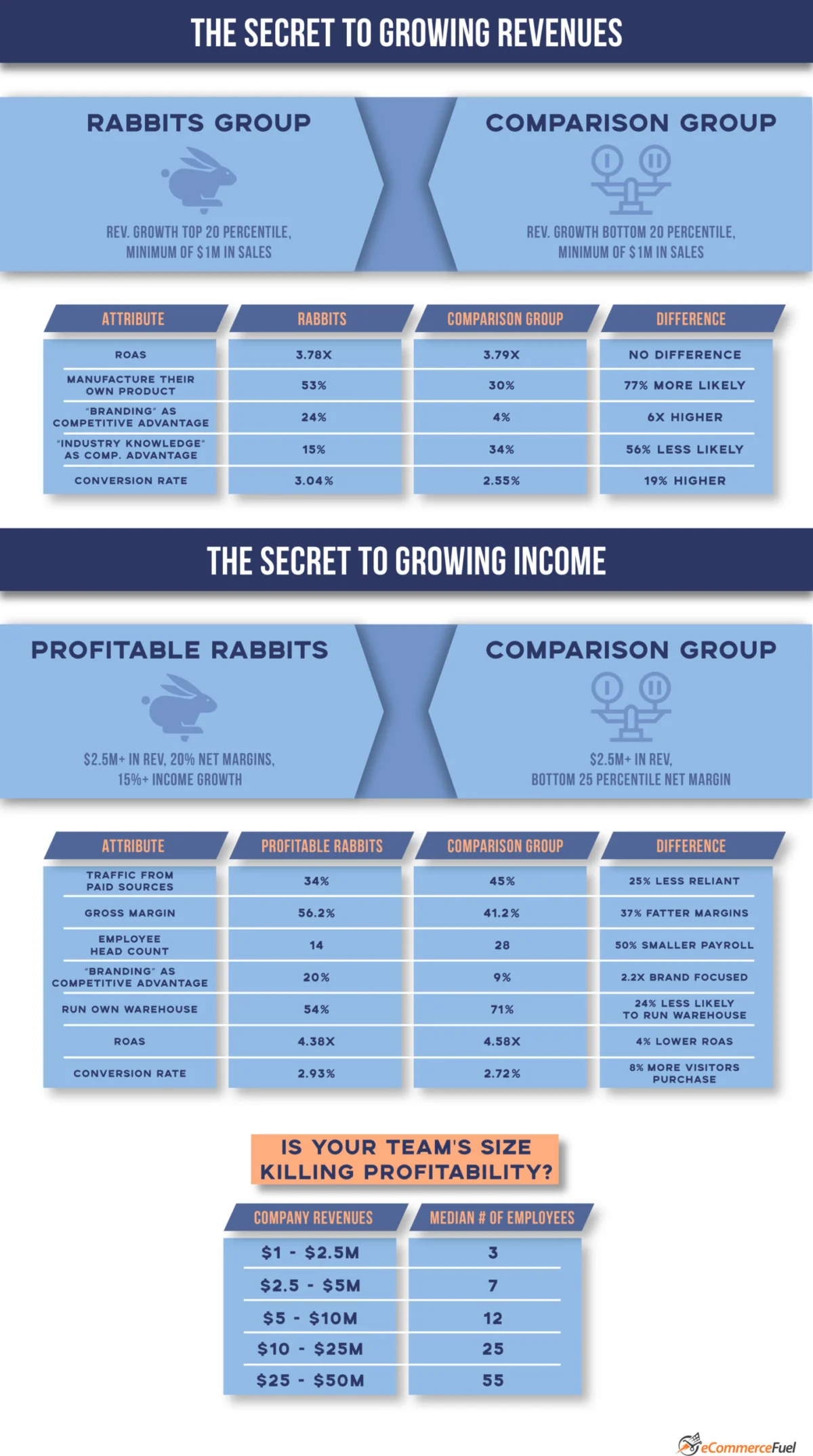
This case is not an isolated incident. Research analyzing the operational and financial structures of hundreds of e-commerce businesses consistently highlights a correlation between lean operations and superior profitability. A comprehensive study, which examined the factors differentiating highly profitable online stores from those struggling to achieve similar financial success, found that marketing prowess was not the primary differentiator. While return on ad spend (ROAS) and customer acquisition cost (CAC) are critical metrics, the study revealed that top-performing businesses did not necessarily exhibit significantly better performance in areas like Facebook advertising or search engine optimization (SEO). Instead, the most striking disparity lay in their operational expenditures.
The data indicates that leading profitable stores maintained payrolls approximately half the size of their less profitable counterparts. Furthermore, these successful businesses were 25% more likely to outsource their warehouse operations, indicating a strategic decision to leverage external expertise and infrastructure for fulfillment rather than investing heavily in in-house logistics. This lean approach also translated to a reduced reliance on paid traffic, with these businesses being 25% less dependent on paid marketing channels. The overarching conclusion from this research is compelling: operational leanness consistently trumps marketing cleverness when it comes to driving sustainable profitability. This finding is set to be further elaborated and updated in an upcoming eComFuel Trends Report, which invites business owners to contribute their data to validate these patterns.

The concept of "lean" in this context extends far beyond merely reducing headcount. It encompasses a holistic review of all overhead expenses, including physical office spaces that may no longer be necessary in a post-pandemic remote-first world, underutilized warehouse facilities, and a multitude of recurring SaaS subscriptions that often auto-renew without conscious oversight. The key to effective lean operations lies in a deliberate and strategic approach to identifying and eliminating non-essential expenditures. A critical filter for this process is to assess what functions are truly core to a brand’s unique value proposition. For instance, if a brand’s competitive advantage lies in its distinctive product design, retaining in-house design talent would be a strategic necessity. Conversely, if packing boxes and managing fulfillment are not core competencies or differentiators, outsourcing these functions to a specialized 3PL provider often proves to be a more cost-effective and efficient solution. This intentionality in resource allocation is a hallmark of profit-driven businesses.
The transition to a leaner operational model often necessitates confronting uncomfortable truths and engaging in difficult conversations. Many entrepreneurs tend to postpone these discussions until they are forced to by external pressures, such as economic downturns, cash flow crises, or a significant decline in profitability. However, business owners who consistently achieve high profitability are proactive in addressing these issues. They engage in candid self-assessment, questioning the necessity of certain roles or expenditures that may have been adopted out of habit rather than genuine business need. This includes regularly evaluating the ROI of software subscriptions and contemplating hypothetical cost-cutting scenarios, such as identifying what could be eliminated if a 25% reduction in expenses were suddenly required. By undertaking these proactive assessments and implementing strategic cuts, they ensure their businesses remain resilient and financially sound, not out of necessity, but as a result of deliberate planning.

Beyond operational efficiencies, a second, often overlooked, lever for enhancing profitability is tax optimization. Many business owners initially perceive taxes as a fixed cost, a percentage of income that must be paid regardless of strategic planning. However, astute entrepreneurs have discovered that by being intentional about their tax strategies, they can significantly reduce their tax burden without resorting to illicit schemes. This involves a proactive approach to understanding and leveraging various tax-saving opportunities.
Consider a comparative analysis of two hypothetical store owners, each with identical businesses generating $2.5 million in revenue and $250,000 in profit, and facing similar personal financial circumstances. Owner A, who has not strategically managed his tax obligations, might pay upwards of $75,000 in taxes annually. In contrast, Owner B, who has diligently implemented tax optimization strategies, could potentially reduce his tax liability to as low as $21,000, representing a substantial annual saving of approximately $54,000. This dramatic difference is achieved through a combination of well-established, legal tax planning methods:

- Profit Sharing Contributions: Owner B contributes a significant portion of profits, such as $45,000, into retirement accounts through profit-sharing plans. This strategy allows for substantial tax-deferred growth, effectively saving an estimated $13,500 in taxes annually, assuming a 30% marginal tax rate.
- Appreciated Stock Donations: When making charitable contributions, Owner B donates appreciated stock rather than cash. This strategy allows him to avoid capital gains tax on the stock’s growth while still receiving a deduction for its fair market value, yielding savings of approximately $3,500.
- Maximized Health Savings Account (HSA): Owner B maximizes his family’s HSA contributions to the annual limit of $8,500. HSAs offer triple tax advantages: contributions are tax-deductible, earnings grow tax-free, and qualified withdrawals for medical expenses are also tax-free, resulting in estimated tax savings of $2,550.
- Paying Children for Work: Owner B employs his three children for legitimate work within the business, paying each $7,000 annually. These payments are deductible business expenses for Owner B, and the children can invest these earnings in Roth IRAs, benefiting from tax-free growth for decades. This strategy can yield savings of approximately $6,300.
- Inventory Donations: Owner B strategically donates slow-moving inventory, valued at $60,000, to charitable organizations. Instead of liquidating at a loss, he receives a deduction at fair market value. This highly underutilized strategy in e-commerce can generate substantial tax savings, estimated at $18,000 in this scenario.
The invisibility of these tax optimization opportunities often stems from the fragmented nature of tax reporting. Personal returns, business filings, brokerage statements, and payroll tax reports are typically managed in disparate systems, preventing business owners from seeing a consolidated view of their overall tax liabilities. This lack of a comprehensive overview hinders their ability to identify potential savings. While many business owners have competent accountants who ensure compliance, these professionals may not proactively offer strategic tax-saving ideas.
A simple yet effective test for the quality of one’s CPA is to ask when they last proactively presented a novel tax-saving strategy. If the answer is uncertain or negative, it suggests the accountant may be providing adequate compliance services but missing opportunities for significant financial optimization. The substantial difference in tax liabilities observed between Owner A and Owner B is not a result of complex financial engineering but of intentional, informed planning.

In essence, the e-commerce landscape is witnessing a fundamental shift in how success is measured. While marketing metrics like ROAS, CAC, and LTV remain important, the ultimate determinant of a business’s health and owner well-being is often its profitability. By embracing operational leanness, meticulously managing overhead, and strategically optimizing tax liabilities, e-commerce businesses can achieve greater financial success and reduced stress. The focus is moving from merely acquiring customers to efficiently retaining earnings, a more sustainable and rewarding path to long-term growth. Those who prioritize these less glamorous but highly impactful levers are positioning themselves for enduring prosperity in a competitive market.