As the landscape of artificial intelligence shifts from passive information retrieval to active task execution, a critical technical divide has emerged between two primary architectures: Agentic Large Language Models (LLMs) and Large Action Models (LAMs). While both systems are designed to bridge the gap between human intent and digital execution, they represent fundamentally different philosophical and engineering approaches to the "doing" aspect of AI. Understanding this distinction is becoming essential for enterprise leaders, software architects, and developers who are moving past the "chatbot" era toward a future of autonomous digital workers.
The current AI market is undergoing a transition from generative AI—focused on producing text, images, and code—to agentic AI, which focuses on achieving specific outcomes. Industry analysts at Gartner and IDC suggest that by 2026, over 40% of enterprise applications will feature some form of embedded agentic reasoning. However, the reliability of these agents depends heavily on whether they are built as an extension of a language model or as a dedicated action-oriented system.
Defining the Architectures: Scaffolding vs. Weights
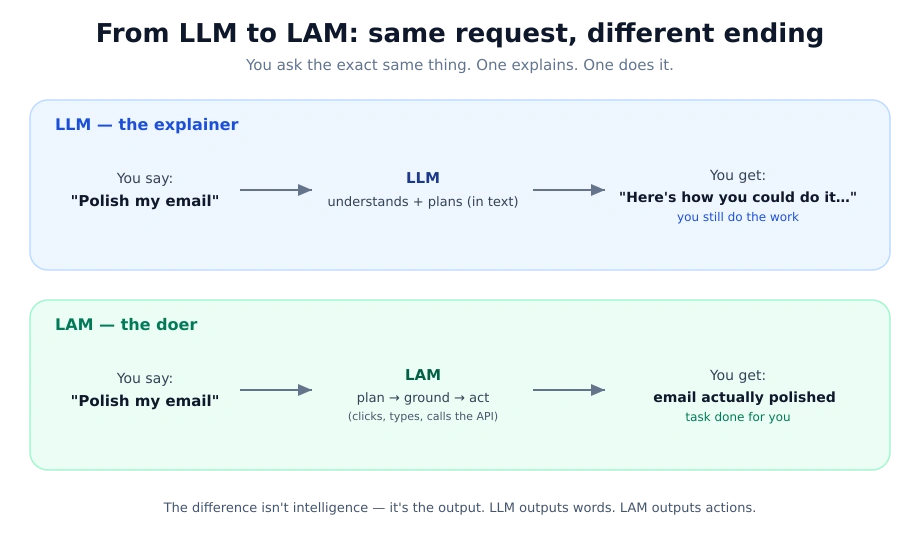
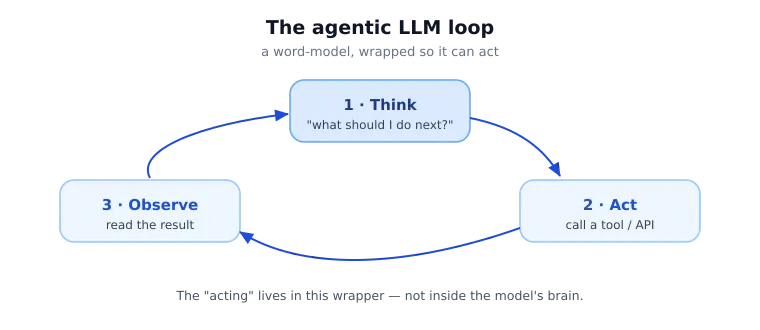
The core difference between an Agentic LLM and a Large Action Model lies in where the "intelligence" for taking action resides. In an Agentic LLM, the ability to perform a task is an emergent property of its reasoning capabilities, facilitated by external software. Conversely, in a LAM, the ability to perform a task is baked directly into the model’s training data and architecture.
An Agentic LLM utilizes a standard foundation model, such as OpenAI’s GPT-4o, Anthropic’s Claude 3.5 Sonnet, or Google’s Gemini 1.5 Pro. These models are fundamentally word predictors. To make them "agentic," developers place them inside a reasoning loop, commonly referred to in the research community as a ReAct (Reason + Act) loop. In this configuration, the model is prompted to think step-by-step: it reads a goal, writes out a plan, selects a tool from a provided list (like a calendar API or a database query), observes the result, and repeats the process until the task is finished. The "agency" here is a result of the orchestration layer—the scaffolding—rather than a change in the model’s core objective.
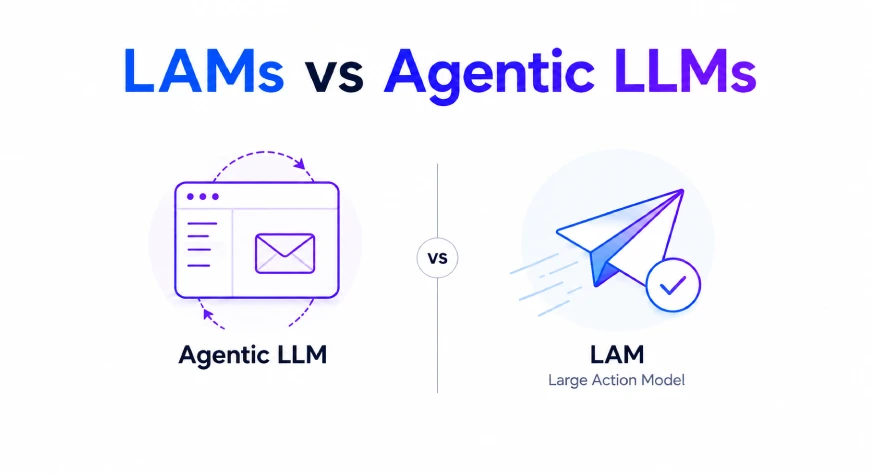
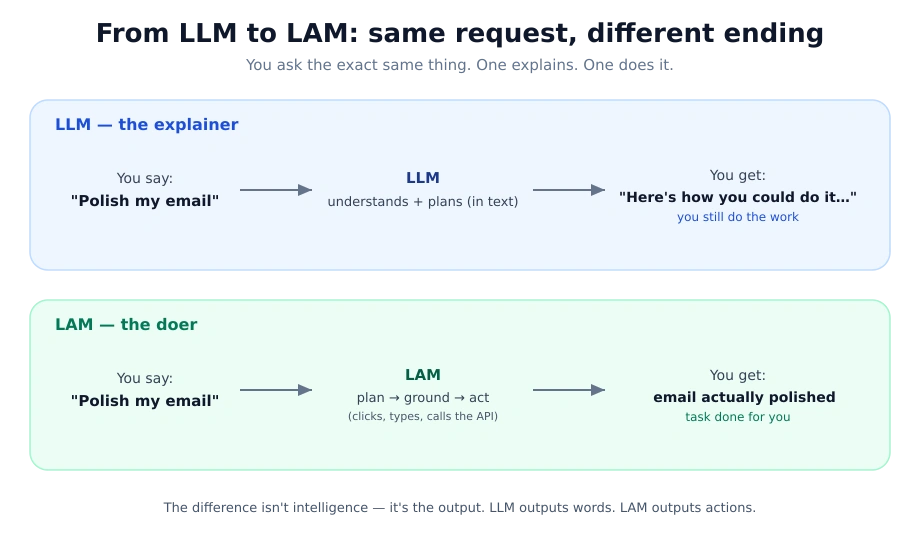
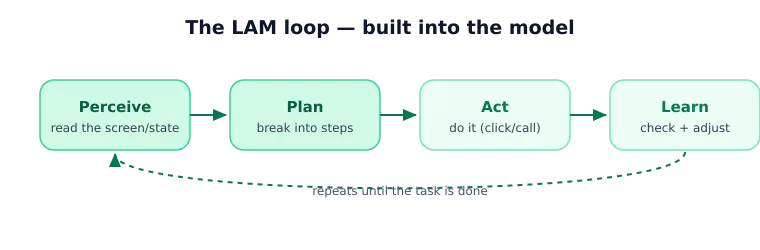
A Large Action Model, however, is trained from the ground up with the primary objective of executable action generation. Instead of being trained solely on the vast expanse of the internet’s text, a LAM is trained on "action trajectories." This includes recordings of human-computer interactions, such as mouse clicks, keystrokes, API sequences, and UI navigation patterns. When a LAM receives a command like "book a flight," it isn’t just predicting the next most likely word; it is predicting the next most likely state-change in a digital environment.
The Chronological Evolution of AI Agency
The journey toward these two architectures has been rapid, spanning less than half a decade of intensive development.
In 2022, the release of ChatGPT demonstrated that LLMs could follow complex instructions, but they remained trapped within the "chat box." Users could ask for a travel itinerary, but the AI could not actually book the hotel. By early 2023, open-source projects like AutoGPT and BabyAGI went viral by demonstrating that LLMs could be put into recursive loops to attempt multi-step tasks. While groundbreaking, these early "Agentic LLMs" were notoriously unreliable, often getting stuck in infinite loops or "hallucinating" API calls that didn’t exist.
By late 2023 and early 2024, the industry saw the emergence of specialized action-oriented research. Companies like Adept AI introduced ACT-1, a model specifically designed to interact with web browsers and software like Salesforce and Excel. Simultaneously, Salesforce Research introduced the "AgentOhana" pipeline, a framework designed to unify diverse action data into a standardized format for training. This period marked the birth of the Large Action Model as a distinct category, separate from general-purpose chatbots.
In 2025 and moving into 2026, the trend has shifted toward "Tiny Giants"—small, highly efficient LAMs that can outperform massive generalist models on specific functional tasks. Salesforce’s xLAM-1B, for instance, has become a benchmark for this movement, proving that a 1-billion parameter model can exceed the function-calling accuracy of a 175-billion parameter generalist model if it is trained specifically for actions.
Supporting Data: Efficiency and Reliability Benchmarks
The performance gap between these two approaches is most visible in function-calling benchmarks and operational costs. General-purpose LLMs are "heavy" in terms of compute requirements. Running a 70-billion or 400-billion parameter model to perform a simple API call is computationally expensive and introduces significant latency.
Data from recent function-calling leaderboards indicates that while GPT-4o remains a top performer due to its massive scale and sophisticated reasoning, specialized models like xLAM-1B and xLAM-70B are closing the gap. In specific benchmarks involving the Berkeley Function Calling Leaderboard (BFCL), specialized action models have demonstrated the ability to reduce "parameter hallucination"—the tendency of an AI to invent arguments for an API—by as much as 30% compared to non-fine-tuned generalist models.
Furthermore, the "Agentic LLM" approach often requires multiple "turns" or tokens to reach a conclusion. Because the model must "think out loud" in its reasoning loop, it consumes more tokens. A LAM, designed to output structured JSON or direct API calls natively, can often complete the same task in a single inference pass, leading to a potential 50-80% reduction in operational costs for high-volume enterprise workflows.
Industry Perspectives and Official Responses
Leading figures in the AI space have voiced varying perspectives on which architecture will ultimately dominate. Sam Altman, CEO of OpenAI, has frequently alluded to the concept of "agents" as the next great frontier, suggesting that future iterations of GPT will move closer to native action-taking. However, OpenAI’s current approach remains largely agentic-orchestration based, relying on "GPTs" and the Assistants API.
In contrast, Marc Benioff, CEO of Salesforce, has positioned LAMs as the backbone of the "Third Wave of AI." During the announcement of Salesforce’s Agentforce, the company emphasized that their "Atlas Reasoning Engine" utilizes specialized models (xLAM) because enterprise customers require a level of "guardrailed reliability" that general-purpose chatbots cannot provide.
Technical experts from Anthropic have noted that while general-purpose models are better at "handling the unexpected" due to their broad knowledge base, they can be "distracted" by their own training data when precision is required. This has led to a consensus among many researchers: the most robust systems will likely be hybrids.
Fact-Based Analysis of Implications
The choice between an Agentic LLM and a LAM carries significant implications for business strategy and technical debt.
For open-ended tasks—such as "research this topic and write a summary of how it affects my industry"—the Agentic LLM is superior. These tasks require deep semantic understanding, synthesis of disparate information, and creative output. The "reasoning loop" allows the model to pivot its strategy if it encounters a paywall or a dead link, using its general intelligence to find a workaround.
However, for bounded, repetitive, or high-stakes tasks—such as "process these 500 invoices through the ERP system"—the LAM is the clear winner. In these scenarios, flexibility is actually a liability. A general-purpose LLM might decide to "be helpful" by formatting a date differently or adding a polite comment to a data field, which can break downstream automated systems. A LAM, trained on the strict trajectories of that specific task, is far more likely to adhere to the required protocol.
The "2 AM incident" problem remains the biggest hurdle for Agentic LLMs in production. Because the agency is "bolted on" via prompts and code, small changes in the underlying foundation model (a "silent update" by the provider) can cause the agentic loop to fail, leading to unpredictable behavior in the middle of the night. LAMs, being specialized and often hosted locally or in controlled environments, offer a more predictable performance profile.
The Future: A Convergent Ecosystem
As we look toward the remainder of 2026, the distinction between these two models may begin to blur as "hybrid" systems become the standard. In a hybrid architecture, a Large Language Model acts as the "brain" or the "dispatcher." It interacts with the human user, understands the nuance of the request, and performs the high-level planning. Once a specific, bounded task is identified—such as executing a payment or updating a CRM record—the LLM hands the execution off to a Large Action Model.
This division of labor mirrors the human brain’s own structure, where the prefrontal cortex handles high-level planning and reasoning, while the motor cortex and specialized neural pathways handle the execution of physical movements.
In conclusion, the shift from Agentic LLMs to Large Action Models represents a maturing of the AI field. While the flexibility of general-purpose models sparked the initial excitement, the demand for reliability, speed, and cost-efficiency is driving the industry toward specialized action models. Organizations that successfully navigate this divide—using Agentic LLMs for thinking and LAMs for doing—will be the ones that move beyond the hype and into the realm of true autonomous productivity.