While the right press coverage is often deemed priceless, many press mentions traditionally come at a significant cost, with newswires existing precisely to facilitate guaranteed attention. These services, despite their outlay, are frequently utilized for their content syndication capabilities, pushing stories to a range of publications that then republish, rewrite, or reference the original material. However, a recent comprehensive analysis by BuzzSumo reveals a compelling alternative: strategically targeting existing content and PR syndication networks to secure high-value, organic coverage without direct payment. This groundbreaking research, building upon a 2018 study by US-based agency Fractl, maps out intricate content flows between hundreds of high-traffic publications, offering invaluable insights for refining content syndication strategies and achieving greater mileage from earned media.
The Evolving PR Landscape: A Shift Towards Organic Amplification
For years, the PR industry has relied heavily on paid newswires to disseminate press releases and content, viewing them as a necessary investment for widespread reach. These services effectively syndicate content by distributing stories to a vast array of media outlets, which then republish or rewrite the material, ideally providing a reference or backlink to the original source. This model, while effective in ensuring basic dissemination, often leaves PR professionals wondering about the true engagement and amplification potential of such paid placements. The aspiration for many remains the elusive "dream" of organic syndication, where a story spreads naturally across diverse platforms, multiplying its impact exponentially.
This ambition has gained even greater urgency with recent shifts in search engine algorithms. Earlier this year, Google issued an official statement advising against the use of canonical link elements for verbatim syndicated content, instead recommending that publishers no-index such articles to prevent duplication issues and ensure the original story maintains its ranking in search engine results pages (SERPs). This policy change means that audiences are less likely to discover syndicated stories through organic search. Consequently, the importance of social media engagement as a metric for earned content syndication has surged, highlighting the need for PR strategies that prioritize content likely to be shared widely across social platforms.
BuzzSumo’s Groundbreaking Study: A New Blueprint for PR
Recognizing this evolving landscape, BuzzSumo undertook its own extensive analysis of publication networks, examining millions of links exchanged between the world’s top 100 most engaging publishers over the last year. The study’s methodology was meticulously designed to infer syndication patterns and strong editorial connections. For each of the top 100 publications, BuzzSumo identified their top 10 inbound and outbound linking publications, strictly within the same pool of high-authority sources. This focused approach allowed researchers to analyze the flow of authority and attention, providing a clear roadmap for PR professionals aiming for impactful, unpaid coverage.
The study’s data points included:
- The top 100 most engaging publications.
- Average engagement per article for each publication.
- The number of backlinks received by each publication.
- The total social engagement driven by those backlinks.
It’s crucial to note that while not all analyzed links definitively represent verbatim syndication, the sheer volume and quality of connections between these high-authority publishers strongly infer significant content repurposing or referencing.
Key Findings: Unpacking Publisher Connections
1. Strongest Individual Syndication Pathways
The analysis revealed several powerful, high-engagement connections between individual publications:
- The Washington Post to AP News: The most engaging connection observed, with The Washington Post sending a remarkable 567 million backlink engagements to AP News. Given AP News’s role as a news agency, distributing articles via its "wire" to subscribing outlets, this suggests that content picked up by AP News has a very high chance of being syndicated by The Washington Post, a publication with the second-highest average engagement per article in the study.
- The Daily Mail to The Metro: The second most engaging connection, with 339 million backlink engagements flowing from The Daily Mail to The Metro.
- BBC US/Global to BBC UK: Reflecting internal synergy, bbc.com sends 312 million backlink engagements to bbc.co.uk.
- BBC UK to BBC US/Global: A reciprocal relationship, with bbc.co.uk sending 124 million backlink engagements back to its international counterpart.
- CBS News to CBS Sports: This strong internal link, accounting for 123 million backlink engagements, indicates that sports stories picked up by CBS Sports are highly likely to be syndicated across CBS’s broader news platform, which boasts the highest average engagement per article among all studied publications.
- Comcast Publications (Internal): The Comcast family of publications demonstrated substantial internal linking, sharing 395 million backlink engagements among themselves, making it a highly integrated network.
- The Metro to The Daily Mail: Completing the cycle of the second-strongest individual connection, The Metro also heavily syndicates Daily Mail content, sending 77 million backlink engagements.
These findings underscore the significant amplification potential inherent in certain publisher relationships, especially within news agencies and media conglomerates.
2. Who Earns the Most Links? Quality Over Quantity
While The Mirror received the highest number of links overall (326K), Associated Press News emerged as the leader in earning the most engaging backlinks, accumulating 585 million engagements from its connections. This distinction is critical: a high volume of links from low-engagement articles is far less valuable than fewer, but highly engaging, links. As the article vividly puts it, it’s "like performing at The Colosseum… to nobody" versus "performing in an intimate, yet packed-out venue at the Edinburgh Festival Fringe, to an audience that hangs off your every word." Publications like The Metro, The Mirror, BBC, CBS Sports, and Rolling Stone demonstrated strength in both link volume and engagement, indicating robust story syndication.
3. The Influence of Publisher Networks: Family Ties
The study extended its analysis to family-owned publisher networks, identifying which groups are most effective at internal content syndication.
- Comcast stood out, sharing the most engaging internal links of any family-owned network, with 680 million engagements. It’s also one of the most insular, sending 95.3% of its most engaging backlinks to its own publications.
- Penske Media Corporation (owner of Variety and Billboard) followed closely with 670 million backlink engagements within its network.
- In contrast, Reach PLC (Mirror, Daily Star) received the most links (670K) but ranked 7th in backlink engagement and plummeted to 20th in average engagement per article, illustrating the "quality over quantity" principle.
- Condé Nast publications (Vanity Fair, Ars Technica) were identified as least likely to pass links internally, with no observed article links between their top 100 publications.
This suggests that pitching to publications within highly integrated family groups like Comcast or Penske Media offers a strong chance for internal syndication across engaging content.
4. Beyond Family: Cross-Network Syndication Powerhouses
Beyond internal networks, the study explored connections between unrelated publisher groups.

- News Corp and Dotdash Meredith were highlighted as prime targets for cross-network syndication.
- Notably, many family groups send more engaging links to Dotdash Meredith publications than they do to their own. For example, a story in People (a Dotdash Meredith publication) has the potential to be picked up by 8 other established syndication networks, and individual articles on People already see high average engagement.
- The strongest unrelated connection was observed between The Daily Mail and The Sun, indicating that coverage in one significantly increases the chance of being featured in the other.
Targeting these cross-network hubs can significantly amplify PR efforts, extending coverage across a wider variety of influential media ecosystems.
5. Independent Voices with Broad Echoes
Independent publications, those not owned by larger media groups, also play a vital role. The New York Times and The Washington Post were identified as epicenters for independent syndication, with numerous other publications linking back to them. The Washington Post, in particular, leads the independent category for average article engagement (5,100 engagements per article), promising both attention and links. Interestingly, both these publications maintain paywalls yet still attract substantial engaging links, although the study found a broader trend.
6. The Paywall Paradox: Impact on Syndication
A significant finding concerns the impact of paywalls:
- Paywall publications are 60% less likely to receive backlinks, and thus be syndicated.
- They also receive 63% less backlink engagement compared to non-paywall counterparts.
Out of the 100 publications analyzed, 17 had paywalls and 83 did not. This data suggests that while top-tier paywall sites can still be influential, for maximum syndication potential, non-paywall publications generally offer greater organic amplification.
7. Top Outbound Syndicators: Who Spreads the Word?
The study also identified which publications are most likely to link out to others, effectively acting as "super-syndicators."
- Raw Story linked to the greatest number of other top 100 publications (54), but its articles had relatively low engagement.
- The Washington Post, on the other hand, sent 634 million backlinks to 41 of the top 100 publications, making it the most valuable syndicator in terms of engagement.
This indicates that securing coverage in The Washington Post offers the highest likelihood of your story being amplified through engaging backlinks across a broad network.
Strategic Content for Maximum Reach
Beyond identifying key publishers, the study also delved into the characteristics of content most likely to achieve syndication.
1. Winning Headlines and Visual Storytelling
- Location-Specific Headlines: Phrases like "By state," "Cities with the biggest," or "By country" consistently drove high link counts (9 to 17 links per article). This aligns with expert analysis, like Amanda Milligan of Stacker Studio, who notes that audiences have a vested interest in local stories, making them highly shareable and attractive to publishers.
- Visual/Data-Led Campaigns: Articles incorporating visuals or data (e.g., "visualizing" or "visualized" in the headline) earned 12 to 22 links on average, significantly higher than the overall average of 7 links per article. Creating unique, data-driven visuals is a powerful tactic, as it compels publications to reference the original source.
2. Leveraging News Aggregators
News aggregators, ranging from link directories (All Top) to content republishers (MSN, Yahoo), and social platforms (Reddit), are crucial for extending content lifecycles. They often use automation (algorithms) or manual curation to distribute third-party news.
- Reddit, NewsBreak, and Yahoo were identified as top news aggregators, sending the most engaging backlinks.
- These aggregators predominantly send their most engaging links to Business Insider, BuzzFeed, and The New York Times.
Securing coverage in these target publications dramatically increases the chances of being picked up and amplified by major news aggregators, leading to broader exposure. Notably, aggregators that actively rewrite or republish content (like MSN, Yahoo) are particularly valuable, as they are more likely to include the all-important link back to the brand’s website.
3. Maximizing News Agency Amplification
News agencies like AP News and BBC News serve as powerful multipliers. Their journalists write articles that are then distributed via "wire" (RSS feeds) to numerous subscribing news publications.
- For BBC News, the study found that existing coverage in The Guardian significantly increases the likelihood of syndication across the BBC network.
- To get picked up by Associated Press News (the world’s largest news agency), in addition to direct pitching, aiming for coverage in The New York Times is a strategic move, as AP News frequently references and repurposes content from this publisher.
Actionable Insights for PR Professionals
The insights from this study provide a clear, data-driven framework for modern PR strategies.
1. Identifying High-Impact Journalists:
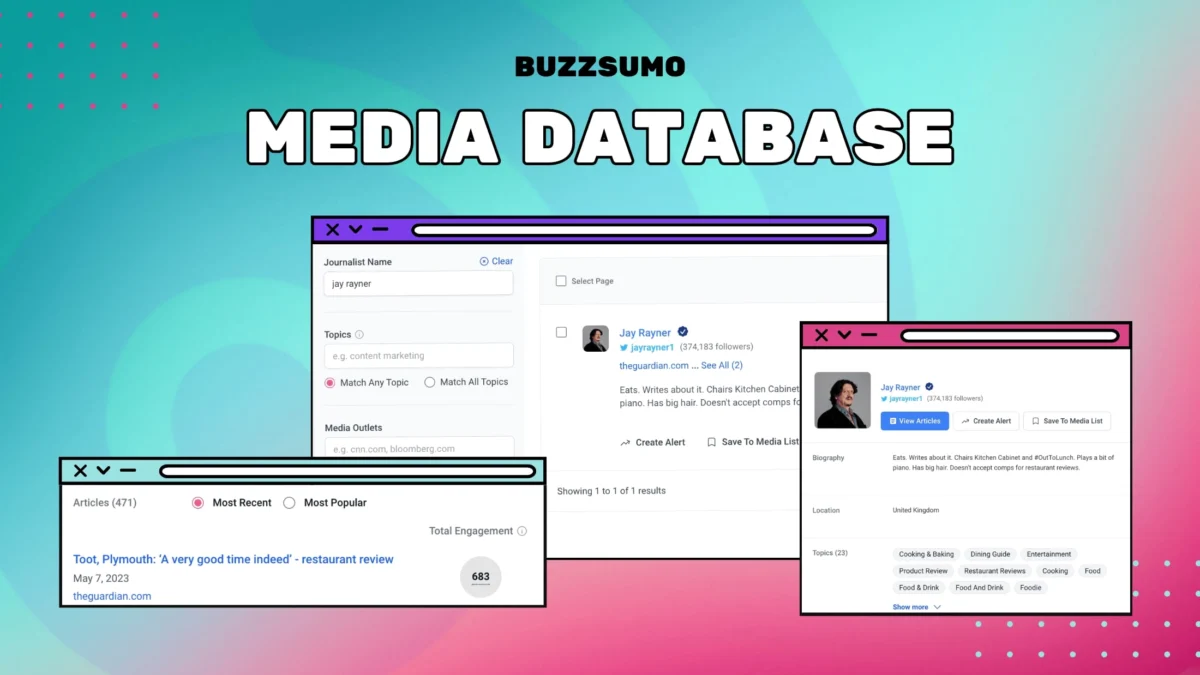
- Utilize tools like BuzzSumo’s Journalist Database to search for relevant journalists by name, topic, or publication.
- Crucially, use BuzzSumo’s Content Analysis Report to analyze individual journalists. By comparing up to 10 journalists, PRs can assess their average engagement and the number of backlinks their content typically generates. This allows for prioritizing outreach to journalists who possess the power to amplify a story far beyond their immediate publication.
2. Building a Proactive Syndication Strategy:
- Integrate Syndication Research from the Outset: Instead of a post-pitching afterthought, make syndication potential a core criterion during creative brainstorms.
- Analyze Link-Worthy Headlines: Use the Content Analyzer to identify topics and headline structures that consistently earn links within top-tier media. Location-specific and data-rich stories are strong contenders.
- Prioritize Publications with Strong Syndication Networks: Focus on pitching to publications and journalists that have demonstrated a history of being referenced by other high-authority outlets, both within their own networks and across unrelated groups.
- Consider the Paywall Factor: While not a deal-breaker for all campaigns, be mindful that non-paywall content generally sees greater syndication and engagement.
Conclusion: The Future of Earned Media
In an increasingly fragmented and algorithm-driven media landscape, the value of strategic, data-informed PR is more pronounced than ever. The BuzzSumo study unequivocally demonstrates that the "dream" of organic, high-engagement press coverage is achievable through a nuanced understanding of publisher networks. By moving beyond a sole reliance on paid newswires and embracing a proactive content syndication strategy, brands and clients can unlock a cascade of passive coverage, maximizing the reach and impact of their PR efforts without incurring additional costs.
The right kind of exposure is indeed priceless. By leveraging these insights, PR professionals can enhance their pitching, target smarter, and ensure their stories resonate across the media ecosystem, truly boosting their brand’s visibility and influence.