The digital landscape is undergoing a profound transformation, with brands globally grappling to establish a foothold in the rapidly evolving realm of Answer Engine Optimization (AEO). As generative AI increasingly mediates how users access information, understanding the optimal on-page content formats becomes paramount for digital visibility. Groundbreaking research from two independent 2026 datasets—HubSpot’s State of AEO 2026 report and Wix Studio’s AI Search Lab—has shed critical light on the content types most frequently cited by leading large language models (LLMs) and AI answer engines. These findings offer a strategic roadmap for content creators aiming to secure prime positioning in an AI-first search environment.
The Dawn of AEO: A Paradigm Shift in Digital Visibility
The emergence of AI Overviews, ChatGPT, Gemini, and Perplexity has heralded a new era, fundamentally altering the dynamics of online search. Unlike traditional search engines that present a list of links, AI answer engines synthesize information from multiple sources to provide direct, concise answers. This shift necessitates a re-evaluation of content strategies, moving beyond mere keyword optimization to a focus on clarity, authority, and structured data that AI can readily comprehend and cite. Brands are no longer just competing for clicks but for citations—the direct attribution within an AI-generated answer. The urgency to adapt is palpable, as early adopters stand to gain a significant competitive advantage in capturing audience attention and establishing digital authority.
The HubSpot State of AEO 2026 report, which meticulously analyzed thousands of citation themes between December 2025 and March 2026, alongside Wix Studio’s AI Search Lab, which indexed over a million citations across 75,000 AI answers, collectively paint a clear picture. These comprehensive studies provide an unprecedented look into the content formats that resonate most effectively with various AI platforms.
Key Findings: The Most-Cited Content Formats for AI
The consensus from both reports highlights listicles, articles (or blog posts), product pages, and category pages as the most universally favored content types by AI answer engines. Notably, comparison content stands out with an exceptional 95% citation rate specifically within ChatGPT, making it the highest-performing format across any engine in either dataset. This robust evidence underscores that content type is not merely a preference but a critical determinant of AI visibility.
![On-page content formats answer engines actually favor [new research]](https://53.fs1.hubspotusercontent-na1.net/hubfs/53/best-on-page-content-formats-for-ai-1-20260525-6914910.webp)
Here’s a breakdown of the most effective formats:
- Listicles and Best-of Posts: These formats are highly digestible and align well with commercial intent queries like “Best [X]” or “Top [N] [X].” Wix Studio’s data shows listicles accounting for 21.9% of all citations and a remarkable 40.86% of citations on commercial queries. Their clear, enumerated structure makes them easy for LLMs to extract and summarize.
- Long-Form Articles and Explainer Blog Posts: Ideal for informational queries ("What is X?", "How does X work?"), these are foundational for establishing expertise. HubSpot’s report found articles leading citations in AI Overviews (42% citation rate) and Gemini (76%), while Wix noted they comprised 45.48% of citations on informational queries. Their in-depth nature provides comprehensive answers favored by AI seeking detailed explanations.
- Product and Landing Pages: Essential for transactional and navigational queries, especially when users know what they are looking for. HubSpot’s data shows product listings and landing pages achieving an 84% citation rate on Perplexity, the highest for any format on that engine. Wix’s analysis indicates they make up 13.7% of all AI citations, concentrating heavily on transactional (24.88%) and navigational (21.95%) searches.
- Category Pages: Distinct from individual product pages, these serve navigational and commercial-exploratory intents, allowing users to browse options. Wix Studio identified category pages as a significant contributor, capturing 11.3% of all AI citations, particularly visible in e-commerce and home repair sectors.
- Comparison Posts (X vs. Y): As highlighted, these dominate ChatGPT with an astounding 95% citation rate, making them indispensable for comparative commercial queries ("Brand A vs. Brand B"). Their structured approach to highlighting differences and similarities is perfectly suited for AI synthesis.
While these content types are broadly effective, it’s crucial to note that content type is just one of three on-page layers influencing citations. The other two are the intent-matched title pattern and citation-correlated structural elements.
Beyond Format: Title Patterns and Structural Signals
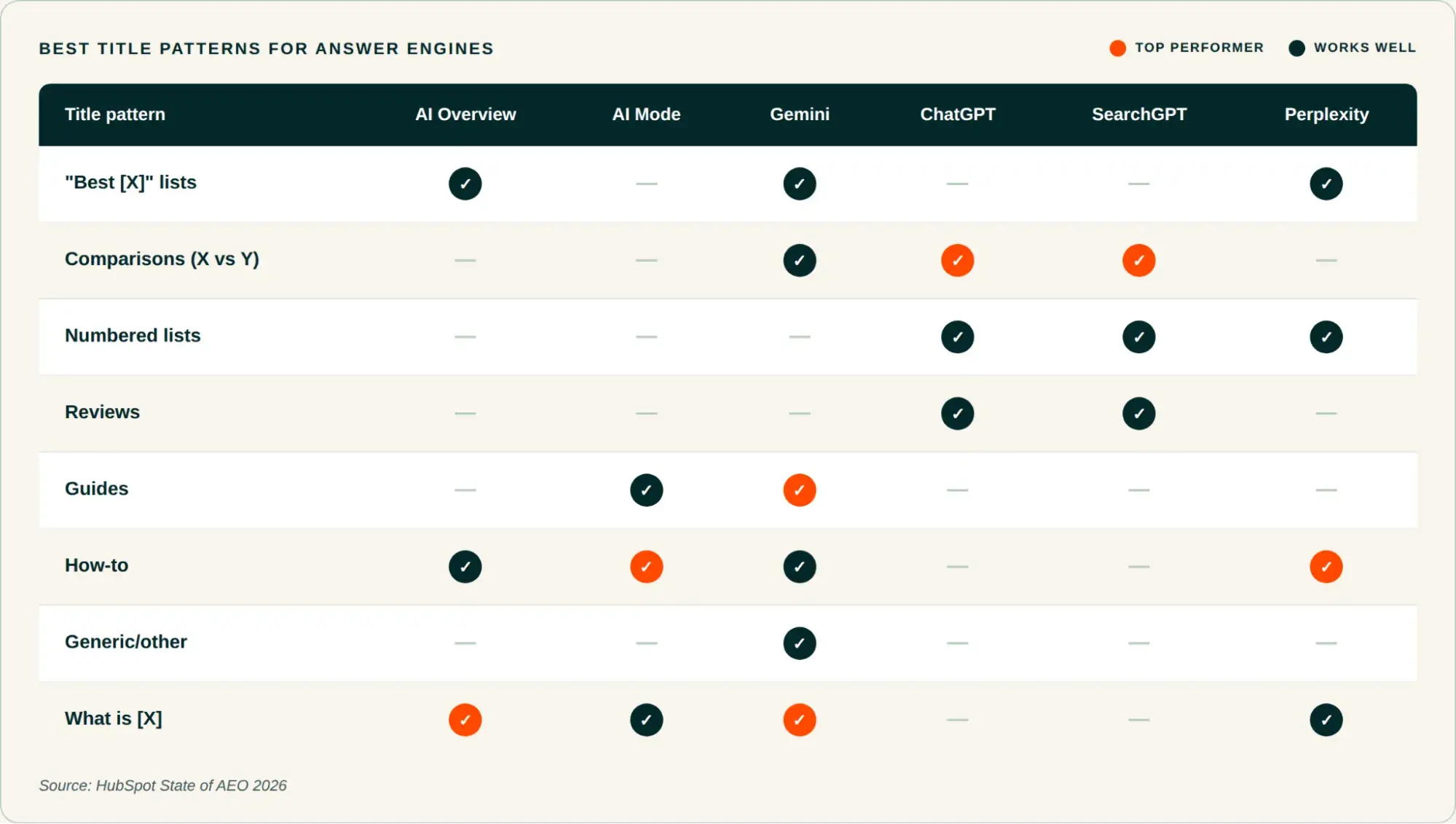
The effectiveness of a content format is significantly amplified by its accompanying meta title and internal structural elements. HubSpot’s State of AEO 2026 emphasized that title pattern is the single most significant citation factor in meta titles. For instance:
- "What is X?" titles excel on AI Overviews and Gemini, aligning with informational intent.
- "X vs. Y" titles are potent for ChatGPT and SearchGPT, driving comparative analysis.
- "How to X" titles perform strongly on Google AI Mode and Perplexity, catering to procedural queries.
- "Best X" titles are effective across AI Overviews, Gemini, Perplexity, ChatGPT, and SearchGPT for commercial queries.
Furthermore, specific structural elements consistently correlate with higher AI citations across all content types:
- Statistics and Data: Quantifiable facts provide verifiable information, which LLMs prioritize for factual accuracy.
- Visible Last-Updated Dates: Signal recency and relevance, crucial for AI to provide up-to-date answers.
- Author Bios: Establish authority and credibility, especially important for sensitive topics or "Your Money Your Life" (YMYL) content.
- FAQ Sections with Schema Markup: Directly address natural-language questions and provide structured data (FAQPage schema) that AI can easily extract.
The inclusion of the year in titles and H1s also showed a correlation with higher citations in AI Overviews, although this strategy should be paired with a commitment to annual content refreshes to maintain accuracy.
Why These Formats Resonate with LLMs: The Technical Underpinnings
![On-page content formats answer engines actually favor [new research]](https://no-cache.hubspot.com/cta/default/53/9dd5e54b-fbef-4dd0-bc44-1689feb1ea18.png)
The success of these specific content formats for AI search optimization stems from three core principles: predictable extraction, alignment with LLM output patterns, and clear citation signals.
-
Predictable Extraction: LLMs do not "read" pages like humans. They process tokenized chunks of information, weighting different parts of the content unevenly. Research, including Stanford studies, indicates a U-shaped accuracy curve, where LLM performance dips if crucial information is buried in the middle of long texts. Consistent headers, short sections, and front-loaded answers ensure important content is positioned where models are most likely to use it. A 2026 GEO-SFE preprint further found that structured formats like lists and tables had 43% better LLM extraction accuracy compared to prose. This highlights why listicles and comparison tables are so effective—their inherent structure makes information retrieval straightforward for AI.
-
Alignment with LLM Output Patterns: The favored content formats mirror the way LLMs are designed to generate answers: concise, organized, and often in list or summary form. When content is structured similarly to how an LLM would ideally output an answer, it becomes easier for the AI to "learn" from and directly cite. This reduces the processing overhead and the risk of misinterpretation.
-
Clear Citation Signals: Schema markup (e.g., Article, HowTo, FAQPage, ItemList) acts as a direct instruction to crawlers, declaring the content’s purpose before a word is parsed. This "semantic hint" significantly aids AI in categorizing and understanding the page. Visible last-updated dates and author bios are strong signals of recency and authority, crucial for establishing trustworthiness. Declarative claims with named subjects and verifiable facts provide language that models can lift directly and attribute confidently. The GEO-SFE preprint revealed that structural changes alone could produce an average 17.3% citation lift across generative engines, even without altering the content’s meaning. These signals don’t replace quality content but make it more discoverable and attributable to AI.
Strategic Application: Structuring Pages for AI Success
Implementing these insights requires a dual approach: optimizing new content creation and auditing existing pages. While some structural elements are format-specific (e.g., numbered steps for how-to guides), universal structural elements apply to almost every page, creating a baseline that enhances AI comprehension:
- Front-loaded TL;DR sections: Provide a concise summary at the beginning.
- Clear H1 matching intent: Ensure the main heading accurately reflects the user’s query.
- H2/H3 hierarchy: Break down content into manageable, semantically organized sections every 150-200 words.
- Descriptive FAQ sections: Directly answer common questions.
- Visible last-updated date: Crucial for signaling freshness.
- Author bio with schema: Establishes credibility and expertise.
- Internal links and topic clusters: Connect related content, enhancing crawlability and contextual understanding for AI.
Structured Data for AI:
Mapping the correct schema type to each page is fundamental. Article schema for editorial posts, HowTo for procedural guides, FAQPage for Q&A sections, and ItemList for listicles. Including author and organization schema on every page clearly declares the source and brand behind the content. While schema markup isn’t a guaranteed citation booster, it’s an SEO best practice that indirectly influences how AI interprets content by providing explicit semantic signals.
![On-page content formats answer engines actually favor [new research]](https://53.fs1.hubspotusercontent-na1.net/hubfs/53/best-on-page-content-formats-for-ai-2-20260525-5829990.webp)
Templates for Optimal On-Page Content Formats:
To provide practical guidance, here are refined templates for the five most effective page types, assuming universal structural elements are already in place:
-
Long-Form Articles and Explainer Blog Posts:
- Reader Question: "What is X?", "Why does X happen?", "How does X work?" (conceptually)
- Title Pattern: "What is [X]?"
- Template: Comprehensive introduction with TL;DR, clear definition, historical context (if applicable), detailed explanation broken into H2s/H3s, statistics and data integrated, author bio, relevant internal links, FAQ section with schema.
-
Listicles and Best-of Posts:
- Reader Question: "Best [X]?", "Top [N] [X]?", "[X] tools?"
- Title Pattern: "Best [X]" or numbered list
- Template: Engaging intro with TL;DR, criteria for selection, numbered H2s/H3s for each item (using brand names where applicable), brief description of each item, pros/cons, pricing (if commercial), CTA, visible last-updated date, FAQ section.
-
Comparison Posts (X vs. Y):
- Reader Question: "[Brand A] vs. [Brand B]?", "Is [X] better than [Y]?"
- Title Pattern: "X vs. Y"
- Template: Concise intro setting context, clear summary of differences (TL;DR), side-by-side comparison table (crucial for AI extraction), detailed H2s for each product/service, specific feature comparisons, use cases for each, statistics, author bio, visible last-updated date.
-
Product and Landing Pages:
- Reader Question: "[Brand] [product name]?", "[Brand] [feature name]?"
- Title Pattern: Product or feature name
- Template: Clear product/feature name in H1, concise description, key benefits, detailed specifications in tables/bullet points (with product schema), use cases, customer reviews/testimonials, clear CTA, images/videos, FAQ section.
-
Category Pages:
- Reader Question: "[Category] tools?", "[Category] software?", "[Category] in [location]?"
- Title Pattern: Category name
- Template: Clear category name in H1, brief category description, list of products/services within category (with ItemList schema), filters/sorting options, navigational links to subcategories, relevant internal links, concise FAQ section.
Optimizing Existing Content: A 5-Step Audit and "Chunking" Strategy
![On-page content formats answer engines actually favor [new research]](https://53.fs1.hubspotusercontent-na1.net/hubfs/53/best-on-page-content-formats-for-ai-3-20260525-9814874.webp)
For existing content, a systematic audit is essential. Focus on high-leverage changes first, leveraging any existing SEO equity. The following 5-step quick audit is recommended:
- Identify High-Value Pages: Prioritize pages already ranking well organically or those targeting high-intent queries.
- Match Intent and Format: Ensure the content format aligns with the dominant user intent (informational, comparative, commercial, procedural, transactional/navigational).
- Check Title Patterns: Update meta titles and H1s to include proven AI-friendly patterns.
- Add Structural Elements: Integrate visible last-updated dates, author bios, and FAQ sections with schema.
- Enhance "Chunkability": Restructure long paragraphs into shorter, more digestible sections.
Making content more "chunkable" is vital for AI. This involves:
- Breaking up large paragraphs: Aim for 2-3 sentences per paragraph.
- Using bulleted and numbered lists: Presents information clearly.
- Employing subheadings (H2s, H3s, H4s): Creates a logical hierarchy and improves readability for both humans and AI.
- Front-loading answers: Place the most important information at the beginning of sections.
Tools like HubSpot Content Hub can facilitate bulk updates and provide built-in SEO recommendations, streamlining the optimization process for large content libraries.
Measuring and Governing AI Visibility
To validate the impact of these content format changes, marketers must establish a robust measurement framework for AI visibility. Three key metrics form the baseline for tracking across ChatGPT, Gemini, and Perplexity:
- Citation Rate: The percentage of queries where the AI answer engine cites at least one page of a specific content type.
- Share of Voice: The proportion of citations your brand receives compared to competitors for a tracked set of prompts.
- Brand Visibility Score: An overall measure of how often your brand is cited across relevant AI queries.
Manually tracking these metrics can be cumbersome. Solutions like HubSpot AEO automate prompt tracking, provide brand visibility scores, and benchmark competitor share, allowing marketers to quickly assess performance. It’s also important to map AI visibility to page-level performance, tracking conversions like demo signups or content downloads. Given that referrer data from AI engines is often incomplete, marketers should monitor branded search volume and direct traffic shifts as proxy signals for AI-driven engagement.
For long-term relevance, a strong governance model is indispensable. Assigning content cluster owners who manage review cadences and handle updates ensures content remains fresh. Triggers for updates include citation drops, new competitor entries in AI answers, or major LLM model releases. Regular refresh tactics should focus on high-impact areas: updating statistics, revising the TL;DR, and ensuring schema markup is accurate and complete.
![On-page content formats answer engines actually favor [new research]](https://53.fs1.hubspotusercontent-na1.net/hubfs/53/best-on-page-content-formats-for-ai-4-20260525-9253081.webp)
The Future of Content in an AI-First World
The insights from the HubSpot and Wix research mark a critical juncture for content strategy. Brands that proactively adapt their content to be easily digestible, authoritative, and structurally predictable for AI answer engines will be best positioned to thrive in the evolving digital landscape. This isn’t merely about optimizing for a new algorithm; it’s about reshaping content to meet the fundamental demands of a new information paradigm. The emphasis on clarity, structure, and user intent ensures that content remains valuable not just for AI, but ultimately for the human audience it serves. As AI continues to integrate deeper into search, the ability to produce AI-optimized content will become a core competency for any brand aiming for sustained digital visibility and market leadership.