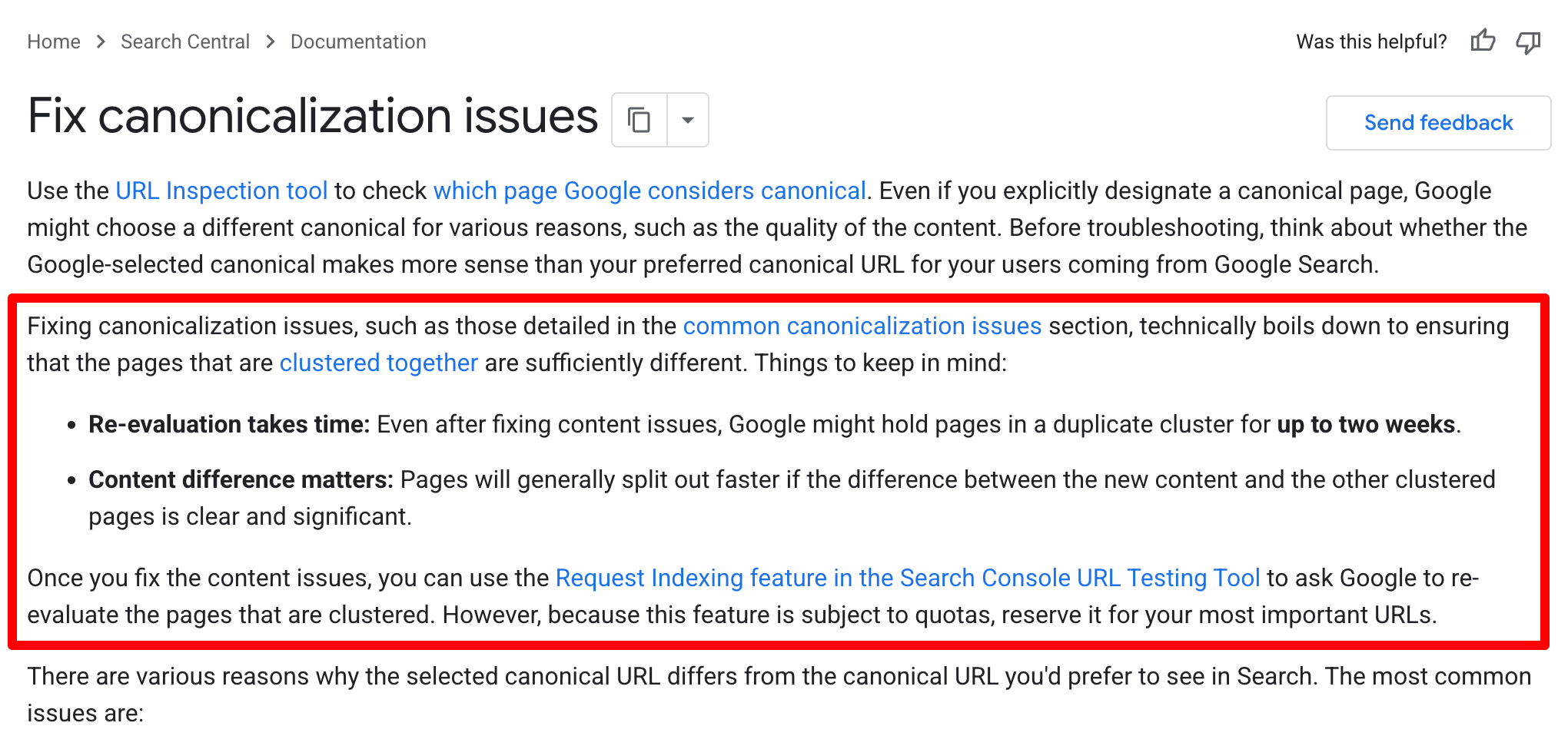
Google has recently updated its official documentation regarding canonicalization, providing crucial clarifications on the timeframe required for canonicalization issues to resolve and further elaborating on the concept of "duplicate clusters." The key takeaway from these updates is that even after webmasters implement fixes for content issues, Google may continue to hold pages within a duplicate cluster for a period of up to two weeks. This adjustment aims to offer clearer expectations to webmasters and SEO professionals regarding the re-evaluation time for canonicalization changes to take effect within Google Search.
The specific modification, now prominently featured at the top of Google’s "Fix canonicalization issues help documentation," states, "Even after fixing content issues, Google might hold pages in a duplicate cluster for up to two weeks." This new section further elaborates on factors influencing the resolution speed, adding, "Pages will generally split out faster if the difference between the new content and the other clustered pages is clear and significant." Concurrently, an additional clarification has been introduced to the "what is URL canonicalization document," explicitly defining Google’s process: "If Google finds multiple pages that seem to be the same or the primary content very similar, it clusters them together." These updates, as confirmed by Google, were designed to provide "better expectations about how long it takes for canonicalization changes to take effect" and offer "clarifications on re-evaluation time."
Understanding Canonicalization: A Cornerstone of SEO
To fully grasp the significance of Google’s latest updates, it is essential to understand the fundamental concept of canonicalization within the realm of Search Engine Optimization (SEO). Canonicalization is the process by which search engines determine the single, authoritative version of a piece of content when multiple URLs exist that display identical or very similar content. In essence, it tells search engines which version of a page is the "canonical" one, meaning the preferred version to be indexed and ranked in search results.
The necessity for canonicalization arises from the inherent complexities of website architecture and content management. Many common scenarios can lead to duplicate content, even unintentionally. These include:
- URL Variations: Different URLs pointing to the same content due to parameters (e.g.,
example.com/product?color=redvs.example.com/product), session IDs, tracking codes, or sorting options. - Protocol and Domain Variations: Content accessible via
http://,https://,www., or non-wwwversions (e.g.,https://www.example.comvs.https://example.com). - Trailing Slashes: URLs with and without trailing slashes (e.g.,
example.com/page/vs.example.com/page). - Default Pages: Directory index files (e.g.,
example.com/folder/vs.example.com/folder/index.html). - Content Syndication: When content is published on multiple sites (e.g., blog posts cross-posted to LinkedIn).
- Printer-Friendly Versions: Separate URLs for printer-friendly versions of pages.
- Pagination: While often handled with
rel="next"/rel="prev", sometimes individual paginated pages can be seen as duplicates of the main category page if not properly managed.
For search engines like Google, duplicate content presents several challenges. It can lead to wasted crawl budget, where Googlebot spends time crawling multiple identical pages instead of discovering new or updated unique content. More importantly, it can dilute ranking signals. If link equity and other ranking factors are spread across several duplicate URLs, the "true" authoritative page may not receive its full credit, potentially hindering its performance in search results. From a user perspective, duplicate content can also lead to a poorer search experience if multiple identical results appear.
Webmasters primarily communicate their canonical preferences to Google using the rel="canonical" HTML tag, placed in the <head> section of a webpage. This tag explicitly points to the preferred URL. However, it’s crucial to understand that rel="canonical" is a strong hint, not an absolute directive. Google also considers other signals when determining the canonical URL, including internal linking patterns, sitemap entries, 301 redirects, and even the content itself. This multi-faceted approach highlights the complexity of Google’s canonicalization algorithm, which aims to select the most representative URL for a given piece of content, even if the webmaster’s preferred canonical is not explicitly set or conflicts with other signals.
The Latest Google Documentation Updates in Detail
The recent updates to Google’s developer documentation serve as a critical clarification for webmasters navigating the intricacies of canonicalization. Previously, the timeframe for canonicalization changes to propagate through Google’s systems was often a point of speculation and uncertainty within the SEO community. The new additions aim to demystify this process, providing more concrete expectations.
The primary addition to the "Fix canonicalization issues help documentation" addresses the processing time directly. The statement "Even after fixing content issues, Google might hold pages in a duplicate cluster for up to two weeks" is a significant disclosure. It indicates that the resolution of canonicalization problems is not instantaneous. This two-week window allows for Google’s systems to re-crawl, re-process, and re-evaluate the relationship between previously clustered pages. This delay is likely attributable to the massive scale of the web, the resource intensity of indexing, and the need for Google’s algorithms to confidently confirm changes before updating their canonical selections.
Furthermore, the documentation now includes a vital nuance: "Pages will generally split out faster if the difference between the new content and the other clustered pages is clear and significant." This directive underscores the importance of not just making minor tweaks, but truly differentiating content when attempting to break pages out of a duplicate cluster. For webmasters aiming to distinguish previously similar pages, superficial changes may not suffice; substantive revisions that create distinct value propositions and informational content are more likely to accelerate Google’s re-evaluation process. This guidance implicitly pushes webmasters towards creating genuinely unique content rather than merely attempting to "trick" the algorithm with minimal alterations.
The second notable update clarifies Google’s internal terminology and process. The "what is URL canonicalization document" now explicitly states, "If Google finds multiple pages that seem to be the same or the primary content very similar, it clusters them together." This direct explanation solidifies the concept of "duplicate clusters" as a fundamental mechanism within Google’s indexing infrastructure. It illustrates that when Google identifies what it perceives as duplicate or near-duplicate content across various URLs, it logically groups these URLs into a cluster. From this cluster, Google then selects a single canonical URL to represent the entire group in its index and search results. The other URLs within the cluster are typically not indexed independently, and their ranking signals are consolidated to the chosen canonical.
Google’s official statement regarding these changes highlighted its intention to provide "clarifications on re-evaluation time" and "to provide better expectations about how long it takes for canonicalization changes to take effect." This indicates a conscious effort by the search giant to improve transparency around its complex indexing processes, addressing a common pain point for webmasters and SEOs who often struggle with the perceived black box nature of Google’s operations.
The Nuance of "Duplicate Clusters"
The explicit mention and explanation of "duplicate clusters" in Google’s updated documentation offer valuable insight into how the search engine internally manages perceived content redundancy. When Google encounters multiple URLs that contain identical or substantially similar primary content, its algorithms don’t simply discard the non-canonical versions outright. Instead, it aggregates them into a conceptual "cluster." Within this cluster, Google then employs a sophisticated set of signals to determine the single, most representative URL to serve as the canonical.
These signals can include the rel="canonical" tag specified by the webmaster, the internal linking structure of the website, external backlinks pointing to different versions, the presence of URLs in sitemaps, and even the server response codes (e.g., 301 redirects). The purpose of clustering is multi-faceted: it conserves crawl budget by not needing to process and index every single duplicate URL independently, it consolidates ranking signals to ensure the most authoritative version benefits from accumulated equity, and it streamlines the search results by presenting only one primary entry for a given piece of content.
For webmasters, understanding this clustering mechanism is crucial. It explains why simply adding a rel="canonical" tag might not always yield immediate results, or why Google might choose a different canonical URL than the one specified. Google’s algorithm attempts to infer the "best" canonical based on a holistic view of the web, and if conflicting signals exist or if the content is not sufficiently distinct, pages may remain clustered longer than desired. The recent update reinforces that breaking out of such a cluster, especially if Google initially perceived the content as highly similar, requires not only the correct technical signals but also, critically, a significant and clear differentiation of content.
Historical Context: Google’s Evolving Guidance
The discourse around canonicalization is not new; it has been a persistent and evolving topic in the SEO landscape for well over a decade. Google first introduced the rel="canonical" tag in 2009, acknowledging the widespread problem of duplicate content on the web and offering webmasters a standardized way to communicate their preferred URLs. Prior to this, webmasters often relied on 301 redirects or meta noindex tags, which had their own limitations and implications.
Since its introduction, Google’s guidance on canonicalization has undergone several refinements and clarifications. The search engine has consistently emphasized that rel="canonical" is a strong hint, not a command, reflecting the complexity of its ranking and indexing systems. There have been numerous instances where Google’s algorithms have overridden a webmaster’s declared canonical, often due to perceived stronger signals from other sources or technical errors in implementation. These discrepancies have historically led to frustration and confusion within the SEO community, prompting calls for greater transparency from Google.
The latest update can be seen as part of Google’s ongoing effort to bridge this knowledge gap. By explicitly stating the "up to two weeks" timeframe and explaining the "clustering" mechanism, Google is providing more granular detail about its internal processes. This move aligns with a broader trend of Google offering more specific guidance on technical SEO aspects, as seen in updates to documentation concerning Core Web Vitals, schema markup, and various crawling and indexing best practices. Such clarifications help to standardize expectations and empower webmasters with better information to troubleshoot and optimize their sites effectively.
Implications for Webmasters and SEO Professionals
The recent updates to Google’s canonicalization documentation carry significant implications for webmasters and SEO professionals, reshaping expectations and reinforcing best practices.
Patience as a Virtue: The Two-Week Window
Perhaps the most direct implication is the explicit "up to two weeks" waiting period. This formally quantifies what many SEOs have anecdotally experienced: changes to canonicalization are not instant. This information is critical for managing client expectations, planning SEO campaigns, and troubleshooting. When a canonicalization issue is identified and corrected, webmasters should now anticipate a minimum of two weeks before expecting to see changes reflected in Google’s index, such as the correct page appearing in Search Console’s URL Inspection tool or improved organic visibility for the intended canonical. This timeframe necessitates a more strategic and less reactive approach to canonicalization fixes. Rushing to implement further changes or contacting Google support prematurely within this window is unlikely to accelerate the process.
The Imperative of Distinct Content
The emphasis on "clear and significant" differences for pages to "split out faster" from a duplicate cluster is a strong signal for content strategy. It underscores that Google values unique, high-quality content. For websites, especially large e-commerce platforms or those with extensive product catalogs, this means moving beyond boilerplate descriptions or minor variations. Instead, investing in truly differentiated content – unique product benefits, detailed specifications, richer media, distinct use cases, or comprehensive guides – becomes paramount. Superficial content changes are unlikely to convince Google’s algorithms that a page is genuinely unique enough to warrant independent indexing outside of a cluster. This insight encourages a higher standard for content uniqueness, influencing how content is generated, optimized, and maintained across a site.
Proactive Canonicalization Strategies
These updates reinforce the need for proactive and robust canonicalization strategies from the outset of website development and content creation. Rather than reacting to canonicalization issues discovered later, webmasters should implement preventative measures. This includes:
- Consistent Internal Linking: Ensuring all internal links point to the preferred canonical version of a URL.
- Sitemap Accuracy: Listing only canonical URLs in XML sitemaps.
- 301 Redirects: Implementing 301 redirects for deprecated or duplicate URLs to their canonical counterparts.
rel="canonical"Implementation: Correctly using therel="canonical"tag on all pages, including self-referencing canonicals where appropriate.- Parameter Handling: Configuring URL parameters in Google Search Console to inform Google how to treat them (e.g., ignore, paginate).
- HTTP/HTTPS and WWW/non-WWW Consistency: Ensuring a consistent site-wide preference is enforced through redirects.
Monitoring and Troubleshooting
The updates implicitly stress the continuous need for diligent monitoring of canonicalization status. Google Search Console remains an indispensable tool for this. Webmasters should regularly check the "Coverage" report for "Duplicate, Google chose different canonical than user" or "Duplicate, submitted URL not selected as canonical" warnings. The URL Inspection tool can provide real-time status updates on how Google perceives a specific URL, including its chosen canonical. Understanding these reports and having a clear expectation of the two-week resolution window will enable more effective troubleshooting and a more accurate assessment of SEO efforts.
Industry Reactions and Expert Perspectives
While Google’s announcement did not include direct statements from industry experts, the general sentiment within the SEO community tends to lean towards a welcome, albeit sometimes qualified, appreciation for increased transparency. SEO professionals frequently express a desire for more explicit guidance from Google on its algorithms and processes, which are often perceived as opaque.
The clarification of the two-week timeframe is likely to be met with a mix of relief and mild frustration. Relief, because it provides a concrete expectation, replacing previous guesswork. Frustration, perhaps, because in the fast-paced world of digital marketing, two weeks can feel like a significant delay, especially when urgent fixes are required. However, most seasoned SEOs understand the immense scale and complexity of Google’s operations, making such processing times understandable.
Many experts would likely interpret this update as Google acknowledging and formalizing a common experience. It confirms that the algorithms require time to re-evaluate and consolidate signals, especially when dealing with content that was previously categorized as highly similar. This fosters a more realistic approach to SEO, discouraging expectations of instant results from technical changes. The emphasis on "clear and significant" content differences also aligns with long-standing SEO best practices that prioritize content quality and uniqueness, reinforcing the idea that superficial tweaks are less effective than substantive improvements.
Broader Impact on Search Engine Optimization
These canonicalization updates, while specific in their focus, have broader implications for the overall landscape of Search Engine Optimization. They underscore several fundamental principles that remain central to achieving and maintaining strong organic search visibility.
Firstly, the updates reinforce the critical importance of technical SEO hygiene. Correct canonicalization is not merely a minor tweak; it is a foundational element that ensures search engines properly understand and value a website’s content. Without it, even the most compelling content or robust link-building efforts can be undermined by internal conflicts and diluted signals. This reiterates that technical soundness must precede or accompany content and outreach strategies.
Secondly, the emphasis on "clear and significant" content differences further solidifies the primacy of unique and valuable content. Google’s algorithms are continuously evolving to reward content that genuinely serves user intent and offers distinct value. The canonicalization updates serve as another data point reinforcing this philosophy. Websites that merely duplicate content, even with slight variations, are at a disadvantage compared to those that invest in creating unique, authoritative, and user-centric material. This push towards content quality influences not just canonicalization, but also broader ranking factors like E-E-A-T (Experience, Expertise, Authoritativeness, Trustworthiness).
Finally, these updates highlight the continuous learning curve for digital marketers. The search landscape is dynamic, and Google’s documentation serves as an essential resource for staying abreast of best practices. The specificity of these updates means that SEO professionals must not only understand the theoretical concepts but also the practical operational nuances of Google’s systems. It encourages a data-driven, patient, and methodical approach to SEO, where understanding Google’s explicit guidance is paramount to successful implementation and troubleshooting.
In conclusion, Google’s recent clarifications on canonicalization resolution times and the explicit mention of "duplicate clusters" provide valuable insights for webmasters and SEOs. The two-week re-evaluation period and the imperative for clear and significant content differentiation demand a more patient, proactive, and quality-focused approach to site management. These updates underscore the ongoing complexity of search engine indexing and reinforce the fundamental SEO principles of technical accuracy, unique content, and continuous learning. By adhering to these guidelines, webmasters can better ensure their content is properly indexed and achieves its full potential in organic search results.