The landscape of public relations is more competitive and dynamic than ever, demanding not just creativity but also strategic foresight backed by robust data. In an environment where securing media coverage and meaningful engagement is paramount, the ability to generate truly resonant campaign ideas can feel like a daunting task. The pressure to innovate, coupled with the inherent risk of investing in untested concepts, often deters even seasoned professionals. However, a systematic, research-centric approach can significantly elevate the probability of a campaign’s success, transforming speculative ideas into validated strategies. This article outlines a comprehensive two-step process, leveraging sophisticated content analysis tools and drawing insights from successful campaigns, to consistently produce PR initiatives that capture attention and drive measurable results.
The Evolving PR Landscape and the Imperative for Data
For decades, public relations operated largely on intuition, relationships, and a deep understanding of journalistic sensibilities. While these elements remain crucial, the advent of digital media and the proliferation of content platforms have ushered in an era where data analytics is indispensable. Today’s PR professionals face the challenge of breaking through unprecedented noise, with audiences bombarded by information from countless sources. Earned media, once primarily measured by press clippings, now encompasses a broader spectrum including backlinks, social shares, comments, and sentiment. This shift necessitates a more scientific approach to campaign ideation, moving beyond brainstorming sessions alone to a foundation built on audience insights and content performance metrics. The goal is no longer just to get noticed, but to provoke a desired reaction, foster meaningful connections, and ultimately, contribute to a brand’s strategic objectives.
Step 1: Unearthing Resonant Themes and Emotional Triggers
The bedrock of any successful PR campaign lies in its ability to tap into themes that are already deeply embedded in public consciousness and to evoke powerful emotional responses. Before a concrete campaign idea can even begin to form, it is critical to understand what topics consistently resonate with target audiences and what sentiments these topics typically generate. This initial phase is not about instant breakthroughs but about methodical exploration and data interpretation.
To confidently predict a PR idea’s potential for widespread coverage, valuable backlinks, and significant social engagement, a thorough investigation into content performance is essential. This involves identifying themes that are both:
a) Consistently discussed across relevant media platforms.
b) Routinely shared and linked to by audiences and publishers alike.
Success, in this context, is primarily defined by securing high-quality media coverage and backlinks from authoritative sites, with social engagement serving as a crucial secondary Key Performance Indicator (KPI). This early research phase is not the time to force a fully-formed campaign concept. Instead, it’s an exploratory journey into the content ecosystem surrounding your brand or client.
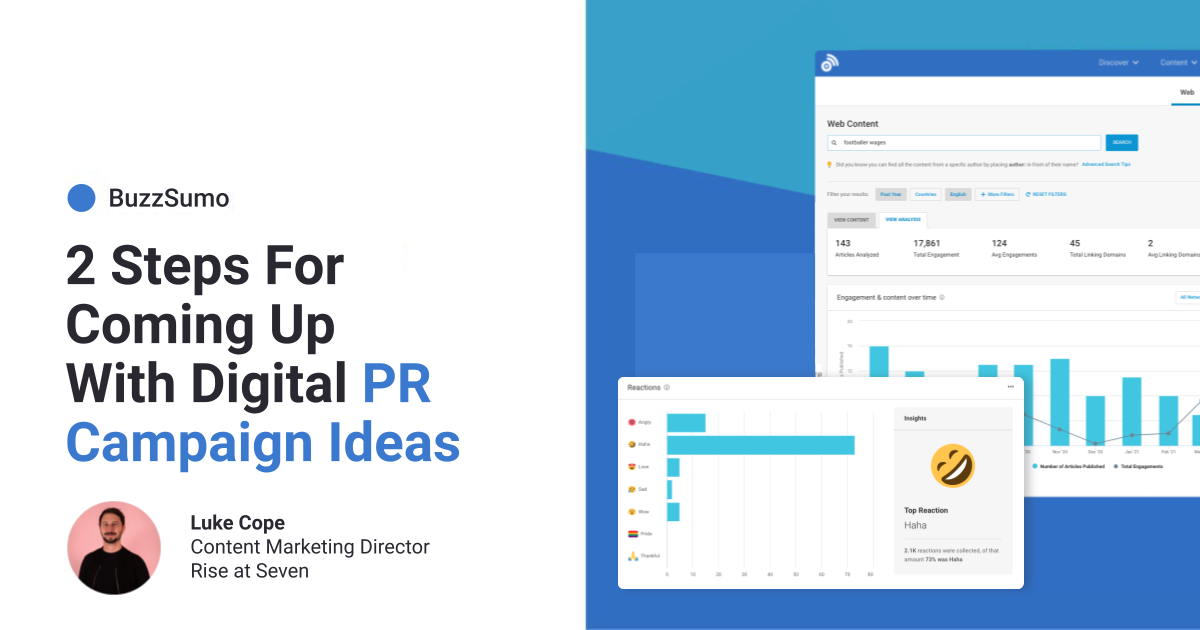
Tools like BuzzSumo’s Content Analysis Report become invaluable here. Beginning with a client’s core product area, such as "Honeymoons" for a travel brand, the research should strategically branch out to related, yet broader, terms like "Engagement rings" or "Weddings." This expansion continues until the themes become too far removed from the core offering. The objective is to identify a "sweet spot" – a core theme with significant, sustained coverage and high reader engagement. For instance, data might reveal that while "Honeymoons" has steady interest, "Weddings" generates a higher volume of articles and stronger average social shares, indicating a broader and more active audience. Similarly, delving into "Engagement Rings" might uncover content that consistently sparks discussions around aspiration, romance, or even financial considerations, pointing to potent emotional levers.
Expert Insights on Emotional Hooks:
Industry thought leaders frequently emphasize the psychological underpinnings of content virality. As one prominent digital PR strategist, Dr. Evelyn Reed, often states, "Information is forgettable; emotion is memorable. A campaign that successfully taps into joy, outrage, curiosity, or nostalgia doesn’t just inform; it incites action and conversation." Understanding the dominant emotions associated with a theme – whether it’s "awe" for celestial events, "frustration" for urban issues, or "aspiration" for luxury goods – provides critical guidance for crafting compelling narratives and visual assets.
Case Study: "A World Without Light Pollution"
Consider the campaign "What the most light-polluted cities in the world would look like without light pollution," developed for a brand selling star maps. The initial product theme, "Star maps," was too niche to sustain a broad campaign. Research then expanded:
- Secondary theme 1: Supermoons: High social engagement, offered reactive PR opportunities.
- Secondary theme 2: Night Sky: Consistent high social engagement.
- Secondary theme 3: Light Pollution: This theme proved to be a goldmine. BuzzSumo analysis revealed it was not only consistently discussed but experiencing a surge in public interest. Timely events, such as SpaceX satellite launches contributing to increased orbital debris and light interference, coupled with the broader conversation around environmental pollution during the COVID-19 pandemic, created a critical window of opportunity.
The content analysis also revealed that articles on light pollution typically evoked either profound sadness (at the loss of natural beauty) or a strong "wow factor" (imagining pristine night skies). This dual emotional spectrum provided clear angles for outreach. The campaign needed to be highly visual to achieve the "wow factor" and intellectually stimulating to make people ponder the impact of light pollution. This data-driven insight validated the campaign’s core concept and its emotional resonance, confirming it was the opportune moment for launch.
Case Study: The "Footballer Car Cost Calculator"
Another illustrative example involved a client specializing in private number plates. The core product theme offered some humorous content but lacked the gravitas for a major campaign. Expanding the research led to aspirational lifestyle themes:
- Secondary theme 1: Celebrity Cars: Generated numerous articles.
- Secondary theme 2: Footballers’ Cars: Showed a significant volume of content and, crucially, a high level of contentious reactions in the comments sections of articles.
Diving deeper into these comments, the PR team observed a consistent pattern: readers were often "mad," expressing frustration, envy, or competitive one-upmanship. This insight was transformative. The idea emerged to create a literal comparison tool – a calculator that would allow individuals to measure their own earnings against the cost of a footballer’s car. This concept directly tapped into the identified emotions of frustration and competitiveness, offering a tangible, interactive experience that validated the campaign’s potential for high engagement and media interest.
Successfully navigating this first step means emerging with a clear understanding of trending themes and the emotional levers that can be pulled, providing a robust, data-backed foundation for campaign development.
Step 2: Optimizing Format and Adding Strategic Depth
An exceptional idea, no matter how compelling, can fall flat if delivered in the wrong format or without sufficient depth. The second crucial step involves meticulously selecting the optimal medium for your message and then enriching that message with layers of data, angles, and interactivity to maximize its impact. The format should not merely present information; it should enhance the emotional experience and facilitate the sharing and understanding of the core message.
The Power of Format:
The "light pollution" campaign, for instance, would have been significantly less impactful as a simple blog post. Its strength lay in its visual nature. The core idea – redesigned skylines – was elevated by a simple "before-and-after" slider code, adding an interactive element that allowed users to actively participate in the "wow factor." This interactivity is not a mere gimmick; studies show that interactive content often generates double the engagement rates of static content, fostering a deeper connection with the audience.
Adding Layers of Depth and Multiple Angles:
Beyond the chosen format, adding layers of depth and developing multiple outreach angles is paramount. A single, strong angle is a good start, but a multi-faceted approach ensures broader appeal and longevity for the campaign. For the light pollution campaign, the initial strong angle highlighted that "85% of Americans had never seen the Milky Way." This immediately resonated with a sense of lost natural wonder. To deepen this, statistics from the Bortle scale (a measure of sky darkness) were integrated, illustrating the stark contrast between the most light-polluted cities (Bortle 10) and their potential appearance as pristine, Bortle 1 skies. Furthermore, while the initial focus might have been the USA, recognizing light pollution as a global issue prompted the expansion of the campaign to include international cities, broadening its relevance and potential media reach.
Case Study: "Touch the Germs" (Implied from original image and context)
Another powerful example, a campaign visualizing germs on public transport, could have been a basic infographic or data list. However, the team went significantly further by incorporating an interactive "microscope function." This allowed users to zoom in and explore the unseen world of bacteria, transforming a factual presentation into an immersive and somewhat unsettling experience. The innovative format and depth of this campaign not only garnered a high volume of backlinks but also attracted the attention of high-profile figures, including the Mayor of London, who commented on the issue. This demonstrates how a well-executed format can elevate a campaign from informative to influential, driving policy discussions and significant public discourse.
Critique and Enhancement: "Who Owns All the Space Junk?" (Aira Campaign)
Even well-executed campaigns can present opportunities for further enrichment. Aira’s campaign on "space junk" featured a commendable visualization of the problem. However, this vast and complex topic had potential for even greater depth. While it effectively presented "who owns all the space junk," additional layers could have been explored:
- Types of Space Junk: Categorizing debris (e.g., defunct satellites, rocket stages, mission-related debris) to illustrate the varied nature of the problem.
- Historical Timeline: Visualizing the accumulation of space junk from the 1960s to the present, demonstrating the escalating challenge.
- Future Projections: Modeling what the orbital environment might look like in 10, 50, or 100 years without intervention, highlighting potential collision risks and their implications for future space exploration.
- Interactive Orbit Map: Allowing users to explore the actual orbits of significant debris, adding a tangible, real-time dimension.
These additions would have transformed an already good piece into an exceptional, highly interactive resource, offering more angles for journalists specializing in science, technology, and environmental issues.
Simplicity as a Virtue: "iPods Visualized as Vinyl"
Conversely, impactful formats don’t always require complex interactivity. Mark Johnstone’s simple yet brilliant campaign visualizing iPods as vinyl records leveraged nostalgia and aesthetic appeal. This format, a series of striking static images, was perfect for its target audience of music and design enthusiasts. Its power lay in its conceptual elegance and immediate visual impact, proving that sometimes, simplicity, when perfectly aligned with theme and emotion, can be profoundly effective.
Depth in Data-Driven Angles: The "Footballer Car Calculator" Revisited
The footballer car calculator, while interactive, also benefited immensely from generating numerous data-driven angles. By comparing weekly wages to car costs, the campaign could produce headlines such as:
- "How Many Years Would It Take an Average Worker to Afford [Famous Footballer]’s Car?"
- "The Most Outrageous Car Purchases by Premier League Stars Revealed."
- "Are Footballers’ Wages Inflating the Luxury Car Market?"
These angles provided diverse entry points for journalists covering finance, sports, lifestyle, and consumer news, ensuring broad media uptake.
Strategic Implementation and Broader Implications
The synthesis of resonant themes, emotional triggers, optimized formats, and strategic depth forms a powerful blueprint for PR success. However, the application of this blueprint extends beyond mere ideation.
Optimizing Outreach with Research:
The initial research into themes and emotions is not just for idea generation; it’s a goldmine for outreach. By exporting lists of journalists and publications that have consistently covered your identified themes, PR professionals can create highly targeted seeding lists. Tools like BuzzSumo’s Journalist Profiles allow for saving relevant contacts and exporting their details, ensuring that pitches are sent to individuals already demonstrating an interest in the campaign’s subject matter. This significantly increases the relevance of outreach, improving open rates and ultimately, securing coverage. Research consistently shows that personalized, relevant pitches are exponentially more effective than mass mailings, underscoring the value of data-informed journalist targeting.
Securing Stakeholder Buy-in:
One of the most persistent challenges in PR is securing internal buy-in for creative campaigns. Ideas can be subjective, leading to disagreements between PR teams, clients, and senior management. The data-driven approach outlined here effectively removes much of this subjectivity. By presenting a comprehensive report on content engagement, emotional sentiment analysis, and theme consistency, PR professionals can provide objective evidence of an idea’s potential. Packaging the findings from the initial research phase into a concise, data-rich proposal builds confidence and facilitates faster, more informed decision-making, ensuring that resources are allocated to campaigns with the highest likelihood of success.
Long-term Impact and Brand Building:
Consistently executing data-backed campaigns does more than just secure short-term media hits. It contributes significantly to long-term brand building, establishes thought leadership, and can even influence SEO through high-quality backlinks. Brands that are perceived as insightful, innovative, and responsive to public sentiment gain credibility and authority. Moreover, by continuously analyzing content performance and audience reactions, PR strategies can evolve, becoming more refined and impactful over time, fostering a cycle of continuous improvement.
Conclusion
In an increasingly fragmented and content-saturated world, the era of purely intuitive PR is giving way to a more scientific, data-driven approach. Successful PR campaigns are not born from chance but from meticulous research into resonant themes and emotional drivers, coupled with strategic decisions about format and depth. By systematically exploring content landscapes, identifying prevailing sentiments, and then crafting interactive, multi-angled narratives delivered through optimal mediums, PR professionals can drastically increase the efficacy and impact of their work. This two-step blueprint – understanding themes and emotions, then optimizing format and depth – provides a robust framework for consistently developing campaigns that not only achieve media coverage and social engagement but also contribute meaningfully to a brand’s strategic objectives and long-term reputation.