The global artificial intelligence landscape has reached a critical juncture where the focus is shifting from raw model parameters to the efficiency of real-time inference. DeepSeek, the high-profile Chinese AI research laboratory, has addressed this challenge head-on with the introduction of DSpark, a specialized module designed to integrate speculative decoding into the DeepSeek-V4 architecture. While initially appearing as a technical refinement for developers, the implementation of DSpark in production environments has demonstrated a transformative impact on performance, boosting per-user generation speeds by 60 to 85 percent without any measurable degradation in model quality.
This development comes at a time when Large Language Model (LLM) providers are facing mounting pressure to reduce latency and operational costs. DSpark distinguishes itself from previous optimization attempts by simultaneously addressing two of the most persistent bottlenecks in speculative decoding: the low quality of draft predictions and the computational waste associated with verifying those drafts. By refining the relationship between the small "draft" model and the large "target" model, DeepSeek has established a new benchmark for high-throughput AI serving.
The Evolution of Speculative Decoding in LLM Architectures
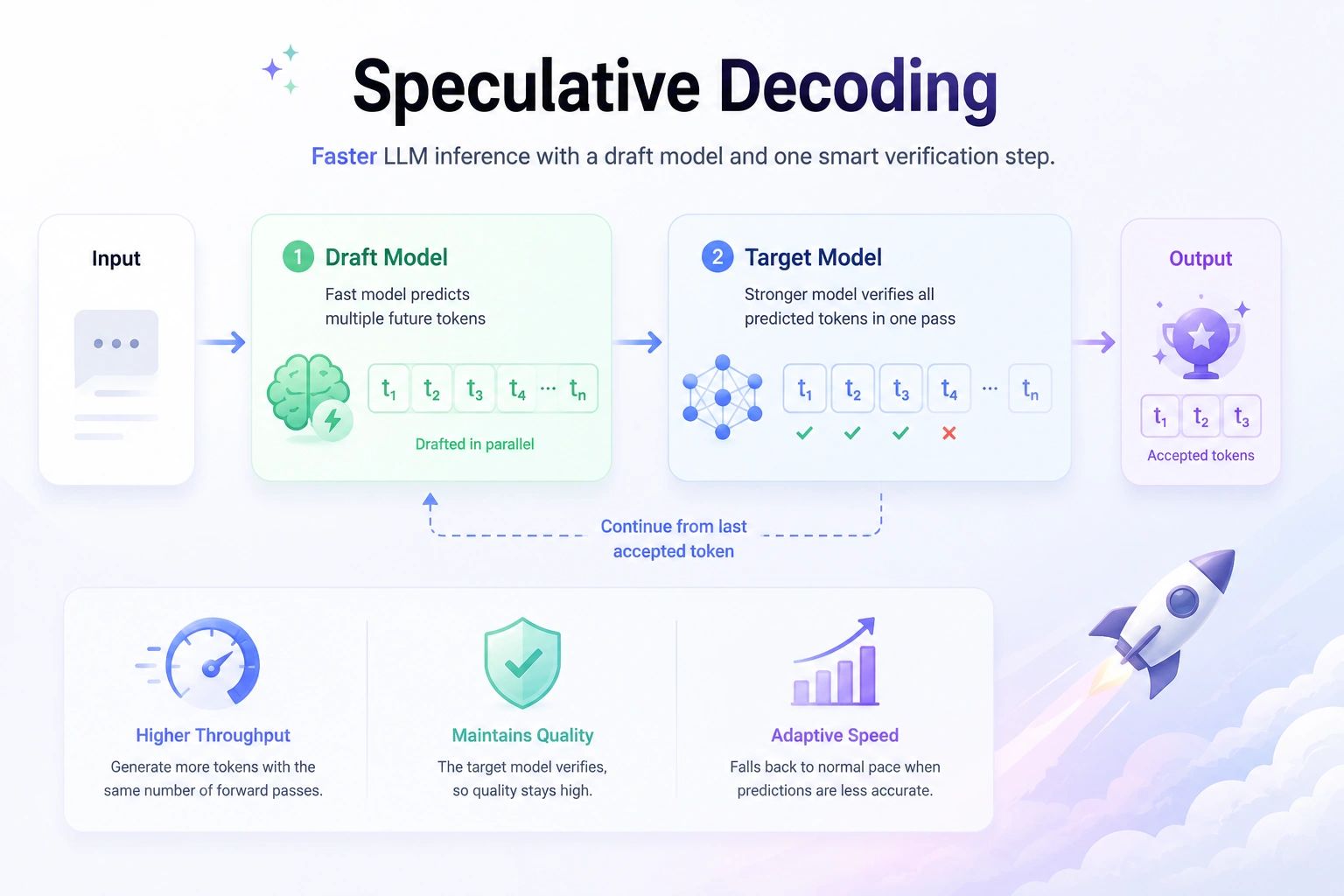
To understand the significance of DSpark, one must first examine the standard mechanics of LLM generation. Traditionally, LLMs function through an autoregressive process, meaning they generate one token (a word or piece of a word) at a time. Each new token requires a complete forward pass through the entire neural network. For massive models like DeepSeek-V4, this process is computationally expensive and introduces significant latency, as the hardware must wait for each sequential calculation to finish before starting the next.
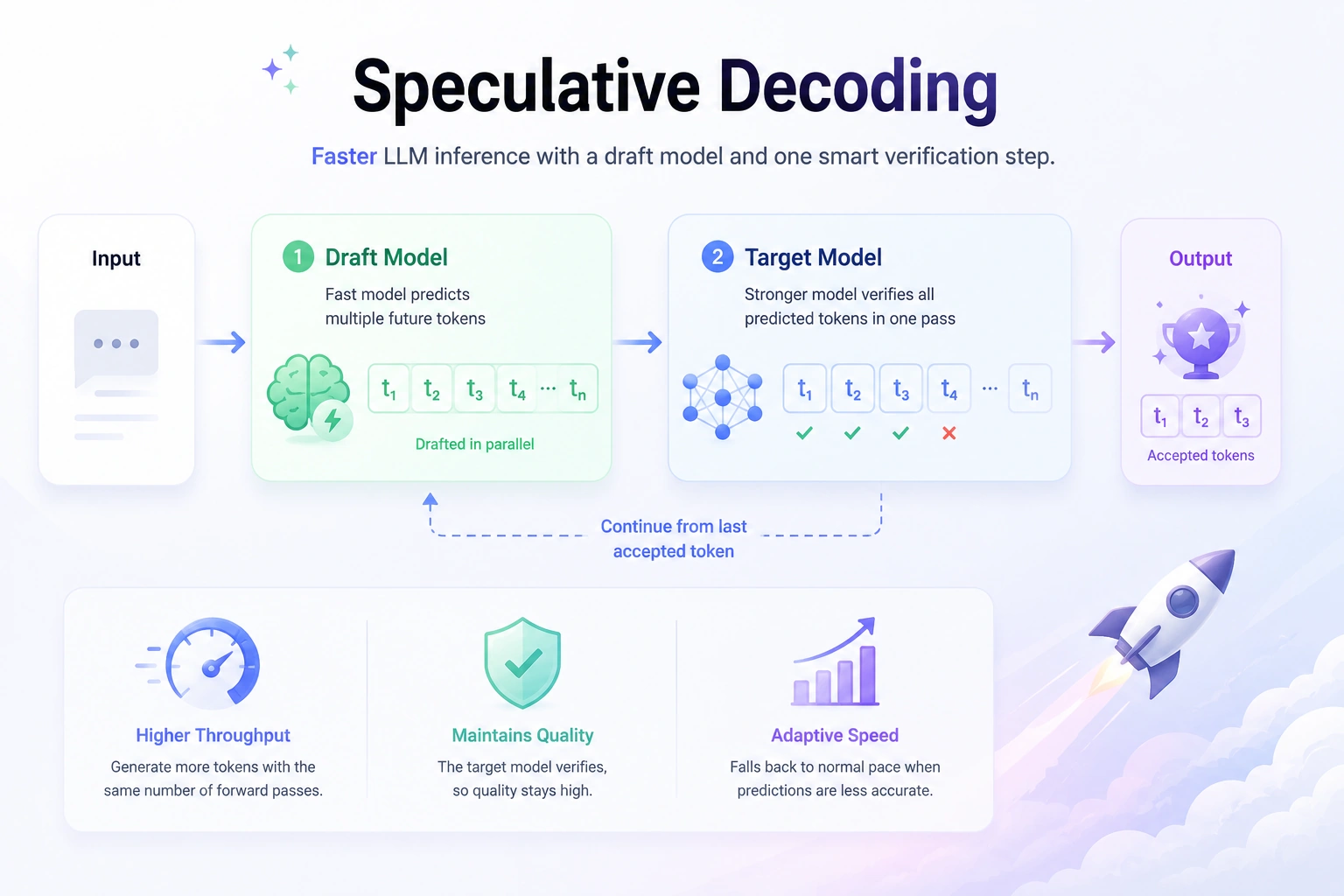
Speculative decoding was introduced as a solution to this linear bottleneck. The process involves a two-model system: a smaller, faster "draft" model and a larger, more capable "target" model. The draft model "speculates" or guesses a sequence of future tokens. The target model then reviews this entire block of tokens in a single forward pass. If the draft model’s predictions align with the target model’s probability distribution, multiple tokens are accepted at once, drastically reducing the total number of forward passes required.
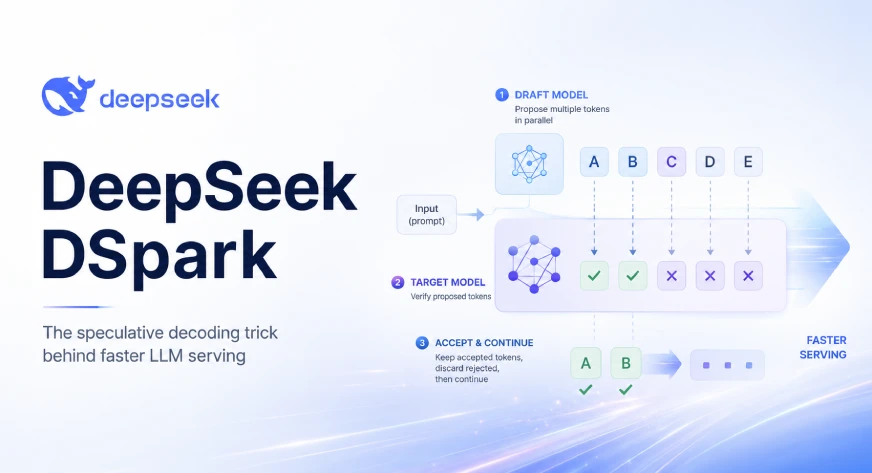
However, historical implementations of speculative decoding have often struggled with a trade-off between speed and accuracy. If a draft model is too simple, its predictions are frequently rejected, leading to wasted computational cycles. Conversely, if the draft model is too complex, the time saved during verification is lost during the drafting phase. DSpark addresses this via a novel "Semi-Autoregressive" approach.
Chronology of Development and the Path to DeepSeek-V4
The journey toward DSpark began with the industry’s realization that standard speculative decoding methods like Eagle and DFlash were reaching their limits. In early 2023, Google and other research institutions popularized basic speculative decoding, but these methods relied on draft models that were either too slow (because they were fully autoregressive) or too inaccurate (because they were fully parallel).
DeepSeek’s research team spent much of late 2023 and early 2024 experimenting with hybrid architectures. Their goal was to create a drafting mechanism that could capture the linguistic dependencies of a sentence while maintaining the speed of a parallel processor. This led to the development of the DeepSpec framework, the underlying training infrastructure for DSpark. By the time DeepSeek-V4 was ready for production, the DSpark module had been refined to include a "Markov head" structure, which the team found provided the optimal balance of complexity and performance.
The release of the DeepSpec repository on GitHub marks the latest step in this timeline, providing the global AI community with the tools to reproduce DeepSeek’s results and apply these efficiency gains to other model families, including Alibaba’s Qwen and Google’s Gemma.
Technical Innovation: The Semi-Autoregressive Drafting Model
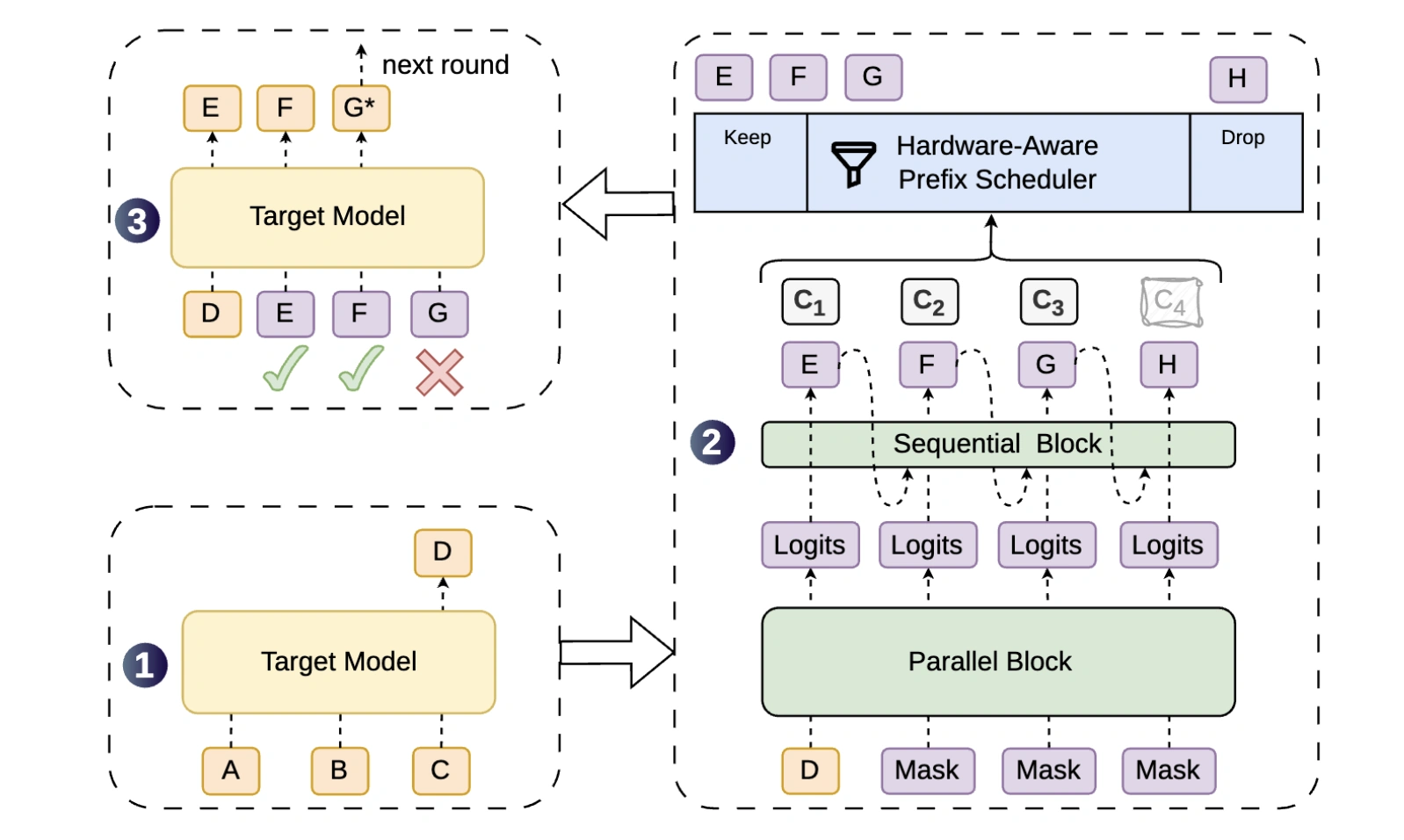
The core innovation of DSpark lies in its semi-autoregressive structure. In a traditional autoregressive context, such as the Eagle3 model, every token is conditioned on every previous token. While accurate, this creates a linear increase in latency. On the other end of the spectrum, parallel models like DFlash attempt to generate an entire block of tokens simultaneously. While fast, this often results in "hallucinated" sequences where individual words make sense in isolation but fail to form a coherent phrase.
DSpark bridges this gap by utilizing a largely parallel structure for raw speed, supplemented by a thin layer of sequencing. This layer adds local dependencies between tokens, ensuring that the draft sequence remains linguistically sound. During its research phase, DeepSeek tested two primary sequencing structures:
- Recurrent Neural Network (RNN) Heads: These offered high accuracy but added significant implementation complexity.
- Markov Heads: These utilized a simpler dependency chain that DeepSeek found captured nearly all the benefits of the RNN approach with far less overhead.
The Markov head was ultimately selected for the production version of DSpark. By focusing on local dependencies, the model avoids the "incoherence" trap. For example, where a parallel model might suggest the nonsensical phrase "of problem," the DSpark module recognizes the statistical dependency between words to suggest more likely sequences like "of course" or "no problem."
Comparative Performance and Benchmarking Data
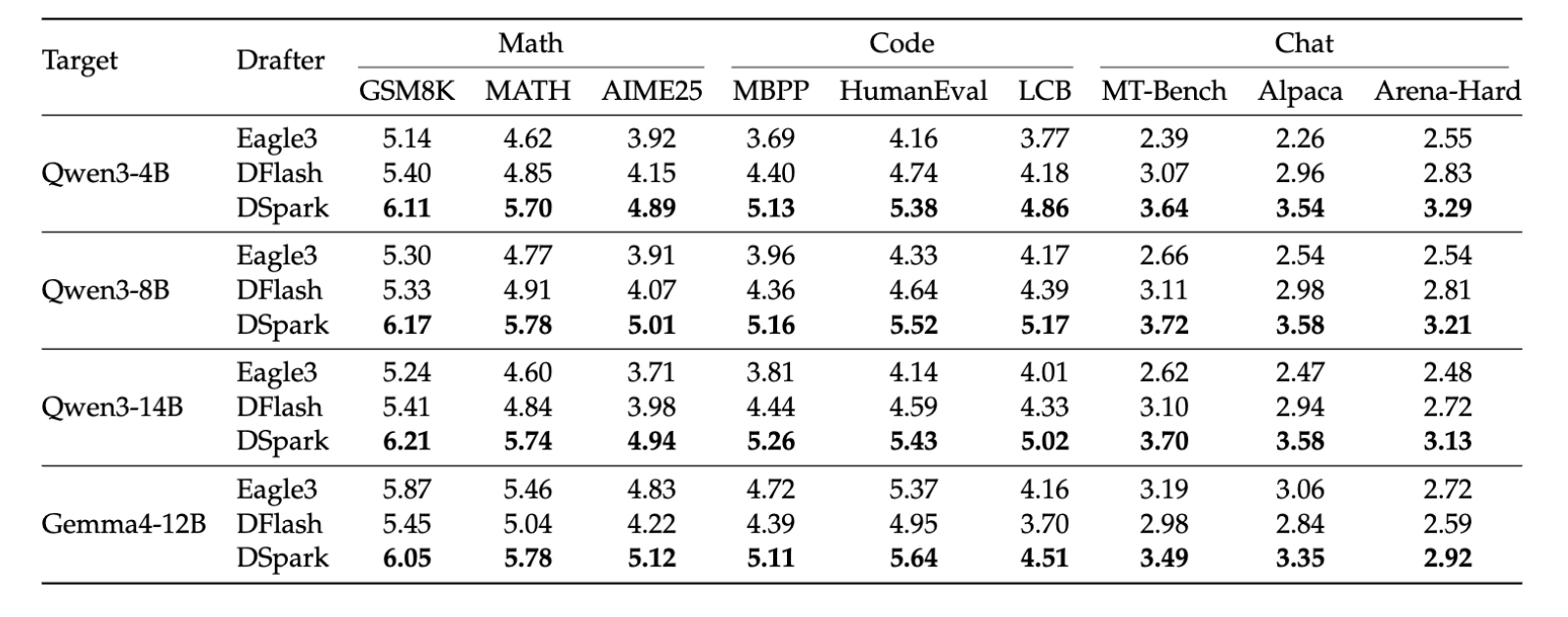
The efficacy of DSpark is supported by extensive benchmarking across multiple model families. DeepSeek’s internal data, which has been verified through open-source evaluations, shows that DSpark consistently outperforms its predecessors.
In tests involving the Qwen3-4B, 8B, and 14B models, DSpark achieved an "accepted length" (the number of tokens successfully predicted and verified per pass) that was 27% to 31% higher than Eagle3. When compared to the parallel DFlash model, DSpark showed an improvement of 16% to 18%.
Crucially, these gains were not limited to DeepSeek’s internal architectures. When applied to Google’s Gemma4-12B, the DSpark framework showed similar improvements. This cross-family performance suggests that DSpark’s methodology is a fundamental improvement in inference logic rather than a model-specific "tweak." The results remained consistent across three primary task types:
- Mathematical Reasoning: Where precise token sequences are critical for logic.
- Code Generation: Where syntax dependencies are highly structured.
- General Chat: Where linguistic fluidity is the primary metric.
Implementation and the DeepSpec Framework
To facilitate widespread adoption, DeepSeek has open-sourced the training and evaluation code under the "DeepSpec" name. This repository allows developers to train draft models for DSpark, DFlash, and Eagle3 architectures. The workflow for implementing DSpark involves three distinct stages: data preparation, model training, and rigorous evaluation.
During the training phase, DSpark utilizes a multi-faceted loss function. It optimizes for the standard language modeling loss (Cross-Entropy), a "distillation loss" that aligns the draft model with the target model’s distribution, and a "speculative-aware loss." This third component is vital, as it trains the model to understand its own confidence levels, which feeds into the system’s scheduling logic.
A unique feature of the DSpark implementation is the "scheduling trick." In production environments, GPU resources are often constrained by high request volumes. DSpark’s scheduler is designed to only verify token sequences that have a "positive expected value." If the draft model’s confidence in a particular sequence is low, the system will bypass the verification step for those tokens to save cycles, ensuring that the target model is only used when it is likely to result in a speedup.
Broader Industry Implications and Future Outlook
The introduction of DSpark signals a broader shift in the AI industry toward "inference-time scaling." As the cost of training massive models continues to climb, the ability to serve those models efficiently becomes a primary competitive advantage. DeepSeek’s decision to open-source the DeepSpec framework suggests a strategic move to position its architecture as the industry standard for efficient LLM deployment.
Industry analysts suggest that DSpark could have a significant impact on the "Inference-as-a-Service" market. Companies like Groq, Fireworks AI, and Together AI, which compete on tokens-per-second metrics, may look to integrate semi-autoregressive drafting techniques to further optimize their hardware utilization. Furthermore, the 60-85% speed increase reported by DeepSeek could effectively lower the entry barrier for enterprises looking to deploy large-scale AI agents that require near-instantaneous response times.
The success of the Markov head over more complex RNN structures also highlights a growing trend in AI research: the preference for "simple and scalable" over "complex and bespoke." By proving that a thin layer of local dependencies is sufficient to stabilize speculative decoding, DeepSeek has provided a blueprint for future optimizations.
As DeepSeek-V4 continues its rollout, the focus will likely turn to how DSpark handles multi-modal inputs and extremely long context windows. For now, the module stands as a significant achievement in the quest for real-time, high-quality AI interaction. The DSpark framework demonstrates that sometimes the most significant leaps in technology come not from increasing the size of the engine, but from optimizing the way the fuel is delivered.