The digital communication landscape in 2026 presents a stark dichotomy for email marketing: while the channel remains undeniably central to organizational success, a significant and widening chasm separates programs that actively invest in robust measurement, deliverability optimization, and cutting-edge technology from those operating on outdated assumptions. This critical insight emerges from Sinch Mailgun’s comprehensive 2026 Email Impact Report, a seminal study drawing on a global survey of over 1,200 email senders and an unprecedented analysis of more than 400 billion real emails processed through Sinch Mailgun infrastructure during 2025. The report, structured across five detailed chapters, meticulously dissects the intricate dynamics of email ROI, industry benchmarks, deliverability trends, the burgeoning adoption of Artificial intelligence (AI), and future investment priorities, offering a definitive roadmap for email senders navigating the complexities of the second half of 2026.
The Enduring Power of Email and the ROI Measurement Gap
Email’s foundational importance to organizations continues unabated into 2026, with a resounding 78% of surveyed senders categorizing it as "very" or "extremely" important. This near-universal organizational belief underscores email’s unparalleled reach and effectiveness in direct communication, customer engagement, and transactional messaging. Such a high level of buy-in is a rarity for any marketing channel, attesting to email’s enduring strategic value in a fragmented digital ecosystem.
However, the report immediately pivots from belief to evidence, revealing a concerning disconnect: fewer than half of senders actively measure the return on investment (ROI) of their email programs. Specifically, only 46% track promotional email ROI, and a mere 43% measure transactional email ROI. This data suggests that a substantial majority of marketing teams are operating on conviction rather than empirical evidence, a precarious position in an era increasingly demanding accountability and data-backed decision-making. The implications of this measurement gap are profound. Without clear ROI data, email programs risk underinvestment, misallocation of resources, and an inability to articulate their full value to stakeholders. This often translates into budget constraints, cited by 43% of senders as the biggest impediment to increased email investment, creating a self-perpetuating cycle where lack of data prevents budget acquisition, which in turn limits investment in measurement tools.
For those who do measure, the returns are compelling. A significant 60% of senders tracking promotional email ROI report returns exceeding $10 for every $1 spent, with 13% achieving an impressive ROI of over $40:1. Similarly, 62% of those measuring transactional email ROI also report surpassing the $10:1 threshold, with 13% again seeing returns above $40:1. While these figures highlight email’s immense potential, Sinch Mailgun’s analysis suggests that an ROI consistently above $40:1 might, counterintuitively, signal underinvestment rather than peak efficiency. This could imply that these highly successful programs are not scaling their efforts sufficiently, potentially leaving substantial revenue on the table by not capitalizing further on proven strategies. The report advocates for an intermediate step for organizations struggling with full ROI tracking: beginning with revenue per campaign. Even with an imperfect attribution model, this initial data point can provide the crucial evidence needed to advocate for greater investment and build momentum towards more sophisticated measurement.
Unveiling True Performance: Benchmarks from 400 Billion Emails
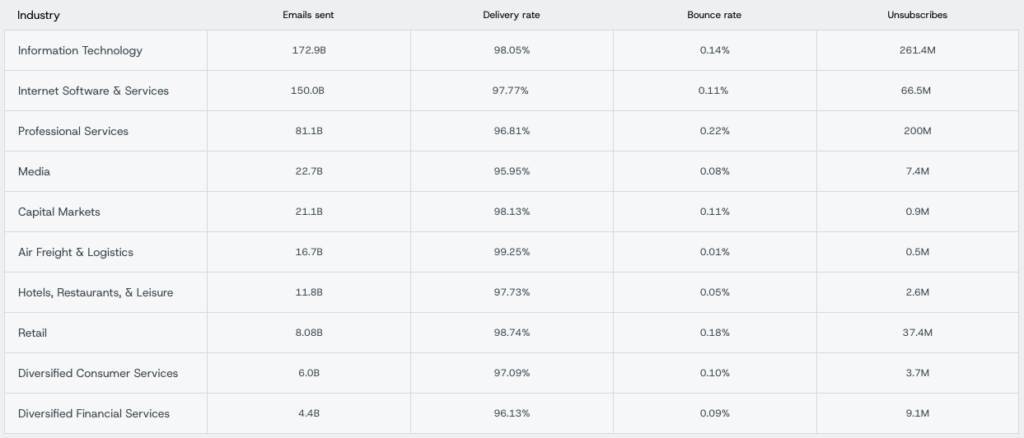
A cornerstone of the 2026 Email Impact Report is its unprecedented approach to industry benchmarks. Unlike many industry reports that rely on self-reported estimates or survey data, Chapter 2 of this report leverages real sending data from Sinch Mailgun’s infrastructure, analyzing 400 billion emails across the top 10 industries by volume in 2025. This methodological rigor provides an authentic, granular view of email performance, cutting through anecdotal evidence to establish concrete industry standards.
The data reveals significant performance disparities across sectors. The Air Freight & Logistics industry leads with an exceptional 99.25% delivery rate and a minuscule 0.01% bounce rate. This superior performance is largely attributable to the nature of their email communications: predominantly transactional sends (e.g., shipping confirmations, tracking updates) sent to recipients who not only expect but actively desire these messages. The high anticipation and critical nature of such emails ensure high engagement and low spam complaints.

In contrast, the Media industry registers the lowest delivery rate among the top 10, at 95.95%. This can be explained by the high volumes of promotional content and broader audience targeting inherent to media organizations, which naturally exert downward pressure on delivery metrics due to increased likelihood of spam complaints or filtering.
However, the report issues a crucial caveat: delivery rate alone can be misleading. An email "delivered" to a spam folder still technically counts as delivered by many metrics. Therefore, the report strongly emphasizes the necessity of pairing delivery rate tracking with inbox placement testing. This dual approach provides a far more accurate understanding of where emails are truly landing, ensuring that messages are not just accepted by mail servers but actually reach the intended recipient’s primary inbox, thereby maximizing visibility and engagement.
Further analysis of unsubscribe rates highlights the importance of contextual data. Information Technology, despite logging the highest raw number of unsubscribes at 261 million, demonstrated a relatively low unsubscribe rate of approximately 0.15% when viewed against its massive 172.9 billion sends. Conversely, the Retail sector generated 37.4 million unsubscribes from a much smaller volume of 8.08 billion sends, resulting in a significantly higher rate per email. This comparison unequivocally demonstrates that raw unsubscribe volume without the critical context of send volume is meaningless for performance evaluation, reinforcing the need for sophisticated data analysis.
The Deliverability Paradox: Progress in Infrastructure, Stagnation in Understanding
Deliverability remains a paramount concern for email senders, with 89% affirming its importance to their organization. Encouragingly, 43% report an improvement in their inbox placement over the past 12 months, signaling genuine progress in the underlying email infrastructure and practices. A key driver of this improvement is the significant growth in DMARC (Domain-based Message Authentication, Reporting, and Conformance) adoption. Mandates and strong encouragement from major email service providers like Gmail, Yahoo, and Microsoft have accelerated this trend. For the first time in Sinch Mailgun’s research, DMARC enforcement is outpacing passive monitoring, with over half of DMARC adopters now implementing "quarantine" or "reject" policies, which actively prevent unauthorized use of a domain and significantly enhance email security and sender reputation. The report’s visual data illustrates this upward trajectory: DMARC adoption grew from 43% in 2023 to 54% in 2024, reaching 61% in 2025, a clear indication of industry-wide movement towards more secure email practices.
Despite this infrastructural advancement, a critical "knowledge gap" persists. The report highlights that 36% of senders erroneously claim to monitor an "email deliverability rate," a metric that, by definition, does not exist in a meaningful way. This confusion underscores a fundamental misunderstanding of key concepts. As previously noted, the "delivery rate" merely indicates server acceptance, while "inbox placement" measures actual arrival in the inbox. Worryingly, only 25% of senders consistently run inbox placement tests to ascertain where their emails truly land. Furthermore, 27% of DMARC users are unaware of the specific policy they have implemented, signaling a lack of engagement with crucial security configurations. This disparity between the availability of advanced tools and the understanding of their application represents a significant challenge for the industry. While the technical infrastructure for better deliverability is improving, the literacy and strategic implementation among senders are lagging, potentially undermining the benefits of these advancements. Industry experts suggest that greater educational initiatives and clearer guidance are essential to bridge this understanding gap, ensuring that marketers can fully leverage the tools at their disposal to optimize inbox placement.
AI’s Uneven Impact: From Experimentation to Strategic Integration
Artificial intelligence is rapidly permeating the email marketing landscape, with 79% of senders either currently using or planning to integrate AI into their programs. However, the report reveals that actual regular use remains relatively low at 27%, indicating that a significant portion of adopters are still in the experimental phase rather than systematically embedding AI into their daily workflows.
The most common applications of AI include copy generation (41%), content personalization (36%), dynamic content creation (29%), send time optimization (27%), and data analysis (27%). A clear pattern emerges from these applications: AI delivers the most substantial value when strategically integrated into decision-making processes, extending far beyond mere content production. Teams that leverage AI for sophisticated personalization, optimizing send times, and A/B testing report compounding returns, experiencing enhanced engagement and improved campaign performance. In contrast, teams limiting AI use to basic tasks like drafting subject lines or generating simple copy see a considerably more limited impact.
The report provides compelling evidence of AI’s performance-tiering effect: 54% of senders who have implemented AI reported moderate or significant year-over-year improvements in their email programs. This stands in stark contrast to only 37% of senders who are not using AI reporting similar improvements within the same timeframe. This 17-point differential, while not proving direct causation, strongly indicates that AI is becoming a significant differentiator, contributing to a widening performance gap between early adopters and those hesitant to integrate.
Intriguingly, 23% of AI users report that the technology has not helped them at all. The report’s analysis concludes that the divergence between those seeing value and those who are not lies not in the AI tool itself, but in the depth of its integration. Superficial use yields superficial results, whereas embedding AI into core strategic functions—from audience segmentation and content creation to predictive analytics and optimization—unlocks its transformative potential. This finding serves as a crucial lesson for organizations: simply adopting AI is insufficient; strategic implementation and continuous learning are paramount to realizing its full benefits.
Strategic Priorities and the Future of Email Investment
Looking ahead to 2026, the top strategic priorities for email senders are clearly defined. "Taking advantage of AI" and "increasing email engagement" are tied as the foremost goals, each cited by 40% of senders. This dual focus underscores a clear understanding that AI is not just a technological trend but a powerful enabler for achieving deeper audience engagement.
Regarding investment, the outlook for email marketing remains largely stable yet cautiously optimistic. Approximately 31% of senders plan to increase their email investment, reflecting confidence in the channel’s ROI and its potential for growth. A substantial 48% intend to maintain their current spending levels, suggesting a steady allocation of resources to a proven channel. Only a small minority, 7%, plan to decrease their email investment, indicating that despite evolving digital trends, email’s core value proposition remains strong.
The report’s overarching conclusion is unequivocal: email works. The extensive data on ROI, industry benchmarks, and deliverability trends consistently supports this assertion. However, the future success of email programs will hinge on a tripartite investment strategy focused on:
- Measurement: Moving beyond assumptions to prove ROI with real, actionable data. This involves investing in analytics tools, attribution models, and the expertise to interpret data effectively.
- Deliverability: Consistently reaching the inbox through robust authentication (e.g., DMARC), meticulous list hygiene, and continuous monitoring of sender reputation and inbox placement. This requires a proactive approach to email health.
- Optimization: Leveraging advanced technologies like AI and systematic A/B testing to continuously improve performance at scale. This involves personalizing content, optimizing send times, and refining strategies based on empirical feedback.
The report thoughtfully emphasizes that none of these crucial areas necessitates an exorbitant budget to initiate. Rather, strategic, incremental investments in these domains will compound over time, leading to significant and sustained improvements in email program effectiveness and, ultimately, enhanced business outcomes. As the digital marketing landscape continues to evolve, the ability to measure, deliver, and optimize email campaigns will increasingly define the leaders from the laggards, solidifying email’s position as a powerful, data-driven engine for growth.