


The primary hurdle for modern enterprises is no longer the technical complexity of the tools, but rather the strategic selection of software that balances simplicity with the sophisticated reliability required to scale. This guide explores the state of A/B testing in 2026, detailing the essential features for beginners and providing a comprehensive analysis of the leading platforms currently shaping the market.
The Fundamental Concept of A/B Testing in 2026
A/B testing, often referred to as split testing, is a method of conducting controlled experiments where two or more versions of a digital asset—such as a webpage, mobile app interface, or specific call-to-action—are shown to different segments of users simultaneously. By comparing Version A (the control) against Version B (the variation), organizations can determine which version performs better based on specific, measurable goals such as click-through rates, lead generation, or completed purchases.
The value of this methodology lies in its ability to eliminate guesswork from the design and marketing process. Instead of relying on subjective opinions or “best practices” that may not apply to a specific audience, businesses use empirical evidence to refine their digital presence. In 2026, this process has been augmented by Artificial Intelligence (AI), which assists in hypothesis generation and the automated identification of winning variations.
A Chronology of Experimentation: From Manual Code to AI Autonomy
The journey of A/B testing technology has undergone several distinct phases that have led to the current “beginner-friendly” era:

- The Manual Era (Pre-2010): Testing was largely a manual process requiring developers to hard-code different versions of pages and statisticians to manually calculate significance.
- The SaaS Revolution (2010–2020): Platforms like VWO and Optimizely introduced visual editors, allowing marketers to make front-end changes without deep coding knowledge.
- The Integrated Insights Phase (2021–2024): Tools began integrating quantitative testing with qualitative behavioral data, such as heatmaps and session recordings, to explain the “why” behind the “what.”
- The AI-Driven Era (2025–Present): In 2026, the focus has shifted toward “Agentic AI,” where software can autonomously suggest variations, predict outcomes, and even deploy winning changes in real-time.
Essential Features for Modern Beginner-Friendly Software
For a platform to be considered suitable for beginners in 2026, it must reduce the “time to insight” by removing technical barriers. Industry analysts point to seven critical features that define a high-quality starter tool:
1. No-Code Visual Editors
The cornerstone of beginner software is a WYSIWYG (What You See Is What You Get) editor. Users must be able to click on elements of a live page to change text, swap images, or adjust button colors without interacting with the underlying source code.
2. Streamlined Goal Setting and Traffic Splitting
Effective tools guide the user through a logical setup wizard. This includes defining the primary conversion metric (e.g., revenue or sign-ups) and automatically dividing incoming traffic between the control and variation to ensure a fair test.
3. “Push-to-Live” Capabilities
A common bottleneck in experimentation is the delay between finding a winner and the engineering team implementing the change. Features like “VWO Deploy” allow non-technical users to push the winning variation to 100% of live traffic instantly, maintaining conversion momentum while waiting for a permanent code update.
4. Automated Statistical Guidance
Beginners often struggle with the concept of “statistical significance.” Modern tools use sequential testing and clear visual indicators to tell the user exactly when a result is reliable and when more data is needed, preventing premature conclusions based on “noise” rather than “signal.”

5. Advanced Pre-Test Segmentation
The ability to target specific audiences—such as mobile users in a particular geographic region—is now a standard feature. Segmentation ensures that experiments are relevant to the specific user journey being optimized.
6. Integrated Behavioral Analytics
Numbers alone rarely tell the full story. By integrating heatmaps and session recordings directly into the A/B testing dashboard, users can see exactly how visitors interacted with a new layout, providing the context necessary for the next round of testing.
7. AI-Powered Automation
In 2026, AI is no longer a luxury. Leading tools now offer AI assistants that can generate hypotheses based on existing page data, write alternative headlines, and summarize complex test results into actionable executive summaries.
The 2026 Market Landscape: A Comparison of Leading Tools
Selecting the right software requires an understanding of the specific needs of the organization. The following platforms represent the best-in-class options for teams entering the experimentation space.
VWO (Visual Website Optimizer)
VWO remains a dominant force in 2026 by offering a platform that scales with the user. It is widely regarded as the most comprehensive “all-in-one” solution.
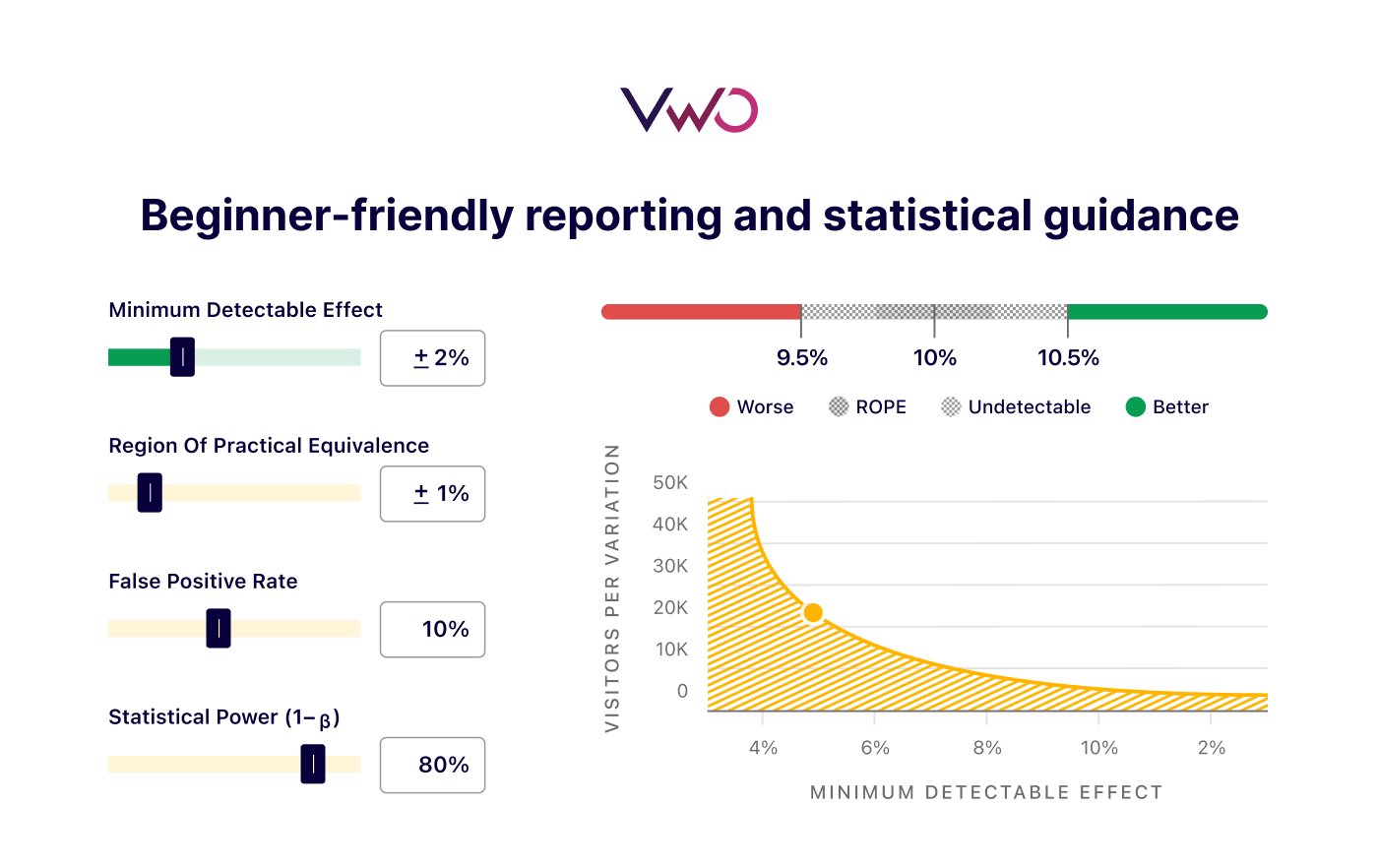
- Best Fit: Teams looking for a tool that starts simple but offers deep enterprise-level capabilities as they grow.
- Key Advantage: Its “VWO AI” suite automates everything from hypothesis creation to audience segmentation.
- Case Study: Shockbyte, a game server provider, utilized VWO to simplify its homepage. By focusing the hero section on their primary product rather than a broad array of options, they achieved a 23.25% increase in clicks to product pages.
Zoho PageSense
Part of the broader Zoho ecosystem, PageSense is an accessible entry point for small businesses already utilizing other Zoho products.
- Best Fit: Small marketing teams on a strict budget.
- Key Advantage: It offers a “Forever Free” tier for up to 5,000 monthly tracked users (MTU), making it ideal for low-traffic startups.
Convert
Convert has carved out a niche by focusing on privacy-first testing and high-speed performance.
- Best Fit: Agencies and mid-sized teams that require advanced testing without the high price tag of legacy enterprise software.
- Key Advantage: It is designed to be flicker-free and highly compliant with global data privacy regulations (GDPR/CCPA).
Unbounce
While primarily known as a landing page builder, Unbounce’s testing capabilities are optimized for paid search and social media campaigns.
- Best Fit: Performance marketers focused on maximizing ROI from advertising spend.
- Key Advantage: Its “Smart Traffic” feature uses AI to automatically route visitors to the variation where they are most likely to convert.
Crazy Egg
Crazy Egg continues to lead in visual optimization, prioritizing behavioral data as the starting point for any test.
- Best Fit: Beginners who want to “see” what users are doing before they start changing elements.
- Key Advantage: Exceptional heatmap and “confetti” report visualizations that make data easy to interpret for non-analysts.
Fibr AI
Representing the newest generation of tools, Fibr AI focuses on “agentic” optimization.

- Best Fit: Product and engineering teams that want a no-code way to run feature-level experiments.
- Key Advantage: It uses autonomous AI to create variants and manage traffic allocation with minimal human intervention.
Expert Analysis: The Philosophy of Momentum
Lucia van den Brink, founder of The Initial, emphasizes that the greatest risk to a business is not choosing the “wrong” tool, but failing to choose any tool at all. Speaking on the VWO Podcast, van den Brink noted that many organizations fall into a cycle of perpetual evaluation. “The danger is that teams keep evaluating tools, never make a decision, and end up not A/B testing at all,” she stated. The consensus among experts in 2026 is that the people and the system behind the tool are more important than the software’s specific feature list. Success in experimentation is driven by a culture of curiosity and the organizational “momentum” to act on data.
Supporting Data: The Impact of Experimentation
Recent industry data underscores the necessity of these tools. Organizations that run at least 30 experiments per year see a 45% higher conversion rate improvement compared to those that run fewer than five. Furthermore, the “democratization” of these tools has led to a 60% increase in testing adoption among small-to-medium enterprises (SMEs) since 2023. The cost of inaction is high; companies that do not test frequently see their customer acquisition costs (CAC) rise by an average of 15% annually due to inefficient digital experiences.
Common Pitfalls to Avoid
For beginners, the road to successful testing is often hampered by avoidable mistakes:
- Ignoring Traffic Volume: A/B tests require a minimum amount of traffic to reach statistical significance. Running a test on a page with 100 visitors a month will likely yield unreliable results.
- Premature Termination: Stopping a test the moment one variation looks like it’s winning is a common error. Tests must run long enough to account for weekly business cycles and achieve a high confidence level (usually 95% or higher).
- Lack of Clear Hypotheses: Testing “just to see what happens” is less effective than testing a specific theory (e.g., “Changing the CTA from ‘Submit’ to ‘Get My Free Quote’ will increase clicks because it emphasizes value over effort”).
Broader Impact and Implications
As we move through 2026, the role of A/B testing is expanding beyond simple web pages into the entire “Customer Experience” (CX) stack. The integration of AI means that experimentation is becoming more proactive than reactive. Instead of a marketer asking “What should I test?”, the software is increasingly asking “I have found an opportunity for a 5% lift; should I run this test for you?”
This shift represents a fundamental change in how digital business is conducted. The barrier to entry has vanished, leaving only the strategic challenge of how to best use the insights generated. For the beginner in 2026, the path forward is clear: choose a tool that feels intuitive, start with a small and measurable experiment, and use the resulting data to build a culture of continuous improvement. In the modern economy, the fastest learner wins.







