

Email verification stands as a foundational, yet frequently overlooked, pillar of effective digital marketing. Far from being a mere maintenance task, it is the crucial first step that underpins the success of all subsequent marketing activities, from crafting compelling messages to leveraging advanced AI for personalization. Neglecting this initial stage can lead to significant financial drain, diminished brand reputation, and skewed performance metrics, ultimately undermining even the most meticulously designed campaigns.
The Evolving Landscape of Email Marketing and Data Imperatives
The trajectory of email marketing has shifted dramatically over the past two decades. What began as a tool for mass communication has evolved into a sophisticated channel for hyper-personalization, nurtured relationships, and measurable conversions. This evolution has been driven by technological advancements, consumer demand for relevant content, and an increasingly complex regulatory environment. Early email marketers often focused on list size, with less emphasis on quality. However, as internet service providers (ISPs) and mailbox providers (MBPs) became more sophisticated in detecting spam and protecting users, the importance of sender reputation emerged. Today, with the rise of artificial intelligence (AI) powering dynamic content and predictive analytics, and a global push towards data privacy (exemplified by regulations like GDPR, CCPA, and CASL), the integrity of email data is not just a best practice—it is an absolute imperative.
The current marketing landscape is highly competitive, with brands vying for attention in crowded inboxes. Personalization, once a luxury, is now a consumer expectation. AI-driven segmentation and content generation promise unprecedented levels of relevance, but their efficacy is entirely dependent on the accuracy and validity of the underlying data. Sending a perfectly crafted, AI-generated message to an invalid email address is not only futile but also actively detrimental, eroding trust and wasting valuable resources. Industry experts consistently highlight that even the most innovative marketing technologies cannot compensate for a fundamentally flawed dataset.
Beyond the Inbox: Why Verification is Non-Negotiable
The primary, and most immediate, benefit of email verification is the direct impact on deliverability and sender reputation. When emails are sent to invalid or non-existent addresses, they result in “hard bounces.” Unlike “soft bounces” (which indicate temporary issues like a full inbox), hard bounces are permanent delivery failures. A high volume of hard bounces signals to MBPs that a sender’s list hygiene is poor. This, in turn, can severely damage sender reputation.
A tarnished sender reputation has cascading negative effects. MBPs may begin to filter future emails into spam folders, or even block them entirely, preventing legitimate messages from reaching engaged subscribers. Research by organizations like Return Path (now Validity) has consistently shown that a bounce rate exceeding 2% can begin to negatively impact deliverability, with rates above 5% often triggering significant filtering. This isn’t just a technical glitch; it’s a direct impediment to marketing reach and a substantial threat to campaign ROI. Proactive verification manages this risk, providing marketers with the confidence to scale campaigns without fear of suspension or widespread delivery failures. By ensuring a clean and valid database, brands protect their ability to connect with their audience, maximizing the impact of their creative assets and strategic messaging.
The “Downstream Fallacy”: Rectifying a Common Marketing Misstep

A common pitfall in email marketing is what industry analysts term the “downstream fallacy.” This occurs when marketing teams allocate a disproportionate amount of resources to the latter stages of the workflow—such as A/B testing subject lines, optimizing calls-to-action, or designing visually appealing templates—while neglecting the fundamental quality of the data at the initial capture point. There’s an understandable pressure for marketers to demonstrate visible results through campaign output, yet the true success of these efforts becomes inherently difficult to measure, or even impossible to achieve, if the underlying email list is unverified.
The downstream fallacy is particularly critical given current economic realities. The 2025 Gartner CMO Spend Survey revealed that marketing budgets have largely flatlined, settling at 7.7 percent of overall company revenue. This figure, while stable, underscores the urgent need for maximum efficiency and resource optimization. In an environment of tighter budgets, every dollar spent must yield measurable returns. Sending emails to “ghosts” or defunct domains represents a direct waste of budget, diverting funds that could otherwise be invested in proven strategies targeting engaged prospects.
Furthermore, bad data exacerbates the perennial challenge of misalignment between marketing and sales teams. When marketing passes unverified or invalid leads to sales, it not only wastes valuable sales time but also erodes trust between departments. Sales teams become skeptical of marketing-generated leads, leading to internal friction and missed revenue opportunities. By prioritizing upstream data validity, marketing ensures that the leads handed off to sales are actionable, fostering a more cohesive and effective sales-marketing funnel. Correcting the downstream fallacy requires a cultural shift, emphasizing that audience validity is not merely a technical chore but the foundational launchpad for all subsequent, high-impact marketing activities.
Building from the Ground Up: The Hierarchy of Email Success
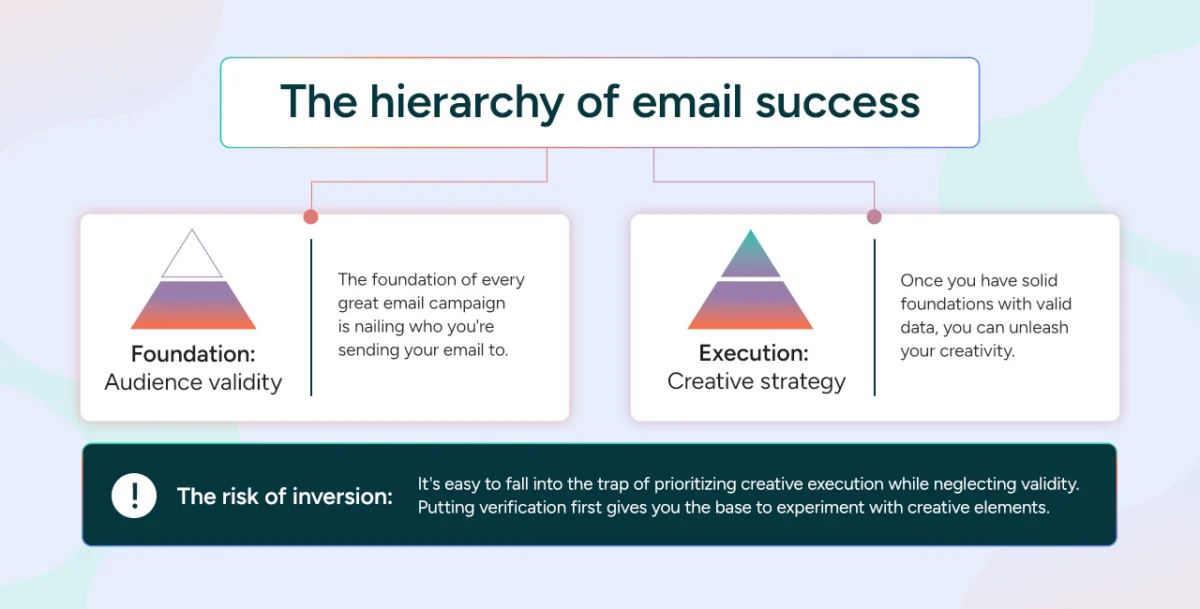
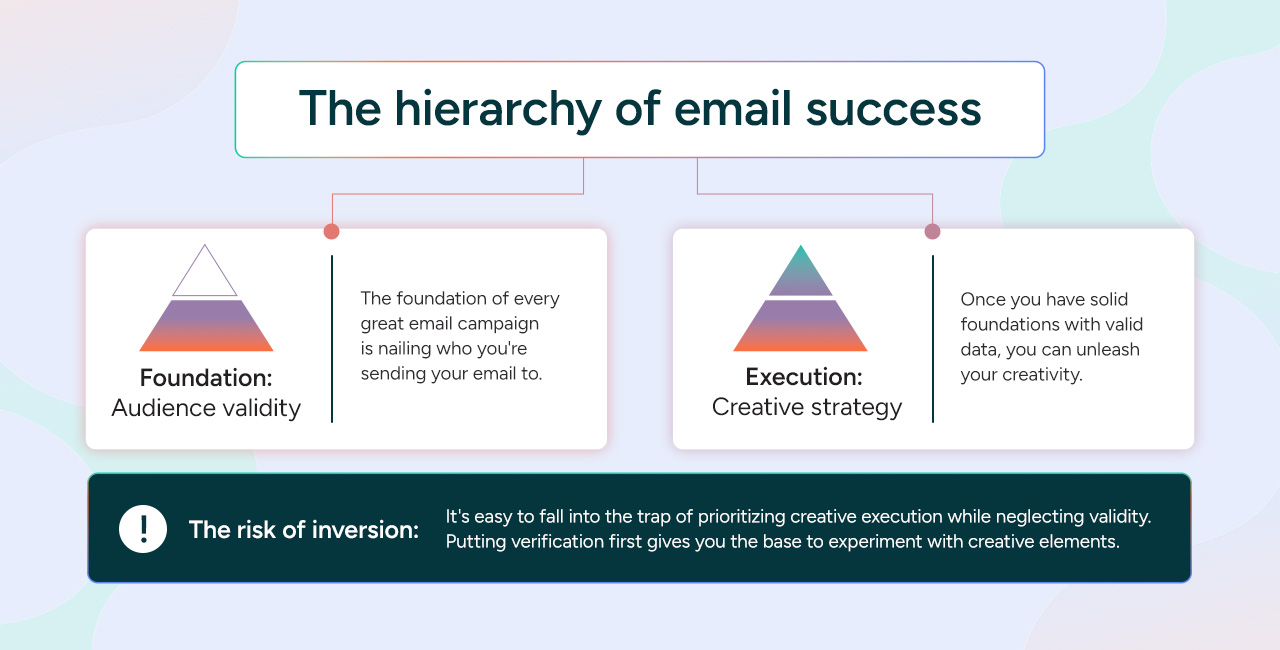
A truly successful email campaign is built upon a clear hierarchy of priorities, where foundational elements must be established before creative execution can yield optimal results.
-
Foundation: Audience Validity: This is the bedrock of any email marketing endeavor. It involves ensuring that every email address on a list is active, deliverable, and belongs to a genuine recipient. This step goes beyond simply having a large list; it focuses on having a quality list. By establishing audience validity first, marketers prevent shouting into the void, both literally (sending to non-existent addresses) and figuratively (sending irrelevant messages to uninterested parties). This foundational step ensures that all subsequent resource allocation—be it in design, copy, or personalization—is applied to a receptive and reachable audience, maximizing efficiency and preventing wasted effort from the outset. A healthy, validated list is also inherently scalable, allowing for growth without the accompanying penalties of increased bounce rates and damaged reputation.
-
Execution: Creative Strategy: Once a solid foundation of valid data is in place, marketers are free to unleash their creativity. This layer encompasses compelling copywriting, intuitive design, strategic personalization tactics, and engaging calls-to-action. The creative strategy is what drives engagement, open rates, and click-through rates. However, its effectiveness is entirely contingent upon the deliverability secured by email verification. Without the foundation of audience validity, even the most brilliant creative will fail to reach its intended target, rendering the effort moot.
-
The Risk of Inversion: A common and costly mistake is to invert this hierarchy, prioritizing creative execution and campaign output over the fundamental health of the email list. This inversion can create a false sense of security, where marketers believe they are optimizing campaigns based on flawed data, leading to inaccurate conclusions about what resonates with their audience. To rectify this inversion, a significant cultural shift is often required within marketing teams. This involves championing clean data metrics, such as low bounce rates and high deliverability, with the same fervor as traditional engagement metrics like click-through rates and conversion rates. Embracing this shift ensures that resources are allocated intelligently, building campaigns on a robust, verifiable base rather than on speculative assumptions.
The Mechanics of Cleanliness: How Email Verification Works
Modern email verification is a sophisticated process that extends far beyond a simple syntax check for the “@” symbol. While basic syntax validation helps identify clearly malformed addresses, it provides no insight into the actual deliverability or quality of an email. A comprehensive verification process involves several technical checks designed to identify various types of bad data.
Key technical aspects include:
- Domain Validation: Verifying that the domain exists and has valid Mail Exchange (MX) records, which are necessary for receiving email.
- SMTP Connection and Response: Attempting to connect to the email server (SMTP) for the specified domain and user, and interpreting the server’s response. This can distinguish between permanent failures (non-existent user) and temporary issues (mailbox full).
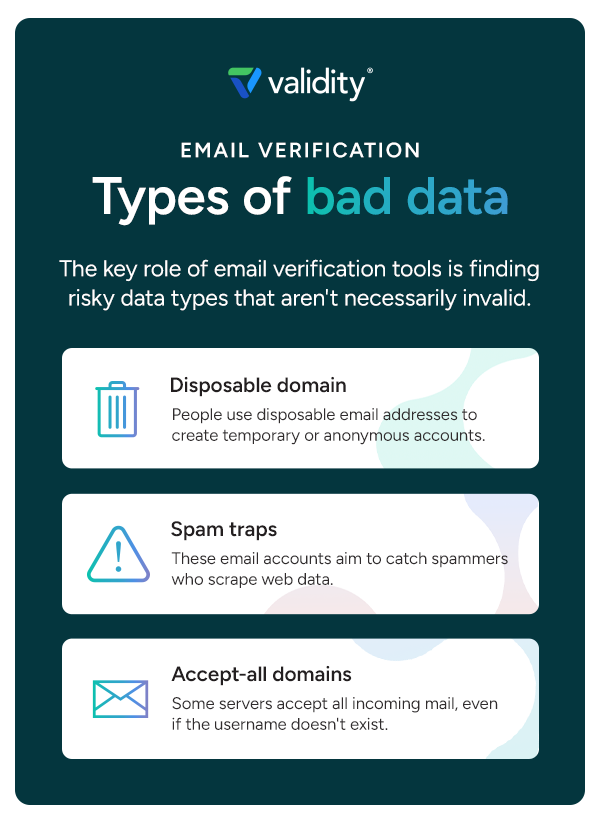
- Identifying Bad Data Types: Advanced tools go further to flag addresses that, while technically valid, pose risks to sender reputation or deliverability:
- Spam Traps/Honeypots: Email addresses specifically set up by MBPs or anti-spam organizations to catch spammers. Sending to these can immediately blacklist a sender.
- Disposable Email Addresses (DEAs): Temporary email addresses often used to sign up for services without revealing a primary address. These indicate low engagement and can harm list quality.
- Role-Based Emails: Addresses like “info@”, “sales@”, or “admin@”. While sometimes legitimate, they often represent a department rather than an individual, leading to lower engagement and potential spam complaints.
- Catch-All Domains: Domains configured to accept all emails sent to them, regardless of whether the specific user exists. This makes it difficult to ascertain user validity and can hide non-existent users.
- Toxic Domains: Domains associated with known spammers, botnets, or sources of fraudulent activity.
- Complainers: Individuals with a history of marking emails as spam.
By identifying and removing these risky data types, email verification tools serve as a crucial first line of defense for compliance with data protection regulations such as the General Data Protection Regulation (GDPR) in Europe, the California Consumer Privacy Act (CCPA) in the United States, and Canada’s Anti-Spam Legislation (CASL). These regulations mandate consent and proper data hygiene, and knowingly sending to unverified or potentially fraudulent addresses can lead to severe penalties, including hefty fines and reputational damage.
The Hidden Costs: Quantifying the Impact of Bad Data
The costs associated with poor email data hygiene extend far beyond merely wasted email sends. These costs can be categorized into direct, indirect, and opportunity costs, all of which significantly impact a company’s bottom line.
Direct Financial Costs:
- Email Service Provider (ESP) Charges: Most ESPs charge based on subscriber count or email volume. Every invalid or non-existent contact on a list translates directly into wasted subscription fees. By purging these contacts, businesses can reduce their overall ESP expenditure, potentially moving down to a lower pricing tier and immediately improving the integrity of their data.
- Wasted Advertising Spend: In integrated marketing campaigns, email lists are often used for retargeting on social media or other ad platforms. Sending these targeted ads to invalid email addresses means wasted impressions and clicks, directly draining advertising budgets.
Indirect Operational Costs:
- Skewed Analytics and Reporting: Bad data distorts campaign metrics. High bounce rates inflate the “unengaged” segment, making it difficult to accurately assess open rates, click-through rates, and conversion rates among the genuinely engaged audience. This leads to faulty conclusions from A/B tests and misguided strategic decisions.
- Reputational Damage: As discussed, high bounce rates directly harm sender reputation, leading to lower deliverability for all future campaigns. Recovering a damaged sender reputation is a long, arduous, and often expensive process, potentially involving IP warming, reputation monitoring services, and extensive communication with MBPs.
- Sales Cycle Inefficiencies: When marketing passes invalid leads to sales, sales representatives waste valuable time attempting to contact non-existent prospects. This “operational drag” not only reduces sales productivity but also fosters distrust between marketing and sales, hindering overall revenue generation efforts.
- Increased IT and Storage Burden: Bloated databases filled with bad data require more storage space, increasing cloud storage costs and slowing down sync times between various marketing automation, CRM, and analytics platforms. This adds unnecessary load on IT infrastructure and personnel.
Opportunity Costs:
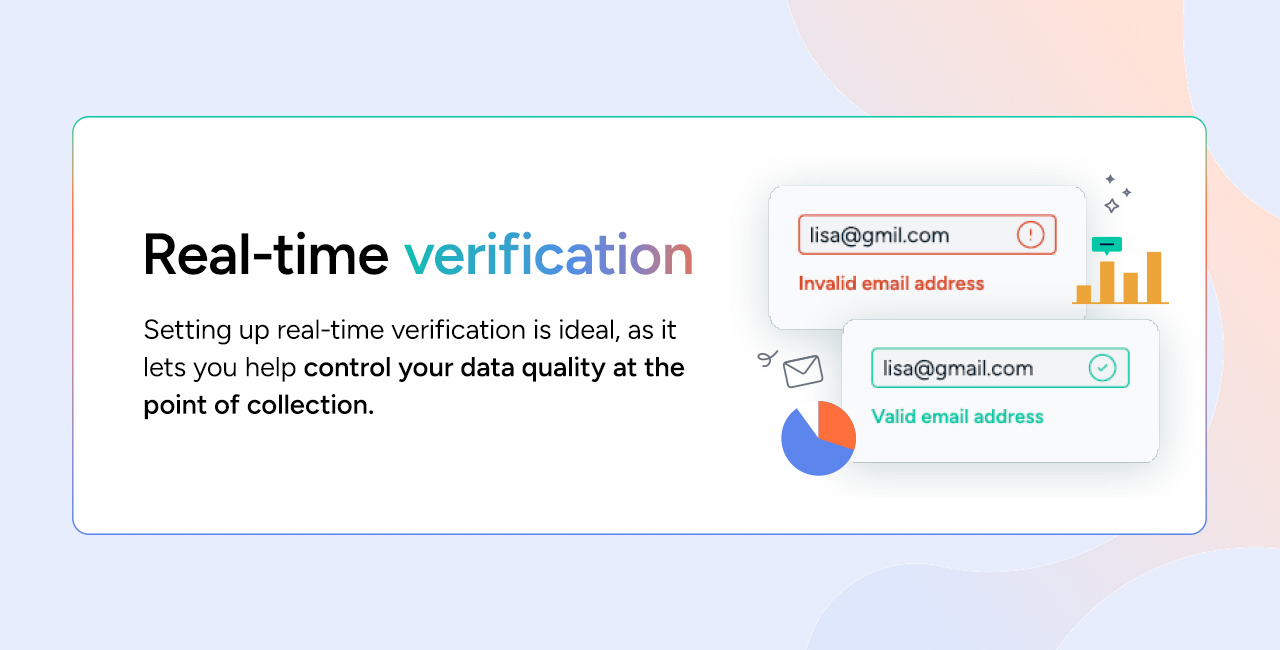
- Lost Leads and Revenue: The most significant opportunity cost is the loss of potentially valuable leads due to uncorrected errors. For instance, a simple typo in a domain name (e.g., “gamil.com” instead of “gmail.com”) can mean a lost subscriber who genuinely intended to opt-in. Real-time verification at the point of capture can correct these human errors, instantly recovering valuable prospects.
- Diminished Customer Experience: A seamless sign-up process, where typos are immediately flagged and corrected, reinforces a brand’s professionalism and ensures the prospect receives the information they requested instantly. Conversely, failing to deliver promised content due to an invalid address creates a negative first impression.
- Delayed Market Entry and Competitive Disadvantage: Companies bogged down by data cleanup are slower to react to market changes and launch new campaigns. Competitors with superior data hygiene can move faster, capture market share, and iterate more effectively based on accurate performance data.
Industry reports consistently underline these costs. A study by the Data & Marketing Association (DMA) estimated that poor data quality costs U.S. businesses billions annually, highlighting that accurate, verified data is a strategic asset.
A Multi-Faceted Approach: Implementing an Effective Verification Strategy
Implementing a robust email verification strategy requires a multi-faceted approach, integrating various tools and processes into the marketing workflow.
-
Real-time Verification at Point of Entry: This is the most proactive measure. By integrating real-time verification Application Programming Interfaces (APIs) into web forms (e.g., sign-up forms, lead magnet downloads), businesses can validate email addresses as users type them. If a typo is detected or an address is identified as invalid, the user is prompted to correct it instantly. This prevents bad data from entering the database in the first place, ensures a frictionless user experience, and immediately improves the quality of leads passed to sales.
-
Bulk Verification for Existing Lists: Data naturally decays over time. People change jobs, companies go out of business, domains expire, or email accounts are abandoned. This decay rate can be as high as 25-30% annually, particularly in fast-moving B2B sectors. Regular bulk verification, typically performed quarterly or semi-annually, allows marketers to clean existing lists, removing invalid, dormant, or risky addresses. This process is essential for maintaining list hygiene and maximizing the value of historical data.
-
Continuous Monitoring and Regular Maintenance: Email verification should not be a one-off event but an ongoing process. Establishing a regular cadence for list maintenance, whether monthly or bi-monthly, helps catch invalid addresses before they accumulate and impact sender reputation. The ideal frequency depends on the industry, list growth rate, and audience churn. High-velocity sectors like SaaS or e-commerce, with rapid lead acquisition and potential churn, may require more frequent checks.
-
Pre-Campaign Validation: For high-stakes campaigns, such as major seasonal promotions (e.g., Black Friday, Cyber Monday), product launches, or critical announcements, it is a best practice to perform a final email list validation immediately before sending. This ensures that the campaign reaches the most up-to-date and valid audience, maximizing deliverability and ensuring that critical messages land in inboxes when it matters most.
-
Strategic Management of Unknowns: Email verification tools sometimes return a small percentage of addresses with an “unknown” status. This can be due to server timeouts, strict security settings, or temporary network issues. A common mistake is to treat these unknowns as valid. A more prudent strategy is to segment these contacts onto a “quarantine list.” These addresses can then be tested with low-volume, text-only re-engagement emails. Crucially, this testing should ideally be done using a secondary sending IP address to protect the primary sender reputation. If an unknown address bounces, it can be removed; if it engages, it can be moved back to the main list, effectively recovering genuine leads while minimizing risk.
Industry Standards and Technological Edge: The Role of Solutions like Validity BriteVerify
When selecting an email verification partner, speed, accuracy, and scalability are paramount. These attributes are critical for maintaining a seamless user experience during real-time verification and efficiently processing massive datasets during bulk cleanses. Solutions like Validity’s BriteVerify have emerged as industry standards due to their robust capabilities and proven track record.
BriteVerify, for instance, is relied upon by tens of thousands of organizations globally, underscoring its reputation for improving customer data quality. Its ability to handle massive data volumes without introducing latency is a key differentiator. This ensures that real-time verification APIs do not slow down user-facing forms, maintaining a positive user experience. Whether processing thousands of leads per hour or millions of records in a batch, the underlying technology scales to meet diverse demands.
The accuracy of an email verification tool is directly tied to the quality of its network and its relationships with email providers. BriteVerify leverages extensive relationships with inbox providers and a vast global data network. This allows it to perform more accurate status checks than tools that rely solely on basic scraping techniques. By minimizing the number of “unknown” results, BriteVerify helps businesses retain more genuinely valid leads while effectively identifying and removing bad data that could otherwise harm sender reputation. Furthermore, its seamless integration capabilities mean businesses can adopt the solution with minimal disruption to existing systems, reducing onboarding headaches and accelerating time-to-value.
Conclusion: Maximizing Every Send in a Data-Driven World
In the increasingly complex and competitive landscape of digital marketing, email verification is no longer an optional add-on but an essential, strategic imperative. By prioritizing audience validity as the foundational layer of every campaign, marketers empower their creative teams, optimize resource allocation, and protect their invaluable sender reputation. This shift from reactive maintenance to proactive data hygiene enables innovation and accurate optimization, fostering sustainable growth.
Solutions like BriteVerify offer the technological prowess to implement this critical strategy effectively, providing tools for real-time validation at the point of capture, regular bulk cleanses, and pre-campaign verification. By embracing these practices, organizations can transform their email marketing from a potential liability into a consistently high-performing channel, ensuring every send reaches its intended recipient and maximizes measurable ROI in a data-driven world. The era of “send and pray” is over; the future belongs to precision, validation, and trust.








