The seismic shift in search engine results brought about by the advent of AI-powered overviews has left many in the digital marketing industry grappling with uncertainty. Ever since generative AI tools like ChatGPT emerged, a significant focus has been placed on understanding how to gain visibility within these new search paradigms. WordStream by LocaliQ, a prominent player in the digital marketing analytics space, has been actively exploring this evolving landscape, not only by writing about it but also by attempting to optimize its own content for AI-driven search. Despite these efforts, the initial outcomes have been met with a degree of disillusionment, characterized by increased mentions of AI in search results but with a negligible impact on traffic, a decline in clicks from traditional organic rankings, and a palpable sense of frustration.
This sentiment has led to a widespread industry pivot, with many marketers adopting the mantra that “citations are the new rankings” and “brand exposure is the new traffic.” This capitulation reflects a broader acceptance of a reality where AI tools, powered by vast datasets, aggregate information from established websites – those that have meticulously built authority and expertise over years – without necessarily directing commensurate traffic back to the original sources. The prevailing advice has been to accept this new order and adapt optimization strategies accordingly to remain relevant.
However, Elisa Gabbert, WordStream’s Director of Content and SEO, offers a dissenting perspective. She contends that optimizing solely for AI search is a misguided approach, citing not only the notably low click-through rates associated with AI overviews but also the inherent instability of the data. Gabbert observed a significant inconsistency in the AI Overviews she encountered for similar queries, noting that different sources were cited each time. This lack of consistency raises a critical question: if Google’s AI cannot maintain a stable citation pattern, how can marketers effectively determine what the AI is prioritizing, and what assurance do they have that their hard-won citation will not disappear the following day?
![Should You Even Try to Optimize for AI Overviews? [Study] | WordStream](https://www.wordstream.com/wp-content/uploads/2026/06/ai-stability-study-wordstream.jpg)
To rigorously test this hypothesis, WordStream embarked on a six-week experiment. For a period of six weeks, a WordStream researcher meticulously conducted the same 14 searches, focusing on common marketing terms, every Thursday afternoon. The top 10 sources cited within the resulting AI Overviews were manually recorded. This intensive process, which involved approximately 10 hours of direct observation and data analysis, aimed to provide empirical evidence regarding the stability and characteristics of AI search results.
The experiment yielded two primary conclusions. Firstly, it solidified the team’s hypothesis that optimizing for AI search is an unreliable strategy due to its inherent volatility. Secondly, it uncovered intriguing insights into what Google currently appears to value in its AI-generated results. The findings offer a valuable, data-driven perspective on navigating this nascent and rapidly changing digital frontier.
Six Surprising Results from WordStream’s AI Results Stability Study
The core of WordStream’s investigation revolved around the stability of AI Overviews. The underlying question was whether these AI-generated summaries remained consistent over time, a crucial factor for marketers considering the investment of time and resources into optimizing for them. The findings revealed a stark reality: the AI Overviews looked significantly different with each iteration.
AI Overview Results Exhibit Extreme Instability Over Time
![Should You Even Try to Optimize for AI Overviews? [Study] | WordStream](https://www.wordstream.com/wp-content/uploads/2026/06/ai-overviews-source-stability.webp)
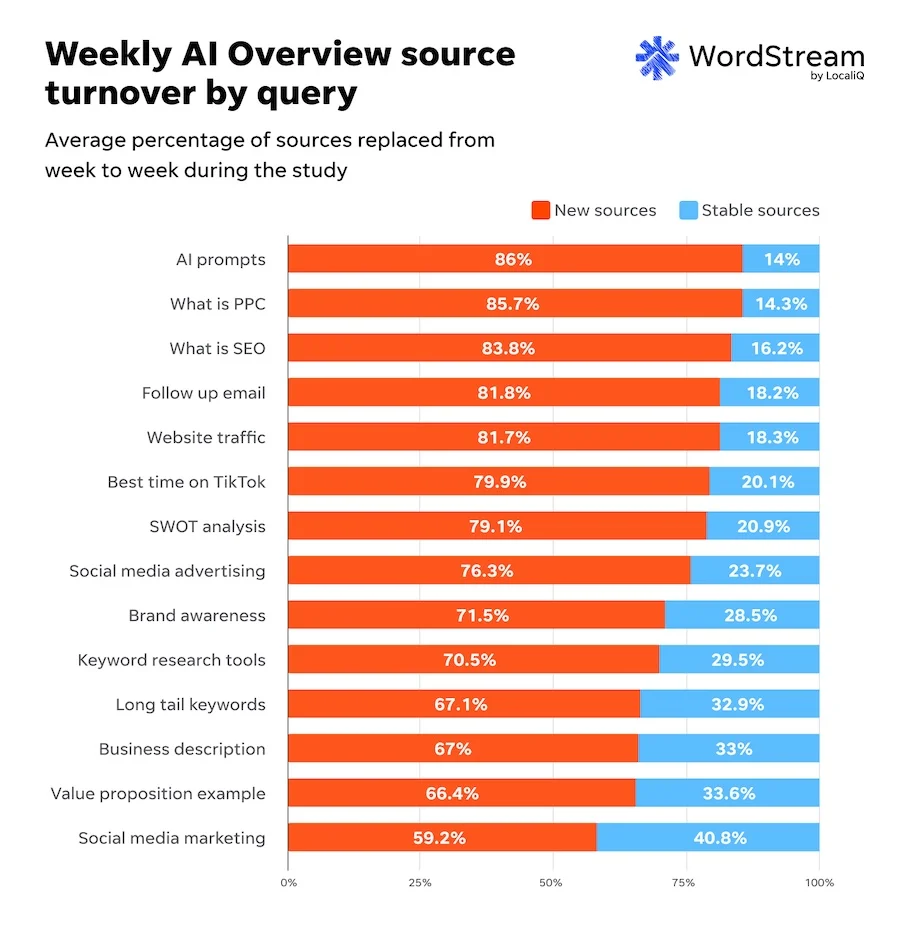
On average, the retention rate of cited sources from one week to the next was a mere 50%, akin to a coin flip. In some instances, this retention rate plummeted to as low as 20%. Cumulatively, approximately three out of every four sources cited in an AI Overview changed from one week to the next. This level of volatility far surpasses the fluctuations typically observed in traditional search engine rankings, which, while subject to change, did not historically exhibit such dramatic shifts unless accompanied by significant algorithm updates. Moreover, even a temporary ranking in traditional search often translated into tangible clicks, a benefit that AI Overviews currently struggle to provide.
The instability was not confined to the cited websites; the very layout and structure of the AI Overviews also underwent frequent modifications. For example, the search query “keyword research tools” saw the number of cited sites fluctuate between six and fifteen in different weeks. In one instance, a search for “AI prompts” yielded no AI Overview at all. This means a marketer could be prominently featured in the top 10 cited sources one week, only to completely disappear from the AI results the following week.
Furthermore, the experiment highlighted that individual experiences might differ. While the study focused on a specific set of queries, it’s acknowledged that other users might encounter different results. This variability itself underscores the challenge of optimization, as it points to a constantly moving target. The findings are further corroborated by an independent experiment conducted by BuzzStream, which examined source overlap across different AI search platforms. Their research indicated that a significant 76% of AI-cited sources appear on only one platform, with less than 1% appearing across multiple platforms. This suggests that achieving visibility in Google’s AI Overviews does not guarantee presence on other AI tools like ChatGPT or Gemini.
Implications for Marketers: While AI visibility is undoubtedly valuable for brand awareness, marketers are advised not to place all their reliance on AI search results. The dynamic nature of these results means that even achieving a citation is not a guarantee of sustained visibility or, more importantly, traffic.
![Should You Even Try to Optimize for AI Overviews? [Study] | WordStream](https://www.wordstream.com/wp-content/uploads/2026/06/ai-overviews-source-types.webp)
AIO Results Tend to Follow a Predictable Formula
Despite the overall instability, the WordStream experiment identified a discernible pattern or “formula” that Google’s AI Overviews appeared to follow. For each search conducted, the AI results reliably included specific types of content:
- Definition-based content: Explanations and definitions of terms.
- Tips and how-to content: Actionable advice and instructional guides.
- Listicles: Content presented in a list format.
- Product pages or category pages: Direct links to relevant products or services.
- Community/Forum content: Discussions and insights from online communities.
While there was variation in the specific sources within these categories, the AI consistently drew from these established content types. This suggests that websites not producing content that aligns with these categories might face significant challenges in appearing in AI Overviews, irrespective of their content’s quality or optimization.
The data presented by WordStream, illustrated by a visual representation of source types, indicates a strong reliance on established content formats. This pattern echoes observations made by SEO expert Tom Demers, who noted a similar thematic consistency when conducting SEO audits of the first page of organic search results. This suggests that Google may be applying a comparable logic across its search functionalities, prioritizing established content structures.
Implications for Marketers: For businesses solely relying on traditional articles to rank in AI Overviews or organic search, the competitive landscape is particularly challenging. Google appears to favor high-domain authority websites for these slots. In the conducted searches, prominent examples included Forbes (Domain Rating 94), Mailchimp (DR 93), and Semrush (DR 92). Creators and smaller brands might find a more accessible pathway to visibility by consistently publishing content on social media platforms like TikTok and Facebook, or by producing video content for YouTube, including YouTube Shorts. Publishing on social sites is not only a potential avenue for AI visibility but also a significant driver of overall traffic. According to WordStream’s Small Business Website Trends Report, 64% of small businesses identify social media as a primary source of traffic, surpassing SEO at 52%.
![Should You Even Try to Optimize for AI Overviews? [Study] | WordStream](https://www.wordstream.com/wp-content/uploads/2025/12/Website-Trends-Web-07-1.webp)
Reddit Emerges as a Significant Beneficiary
The study highlighted Reddit’s substantial presence in AI Overviews, a trend that aligns with its growing prominence in search results over the past five years. Google has demonstrably prioritized community-driven content, with this emphasis intensifying over the last two years. Many of the searches performed during the experiment, particularly those seeking tips and definitions, consistently featured Reddit results. This underscores Google’s increasing reliance on user-generated, experience-driven content to inform its AI summaries.
The data visualization of the most frequent sources in Google AI Overviews clearly shows Reddit as a leading contributor. This indicates that discussions and shared experiences on Reddit are being recognized by AI algorithms as valuable sources of information.
Implications for Marketers: Establishing a presence on Reddit can lead to more valuable direct referral traffic than a mere impression in an AI Overview. However, proactive marketing on Reddit is challenging due to the platform’s community-centric ethos. Marketers must engage creatively, identifying relevant subreddits, building brand awareness organically, and potentially exploring paid advertising options to gain visibility. WordStream offers a guide to Reddit marketing for those seeking further insights.
Social Sites and Video Content Offer Opportunities for Creators and Smaller Brands
The consistent appearance of content from YouTube and social media platforms like TikTok and Facebook in AI Overviews was a notable finding. The prevalence of TikTok results, especially when compared to Instagram despite Instagram’s content now being indexed by Google, suggests a potential pathway for businesses already cultivating a following on TikTok to gain crossover visibility in AI search.
![Should You Even Try to Optimize for AI Overviews? [Study] | WordStream](https://www.wordstream.com/wp-content/uploads/2026/06/google-serp-communities-forums-section.webp)
The AI Overviews often featured a mix of content from large, industry-specific brands alongside individual creators and smaller businesses. This variability presents an opportunity for those producing engaging video and social content that directly addresses customer search queries.
Furthermore, consistent social media engagement and the creation of short-form videos offer broader business benefits. As previously noted, social media is a key traffic driver for small businesses. Additionally, studies indicate that short-form videos boast the highest return on investment among various content types, making them a strategic asset for content creation.
Implications for Marketers: Google’s increasing reliance on social content signifies an opportunity for businesses. By creating video and social content that aligns with customer search intent, smaller brands and individual creators can potentially outperform larger websites with higher domain authority. This aligns with the broader trend of social media being a significant traffic source for SMBs and the strong ROI associated with short-form video content.
Content from Educational Institutions: An Unexpected Success Story
A surprising revelation from the study was the consistent presence of .edu websites in AI Overview results, a phenomenon observed in nearly every search conducted. This finding appears to diverge from Google’s stated guidelines, which emphasize building niche expertise and focusing on specific areas. While universities may not possess greater expertise in areas like social media marketing than established industry leaders such as Sprout Social or Hootsuite, their .edu domain suffix seems to confer a significant advantage in AI sourcing.
![Should You Even Try to Optimize for AI Overviews? [Study] | WordStream](https://www.wordstream.com/wp-content/uploads/2026/06/most-frequent-sources-in-google-ai-overviews.webp)
This observation lends further credence to the hypothesis that AI systems prioritize content from sources perceived as highly trustworthy. Educational and organizational (.org) domains are often viewed as authoritative and credible, making them a natural fit for AI-generated summaries.
Implications for Marketers: For entities that are not educational institutions or non-profit organizations, there is limited direct strategic takeaway from this finding. However, for those with .edu or .org domains, this presents a favorable opportunity. If content is created around relevant AI search queries, there is a strong probability of surfacing in AI results, leveraging the inherent trust associated with these domain types.
Interpretation of Search Intent: An Area of Uncertainty
A significant challenge identified was the AI’s fluctuating interpretation of query intent from week to week, particularly for definition-based searches like “What is PPC?” or “What is SEO?”. Google’s AI demonstrated difficulty in both accurately understanding the user’s intent and surfacing results that precisely matched that intent. For instance, a search for “What is PPC?” could yield results related to pay-per-click advertising, but also encompass production planning and control, or public procurement commission. This ambiguity persisted even for a user who consistently searches for marketing-related content.
The AI Overviews often presented a mixed bag of results, including definitions from encyclopedic sources like Wikipedia alongside tips and strategies from industry-specific sites. However, a prevalent theme was the inclusion of in-depth guides related to the core topic, such as comprehensive guides to PPC.
![Should You Even Try to Optimize for AI Overviews? [Study] | WordStream](https://www.wordstream.com/wp-content/uploads/2026/06/ai-overview-tiktok-youtube-results.webp)
Implications for Marketers: The consistent citation of in-depth, 101-level guides in AI Overviews highlights the importance of creating comprehensive educational content. Such content should encompass definitions, tips, strategies, relevant tools, and illustrative examples. This also reinforces the critical need to optimize for “query fan-out,” a concept describing how AI systems address related questions and topics stemming from an initial query. By optimizing for query fan-out, businesses can increase their chances of appearing in AI results, especially when the AI exhibits uncertainty regarding search intent.
The Absence of Thought Leadership in AI Overviews
Google’s stated commitment to valuing original, well-written content, which historically favored thought leadership, appears to have diminished in the context of AI Overviews. While thought leadership content from trusted brands previously performed well in organic search, its absence in AI Overviews was a glaring omission.
This trend is understandable from an AI perspective, as generative engines tend to surface content that is easily verifiable or aligns with established consensus. Opinions and strong, unique takes on subjects are inherently more difficult for AI to quantify and verify. The potential consequence, as observed by some analysts, is a future filled with repetitive and generic content, as businesses may deprioritize creating original thought leadership if it is not rewarded by AI search. This creates a disconnect between Google’s stated preference for unique content and the apparent algorithmic reward structure of AI Overviews, which favors foundational, easily digestible information.
Implications for Marketers: While thought leadership content may not be a primary focus for AI systems, it remains a valuable asset for other channels. It is well-suited for social media platforms where it can initiate conversations with an audience. Furthermore, thought leadership content continues to find audiences through newsletters and other direct communication channels. A recent report indicated that thought leadership content generated more traffic from marketing newsletters than from organic search, demonstrating its enduring relevance in alternative contexts. Thought leadership is not obsolete; its primary impact may simply be shifting away from traditional organic search.
![Should You Even Try to Optimize for AI Overviews? [Study] | WordStream](https://www.wordstream.com/wp-content/uploads/2026/06/google-content-guidelines-expertise.webp)
The Strategic Implications of AI’s Instability
The overarching conclusion from WordStream’s study is that AI search results are inherently unstable and challenging to optimize for and track. While marketers should not entirely disregard AI optimization, the most effective generative engine optimization (GEO) strategy is one that simultaneously drives meaningful performance in channels that directly contribute to core business objectives. The pursuit of AI citations should not become an end goal in itself.
Instead, SEO and content strategies that prove effective in the current AI landscape include:
- Comprehensive, 101-level content: Creating foundational guides that thoroughly explain topics, including definitions, tips, and strategies.
- Optimizing for query fan-out: Anticipating and addressing related questions and sub-topics that an AI might explore beyond the initial query.
- Leveraging social media and video: Actively participating on platforms like TikTok, Facebook, and YouTube to create engaging content that can be surfaced.
- Building community presence: Engaging with relevant online communities, such as Reddit, to foster organic mentions and drive direct traffic.
- Focusing on trustworthiness and authority: Continuing to build credibility through high-quality, well-sourced content, particularly for .edu and .org domains.
WordStream offers further insights into optimizing for GEO, emphasizing a holistic approach that integrates AI visibility with traditional marketing goals. For businesses seeking more personalized guidance in adapting their strategies for the evolving AI search environment, direct consultation services are available.
About the Experiment and Data: The WordStream experiment focused exclusively on the websites listed within the “Sources” section of Google AI Overviews. The selection of search queries was based on terms that commonly led users to WordStream’s content via Google Search Console. The research was conducted weekly between April 2, 2026, and May 7, 2026, with the first 10 cited sources meticulously recorded each time. This systematic approach provides a robust dataset for understanding the dynamics of AI-driven search citation patterns.