


The core challenge for modern enterprises is no longer the technical complexity of the tools, but rather the strategic selection of a platform that offers both immediate accessibility and the scalability to grow alongside the business. This guide provides a comprehensive overview of the current A/B testing market, the essential features required for beginners, and a strategic framework for implementation.
The Evolution of Experimentation: From Code to Context
A/B testing, at its fundamental level, is a controlled experiment where two or more versions of a digital asset—such as a landing page, an email, or a mobile app interface—are shown to different user segments simultaneously. By comparing Version A (the control) against Version B (the variation), organizations can determine which iteration performs better based on specific metrics like click-through rates, sign-ups, or revenue.
Historically, this process required manual traffic splitting and server-side code adjustments. However, the 2026 market is defined by “visual editors” and “agentic AI,” where the software handles the statistical heavy lifting. This evolution allows marketers to focus on psychological triggers and user intent rather than syntax and deployment cycles.

Essential Features for the Modern Beginner
For those entering the experimentation space, certain features are non-negotiable. These tools must bridge the gap between complex data science and intuitive marketing workflows.
1. No-Code Visual Editors
The hallmark of a beginner-friendly tool is the ability to modify live pages without touching a single line of code. Modern visual editors allow users to drag and drop elements, change headlines, and swap images in a “What You See Is What You Get” (WYSIWYG) environment. This removes the reliance on IT departments, significantly shortening the time-to-market for experiments.
2. Integrated Behavioral Insights
Data without context is often misleading. Leading platforms now integrate heatmaps, session recordings, and click-maps directly into the A/B testing dashboard. While quantitative data shows what happened (e.g., Version B had a 10% higher conversion rate), behavioral insights explain why (e.g., users ignored the sidebar and focused on the center-aligned CTA).
3. Automated Statistical Significance
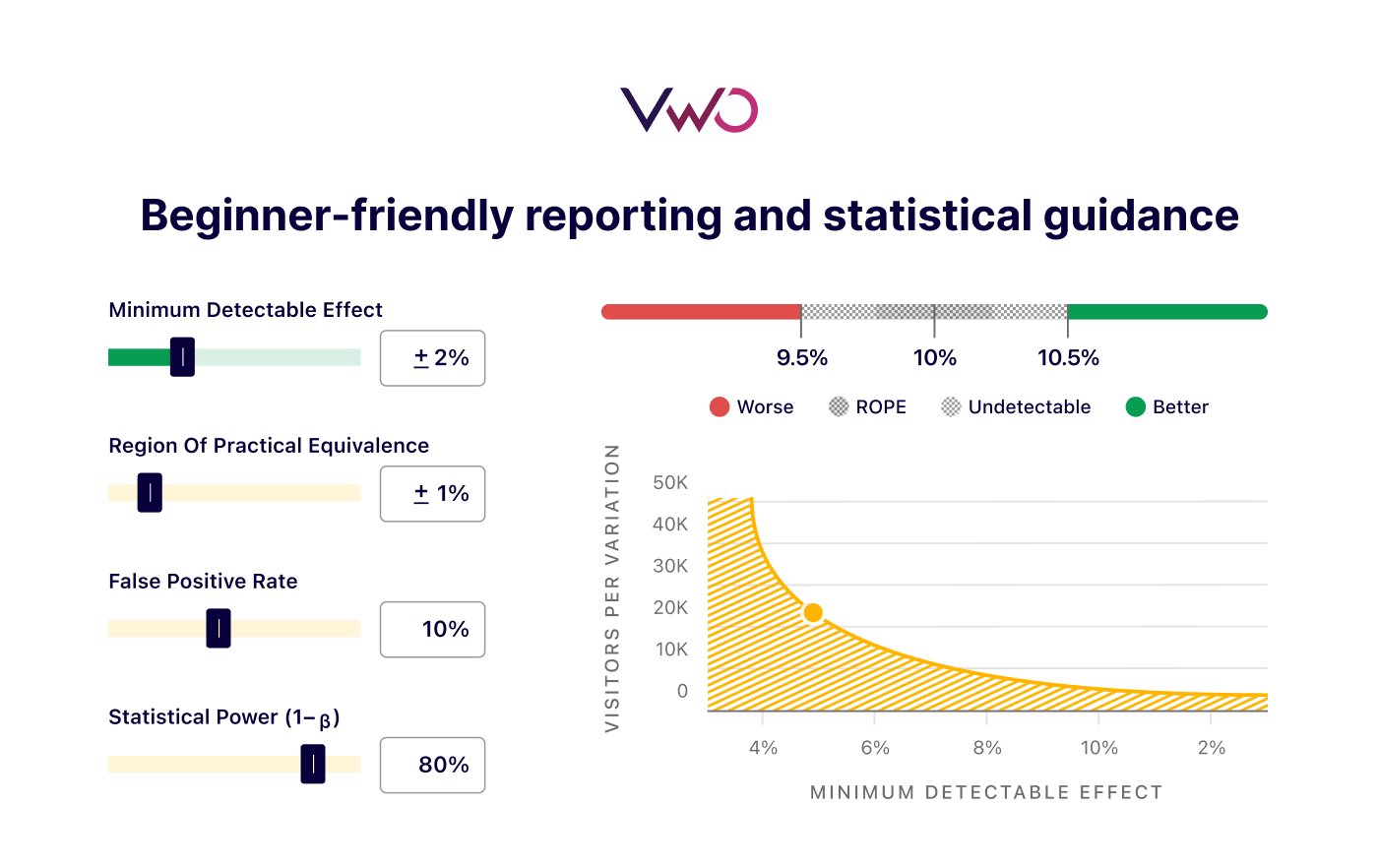
Beginners often fall into the trap of “peeking”—stopping a test as soon as one version looks like a winner. Professional-grade beginner software now includes built-in statistical guidance, such as sequential testing or Bayesian statistics, which automatically alerts the user when a result is reliable and statistically significant.

4. Push-to-Live Capabilities
One of the most significant advancements in recent years is the “Push-to-Live” feature. Once a winning variation is identified, tools like VWO Deploy allow teams to push that change to 100% of their traffic instantly. This bypasses the traditional development queue, ensuring that the benefits of the test are realized immediately while waiting for a permanent code update.
The 2026 Competitive Landscape: A Comparative Analysis
The market for A/B testing software has fragmented into specialized niches. Below is an analysis of the leading platforms tailored for entry-level and mid-market users.
| Platform | Ease of Use | Target Audience | Key Strength |
|---|---|---|---|
| VWO | Moderate | Scalable Teams | All-in-one experimentation and behavioral analysis. |
| Zoho PageSense | High | Small Businesses | Budget-friendly entry point for basic web testing. |
| Convert | Moderate | Privacy-Conscious | Enterprise-grade power without the complex UI. |
| Unbounce | High | Performance Marketers | Specialized in high-converting landing pages. |
| Crazy Egg | High | Visual Marketers | Emphasis on heatmaps and visual user journeys. |
| Fibr AI | Moderate | Tech-Forward Teams | Autonomous, AI-driven variant generation. |
VWO: The Scalability Leader
VWO remains a dominant force because it allows teams to start with simple A/B tests and eventually transition into multivariate testing and feature management without switching platforms. Their 2026 suite includes “VWO AI,” which can generate hypotheses based on existing webpage data, further lowering the barrier for beginners.
Zoho PageSense: The Accessibility Choice
For small teams or solo entrepreneurs, Zoho PageSense offers a “forever free” tier and a low-cost entry point. It focuses on the entire visitor journey, from top-of-funnel tracking to bottom-of-funnel conversion, making it a holistic choice for those on a tight budget.
Fibr AI: The New Frontier
Fibr AI represents the next generation of optimization. By utilizing “Agentic AI,” the platform can autonomously create variations and adjust traffic allocation based on real-time performance. This is particularly useful for teams that want to maintain a “set it and forget it” approach to optimization.
Strategic Implementation: A Chronological Roadmap
Success in A/B testing is rarely about the tool alone; it is about the process. Organizations that see the highest ROI follow a structured chronology.
- Baseline Analysis: Before testing, teams must analyze current performance. This involves identifying “leaky” pages where visitors drop off at high rates.
- Hypothesis Generation: A valid test requires a clear hypothesis. For example: “By changing the CTA from ‘Submit’ to ‘Get My Free Guide,’ we will increase sign-ups by 15% because it clarifies the value proposition.”
- Variant Creation: Using a visual editor, the marketer creates the alternate version.
- Traffic Allocation: The software splits incoming visitors (e.g., 50% to Version A, 50% to Version B).
- Statistical Monitoring: The test runs until it reaches a pre-determined level of statistical significance—usually 95% or higher.
- Analysis and Deployment: The winner is analyzed for deeper insights, and the results are deployed to the live site.
Industry Perspectives and Expert Analysis
Lucia van den Brink, founder at The Initial, emphasized the importance of momentum in a recent industry podcast. “Companies should use the momentum and motivation within their organization to start demoing tools and implement them as quickly as possible,” van den Brink stated. “The danger is that teams keep evaluating tools, never make a decision, and end up not A/B testing at all. In the end, it’s the people and the system behind it that make it work.”
This sentiment reflects a broader industry shift: the “Analysis Paralysis” of tool selection is often more damaging than picking a “sub-optimal” tool. In 2026, the cost of inaction is significantly higher than the cost of a starter software subscription.

Avoiding the “Beginner’s Trap”: Common Pitfalls
Despite the ease of modern software, several common mistakes continue to hinder new experimenters:
- Testing Low-Traffic Pages: Statistical significance requires a sufficient sample size. Testing a page with only 100 visitors a month will rarely yield actionable results.
- Ignoring Mobile Users: With over 60% of global web traffic originating from mobile devices, failing to optimize the mobile experience is a critical oversight.
- Over-complicating Early Tests: Beginners should focus on high-impact elements like headlines, CTA buttons, and hero images before attempting complex layout overhauls.
- Price-Only Decision Making: A cheap tool that lacks reliable support or advanced segmentation may cost more in the long run through lost opportunities and inaccurate data.
The Broader Impact on Global Commerce
The democratization of A/B testing software is fundamentally changing how businesses compete. In the past, only tech giants like Amazon or Google could afford to run thousands of experiments. Today, a local e-commerce boutique can use AI-powered tools to achieve similar levels of optimization.
As we move through 2026, the integration of AI will likely make these tools even more autonomous. The role of the “Beginner” will shift from a builder of tests to an orchestrator of experiments. By removing technical barriers, the industry is forcing a return to marketing fundamentals: understanding the user, crafting a compelling message, and providing a seamless path to conversion.
For organizations looking to remain competitive, the mandate is clear: start small, use the right tools to remove friction, and build a culture of continuous experimentation. The technology is ready; the only remaining variable is the willingness to begin.







