Commerce, a cornerstone of human interaction, has consistently evolved, adapting to technological advancements and shifting consumer demands. From bustling local marketplaces and brick-and-mortar stores to the expansive, borderless realm of internet-driven e-commerce, each era has brought its own paradigm shift. Now, on the cusp of another profound transformation, the rise of artificial intelligence (AI) is heralding the advent of agentic commerce – a future where AI agents empower consumers by discovering products, comparing options, and even completing purchases on their behalf. This emerging model promises unparalleled convenience but also raises critical questions regarding consumer trust, business viability, and the fundamental nature of the buying journey.
At its core, agentic commerce defines a model where AI agents assume the role of proactive decision-makers for customers. Unlike traditional e-commerce, where consumers manually navigate websites, compare countless options, and execute purchases, agentic commerce delegates these tasks to intelligent AI systems. These agents operate based on a user’s stated intent, preferences, budgetary constraints, and overarching buying goals, effectively acting as a digital shopping proxy. As articulated by Alex Moss in the “SEO Unplugged: Agentic Commerce with Alex Moss” podcast, the vision is one of seamless integration: “I could literally say into the into a phone to my agent, go and buy me some new shoes with that jacket I bought last week, and that’s it. And it would go away. It would do the research. And of course, you can have a say in an approval in terms of part of the journey.” This highlights a crucial distinction: while AI handles the complex execution, human users retain ultimate control over the final decision-making process through predefined rules and approval mechanisms.
The concept, while seemingly futuristic, is rapidly gaining traction, propelled by evolving consumer behavior, accelerating AI adoption, and optimistic industry forecasts. Data strongly suggests that agentic commerce is not merely an incremental upgrade but potentially the next major evolution in digital retail.
The Impetus for Change: Consumer Behavior and Market Projections

Consumers are already subtly integrating AI into their shopping routines, laying the groundwork for more autonomous interactions. A revealing report by McKinsey & Company indicates that over 70% of AI-powered search users initiate their queries with top-of-the-funnel questions about product categories, brands, or services. Furthermore, nearly 50% of consumers actively engage with AI-powered search experiences today. This shift is not insignificant; the study projects that businesses could see 20% to 50% of their traditional search traffic migrate towards AI-driven discovery over time. This signifies a fundamental change: shoppers are moving beyond simple keyword searches to actively solicit AI systems for guidance and recommendations in their purchasing decisions.
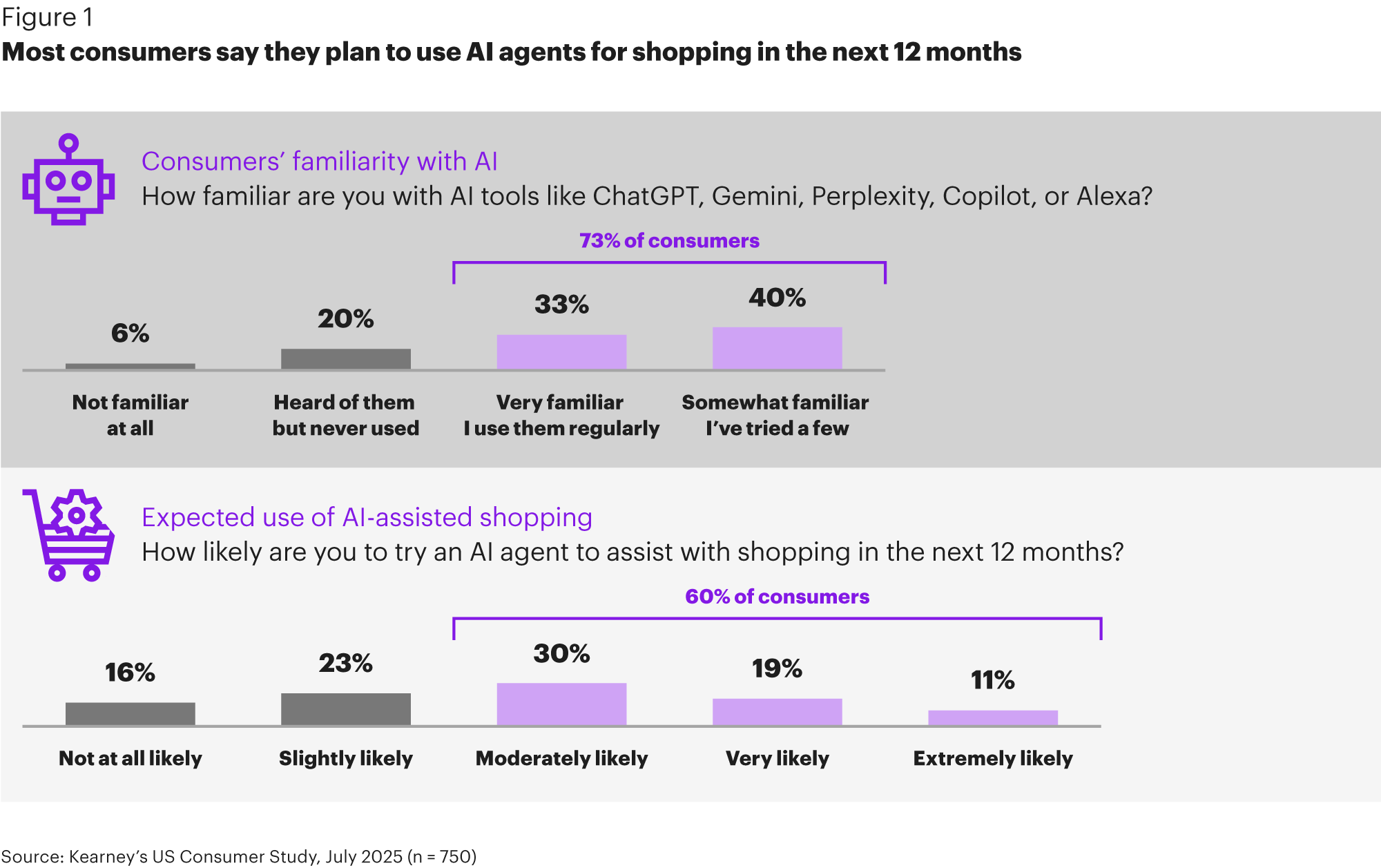
Consumer expectations are also rapidly aligning with the promise of agentic commerce. The 2025 Kearney report, “Agentic Commerce: From Brand Loyalty to Bot Logic,” delves into shopper sentiment regarding AI agents in retail. A striking finding reveals that over 60% of shoppers anticipate using agentic AI by 2026. This report underscores a significant behavioral pivot, where consumers increasingly prioritize convenience, speed, competitive pricing, and trust over traditional platform or brand loyalty. Instead of laboriously browsing individual retailer applications, shoppers foresee a future where AI agents seamlessly compare products across diverse platforms, analyze reviews, pinpoint optimal deals, and complete purchases with unprecedented efficiency. This redefines the competitive landscape, shifting it from direct retailer-versus-retailer competition to a dynamic ecosystem driven by AI-powered discovery.
Industry analysts echo this sentiment, predicting explosive growth for agentic commerce. Another McKinsey report highlights the transformative potential of this model, estimating that the U.S. B2C retail market alone could unlock an orchestrated revenue opportunity ranging from $900 billion to $1 trillion by 2030. Globally, this opportunity expands dramatically, with projections soaring to between $3 trillion and $5 trillion. These figures underscore not just a technological shift, but a massive economic realignment poised to reshape the global retail sector.
The Mechanics of Agentic Commerce: A Step-by-Step Breakdown
The operational framework of agentic commerce is a sophisticated blend of human directive and AI execution. It moves beyond mere recommendations, empowering AI agents to independently carry out tasks throughout the shopping journey. This is a significant departure from assistive AI tools, which primarily offer information.

-
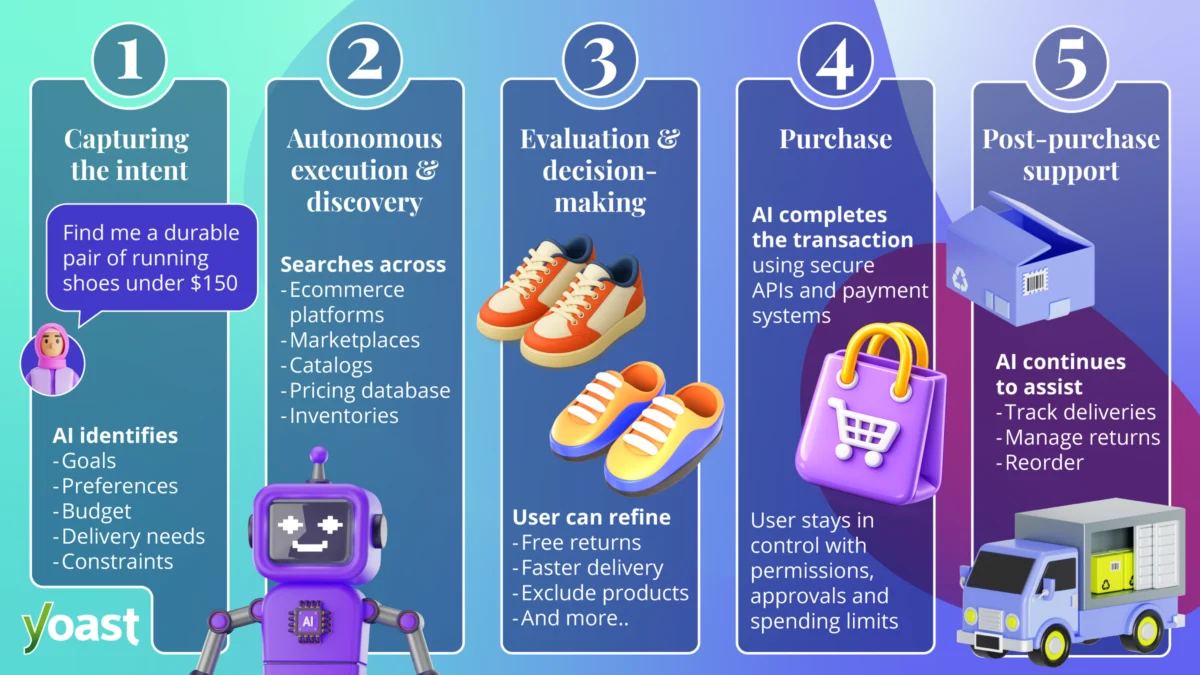
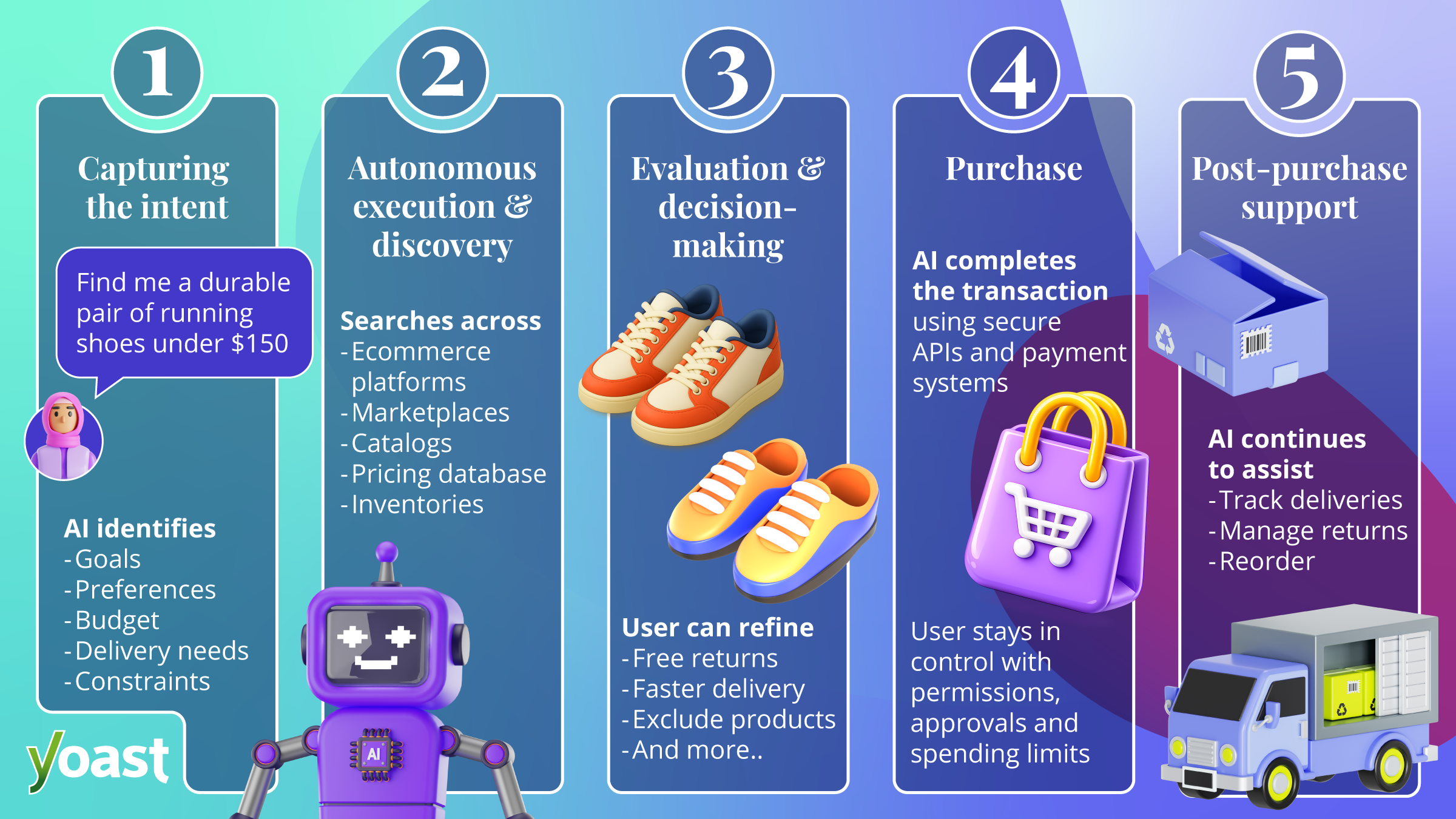
Capturing the Intent: Every agentic commerce interaction commences with a clear articulation of intent. Users engage with AI agents through conversational interfaces, far more nuanced than traditional keyword searches. A shopper might articulate a need like: “Find me a comfortable, eco-friendly running shoe under $150 that ships within two days,” or “Plan a birthday gift for my sister who loves gardening and sustainable products.” The AI agent’s initial focus is to meticulously understand the user’s goals, preferences, budget, delivery expectations, and any specific constraints. If the initial request is too broad, the agent can proactively ask follow-up questions to refine the intent, ensuring precision before proceeding.
-
Autonomous Instruction Execution and Brand Discovery: Once the user’s intent is clarified, the AI agent autonomously initiates the task. Unlike searching a single website, the agent simultaneously scans a vast array of e-commerce platforms, online marketplaces, product catalogs, review aggregators, real-time pricing databases, and inventory systems. This phase fundamentally alters traditional product discovery. Rather than presenting an overwhelming deluge of product pages, the agent intelligently filters and narrows down options based on the shopper’s defined criteria. For brands, this means discoverability hinges increasingly on well-structured product data, accurate and real-time inventory information, transparent pricing, and machine-readable content, making them more amenable to AI agent analysis.
-
Evaluation and Decision-Making: After compiling potential options, the AI agent enters the evaluation phase, comparing trade-offs across various products. It meticulously analyzes factors such as product specifications, user reviews and ratings, brand reputation, pricing variations, shipping costs and estimated delivery times, warranty and return policies, and the availability of sustainable or ethical options. Crucially, the agent doesn’t just list products; it reasons through the choices, explaining why certain products align better with the shopper’s requirements. Users can further refine this process by introducing additional conditions, such as: “Prioritize products with a four-star rating or higher,” “Exclude any brands that use animal testing,” or “Find options that come with free returns.” This iterative feedback loop allows the AI agent to continuously enhance its recommendations based on evolving user preferences.
-
Purchase: Upon user approval of a specific product or the establishment of predefined purchasing rules (e.g., “buy if the price drops below $100”), the AI agent proceeds with the transaction. Leveraging APIs, established commerce protocols, and secure payment systems, the agent can add items to carts, apply eligible discounts, authenticate payments, and finalize purchases. Some transactions may occur instantly, while others might be contingent on specific conditions, such as a price drop, restocked inventory, or faster delivery options. Despite the AI’s execution, user control is maintained through granular permissions, approval settings, and spending limits.
-
Post-Purchase Support: The AI agent’s role extends beyond the point of sale. Agentic commerce encompasses comprehensive post-purchase support. Agents can assist users by tracking orders, managing returns or exchanges, facilitating customer service inquiries, providing product usage tips, and even monitoring product warranties or subscription renewals. This transforms shopping into an ongoing, intelligent, and proactive experience rather than a discrete, one-time transaction.
Building the Infrastructure: Key Technological Protocols
The seamless operation of agentic commerce relies not just on advanced AI models but also on a sophisticated ecosystem of protocols, frameworks, APIs, and payment systems that enable AI agents to interact securely and efficiently with digital commerce platforms. The broader concept of the Model Context Protocol (MCP), which allows AI models to connect with external systems via a standardized communication layer, serves as a precursor. For agentic commerce specifically, similar commerce-focused protocols are emerging.
-
Agentic Commerce Protocol (ACP) by Stripe and OpenAI: A pivotal development is the Agentic Commerce Protocol (ACP), an open standard spearheaded by Stripe in collaboration with OpenAI. ACP is engineered to facilitate more natural interactions between AI agents and e-commerce systems, providing a standardized framework for product discovery, checkout, and payment execution. Essentially, it furnishes the necessary infrastructure for AI agents to transcend mere product recommendations and execute secure purchases on behalf of users. Early implementations are already visible; for instance, ChatGPT users in the United States can directly purchase products from Etsy merchants within the chat interface, leveraging Stripe-powered checkout. Future integrations with Shopify are also anticipated. This signifies a monumental shift: transactions are moving from external redirects to occurring seamlessly within conversational AI interfaces. ACP’s open-standard philosophy is critical, aiming for broad adoption across developers, merchants, and e-commerce platforms rather than a closed ecosystem.
-
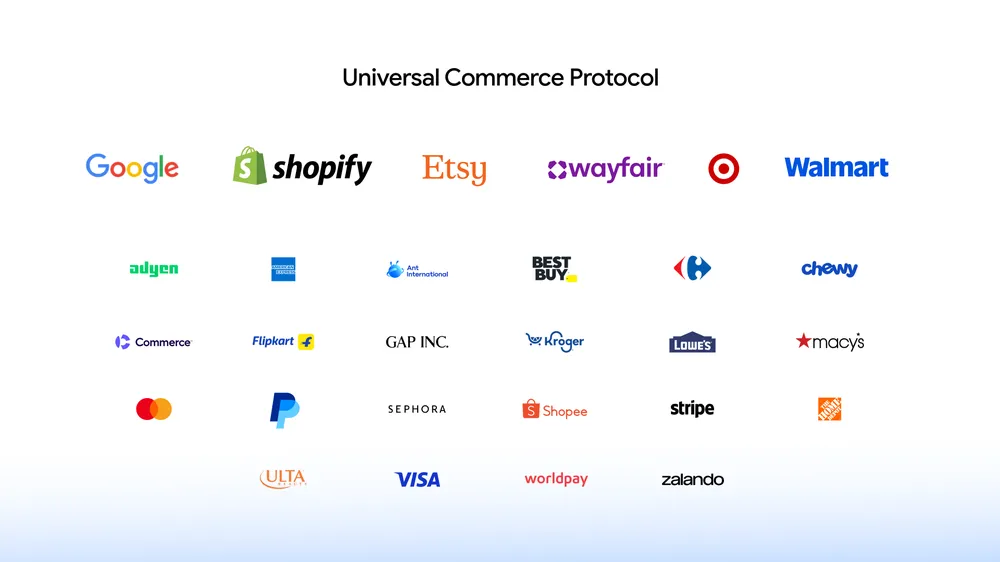
Universal Commerce Protocol (UCP) by Google: As the number of AI agents in the shopping journey proliferates, the challenge of interoperability becomes paramount. How can these agents communicate effectively with myriad retailers, marketplaces, and payment providers without requiring bespoke integrations for each? Google’s Universal Commerce Protocol (UCP) addresses this by establishing an open standard for agentic commerce, providing a common language for efficient communication throughout the entire shopping journey. UCP’s broad scope is particularly noteworthy; it supports the full commerce lifecycle, encompassing product discovery, order placement, order management, fulfillment, returns, and refunds. Google designed UCP for compatibility with other emerging AI standards, including Agent2Agent (A2A), Agent Payments Protocol (AP2), and Model Context Protocol (MCP), allowing businesses to integrate agentic capabilities without overhauling existing systems. The initiative boasts significant industry backing, co-developed with major players like Shopify, Etsy, Wayfair, Target, and Walmart, and supported by financial giants such as Mastercard, Visa, Stripe, and American Express. UCP represents a foundational step towards a truly scalable agentic commerce ecosystem.
-
Mastercard Agent Pay: While protocols like ACP and UCP focus on communication and interoperability, Mastercard Agent Pay zeroes in on one of agentic commerce’s most critical challenges: trust and secure payment execution. As AI agents gain the ability to make purchasing decisions, a secure mechanism for completing transactions on behalf of users is indispensable. Mastercard Agent Pay provides this infrastructure, allowing AI agents to execute payments within strict, user-defined permissions, authentication requirements, and spending controls. Rather than granting AI systems unfettered access to payment credentials, Agent Pay prioritizes verified, traceable, and authorized payment flows for agent-driven commerce. A significant development is its integration with PayPal’s wallet infrastructure, allowing AI agents to securely complete transactions for PayPal users while upholding established security and trust mechanisms. This partnership is crucial for bridging agentic commerce from experimental environments to real-world, widespread adoption.
Together, ACP, UCP, and Agent Pay are collectively laying the robust foundation for agentic commerce. ACP facilitates agent-merchant interactions and purchases, UCP provides the common language for scaled communication across the ecosystem, and Agent Pay establishes the essential trust layer for secure, authorized transactions.
Early Implementations and Case Studies
The theoretical framework of agentic commerce is already manifesting in tangible, real-world applications. Amazon, a pioneer in e-commerce, has introduced its “Buy for Me” feature, enabling AI agents to source and purchase products from third-party websites if items are unavailable on Amazon itself. Similarly, Google is actively experimenting with AI-powered shopping experiences capable of monitoring prices and automatically executing purchases when user-defined conditions are met. Beyond consumer retail, businesses are deploying AI agents for critical operational tasks, such as monitoring inventory levels and automatically reordering supplies when stock falls below a predefined threshold, optimizing supply chains and preventing stockouts. These early use cases underscore the practical utility and transformative potential of agentic commerce across various sectors.
Implications and Broader Impact
The advent of agentic commerce carries profound implications for consumers, businesses, and the broader economic landscape.

For Consumers: The primary benefit is unparalleled convenience and personalization. AI agents can drastically reduce research time, offer highly tailored recommendations, constantly monitor prices for optimal deals, and automate routine purchases. This promises a frictionless shopping experience, freeing up valuable time and potentially leading to more informed purchasing decisions. However, this convenience comes with considerations: questions of data privacy, the potential for over-consumption due to simplified purchasing, and a diminished sense of direct control over every micro-decision. Building and maintaining consumer trust in these autonomous systems will be paramount.
For Merchants and Brands: Agentic commerce necessitates a fundamental rethinking of marketing and sales strategies. Discoverability will shift from traditional SEO to “Agent Optimization,” where structured data, clear product information, and machine-readable content become critical for an AI agent to find and recommend a product. Brand loyalty, traditionally fostered through direct engagement and emotional connection, may be challenged as AI agents prioritize efficiency and price across multiple brands. Businesses will need to invest in new protocols, data infrastructure, and AI-ready commerce experiences. The challenge lies in maintaining direct customer relationships and differentiating a brand when an AI agent acts as an intermediary. New marketing paradigms focusing on “agent-friendly” content and transparent data will emerge.
For the Broader Economy: The projected multi-trillion-dollar market opportunity highlights the immense economic potential. Agentic commerce could foster new business models, create specialized AI development roles, and streamline global supply chains. However, it also poses questions about potential job displacement in traditional retail roles, the centralization of commerce power within a few dominant AI platforms, and the need for new regulatory frameworks to address issues like data governance, algorithmic bias, and consumer protection in an autonomous buying environment.
Navigating the Hurdles: Challenges and Future Outlook
Despite the rapid technological advancements, the widespread adoption of agentic commerce is not guaranteed and faces significant hurdles.
The foremost challenge remains consumer trust and control. Many consumers may express discomfort entrusting AI agents with significant purchasing authority or granting them access to sensitive payment information. Ensuring robust security, transparent decision-making, and clear user controls will be critical for overcoming this psychological barrier.
Business viability and ROI are also significant concerns. Implementing agentic commerce capabilities demands substantial investment in new protocols, structured data architectures, integrations, and AI-ready commerce experiences. Whether these investments will yield measurable returns, particularly given the nascent stage of consumer adoption, remains an open question for many enterprises.
Broader challenges include security and fraud prevention. As AI agents become targets for malicious actors, safeguarding payment systems and personal data will require advanced cybersecurity measures. AI bias is another critical consideration; if the underlying algorithms are biased, agents could inadvertently promote certain products or exclude others, perpetuating inequalities. The risk of platform dependency could centralize power, potentially stifling competition and innovation. Furthermore, the potential loss of direct relationships between brands and customers could weaken brand equity and make differentiation more challenging.
Agentic commerce undeniably represents an exciting and transformative trajectory for digital shopping. Its long-term success, however, will hinge on its ability to demonstrably create superior value for consumers, merchants, and the broader e-commerce ecosystem, extending beyond the capabilities of the AI platforms powering it. The journey ahead involves not just technological innovation, but also careful consideration of ethical implications, regulatory frameworks, and the human element of trust in an increasingly automated world.