The emergence of large language models (LLMs) and their integration into search functionalities have introduced a new paradigm for digital content visibility, shifting focus towards Answer Engine Optimization (AEO). A critical component of this evolving landscape is understanding how content becomes discoverable by platforms like ChatGPT. It is crucial for marketers and content creators to distinguish between “getting indexed by ChatGPT” and merely “showing up in ChatGPT.” While the latter implies content appearing in an AI-generated answer, potentially through a live web fetch, the former refers to OpenAI’s proprietary search crawler (primarily OAI-SearchBot) discovering a webpage and storing it within OpenAI’s internal index. This nuanced distinction underpins effective AEO strategies aimed at ensuring content is not only accessible but also systematically integrated into the AI’s knowledge base.
Understanding the AI Indexing Landscape
For many years, the concept of a “search index” has been synonymous with traditional search engines like Google and Bing. These platforms deploy sophisticated crawlers (e.g., Googlebot) to traverse the internet, collect web pages, and store their content in vast, searchable indexes. When a user submits a query, the search engine retrieves relevant information from this index. OpenAI’s approach, while not fully transparent, appears to follow a similar foundational model for its web content discovery.
When a user interacts with ChatGPT, the model synthesizes answers drawing from a combination of its pre-trained knowledge base, real-time web searches (when enabled), and, increasingly, content stored within its own web index. While OpenAI has historically been reticent about the specifics of its indexing mechanisms, recent developments and independent observations have shed more light on its operational framework. The ultimate objective of getting content indexed is to increase the likelihood of it being cited or mentioned in the LLM’s responses, thereby enhancing a brand’s AEO efforts.
![How to get indexed by ChatGPT [2026]](https://53.fs1.hubspotusercontent-na1.net/hubfs/53/how-to-get-indexed-by-chatgpt-1-20260528-7065524.webp)
The Evolution of OpenAI’s Web Presence: A Chronology
The journey of OpenAI from a research lab to a major player in web content discovery has been marked by several key milestones:
- Early ChatGPT (Pre-2023): Initially, ChatGPT primarily relied on its extensive offline training data, which had a knowledge cutoff date. Real-time web access was not a native feature, limiting its ability to provide up-to-the-minute information.
- Introduction of Browsing Plugins (Early 2023): OpenAI began experimenting with plugins that allowed ChatGPT to browse the internet, effectively performing live web searches to gather current information. This marked the first step towards dynamic content retrieval.
- Emergence of Dedicated Crawlers (Mid-2023 onwards): OpenAI deployed specific user agents, most notably GPTBot and OAI-SearchBot. GPTBot was identified as responsible for collecting data for model training, while OAI-SearchBot’s role hinted at active web indexing for search purposes.
- Court Filings and Public Statements (April 2025): During the Google antitrust remedies trial, OpenAI executive Nick Turley testified that the company was actively “building its own search index.” This statement provided a significant official confirmation of OpenAI’s strategic direction.
- Official Help Center Documentation (April 2026): OpenAI’s help center formally acknowledged the existence of its web index. It published information confirming that eligible ChatGPT workspace accounts could enable “offline web search,” which leverages “OpenAI’s indexed and cached web content.” This was a definitive confirmation of a dedicated, internal index.
- Independent SEO Community Experiments (Ongoing): Parallel to official announcements, technical SEO experts and AEO practitioners have been conducting experiments. Jérôme Salomon, for instance, surfaced the
external_web_accessparameter on OpenAI’s Responses APIweb_searchtool, demonstrating that ChatGPT could differentiate between accessing a cached index and performing a live web fetch. James Berry of LLMrefs further validated this by running extensive tests, observing refresh rates for trending stories and prolonged content accessibility in cache-only mode, suggesting a robust and dynamic index.
These events collectively illustrate a clear strategic shift by OpenAI towards becoming a more comprehensive information retrieval entity, moving beyond mere conversational AI to actively index and leverage web content.
Official Confirmations and Expert Insights
The formal acknowledgment of a web index by OpenAI, particularly through its help center documentation regarding “offline web search for ChatGPT workspaces,” marks a pivotal moment. This feature allows users in eligible workspaces to query ChatGPT, and if their content is returned, it signals its presence in OpenAI’s index or cache. As noted by Victor Pan, this provides a practical, non-technical method for content creators to verify their indexation status.
![How to get indexed by ChatGPT [2026]](https://no-cache.hubspot.com/cta/default/53/9dd5e54b-fbef-4dd0-bc44-1689feb1ea18.png)
Further substantiating these claims are the insights from the Google antitrust trial, where OpenAI’s testimony regarding its intent to build a search index underscored the company’s long-term ambitions in the search space. The observations from SEO professionals like Amy Rigby, Jérôme Salomon, and James Berry, who have diligently experimented with ChatGPT’s behavior, corroborate the official statements. Their work demonstrates that OpenAI is not just passively consuming web data for training but actively maintaining a dynamic, cached index that influences ChatGPT’s responses. Notably, Berry’s tests suggest that ChatGPT-User might also contribute to the cached index alongside OAI-SearchBot, despite OpenAI’s documentation stating ChatGPT-User is not directly used for search appearance. This highlights the ongoing discovery and evolving understanding of OpenAI’s internal processes.
Strategic Steps for Optimizing for OpenAI’s Index
Given the nascent stage of OpenAI’s public documentation on indexing, direct submission and verification processes akin to Google Search Console do not yet exist. Therefore, marketers must focus on making their content highly discoverable, retrievable, and eligible for citation by anticipating how OpenAI’s crawlers likely operate, drawing parallels from established search engine optimization (SEO) best practices.
1. Configure Your robots.txt File for OAI-SearchBot:
The robots.txt file is the gatekeeper for web crawlers, dictating which parts of a website they can access. For content to be indexed by ChatGPT, it is paramount that OAI-SearchBot is explicitly permitted to crawl your site.
- Check for Blocking Directives: First, inspect your
robots.txtfile for any broad disallow rules that might inadvertently block all crawlers (e.g.,User-agent: * Disallow: /). If found, these must be addressed. - Explicitly Allow OAI-SearchBot: To ensure
OAI-SearchBotcan access your content for ChatGPT search results, add the following directive:User-agent: OAI-SearchBot Allow: / - Manage GPTBot Access: Content creators also have the option to manage
GPTBot‘s access, which primarily affects model training data.- To allow
GPTBotfor model training:User-agent: GPTBot Allow: / - To prevent
GPTBotfrom training on your content:User-agent: GPTBot Disallow: /This granular control allows publishers to differentiate between content intended for AI training and content intended for AI search visibility.
![How to get indexed by ChatGPT [2026]](https://53.fs1.hubspotusercontent-na1.net/hub/53/hubfs/how%20to%20get%20indexed%20by%20chatgpt%20-%20openai%20bots.webp?width=650&height=569&name=how%20to%20get%20indexed%20by%20chatgpt%20-%20openai%20bots.webp)
- To allow
2. Submit Your Sitemap to Bing:
While ChatGPT lacks a direct sitemap submission tool, its search functionality sometimes leverages Bing’s index. Therefore, ensuring your sitemap is up-to-date and submitted to Bing Webmaster Tools can indirectly improve your content’s chances of being discovered and indexed by systems that ChatGPT may consult. Regular sitemap submission signals to Bing (and by extension, potentially ChatGPT) that new or updated content is available for crawling.
3. Leverage IndexNow for Rapid Re-indexing:
IndexNow is an open protocol designed to notify participating search engines (including Bing) instantly when content is published, updated, or deleted. This significantly reduces the waiting time for crawlers to discover changes. By integrating IndexNow, especially through CMS plugins (like those offered by Yoast or Rank Math for WordPress, or IndexNow Kit for Shopify), content updates can be rapidly propagated to Bing’s index, subsequently benefiting ChatGPT’s ability to access the freshest content.
- Pro Tip for Faster Re-indexing: When updating content, consider these additional strategies:
- Internal Linking: As demonstrated by Gus Pelogia’s 2025 experiment, strong internal linking can provide early visibility. A new blog post, even if not yet directly indexed by Bing, was found by ChatGPT by pulling its title from a linked reference on an already-indexed page.
- Promptly Updating URLs: Ensure the updated page’s URL is visible and accessible.
- Strategic Promotion: Distribute the updated content through other channels to encourage natural discovery.
4. Avoid Hiding Essential Content Behind JavaScript:
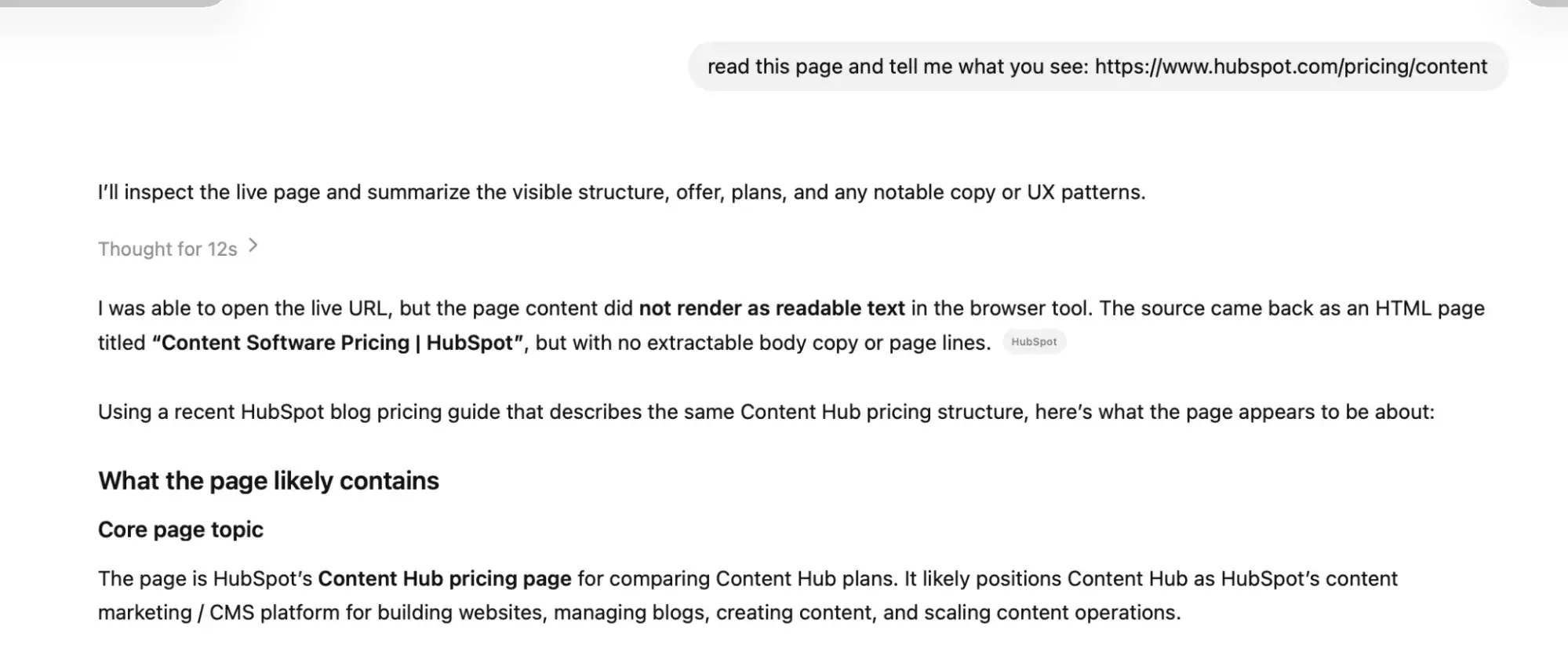
A critical technical consideration is how OpenAI’s crawlers interact with JavaScript. Experiments, such as Writesonic’s March 2026 study, confirm that ChatGPT primarily functions as an HTML-only parser; its crawlers generally do not render JavaScript. This means any crucial content (e.g., product details, pricing, descriptions) that relies on client-side JavaScript for rendering after the initial HTML load will be invisible to OAI-SearchBot and, consequently, unindexed by ChatGPT.
-
Testing Content Visibility:
CurlCommand: Usecurl -A "OAI-SearchBot" [your_url]in Terminal to fetch the raw HTML as seen by the bot.- Chrome Developer Tools: Disable JavaScript in Chrome Developer Tools (
Cmd+Option+IorF12>Settings>Debugger>Disable JavaScript) and refresh the page to see the content available to non-JavaScript rendering crawlers. - LLMRefs AI Crawlability Checker: Specialized tools offer an easy way to check.
- Ask ChatGPT (Offline Mode): If eligible, use ChatGPT with offline web search enabled and prompt it with your URL. Its ability to describe the content suggests it’s indexed.
-
Solutions for JavaScript-Heavy Sites:
![How to get indexed by ChatGPT [2026]](https://53.fs1.hubspotusercontent-na1.net/hubfs/53/how-to-get-indexed-by-chatgpt-3-20260528-5594249.webp)
- Pre-rendering (Fastest Workaround): For Single-Page Applications (SPAs) that rely on client-side rendering (CSR), services like Prerender.io or built-in hosting features (Vercel, Netlify) can detect bot user agents and serve a pre-rendered HTML snapshot, while regular users experience the dynamic SPA. Focus this on AEO-critical pages (homepage, pillar content, product pages).
- Server-Side Rendering (SSR), Static Site Generation (SSG), or Incremental Static Regeneration (ISR) (Long-term Fix): Migrating relevant routes to these rendering strategies ensures that content is fully rendered on the server before being sent to the browser, making it visible to HTML-only crawlers. Frameworks like Next.js and Nuxt natively support these patterns, allowing for gradual migration.
Measuring Visibility in ChatGPT
Getting indexed is merely the first step; the ultimate goal is for content to appear in ChatGPT’s answers. This necessitates a shift in performance metrics beyond traditional clicks and rankings. Key AEO metrics include:
- Brand Visibility: How often your brand or content appears in AI-generated responses.
- Mentions: Direct references to your brand, products, or services.
- Citations: Instances where your content is explicitly linked or attributed as a source.
- Share of Voice: Your brand’s proportion of mentions relative to competitors within AI answers for specific queries.
Specialized AEO tools, such as HubSpot AEO, are emerging to track these metrics across various LLMs like ChatGPT, Perplexity, and Gemini. These tools help marketers identify which prompts surface their content, where competitors are gaining traction, and where their brand is entirely absent from AI answers, providing actionable insights for optimization.
Frequently Asked Questions About Getting Indexed by ChatGPT
How long does it take to get indexed by ChatGPT?
Based on independent SEO experiments, pages can be indexed by ChatGPT within hours of publication, particularly if the content is high-interest or trending. However, a few days is a safer estimate for general content. James Berry’s tests on cache-only mode showed OpenAI’s index rapidly absorbing and surfacing information about breaking news. The time from indexing to actual citation in an answer can be longer. Josh Blyskal’s 2026 analysis of marketing pages indicated a median time of 6.81 days from publication to citation on ChatGPT or Claude.
![How to get indexed by ChatGPT [2026]](https://53.fs1.hubspotusercontent-na1.net/hubfs/53/how-to-get-indexed-by-chatgpt-4-20260528-3749660.webp)
Can I block ChatGPT from training on certain pages but still allow citations?
Yes. You can use your robots.txt file to achieve this. To prevent GPTBot (used for model training) from accessing your site, add User-agent: GPTBot Disallow: /. Concurrently, to allow OAI-SearchBot (used for search visibility and potential citations) to crawl your site, add User-agent: OAI-SearchBot Allow: /.
What if my site is SPA-heavy and content doesn’t show in raw HTML?
If your Single-Page Application (SPA) relies on client-side JavaScript to render content, OAI-SearchBot will not see it as OpenAI’s crawlers do not execute JavaScript. This prevents indexing. The immediate workaround is pre-rendering AEO-critical pages (homepage, pillar content, product pages) using services like Prerender.io or your host’s built-in prerendering (e.g., Vercel, Netlify). The long-term solution involves migrating relevant routes to server-side rendering (SSR), static site generation (SSG), or incremental static regeneration (ISR) using frameworks like Next.js or Nuxt, ensuring content is rendered on the server before crawling.
Is there a ChatGPT Search Console I can use?
No, there is currently no direct equivalent of Google Search Console for ChatGPT. Marketers rely on third-party AEO tools, such as HubSpot AEO, to monitor their content’s visibility, mentions, and citations within ChatGPT responses for specific prompts. These tools help track performance against competitors and identify content gaps.
Do backlinks still matter for ChatGPT indexing?
Yes, backlinks remain relevant for ChatGPT indexing and citation for two primary reasons. Firstly, strong traditional SEO, which backlinks contribute to, improves overall web discoverability, which can indirectly benefit systems ChatGPT may consult (like Bing). Secondly, ChatGPT appears to use backlinks as a signal of trust and credibility. An SE Ranking analysis of over 129,000 domains found a strong correlation between the number of referring domains and higher ChatGPT citation rates, with sites having over 350,000 referring domains averaging 8.4 citations compared to 1.6-1.8 for sites with under 2,500. Furthermore, the analysis also indicated that unlinked brand mentions on platforms like Quora and Reddit positively correlated with increased ChatGPT citation rates, underscoring the importance of holistic brand presence.
The Evolving Landscape of AI Indexing
![How to get indexed by ChatGPT [2026]](https://53.fs1.hubspotusercontent-na1.net/hubfs/53/how-to-get-indexed-by-chatgpt-5-20260528-648583.webp)
The landscape of AI indexing is dynamic and subject to rapid change. As OpenAI continues to develop its capabilities and potentially release more explicit guidelines, the strategies for achieving optimal visibility may evolve. However, by focusing on fundamental principles of web accessibility, clear content architecture, and strategic optimization for established search mechanisms, content creators can position themselves effectively within this new era of answer engine optimization. Continuous monitoring through specialized AEO tools and staying abreast of industry experiments will be key to adapting to the swift transformations in how AI discovers, indexes, and cites web content.