
 rifanmuazin
The relentless flood of digital communication ensures that every Monday morning inbox is a battleground, where dozens of new messages vie for attention. In this competitive landscape, the precise timing of an email dispatch can be the singular determinant between immediate engagement and perpetual obscurity. Far from a mere convenience, strategic email timing has emerged as a critical discipline, directly influencing open rates, click-through rates, and ultimately, conversion metrics for businesses across sectors.
Industry-wide analysis, compiled from years of extensive data, consistently reveals that while no single “magic hour” exists for all audiences, clear trends delineate optimal windows for maximizing email effectiveness. These trends are not static; they reflect evolving digital habits, work rhythms, and consumer behavior. Understanding and leveraging these patterns allows marketers to position their messages for peak visibility and action. This comprehensive analysis delves into the prevailing best practices for email send times, offering a day-by-day breakdown, insights into leveraging proprietary data via tools like GA4, and a strategic overview of timing by campaign objective.
The Foundational Principles of Email Timing
For the vast majority of businesses, a common thread runs through the data: the optimal period for email distribution typically falls between 9:00 AM and 11:00 AM in the recipient’s local time zone. This window capitalizes on a universal behavioral pattern: individuals initiating their workday routines, settling in, and processing initial email backlogs. This post-morning-rush, pre-lunch timeframe often represents a period of focused attention, making recipients more receptive to new information or offers.
The rationale behind the importance of timing is multi-faceted:
- Inbox Saturation: Sending an email during peak activity hours significantly reduces the chance of it being buried under an avalanche of less strategically timed messages.
- Cognitive Load: Early morning (before 8 AM) often finds recipients dealing with urgent operational emails, making them less receptive to marketing messages. Late afternoon sees attention wane as individuals prepare to conclude their workday.
- Actionability: Timely delivery aligns with moments when recipients are most likely to act on a message – whether it’s making a purchase, registering for an event, or consuming content.
A Weekly Engagement Cycle: Day-by-Day Optimizations
While the 9 AM to 11 AM window serves as a robust baseline, a deeper dive into daily specifics reveals nuanced opportunities to fine-tune outreach. These recommendations are derived from aggregated data from millions of emails sent across various platforms, offering a powerful starting point for any email marketing strategy.
Monday: Navigating the Week’s Onset
Recommended Time: 10:00 AM – 12:00 PM local time
Mondays are characterized by a surge in email activity as professionals and consumers alike catch up after the weekend. However, the very first hours of the workday (8:00 AM – 9:00 AM) can be overwhelming, with inboxes filling rapidly with urgent tasks and communications. Sending too early risks your message being lost in this initial rush. Aiming for the late morning, around 10:00 AM to 12:00 PM, allows time for the initial deluge to subside, placing your email in a clearer, more receptive viewing window. This timing leverages the recipient’s refreshed mindset after the weekend, but only once critical initial tasks have been addressed. For businesses announcing new features, launching a weekly newsletter, or sharing important updates, a 10:30 AM dispatch often yields superior visibility and engagement. Modern email platforms, such as AWeber, offer sophisticated scheduling tools that allow marketers to precisely target these windows, even accommodating diverse subscriber time zones.
Tuesday: The Pinnacle of Productivity
Recommended Time: 9:00 AM – 11:00 AM local time
Multiple large-scale studies, including those by industry leaders like HubSpot and Mailchimp, consistently identify Tuesday as the top day for email open rates and overall engagement. By Tuesday, individuals have typically settled into the workweek, completed urgent Monday tasks, and reached a peak in productivity. Their focus is generally high, and they are more receptive to new information, offers, and professional communications.
- Pro Tip for B2B: For business-to-business audiences, aiming for 9:30 AM can be particularly effective, aligning with the mid-morning focus after initial team meetings and planning.
- Pro Tip for B2C: Consumer-focused emails often see better traction closer to 11:00 AM, as individuals might be taking a short break before lunch or engaging in non-work-related browsing.
The high productivity and settled routines of Tuesday make it an ideal day for critical announcements, core content distribution, or significant promotional campaigns that require focused attention.

Wednesday: Sustained Mid-Week Engagement
Recommended Time: 8:00 AM – 11:00 AM local time
Wednesday remains a reliably strong day for email engagement, often mirroring Tuesday’s performance with slightly less inbox competition. The mid-morning window continues to be highly effective, as recipients maintain their work rhythm. This day is well-suited for follow-up communications, educational content, or nurturing campaigns designed to keep subscribers engaged through the middle of the week. While not always as potent as Tuesday for initial opens, Wednesday often boasts strong click-through rates as recipients delve deeper into content.
Thursday: Driving Action Before the Weekend
Recommended Time: 9:00 AM – 12:00 PM local time
Thursday functions much like Tuesday in terms of high activity and receptiveness, especially as individuals prepare for the approaching weekend. This day consistently ranks as one of the best for email-driven orders and conversions across various studies. Recipients are still actively focused on work and planning but haven’t yet mentally transitioned to weekend mode. This makes Thursday an exceptionally strong choice for promotional campaigns, calls-to-action, or content designed to drive immediate purchases or registrations. A timely and relevant email can stand out, prompting action before the end-of-week slowdown.
Friday: The Weekend Transition
Recommended Time: 9:00 AM – 10:00 AM or early afternoon (1:00 PM – 2:00 PM) local time
As the workweek draws to a close, email engagement patterns shift significantly. By late Friday afternoon, attention invariably drifts towards the weekend, leading to a noticeable drop-off in open and click-through rates for many business types. To counter this, marketers should aim to send critical messages early in the day, ideally between 9:00 AM and 10:00 AM, to capture attention before the mental shift occurs.
However, for consumer-based audiences (e.g., retail, hospitality, entertainment), a pre-weekend email sent just after lunch (1:00 PM – 2:00 PM) can be highly effective. This timing taps into the desire for weekend planning, prompting last-minute purchases, bookings, or event registrations. The content for Friday emails should ideally be lighter, more engaging, or directly related to weekend activities.
Saturday: Leisure and Lifestyle Focus
Recommended Time: 10:00 AM – 12:00 PM local time
Saturday generally represents the lowest-performing day for most business-to-business (B2B) communications. However, for consumer-oriented businesses (e-commerce, fitness, entertainment, news media), Saturday can offer unique opportunities. During late morning (10:00 AM – 12:00 PM), many individuals are awake, relaxed, and casually browsing their devices before committing to weekend activities. Messages that align with leisure, lifestyle, or personal interests can see reasonable engagement during this window, benefiting from reduced professional inbox competition. Content should be light, engaging, and directly relevant to weekend consumption or planning.
Sunday: Pre-Week Preparation and Reflection
Recommended Time: 9:00 AM – 12:00 PM, or after 8:00 PM local time
Sunday presents a dual opportunity for email marketers. Many individuals use their Sunday mornings to casually skim emails over coffee, making the 9:00 AM – 12:00 PM window viable for relaxed content. More intriguingly, research reveals a “Sunday night effect,” where email opens peak around 9:00 PM. This phenomenon is attributed to individuals checking their inboxes to prepare for the upcoming workweek, seeking to clear their digital slate before Monday morning. For businesses experimenting with unconventional timing, testing late Sunday evenings can yield surprisingly high open rates, particularly for content that helps recipients organize, plan, or anticipate the week ahead. This can be effective for productivity tips, weekly summaries, or pre-emptive announcements.
Beyond Averages: Unearthing Your Audience’s Unique Rhythm with GA4
While industry averages provide an invaluable roadmap, the ultimate authority on optimal send times resides in your own audience’s behavior. Leveraging analytical tools like Google Analytics 4 (GA4) allows marketers to move beyond generalized trends and pinpoint when their specific subscribers are most active on their website—a strong proxy for email receptiveness.
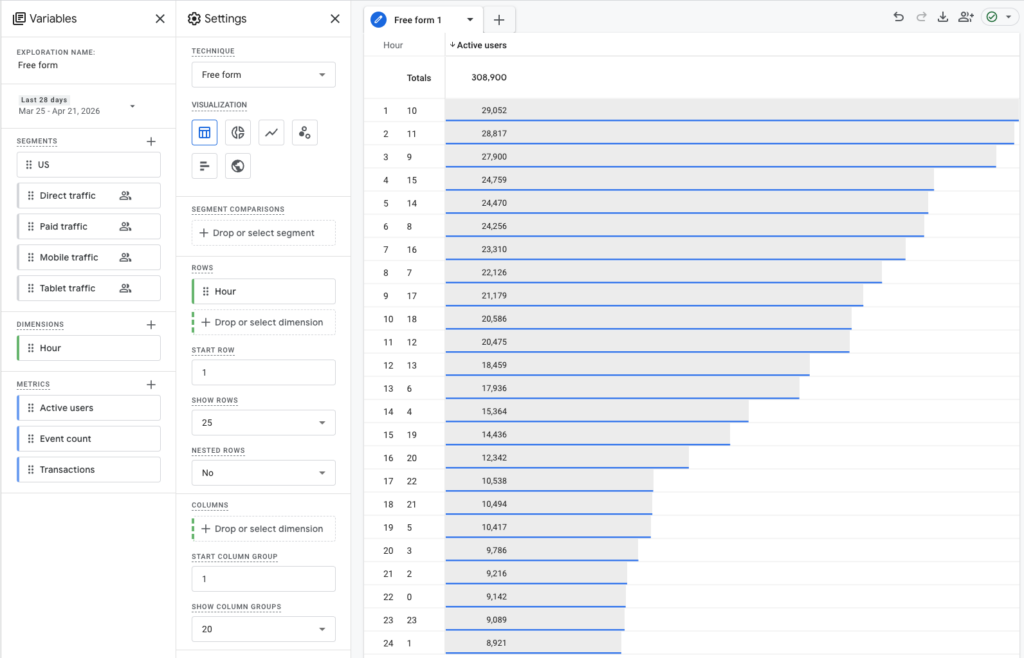
The process is straightforward and yields audience-specific data:
- Access GA4 Exploration Reports: From the left-hand navigation menu within your GA4 property, select “Explore” and initiate a new blank exploration. This powerful feature allows for custom data visualization and analysis.
- Integrate the ‘Hour’ Dimension: In the “Variables” panel, click the ‘+’ icon next to “Dimensions.” Search for “Hour,” which GA4 records as a numerical value from 0 (midnight) to 23 (11 PM). Drag this dimension into your exploration canvas. For a more granular view, consider adding “Day + hour” to cross-reference activity by specific days of the week.
- Select a Key Metric: Under the “Metrics” section, add “Sessions” or, more powerfully, “Engaged sessions.” “Engaged sessions” provides a more accurate representation of active user interaction, filtering out brief, non-committal visits. By visualizing these metrics against the “Hour” dimension, you can clearly observe the peaks and valleys of your website traffic throughout a typical 24-hour cycle.
- Analyze and Interpret: The resulting chart or table will vividly display when your audience is most active on your site. For instance, if your GA4 data indicates that website traffic peaks between 9 AM and 11 AM, this strongly suggests that sending emails during this window will align with your audience’s existing online habits, increasing the likelihood of immediate engagement.
This bespoke analytical approach, taking approximately 15 minutes to configure, provides a data-driven foundation for email scheduling that is tailored precisely to your unique subscriber base, offering a significant advantage over generic industry benchmarks.
Goal-Oriented Timing: Aligning Dispatch with Campaign Objectives
Beyond general newsletters, the optimal send time can also vary significantly based on the specific goal of the email campaign. Different objectives demand different timing strategies to maximize their impact.
- Sales or Promotional Campaigns: For driving immediate sales or promoting special offers, early-to-midweek and mid-morning remain the strongest periods. Avoid launching major promotions late on Friday or over the weekend unless your product or service is explicitly consumer-based and aligns with weekend activities. Interestingly, some data suggests that late afternoon, around 4:00 PM, can sometimes drive stronger order rates for e-commerce-type sends, possibly catching recipients during a brief lull or end-of-day browsing. It’s a worthwhile window to A/B test for specific promotional campaigns.
- Event Reminders: Timing is paramount for event-related communications. A primary reminder should be sent approximately 24 hours before the event, allowing recipients to plan and incorporate it into their schedule. A crucial “last call” reminder, designed to prompt immediate attendance, should follow one to two hours before the event commences.
- Newsletters or Educational Content: For content-rich emails such as newsletters, blog digests, or educational resources, Tuesday or Thursday late morning consistently delivers the highest engagement rates. These days capitalize on peak productivity and attentiveness, ensuring that valuable content is consumed rather than merely opened.
For comprehensive guidance on optimizing content and strategy, resources like AWeber’s email newsletter best practices guide offer deeper insights into crafting effective email campaigns.
The Continuous Loop: Testing, Refining, and Iterating
The journey to discovering your absolute best email send time is not a one-off task but an ongoing process of experimentation and refinement. A dynamic approach is essential to adapt to evolving audience behaviors and market conditions.
- Harness Your Email Service Provider (ESP) Analytics: Your ESP’s built-in reports are a goldmine of information. Regularly review open rates, click-through rates, and conversion metrics, segmenting by send time and day. This direct feedback from your subscribers is your most reliable signal.
- Segment by Time Zone: For geographically dispersed audiences, scheduling emails in the recipient’s local time zone is a non-negotiable best practice. Most advanced ESPs offer this functionality, ensuring that your 10 AM send reaches subscribers in New York, London, and Sydney at their respective 10 AM.
- Implement A/B Testing: Design A/B tests to compare the performance of the same email sent at two different times to distinct, equally sized segments of your audience. For example, send one version at 9 AM and another at 11 AM on the same day. Analyze which time yields superior results across your key metrics. Over time, this systematic testing builds a robust understanding of your audience’s preferences.
- Monitor and Iterate Relentlessly: Email marketing is a living strategy. External factors such as seasonal shifts, holidays, new product launches, or even changes in audience demographics can influence optimal timing. Continuously monitor your performance, draw insights from your data, and be prepared to adjust your send schedule accordingly. If your analytics reveal a consistent pattern of high engagement at an unconventional time, such as 8 PM, adapt your strategy to capitalize on that unique behavior.
Ultimately, truly successful email timing is a reflection of your readers’ specific habits and preferences, not merely adherence to broad industry benchmarks. A data-driven, iterative approach ensures that your emails consistently land when they are most likely to be seen, read, and acted upon.
Conclusion: The Data-Driven Imperative
In the congested digital landscape, the difference between an email that merely lands in an inbox and one that truly resonates often boils down to precise timing. The collective wisdom of years of email marketing data points to clear windows of opportunity: primarily mid-morning on weekdays, with Tuesday and Thursday standing out as exceptionally strong contenders. However, these averages serve as a foundational starting point, not an immutable law.
The true mastery of email send timing lies in a three-pronged approach: a deep understanding of your audience, strategic utilization of proven optimal windows, and a commitment to rigorous, data-driven testing. Tools like GA4 empower marketers to move beyond generic recommendations, providing invaluable insights into when their specific audience is most active and receptive. By aligning your send schedule with these unique behavioral patterns, backed by continuous A/B testing and analytical monitoring, you transcend the guesswork and ensure your emails consistently cut through the noise, driving tangible engagement and achieving desired business outcomes. This commitment to data-informed strategy is precisely when your emails get read, clicked, and converted.









