rifanmuazin
The global digital landscape has reached a point of saturation where incremental improvements in user experience often dictate the difference between market leadership and obsolescence. As organizations strive to refine their digital products, the debate over how to execute experimentation has intensified, centering on a fundamental choice: the adoption of sophisticated A/B testing software tools or the engagement of specialized experimentation services. While software tools provide the infrastructure for internal teams to run and manage experiments, services offer expert-led strategies that prioritize immediate results and specialized knowledge. This decision shapes not only the immediate conversion rate optimization (CRO) outcomes but also the long-term experimentation maturity and data governance of the enterprise.
The Evolution of the Experimentation Landscape
To understand the current tension between software and services, one must look at the chronology of digital testing. In the early 2000s, A/B testing was a manual, code-heavy process reserved for tech giants like Google and Amazon. By the 2010s, the emergence of Software-as-a-Service (SaaS) platforms democratized testing, allowing non-technical marketers to run simple front-end experiments. Today, the industry has entered a “third wave” of experimentation characterized by server-side testing, feature management, and AI-driven personalization.
As the technical barrier to entry has lowered, the strategic barrier has risen. Modern experimentation is no longer just about changing button colors; it involves testing complex algorithms, pricing structures, and backend logic. This complexity is what drives the current market split. According to industry reports, the global CRO software market is projected to expand at a compound annual growth rate (CAGR) of over 10% through 2030, reflecting a massive shift toward data-driven decision-making.
The Case for Internal Ownership: A/B Testing Software Tools
For organizations aiming to build a sustainable culture of experimentation, software platforms like VWO represent a strategic investment in infrastructure. These tools are designed to give organizations direct control over their testing roadmap. When an experimentation engine is owned internally, it allows cross-functional teams—comprising marketing, product, engineering, and analytics—to collaborate on a unified platform.
Infrastructure for Controlled Innovation
Modern experimentation platforms have evolved into comprehensive feature management systems. Beyond simple split URL testing, these tools provide visual and code editors, feature flags, and remote configuration capabilities. This allows engineering teams to manage feature releases with controlled rollouts and “kill switches.” If a new feature negatively impacts system performance or user behavior, it can be instantly disabled without a full code rollback. This capability significantly de-risks the innovation process.
Behavioral Context and Data Integration
A critical advantage of software tools is the integration of behavioral analytics. Leading platforms now combine heatmaps, session recordings, and form analytics with experimental variations. This provides a “why” behind the “what.” For example, if a variation fails, session recordings might reveal that users were confused by a new navigation element, providing the insight needed for the next iteration. Furthermore, enterprise-grade tools integrate with Customer Data Platforms (CDPs) and analytics suites like Google Analytics 4, ensuring a unified data ecosystem where experiments can be measured against long-term metrics like Customer Lifetime Value (CLV).
The Financial and Institutional Upside
While the upfront implementation of an internal tool requires development effort and staff training, the long-term ROI is often superior. The cost per experiment typically decreases as the team’s proficiency grows. Moreover, the institutional knowledge gained—the deep understanding of what resonates with a specific user base—remains within the company rather than residing with an external vendor.

The Case for Speed and Expertise: A/B Testing Services
Conversely, many organizations find that the fastest route to high-impact results is through an A/B testing agency. This model is particularly attractive to firms that have significant web traffic and a healthy budget but lack the internal headcount or technical specialized roles to manage a rigorous testing program.
Immediate Access to Specialized Talent
An agency typically provides a turnkey team consisting of a CRO strategist, a data analyst, a UI/UX designer, and a front-end developer. This eliminates the “cold start” problem. While an internal team might spend months hiring and training, an agency can begin executing high-priority tests within weeks. Agencies also bring a wealth of external perspective; having worked across various industries, they often have a library of proven hypotheses that can be adapted to a new client’s needs.
Organizational Enablement
Hiring an agency is often a catalyst for cultural change. By delivering “quick wins” and demonstrating the financial impact of data-driven changes, agencies can build the necessary internal buy-in for a permanent experimentation budget. For many firms, an agency serves as a bridge, handling the heavy lifting while internal teams observe and learn the methodologies required to eventually bring the function in-house.
Strategic Decision Factors: A Comparative Framework
Deciding between these two paths requires an honest assessment of an organization’s current resources and future goals.
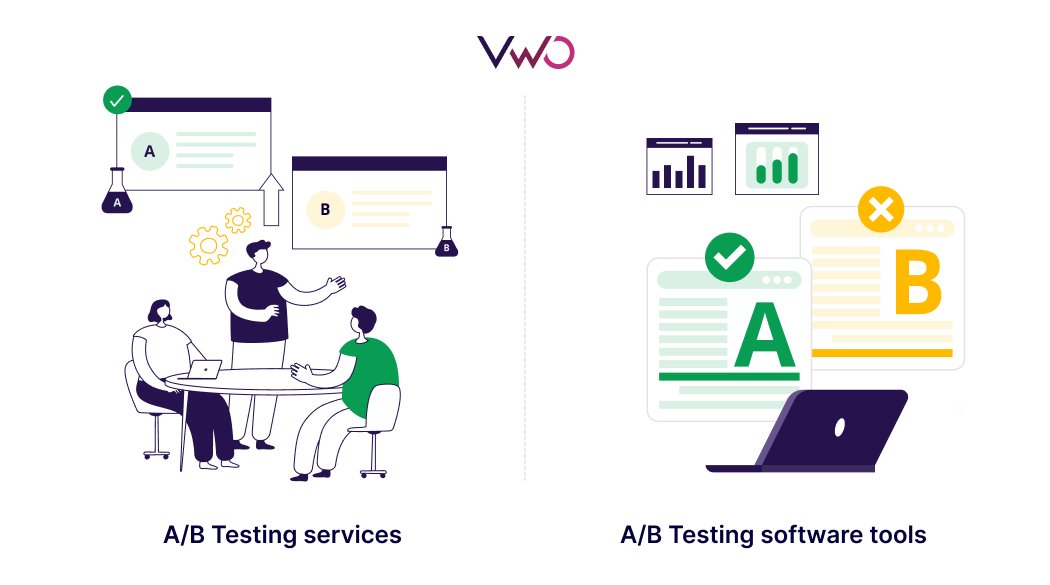
| Strategic Factor | A/B Testing Software/Tools | A/B Testing Services |
|---|---|---|
| Ownership | Fully internal; builds long-term capability | Externalized; expertise resides with agency |
| Velocity | High once internal processes mature | Fast initially; limited by contract scope |
| Data Governance | Full control and unified reporting | Data access may be mediated or fragmented |
| Advanced Features | Includes feature flags, AI, and server-side | Limited to the agency’s chosen toolset |
| Cost Structure | Predictable subscription pricing | Custom pricing; often higher upfront |
| Long-term ROI | Compounds as team maturity grows | Tied to the duration of the engagement |
Traffic Volume and Experiment Complexity
Traffic volume is a primary determinant of success. Organizations with moderate-to-high traffic can benefit from software because they can run multiple tests simultaneously, reaching statistical significance quickly. However, for organizations with low or highly seasonal traffic, every test is a high-stakes gamble. In these instances, an agency’s expertise in prioritization and statistical interpretation is invaluable for extracting meaning from smaller datasets.
Complexity also plays a role. If the goal is to test deep-funnel product experiences or backend algorithms, internal software with server-side capabilities is usually necessary for security and performance. If the focus is primarily on landing page optimization and top-of-funnel marketing, an agency can often manage this effectively using third-party scripts.
Security and Compliance
In highly regulated sectors such as FinTech, Healthcare, and Insurance, data residency and privacy are paramount. Internal software tools allow these organizations to maintain rigorous control over user data, ensuring compliance with GDPR, CCPA, and industry-specific regulations. Outsourcing to an agency introduces an additional layer of data processing, which may require complex legal frameworks and security audits.
The Emerging Hybrid Model
Industry experts increasingly suggest that the choice is not binary. Lucia van den Brink, founder of The Initial, has noted that owning the experimentation process empowers internal teams—designers, developers, and product managers—to verify their own ideas and influence the product roadmap directly. However, many successful organizations adopt a hybrid approach.

In this model, the company invests in a robust software platform like VWO to serve as its permanent “source of truth” and experimentation infrastructure. Simultaneously, they retain an agency for a fixed period to provide strategic guidance, execute complex tests, and train internal staff. This ensures that the organization benefits from immediate expert results while systematically building the internal muscle required for long-term independence.
Real-World Application: The Vandebron Case Study
The impact of choosing the right infrastructure is best illustrated by the Dutch green energy provider Vandebron. The company required a solution that could combine behavioral analytics with testing capabilities to address friction in their registration process. By utilizing an integrated software platform, Vandebron identified a specific usability hurdle in their date-of-birth input field.
Instead of relying on an external agency to hypothesize and iterate over several weeks, the internal team used heatmaps and session recordings to pinpoint the issue. They validated a simplified input method through an A/B test, which resulted in a 16.3% increase in sign-up conversions. This example underscores how internal ownership of tools can lead to rapid, data-backed improvements that directly affect the bottom line.
Conclusion and Future Implications
As artificial intelligence begins to automate the generation of test hypotheses and the creation of variations, the role of the “experimenter” is shifting from execution to orchestration. Organizations that own their software tools will be better positioned to integrate these AI capabilities into their proprietary workflows. Conversely, agencies will likely pivot toward even more high-level strategy and organizational consulting.
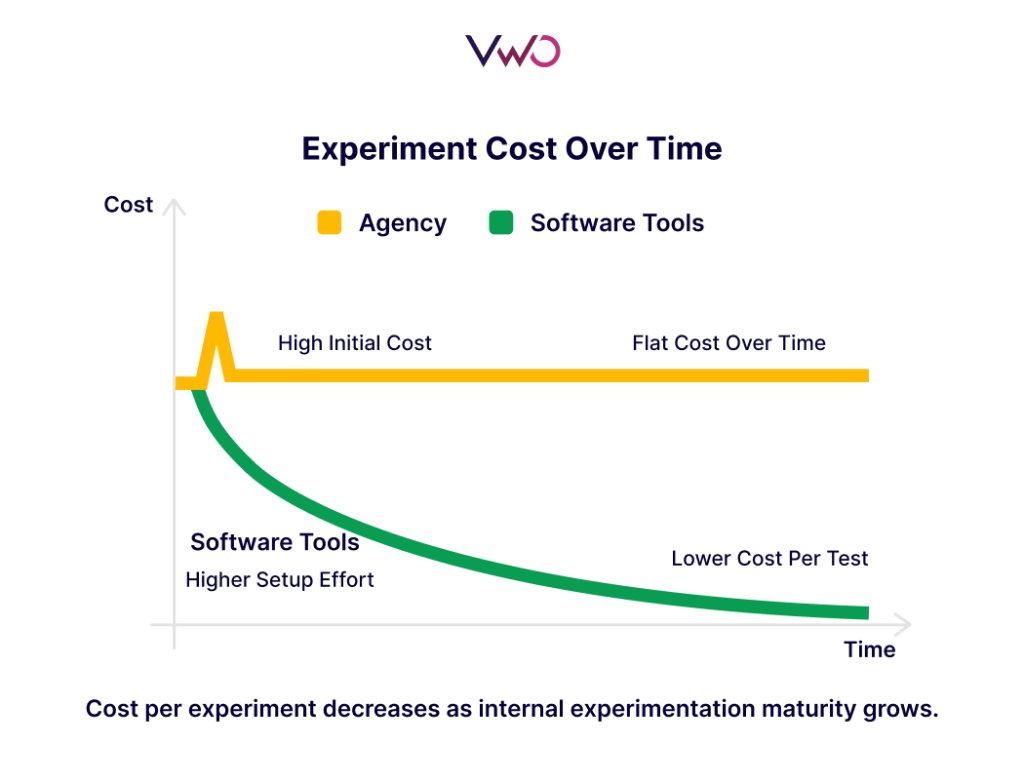
Ultimately, the decision between A/B testing services and software tools depends on where an organization sits on the experimentation maturity curve. Those seeking to build a core competency and a data-driven culture will find that software provides the necessary foundation. Those needing to prove the value of CRO quickly or fill a temporary talent gap will find services to be a powerful accelerant. Regardless of the path chosen, the commitment to rigorous testing remains the only reliable way to navigate the complexities of modern digital consumer behavior.