rifanmuazin
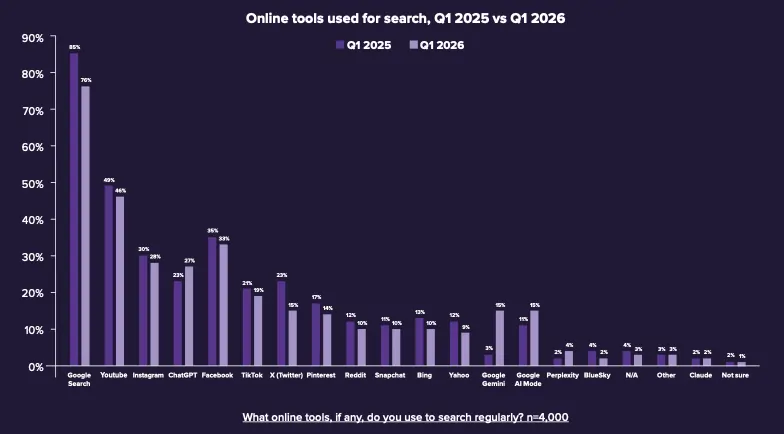
The landscape of digital information retrieval has reached a critical inflection point as of the first quarter of 2026, marking a definitive departure from the era of the singular search engine dominance. According to the latest SearchPulse research conducted by Reflect Digital, the UK public is no longer viewing artificial intelligence as a speculative industry trend but as a functional reality integrated into the fabric of daily life. The report, which draws on comprehensive data from 4,000 to 6,000 respondents across various demographics, indicates that the “front door” to the internet—long represented by Google’s primary search interface—has been effectively dismantled, replaced by a multi-platform discovery ecosystem driven by visual stimulation, social proof, and generative AI.
This transformation is most pronounced among younger demographics, where traditional search habits have been almost entirely restructured. The SearchPulse Q1 2026 data reveals that 54.8% of individuals in the 18-24 age bracket now utilize TikTok as their primary search tool on a regular basis. This marks the first time a social video platform has surpassed Google as the starting point for information seeking in this demographic. However, the shift is not limited to Gen Z; the 24-44 age group is also showing rapid diversification in their search behavior, moving toward what analysts are calling a “Big Three” discovery stack. This stack consists of TikTok for visual inspiration, Instagram for social validation, and specialized AI models for immediate, transactional answers.
The End of Linear Discovery and the Rise of Processing Fluency
The fragmentation of search is not merely a change in platform preference but a fundamental shift in cognitive engagement. Digital marketers and behavioral psychologists point to the concept of “Processing Fluency” as the primary driver behind this change. Traditional search engines often require a high cognitive load, forcing users to scan multiple blue links, evaluate meta-descriptions, and navigate through various websites to synthesize an answer. In contrast, visual and social formats provide immediate, high-context information that requires less mental effort to process.
This move away from “Search Friction” is particularly evident in how users prioritize the ease of information acquisition. The SearchPulse data highlights that younger audiences are bypassing the traditional search funnel in favor of platforms that offer instant gratification. By utilizing AI and social video, these users are effectively collapsing the time between a query and a decision. The report suggests that for the modern consumer, the “linear” journey from awareness to consideration to purchase is becoming obsolete, replaced by a fluid interaction where discovery and transaction occur simultaneously.
Professional AI Adoption: From Hype to Functional Delegation
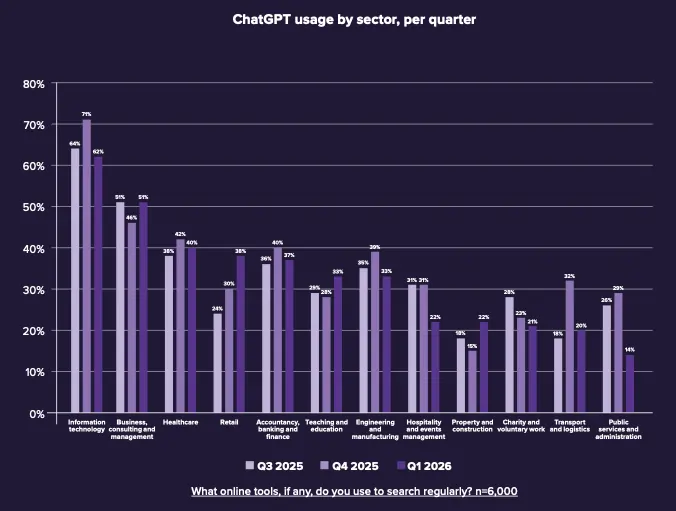
While the general public uses AI for lifestyle and travel queries, the professional sector has adopted these tools as essential personal assistants. The Q1 2026 data shows a direct correlation between professional roles and the depth of AI integration. The IT and Business Consulting sectors remain the early-adopter leaders, with the IT sector consistently reporting the highest usage of ChatGPT and similar Large Language Models (LLMs) across all tracked quarters.

The motivation for this adoption is rooted in the “Principle of Least Effort.” Professionals are no longer debating whether to use AI; instead, they are engaged in a strategic selection process to determine which AI tool is best suited for specific tasks. According to the research, 61.2% of professionals prioritize “ease of use,” while 56.9% cite “quick results” as their primary reason for utilizing generative AI over traditional search methods. These tools are being used to shortcut the research process, find trusted facts without navigating through advertising-heavy search results, and manage the “noise” of the modern information environment.
The Authority Bias and the Migration to Specialized Knowledge Agents
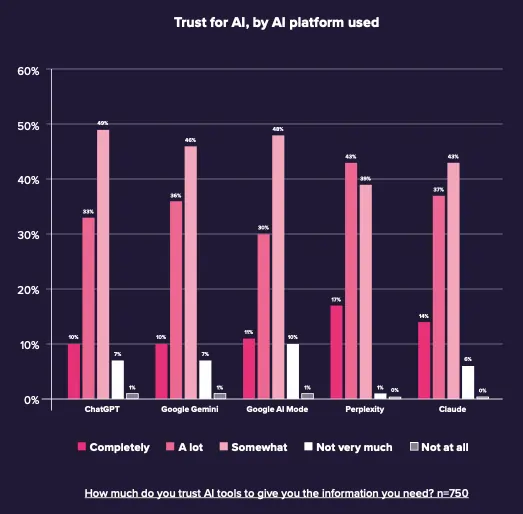
As the novelty of general-purpose AI begins to wane, a new phenomenon known as “The Authority Bias” is reshaping user trust. While mainstream users of platforms like ChatGPT and Google Gemini maintain a balance of trust and skepticism, a new segment of “AI Specialists” is emerging. These users are increasingly migrating toward niche platforms such as Perplexity and Claude, which are perceived as providing greater precision and transparency.
Perplexity, in particular, has seen a significant surge in user confidence. The SearchPulse report indicates that 60% of Perplexity users report “high trust” in the information provided. This signals a broader shift in user behavior: when tasks involve high-stakes decision-making or complex technical requirements, users seek out “Knowledge Agents” that offer citations and verifiable data sources. This move toward specialized AI suggests that the market is moving away from a “one-size-fits-all” AI model toward a more fragmented landscape of specialized tools.
Defining the Four Personas of the New Search World
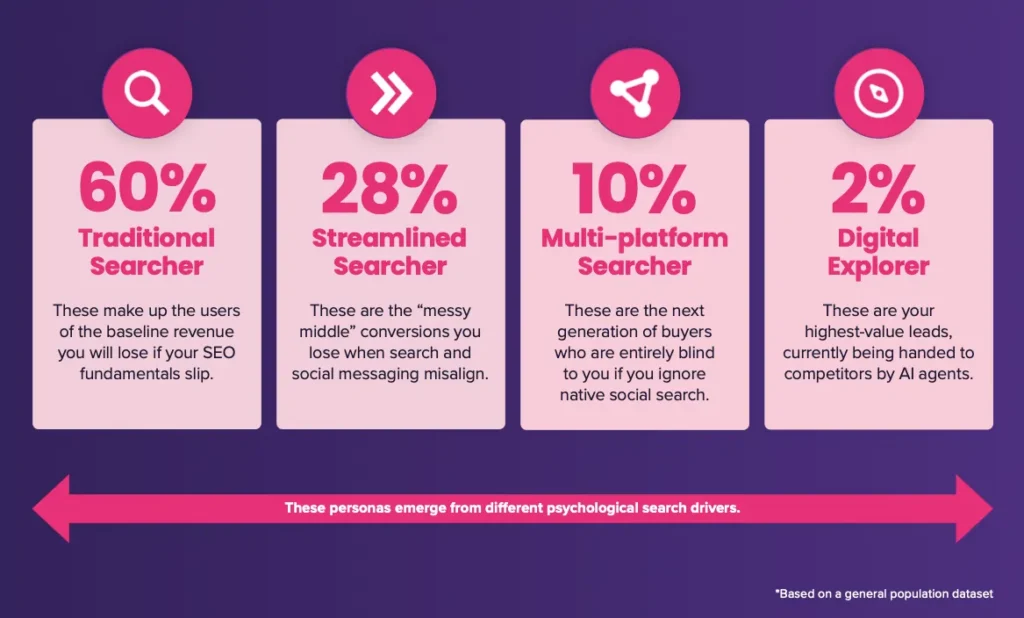
To help brands navigate this fractured landscape, Reflect Digital has identified four distinct search personas based on the underlying psychological drivers of modern users. These personas represent the different ways individuals interact with the digital world to find information:
- The Visual Explorer: Primarily driven by TikTok and Instagram, this user seeks aesthetic inspiration and real-world demonstrations. They value authenticity and “vibe” over technical specifications and are most likely to discover products through influencer-led content.
- The Efficiency Maximizer: This user relies heavily on general-purpose AI like ChatGPT to summarize information and perform transactional tasks. Their primary goal is to save time and reduce the cognitive load of searching.
- The Specialist Researcher: Moving toward platforms like Perplexity and Claude, this persona demands accuracy and citations. They are often professionals or enthusiasts who require deep, verifiable knowledge and are wary of AI “hallucinations.”
- The Social Validator: This user utilizes social media search to find community consensus. They rely on comments, reviews, and social proof to make decisions, viewing the opinions of peers as more trustworthy than traditional brand messaging.
Understanding these personas is crucial for brands that want to maintain visibility in 2026. A brand’s strategy must now account for the fact that a user may move between these personas depending on the intent of their search.
Bridging the AI Trust Gap Through Organic Authority
Despite the rapid adoption of AI, a significant trust gap remains. The SearchPulse data reveals that 35% of the UK public still does not fully trust the answers provided by AI models. For brands, this presents both a challenge and an opportunity. To succeed in an AI-driven search environment, a brand must move from “selling” to “proving.”
The report suggests that the most effective way to bridge this gap is to become a primary source of truth that AI models rely on. This involves a focus on third-party validation and technical excellence. When AI models generate answers, they pull from a vast corpus of data; brands that are frequently cited by independent experts, reputable news outlets, and comprehensive technical documentation are more likely to be featured in AI-generated responses. Consequently, organic authority—built through real-world expertise and citations—has become the strongest competitive advantage in the digital marketplace.
The Advertising Risk and the Trust Paradox
One of the most striking findings in the Q1 2026 report is the potential risk associated with traditional advertising within AI interfaces. As users begin to treat AI models as personal, intimate assistants, they are increasingly viewing paid interruptions as a breach of that intimacy. This has created what researchers call the “Trust Paradox.”
According to the data, 41.5% of respondents stated they would trust a brand less if they saw it advertising within a ChatGPT conversation. This sentiment is particularly strong among users who value AI for its perceived lack of commercial bias. The implication for marketers is clear: in a conversational AI environment, attention cannot be bought in the same way it was on traditional search engine results pages (SERPs). Brands that attempt to force their way into these conversational spaces with intrusive ads risk damaging their long-term credibility. Instead, the focus must shift toward earning mentions through authoritative content and being delivered as a credible recommendation by the AI agent itself.
Chronology of the Search Shift: 2023-2026
The transition from traditional search to the current AI-integrated landscape has occurred with remarkable speed over the last three years:
- 2023: The “Year of Experimentation.” Following the public release of ChatGPT, users began testing the limits of conversational AI, while Google and Bing rushed to integrate LLMs into their search interfaces.
- 2024: The “Rise of SGE.” Search Generative Experience (SGE) became the norm, leading to the “Zero-Click” search phenomenon where users found answers directly on the SERP without clicking through to websites.
- 2025: The “Platform Fracture.” Gen Z’s preference for TikTok search reached a tipping point, and specialized AI tools like Perplexity began gaining significant market share among professionals.
- 2026: The “Functional Reality.” AI is no longer a novelty but a core utility. The search market is officially fragmented, and brand authority is defined by presence across a multi-platform discovery stack.
Broader Implications for the Digital Economy
The findings of the SearchPulse Q1 2026 report have far-reaching implications for the digital economy. As the traditional search monopoly fractures, the cost of customer acquisition is likely to rise for brands that remain dependent on legacy SEO and PPC strategies. The shift toward AI-driven “Knowledge Agents” means that brands must invest more heavily in technical SEO, structured data, and digital PR to ensure they are “machine-readable” and “machine-trusted.”
Furthermore, the data suggests a widening gap between “AI-literate” consumers and those who remain skeptical. This digital divide could influence everything from consumer spending habits to political engagement. For businesses, the challenge for the remainder of 2026 will be to maintain a presence wherever discovery begins—whether that is a 15-second video on TikTok, a deep-dive research query on Perplexity, or a casual conversation with a personal AI assistant.
In conclusion, the AI disruption of 2026 is a functional transformation of how humans interact with information. The brands that will thrive in this new era are those that stop thinking in terms of isolated “channels” and start focusing on building a holistic, authoritative presence that transcends the traditional search box. As the SearchPulse data makes clear, the future of search is not about finding links; it is about being the most trusted answer in an increasingly complex digital world.