rifanmuazin
The digital inbox, once a simple repository for messages, has evolved into a fiercely competitive landscape where attention is a scarce commodity. Every Monday morning, professionals and consumers alike face a deluge of emails, most destined for quick deletion or prolonged neglect. In this environment, the seemingly minor decision of when to click ‘send’ has become a critical strategic lever, capable of elevating a message from obscurity to immediate action. This phenomenon underscores a fundamental truth in digital communication: timing is not merely a convenience but a determinant of success in the crowded digital sphere.
The Escalating Challenge of Inbox Overload and the Rise of Strategic Timing
The sheer volume of email traffic today is staggering. Estimates suggest that over 347 billion emails are sent and received globally each day, a number projected to grow significantly in the coming years. This relentless influx creates an environment of “inbox overwhelm,” where the average user is constantly sifting through a mixture of personal, professional, and promotional messages. For marketers and communicators, this translates into an uphill battle for visibility. A message sent at the wrong moment can quickly be buried under a fresh wave of incoming mail, effectively becoming invisible without ever being opened.
The widespread adoption of smartphones has further intensified this challenge and simultaneously created new opportunities. With email accessible 24/7, recipients are no longer confined to checking their inboxes during traditional office hours. This constant connectivity means that email habits are fragmented and highly personal, influenced by daily routines, work schedules, leisure time, and even psychological states. Consequently, the strategic importance of email timing has moved beyond simple guesswork to become a data-driven science, aimed at maximizing open rates, click-through rates, and ultimately, conversion rates and return on investment (ROI). The objective is no longer just to send an email, but to deliver it precisely when the recipient is most likely to engage.
Decoding the Universal Trends: When Audiences Are Most Receptive
While the ideal email send time is never a one-size-fits-all answer, years of aggregated data from various email marketing platforms and large-scale studies point to clear, actionable trends. For the majority of businesses, a consistent pattern emerges: the sweet spot for email engagement typically falls between 9:00 AM and 11:00 AM in the recipient’s local time zone.
The rationale behind this mid-morning window is rooted in common daily routines. Most professionals have completed their commute, settled into their workstations, and are in the process of catching up on initial emails before the day’s major tasks or meetings commence. This period represents a window of focused attention, where individuals are actively managing their inboxes rather than passively scrolling. Before this window, the inbox can be a chaotic scene of urgent overnight messages. After this window, the day’s tasks begin to take precedence, and attention may wane as lunch breaks approach or as cognitive fatigue sets in during the afternoon. By strategically placing messages within this prime engagement period, senders significantly increase the likelihood of their emails being opened, read, and acted upon, rather than being relegated to the digital graveyard of unread messages.
A Day-by-Day Guide to Optimal Email Dispatch
Understanding these universal trends is the first step; applying them with a day-by-day precision offers a refined approach. These recommendations serve as robust starting points, to be further tailored by individual audience data.
Best Time to Send Emails on Monday:
- Recommended time: 10:00 AM – 12:00 PM local time.
Mondays are characterized by a significant influx of weekend-accumulated emails, often leading to inbox overwhelm in the early hours. Sending too early (e.g., 8-9 AM) risks your message being lost in the initial rush of urgent work communications. By aiming for late morning, when recipients have had a chance to triage their most pressing emails and settle into the workweek, your message is more likely to receive attention. This window allows for a more considered read as the initial chaos subsides, making it suitable for important announcements or weekly newsletters.
Best Time to Send Emails on Tuesday:
- Recommended time: 9:00 AM – 11:00 AM local time.
Multiple large-scale email marketing studies consistently identify Tuesday as the top day for email open rates and engagement. By Tuesday, people have fully settled into the workweek and are often at their most productive. This is an ideal day for critical communications. For Business-to-Business (B2B) audiences, an earlier send around 9:30 AM can be highly effective, aligning with the start of their focused work. For consumer-focused (B2C) emails, a slightly later send, closer to 11:00 AM, tends to work better as individuals may be taking a short break or planning their lunch, making them more receptive to promotional or lifestyle content.
Best Time to Send Emails on Wednesday:
- Recommended time: 8:00 AM – 11:00 AM local time.
Wednesday maintains its position as another reliably strong day for email engagement. The mid-morning window remains optimal, capitalizing on sustained productivity. Inbox competition may be slightly lower than on Tuesday, offering a marginal advantage. An earlier start at 8:00 AM can be tested, as the initial Monday backlog is long cleared, and recipients may be checking emails more casually before diving into their core tasks.
Best Time to Send Emails on Thursday:
- Recommended time: 9:00 AM – 12:00 PM local time.
Thursday often mirrors Tuesday in its effectiveness for email engagement, especially for promotional or conversion-focused sends. Activity remains high as recipients are still deeply engaged in their work, but the mental shift towards the upcoming weekend has not yet fully taken hold. Data frequently shows Thursday as one of the best days for driving email-driven orders or sign-ups, making it a powerful day for calls to action. A timely and relevant message can significantly stand out and motivate action before the end-of-week slowdown.
Best Time to Send Emails on Friday:
- Recommended time: 9:00 AM – 10:00 AM or early afternoon (1:00 PM – 2:00 PM) local time.
Friday presents a dual challenge and opportunity. Engagement generally drops off significantly by late afternoon as people mentally wind down for the weekend. Therefore, sending early in the day is crucial to capture attention before it shifts. For B2B communications, the 9:00 AM – 10:00 AM window is often the last opportunity for serious engagement. However, for consumer-based audiences (e.g., retail, hospitality, entertainment), a strategic email sent just after lunch (1:00 PM – 2:00 PM) can capitalize on pre-weekend planning, prompting last-minute purchases, bookings, or leisure activity considerations.
Best Time to Send Emails on Saturday:
- Recommended time: 10:00 AM – 12:00 PM local time.
Saturday is typically the lowest-performing day overall for most business types, particularly B2B. However, for audiences heavily skewed towards consumer categories (e-commerce, entertainment, fitness, personal development), Saturday can offer niche opportunities. The late morning window, when people are awake and casually scrolling but not yet deeply immersed in weekend activities, can yield modest but focused engagement. It’s a day to test if your content aligns with weekend leisure or purchasing habits.
Best Time to Send Emails on Sunday:
- Recommended time: 9:00 AM – 12:00 PM, or after 8:00 PM local time.
Sunday offers two distinct windows. Many individuals skim emails over morning coffee, providing an opportunity for casual, non-urgent content. More interestingly, there’s a phenomenon known as the “Sunday night effect.” Research indicates a noticeable spike in email opens around 9:00 PM, as people begin to check their inboxes to mentally prepare for the upcoming workweek. This late-evening window can be surprisingly effective for content that helps recipients organize their week, offers last-minute deals, or provides inspiration for the days ahead. Experimenting with late Sunday evening sends can uncover unexpected engagement rates.
The Science of Engagement: Psychological Factors and Digital Habits
The effectiveness of these timing windows is not arbitrary; it’s deeply rooted in human psychology and evolving digital habits. Cognitive load plays a significant role; early to mid-morning, individuals are generally at a higher state of alertness and have fewer competing demands on their attention, making them more receptive to processing new information. The habit loop of checking email – often integrated into morning routines, coffee breaks, and pre-lunch rituals – further reinforces these patterns.
Device usage also influences optimal timing. While desktops dominate during core work hours, mobile devices extend email checking into commutes, evenings, and weekends. This necessitates a responsive design and an understanding that quick scans are common on mobile, favoring concise and visually appealing content during non-work hours.
Crucially, all these factors are influenced by time zones. A “9 AM” send from New York might hit a recipient in Los Angeles at 6 AM, a time likely too early for optimal engagement. Therefore, for geographically diverse audiences, segmenting by time zone and scheduling emails to arrive in the recipient’s local optimal window is paramount for maximizing impact.
Beyond Averages: Harnessing Proprietary Data with Analytics Platforms
While industry averages provide an invaluable baseline, the true competitive advantage lies in understanding your specific audience. No aggregated data can perfectly predict the behavior of your unique subscriber base. This necessitates leveraging proprietary data from your website analytics and email service provider (ESP) reports.
Utilizing Google Analytics 4 (GA4) for Audience Insights:
GA4 offers a powerful, yet often underutilized, method for identifying when your subscribers are most active on your website. This activity strongly correlates with their overall online presence and, by extension, their receptiveness to email.
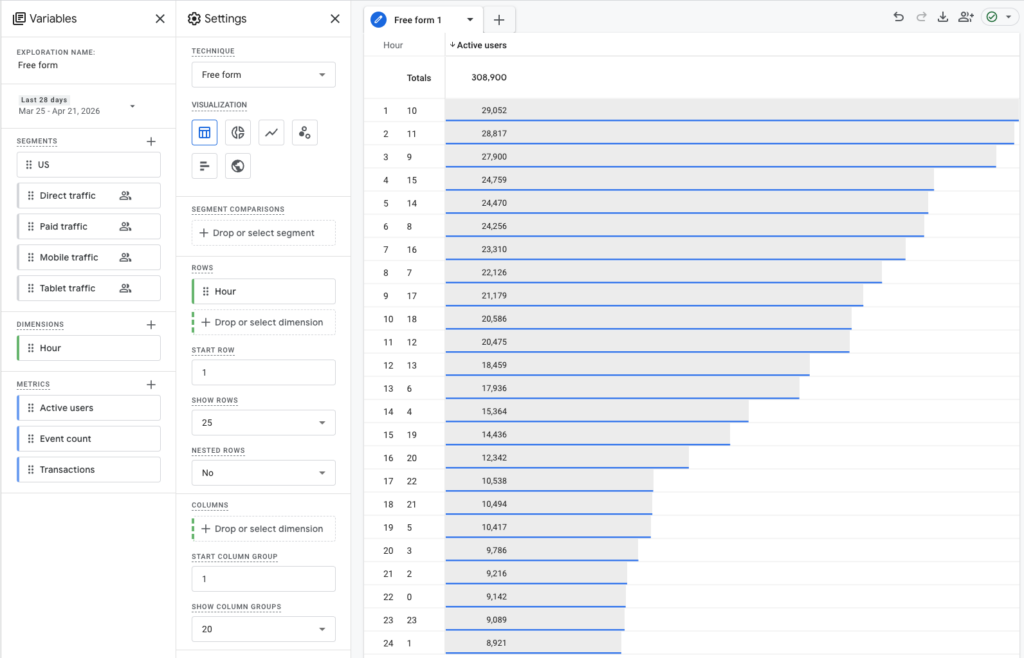
- Open GA4 and Go to Explore: From the left navigation panel, click “Explore” and initiate a new blank exploration. This flexible reporting interface allows for custom data visualization.
- Add the Hour Dimension: In the “Variables” panel, locate and click the ‘+’ symbol next to “Dimensions.” Search for “Hour.” GA4 records hours as a value from 0 to 23 (representing midnight to 11 PM). Drag this “Hour” dimension into your “Rows” section of the exploration. For even deeper insights, you can also add “Day + hour” to cross-reference activity by day of the week.
- Add a Metric: Next, add a relevant metric to understand engagement. “Sessions” or “Engaged sessions” are excellent choices. “Sessions” shows overall visits, while “Engaged sessions” specifically tracks periods where users were actively interacting with your site (e.g., scrolling, clicking, spending more than 10 seconds). Drag your chosen metric into the “Values” section.
- Analyze the Data: The resulting chart will visually represent your website traffic by hour. For instance, if your GA4 data shows peak “Engaged sessions” between 9 AM and 11 AM, this strongly indicates that your audience is most active and receptive during that window, suggesting 9 AM would be an optimal email send time.
This GA4 approach, requiring approximately 15 minutes to set up, provides audience-specific data that is far more potent than generic industry benchmarks. Furthermore, modern Email Service Providers (ESPs) like AWeber offer detailed analytics dashboards that track actual open and click times for your campaigns, providing direct feedback on subscriber behavior. Integrating this with Customer Relationship Management (CRM) data, which logs past interactions and purchase histories, can paint an even richer picture of individual customer habits, enabling hyper-personalized sending.
Tailoring Timing to Campaign Objectives
Beyond general best practices, the optimal send time can also vary significantly based on the specific goal of your email campaign.
- Sales or Promotions: For driving immediate purchases or sign-ups, early in the week (Tuesday/Thursday) and mid-morning are generally most effective due to high engagement. Avoid sending major promotions late Friday or Saturday afternoon unless your audience is explicitly consumer-based and planning weekend activities. Interestingly, some studies suggest that late afternoon, around 4 PM, can drive stronger order rates for e-commerce-type sends, as people might be looking for distractions or planning personal purchases after their main work tasks. A/B testing these afternoon windows for promotional content is highly recommended.
- Event Reminders: Timeliness is critical here. Send the initial reminder 24-48 hours before the event, followed by a “last call” reminder one to two hours prior. This ensures attendees have ample time to prepare and receive a final nudge just before the event begins, minimizing no-shows for webinars, workshops, or in-person gatherings.
- Newsletters or Educational Content: For content-rich emails designed for reading and learning, Tuesday or Thursday late morning consistently delivers the highest engagement. These are periods when recipients are typically focused, open to consuming longer-form content, and not yet distracted by weekend plans.
- Transactional Emails: These emails (e.g., order confirmations, shipping updates, password resets) are expected immediately and typically do not adhere to optimal timing windows. However, follow-up transactional emails, like requests for reviews or product usage tips, can be strategically timed to align with post-purchase engagement patterns.
- Welcome Series: The first email in a welcome series should be sent immediately upon sign-up to capitalize on the subscriber’s expressed interest. Subsequent emails in the series, however, can be strategically timed based on the general optimal windows or insights from your analytics to ensure continued engagement and lead nurturing.
The Iterative Process: Testing, Refining, and Adapting
The journey to discovering your ideal email send time is an ongoing, iterative process. It requires continuous testing, analysis, and adaptation.
- A/B Testing: This is the cornerstone of optimization. Send the same email to two different, equally sized segments of your audience at two distinct times. Compare the key metrics: open rates, click-through rates, and conversion rates. Over time, these tests will reveal clear preferences within your subscriber base.
- Segmentation by Time Zone: For lists spanning multiple geographical regions, scheduling emails in the recipient’s local time zone is non-negotiable. Most advanced ESPs offer features to automate this, ensuring your 10 AM email hits at 10 AM whether your subscriber is in London or Los Angeles.
- Continuous Monitoring: Audience habits are not static. They can evolve due to seasonal changes, economic shifts, new digital trends, or even changes in your product/service offerings. Regularly review your email analytics (opens, clicks, unsubscribes) to spot emerging patterns or shifts in behavior.
- Adapting to External Factors: Be mindful of major holidays, national events, or even local news that might disrupt normal routines. Adjust your sending schedule accordingly. For example, holiday sales might perform better in the evenings, while a major news event could make recipients less receptive to promotional content.
- The Role of Automation and AI: The future of email timing increasingly involves artificial intelligence and machine learning. Advanced email platforms are developing “send time optimization” features that use historical data to automatically predict and send each individual email at the precise moment a particular subscriber is most likely to open it. While still evolving, these tools represent the ultimate in personalized timing.
Ultimately, your most successful timing will always reflect your readers’ actual habits, not just broad industry benchmarks. If your analytics consistently show that a significant portion of your opens happen at 8 PM, then scheduling sends for that time, even if it contradicts general advice, is the correct strategic move.
Broader Implications for Email Marketing Strategy and ROI
Optimizing email send times carries significant broader implications for an organization’s overall marketing strategy and its return on investment.
- Enhanced ROI: By ensuring emails are opened and engaged with, businesses can dramatically improve the effectiveness of their campaigns. Higher open rates lead to higher click-through rates, which in turn drive more traffic to websites, more leads, and ultimately, more sales. This direct correlation translates into a measurable increase in marketing ROI, making every dollar spent on email marketing more impactful.
- Improved Customer Experience: Delivering relevant content at the precise moment a customer is receptive fosters a positive brand perception. It shows respect for their time and attention, reducing the likelihood of annoyance or email fatigue. This thoughtful approach can significantly enhance the customer journey and build stronger, more loyal relationships.
- Competitive Advantage: In a marketplace saturated with digital noise, precision in email timing can be a powerful differentiator. Companies that consistently reach their audience at optimal moments stand out from competitors whose messages may be getting lost in the shuffle. This subtle advantage can lead to increased market share and brand recognition.
- Long-Term Engagement and List Health: Consistently high engagement rates signal to email service providers (ESPs) that your emails are valuable, improving your sender reputation. This, in turn, can lead to better inbox deliverability, avoiding spam folders and ensuring your messages reach their intended audience. Over time, this builds a loyal subscriber base that anticipates and values your communications, forming the bedrock of a healthy and effective email marketing program.
Conclusion
The seemingly simple act of sending an email is, in the modern digital landscape, a complex strategic endeavor. The best time to send emails ultimately boils down to three critical elements: a deep understanding of your audience, a willingness to start with proven windows as a baseline, and a commitment to rigorously testing and refining your assumptions using proprietary data.
While Tuesday and Thursday mornings offer the safest default starting points for most campaigns, the true answer resides within your own analytics. Leveraging tools like Google Analytics 4 to identify when your audience is most active on your website, or scrutinizing your Email Service Provider’s reports for actual open times, provides the definitive roadmap. Matching your send schedule to these unique windows is the most reliable path to ensuring your emails are not just sent, but genuinely read, engaged with, and acted upon, maximizing their impact in an increasingly competitive digital world.