rifanmuazin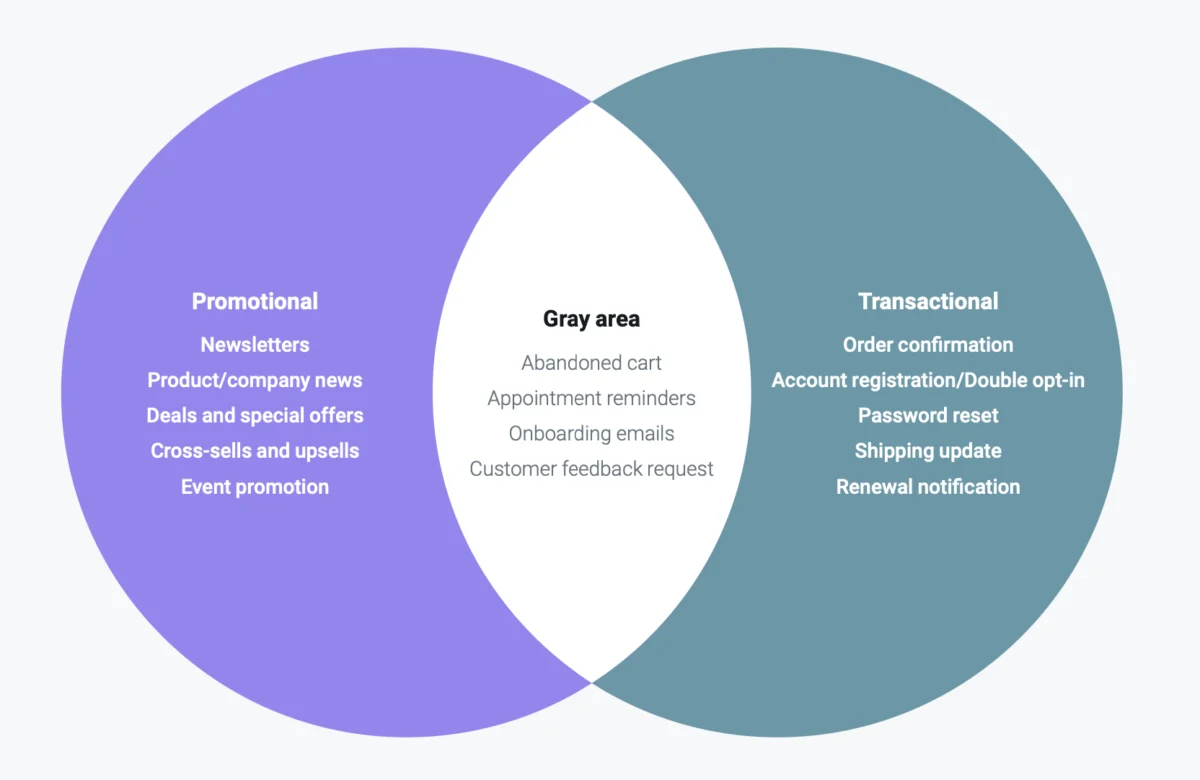
The digital landscape of January 20, 2026, is defined by rapid innovation and fierce competition, yet a fundamental operational schism continues to challenge even the fastest-growing technology companies: the deeply ingrained separation between marketing and transactional email systems. This divide, often playing out daily across Slack channels and meeting rooms, pits the strategic objectives of marketing teams against the operational imperatives of development teams, creating significant and costly problems that undermine growth, brand consistency, and operational efficiency.
For years, the marketing department, vibrant and dynamic, has championed feature-rich platforms designed for crafting beautiful newsletters, sophisticated email automation, and engaging campaigns. Their focus is on driving user acquisition, fostering engagement, and nurturing customer relationships through compelling content and personalized experiences. Concurrently, in a parallel operational universe, the development team meticulously maintains the application’s core transactional email infrastructure, sending critical, time-sensitive notifications such as password resets, welcome messages, and order confirmations. These essential communications, often powered by a robust but separate email API, prioritize reliability, speed, and security above all else. The divergence in tools, workflows, and data management between these two critical functions has become a strategic liability, introducing friction and hidden costs that impede progress.
Historically, this operational separation emerged organically. Early email marketing tools were distinct from the infrastructure required for application-driven notifications. As companies scaled, the specialized demands of each function led to the adoption of disparate solutions. Marketing platforms evolved to offer advanced segmentation, analytics, and design capabilities, while transactional email services focused on high deliverability rates, API integration, and minimal latency for mission-critical messages. This bifurcation, while seemingly logical at the time, has now matured into a bottleneck, forcing businesses to choose between empowering marketers with rich experience tools or providing developers with the raw power and reliability they demand. The evolving consensus among product-led growth (PLG) teams, however, is that this choice is no longer viable. The answer, increasingly, lies in embracing an all-in-one email platform that seamlessly serves both needs, unifying the customer conversation under a single, cohesive infrastructure.
The High Stakes of a Fragmented Email Strategy: Unseen Costs and Operational Friction
The continued operation of two disparate email systems, while appearing manageable on the surface, silently accrues hidden costs that erode a company’s growth trajectory, damage its brand equity, and undermine its operational efficiency. These profound pains are most acutely felt by the very teams tasked with propelling the business forward, creating friction where seamless flow is paramount. Industry analysis indicates that companies with siloed email strategies often experience up to a 15% reduction in customer lifetime value (CLV) due to inconsistent brand experiences and delayed feature rollouts.
Eroding Brand Trust and Customer Loyalty: The Inconsistent User Experience
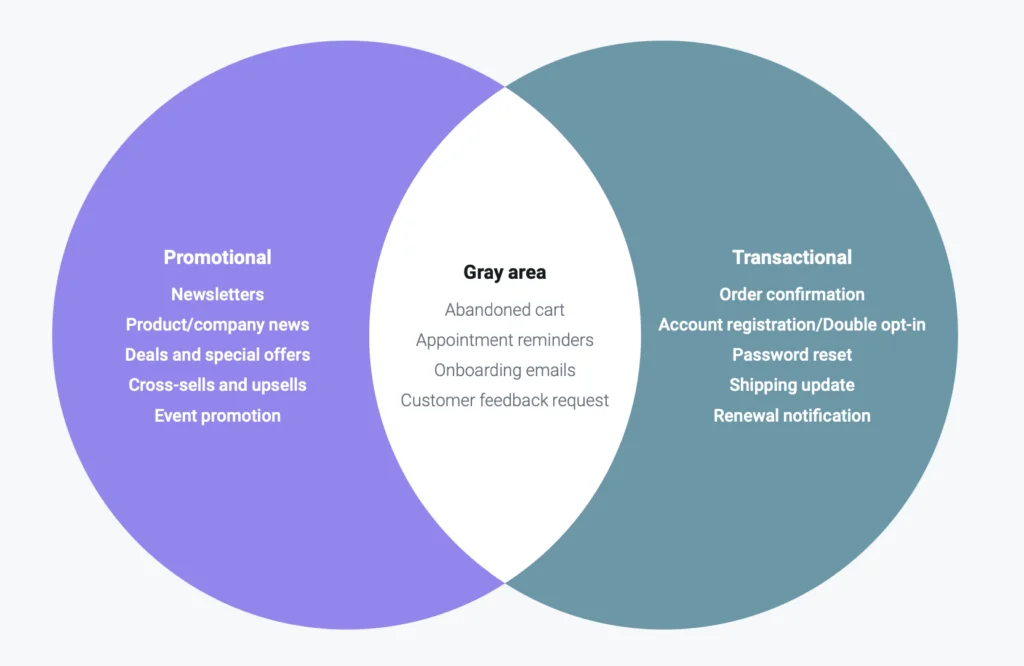
A customer interacts with a brand, not its internal departments. Whether an email is categorized as “marketing” or “transactional” is an internal distinction that holds no relevance for the end-user. To them, every email is part of a single, continuous conversation with the company. When an email strategy is fragmented, this conversation becomes disjointed, and the customer experience deteriorates rapidly, often without immediate internal detection.
Consider a prospective user, initially captivated by a beautifully designed marketing email showcasing a product’s elegant user interface. Intrigued, they sign up for a trial. However, after a minor login error, they request a password reset, only to receive a stark, unbranded, plain-text email that feels archaic and out of place. This jarring inconsistency instantly erodes the trust and excitement carefully cultivated by the marketing team, replacing it with confusion and a subtle sense of disappointment.

This is where brand trust suffers a death by a thousand cuts. Every inconsistent touchpoint—a stark payment receipt, a generic shipping notification, an unhelpful error message—widens the crack in the customer journey. Achieving a truly consistent brand experience becomes an impossible feat. In the user’s mind, if a company struggles to ensure its own emails look uniform, how can they guarantee the product itself will be seamless and reliable? According to a 2024 Mailjet email engagement report, a distinct look and voice across all customer interactions significantly increases recognition and trust, making recipients more likely to open and engage. The fundamental step of combining transactional and marketing email under a unified brand identity is rendered impossible by siloed systems, leading to a fragmented perception of the brand.
Developer Bottlenecks and Stifled Innovation: A Drag on Product-Led Growth
In today’s highly competitive, product-led growth (PLG) environment, speed, agility, and the ability to rapidly iterate are paramount. A product’s communication strategy serves as a critical lever for guiding users towards activation, engagement, and retention. For Product and Growth Leads, however, a divided email strategy is a constant source of friction, epitomized by the dreaded developer bottleneck. A recent industry survey revealed that developers spend an average of 10-15% of their time on email-related tasks that could be automated or managed by non-technical teams, directly hindering innovation.
Imagine a Growth Manager, having meticulously analyzed user behavior data, devises a sophisticated five-part automated onboarding sequence. The objective is to guide new users through key activation steps within their first week, with compelling copy and engaging designs tailored to specific user actions. Yet, the project hits an immediate roadblock. The initial welcome emails are hard-coded into the application and dispatched via a basic transactional service, completely inaccessible to the marketing or growth team.
The request for changes or new email additions enters the development backlog, where it often languishes for weeks, competing for prioritization against critical bug fixes and new feature builds. When it finally receives attention, the implementation is often a diluted version of the original vision, stripped of dynamic content or personalization capabilities due to technical constraints or time limitations. The crucial opportunity to quickly A/B test email subject lines, experiment with different calls-to-action, or dynamically adapt content based on user behavior is lost. The email platform, which should function as a growth accelerator, instead becomes a brake, preventing the rapid experimentation essential for dramatically improving activation rates and reducing churn. This delay directly impacts the core tenets of PLG, where swift iteration and data-driven optimization are key to unlocking user value.
Navigating the Minefield: Governance, Compliance, and Deliverability Risks
For any leader overseeing operations, security, or finance, email governance and compliance are non-negotiable, top-tier priorities. A divided email strategy, characterized by duplicate data stores, fragmented user permissions, and a lack of a central command center, constitutes a ticking time bomb of operational and legal risk. The consequences of non-compliance with data privacy regulations like GDPR and CCPA can be severe, including substantial financial penalties that can reach tens of millions of euros or a percentage of global annual revenue.
With no single source of truth for user consent and data preferences, confidently ensuring compliance becomes a daunting task. When a user in Europe exercises their “right to be forgotten,” can an organization definitively confirm their data has been scrubbed from both the marketing platform and the transactional service’s logs? If a customer unsubscribes from a newsletter, is there absolute certainty they won’t inadvertently receive another promotional email triggered from the “transactional” system, leading to a compliance violation and severely damaging sender reputation? These scenarios are not hypothetical; they represent real and frequent challenges faced by companies managing fragmented email ecosystems.
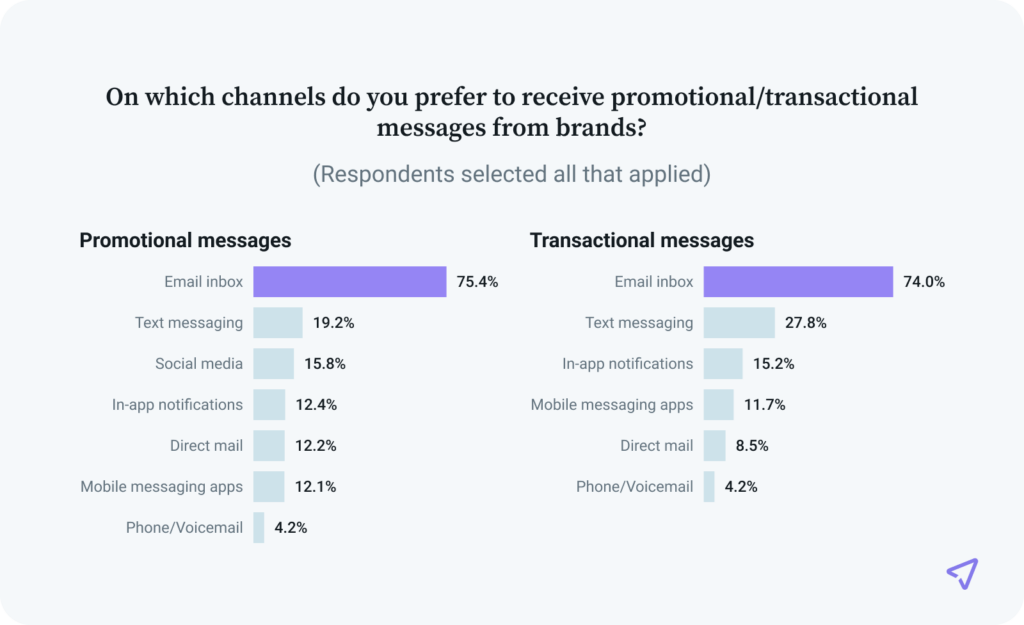
Furthermore, this operational division directly impacts core email deliverability, a critical factor in any email communication strategy. If a transactional system, perhaps due to less stringent monitoring, develops poor list hygiene—for instance, continuously sending emails to invalid or inactive addresses—it can significantly harm the domain’s sender reputation. Because both marketing and transactional systems often send from the same domain, the marketing team’s meticulously crafted campaigns may suddenly start landing in spam folders through no fault of their own. A 2024 Mailjet email engagement report revealed that while 71% of respondents would check their spam/junk folder for a transactional email, this user behavior indicates a breakdown in trust and efficiency. Relying on users to dig through spam for critical communications is akin to a mail carrier delivering important post to a trash can and expecting the recipient to sift through it—a clearly unsustainable and unacceptable practice. Unified systems, with centralized list management and deliverability monitoring, are essential to mitigate these risks and maintain a healthy sender reputation.
The Paradigm Shift: Embracing Unified Email Platforms for Strategic Advantage
The solution to this strategic chaos is not a mere compromise; it is a fundamental shift in operational philosophy. A unified email platform is built on the simple yet profoundly powerful principle that all email communications, regardless of their immediate purpose, are integral parts of a single, overarching customer conversation. By consolidating these functions, businesses unlock profound, business-altering benefits that drive growth, enhance customer loyalty, and ensure robust governance. This represents a paradigm shift from a fragmented, department-centric approach to a holistic, customer-centric model.
Forging a Seamless Customer Journey: The Power of Brand Cohesion
When all a company’s emails originate from a single, centralized platform, it becomes genuinely possible to deliver the cohesive, professional, and consistent brand experience that builds trust and fosters delight. Every customer touchpoint, from the initial marketing welcome series to critical feature announcements and final invoices, speaks with one unified voice, adheres to consistent branding guidelines, and reinforces the company’s identity. This eliminates the brand dissonance that often plagues fragmented systems.
This consistency is primarily enabled through advanced email template management designed for modern, collaborative teams. Platforms like Mailjet offer collaborative tools that allow teams to build and maintain a shared template gallery. Marketing professionals can design beautiful, on-brand, and mobile-responsive templates for every conceivable scenario—password resets, feature updates, usage alerts, payment receipts, and promotional offers. Developers can then seamlessly integrate these pre-approved, branded templates into their applications via simple API calls, confident that every email they trigger is perfectly polished and consistent with the overall brand identity. The protracted and often contentious debate over transactional versus marketing email branding is thus definitively settled, ensuring a seamless and professional customer journey across all touchpoints.
Unleashing Agility: Empowering Teams and Accelerating Innovation
A unified platform fundamentally breaks down the operational walls between product, marketing, and development teams, permanently eliminating the dreaded “developer bottleneck.” This redefines workflows and empowers teams to operate with unprecedented agility, directly fueling product-led growth.
In this reoptimized model, Growth Managers are empowered to independently design, implement, and launch complete email automation sequences for SaaS onboarding, user re-engagement, or new feature adoption using intuitive visual workflow builders. They can A/B test email subject lines for a welcome series to optimize open rates, or experiment with different calls-to-action on a trial expiration nudge to maximize conversions—all without requiring direct developer intervention for every minor tweak. This autonomy drastically reduces time-to-market for critical communication strategies.
The developer’s role, consequently, becomes more strategic and less tactical. Instead of being bogged down with requests to hard-code HTML emails or manage individual email deployments, they can focus on building and enhancing the core product. Their responsibility shifts to enabling this new, agile workflow by making simple, clean API calls from the application to trigger the right template at the right time, with dynamic content injected as needed. This API-first approach, combined with a robust template system, shrinks innovation cycles from months and weeks to mere hours and days, allowing businesses to respond to market demands and user feedback with unparalleled speed.
Robust Control in a Complex Landscape: Ensuring Governance and Compliance
For Platform Owners, Security Officers, and Operations leaders, a unified platform delivers the “holy grail” of email management: a single pane of glass for the entire email infrastructure. From one central dashboard, organizations gain comprehensive visibility and control. They can monitor deliverability metrics across all email types, manage user permissions with granular role-based access control, and maintain a single, global suppression list that guarantees compliance with data privacy regulations like GDPR, CCPA, and future legislative mandates. This centralized control significantly reduces the risk of data breaches, accidental non-compliance, and the associated financial and reputational damage.
Leading platforms are specifically architected to provide both autonomy for individual teams and overarching control for central administrators. Mailjet’s Sub-accounts feature, for instance, exemplifies this by allowing a central administrator to create distinct, sandboxed accounts for different teams, brands, or environments (e.g., development, staging, production). Each team can operate independently with its own templates, sender lists, and analytics, fostering agility. Crucially, the master account owner retains ultimate visibility and control over critical functions such as billing, security policies, and global compliance rules, ensuring that enterprise-wide standards are upheld without stifling individual team innovation. This represents centralized email management without compromising team agility or responsiveness.
The Path Forward: Unifying Email for Future-Proof Growth
The long-standing debate over transactional versus marketing email platforms is, by 2026, increasingly recognized as a relic of a bygone era. Unified email platforms fundamentally flip the script, moving from a fragmented, reactive approach to a holistic, proactive strategy. The strategic advantage they provide in fostering deeper customer relationships, accelerating product innovation, and ensuring robust, centralized governance required to scale with unwavering confidence cannot be underestimated.
By consolidating email operations, businesses can achieve unparalleled brand consistency, streamline workflows, empower teams, and mitigate compliance risks, all while optimizing deliverability and reducing operational overhead. This shift is not merely about technical efficiency; it is about building a more coherent, trustworthy, and agile organization that is better equipped to thrive in the complex digital economy. Companies that embrace this unification will be those best positioned to drive sustainable product-led growth and secure a competitive edge in the years to come. The question is no longer whether to choose between marketing and transactional email platforms, but rather, when to unify them to unlock their combined strategic potential.