rifanmuazin
The landscape of digital communication continues to evolve rapidly, yet email steadfastly retains its position as a cornerstone of organizational engagement. However, a significant divergence is becoming increasingly apparent between email programs that meticulously invest in measurement, deliverability, and optimization, and those that continue to operate on outdated assumptions. This growing chasm, highlighted by Sinch Mailgun’s comprehensive 2026 Email Impact Report, underscores a critical inflection point for businesses worldwide.
Released on April 17, 2026, the Sinch Mailgun 2026 Email Impact Report offers an unparalleled deep dive into the state of email marketing and transactional communication. The report’s findings are meticulously drawn from a global survey encompassing over 1,200 email senders, complemented by a robust analysis of more than 400 billion real emails transmitted through Sinch Mailgun’s infrastructure throughout 2025. This dual-pronged methodology—combining self-reported perceptions with hard, real-world data—provides a uniquely authoritative perspective on current trends and future imperatives. The extensive report is structured into five pivotal chapters, dissecting key areas such as Return on Investment (ROI), industry-specific benchmarks, the intricate science of deliverability, the burgeoning adoption of Artificial Intelligence (AI), and critical investment trends shaping the sector. As businesses navigate the latter half of 2026, the insights gleaned from this report are not merely informative but prescriptive, offering a roadmap for strategic advantage in a competitive digital ecosystem.
The Enduring Power of Email: ROI Under Scrutiny
Despite the proliferation of new communication channels, email’s intrinsic value to organizations remains exceptionally high. A striking 78% of senders surveyed classify email as “very” or “extremely” important to their respective organizations. This profound level of organizational buy-in is a rare endorsement for any marketing channel, attesting to email’s fundamental role in customer acquisition, retention, and operational communication. Yet, a disconcerting gap exists between this strong belief and the tangible evidence supporting it.
Fewer than half of all email senders actively measure the Return on Investment (ROI) of their email programs. Specifically, only 46% track ROI for promotional emails, and an even lower 43% do so for transactional communications. This stark data suggests that a majority of teams are operating on conviction rather than concrete, data-driven evidence. The implications are significant: without clear ROI metrics, email programs struggle to secure increased budget allocations, justify their strategic importance, and demonstrate their contribution to the bottom line. This lack of measurement stands in stark contrast to the often-cited high ROI potential of email marketing. For those who do measure, the returns are often compelling: 60% of senders who track promotional email ROI report returns exceeding $10 for every $1 spent. Even more impressively, 13% of these senders claim an ROI greater than $40:1. Similarly, 62% of senders measuring transactional email ROI report surpassing the $10:1 threshold, with 13% also achieving returns above $40:1. While these high figures are encouraging, Sinch Mailgun’s research cautiously suggests that such exceptionally high returns might paradoxically signal underinvestment rather than peak efficiency, indicating missed opportunities to scale successful programs.
The primary impediment to increasing email investment, cited by 43% of senders, is budget constraints. This creates a challenging feedback loop: budgets are difficult to secure without data, yet the data needed to make the case is often not being collected. The report offers a pragmatic solution, recommending that organizations, particularly those struggling with comprehensive ROI tracking, begin with simpler metrics like revenue per campaign. This intermediate step can provide actionable insights and build a foundation for more sophisticated attribution models over time, even if initial models are imperfect. The emphasis is on starting somewhere to break the cycle of assumption-based decision-making.
Navigating the Inbox: Industry Benchmarks and Deliverability Realities
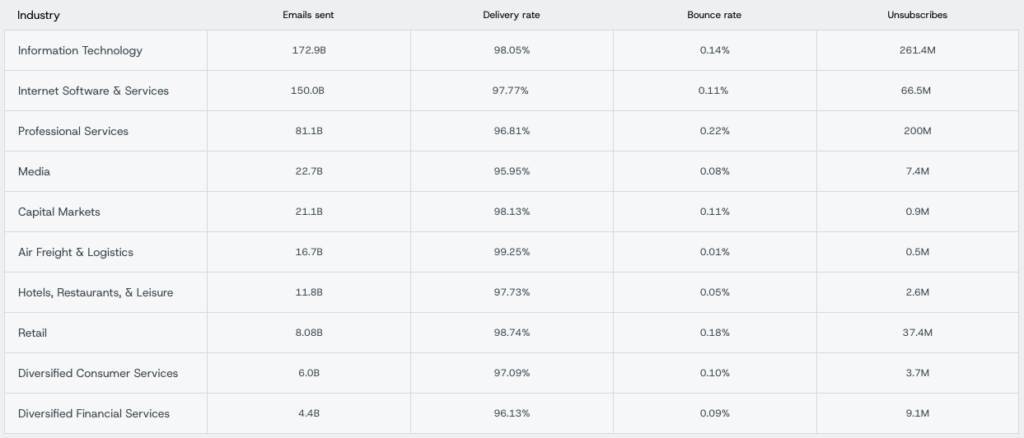
One of the most valuable contributions of the 2026 Email Impact Report is its unique approach to industry benchmarks. Unlike many reports that rely on self-reported estimates from surveys, Chapter 2 leverages real sending data from Sinch Mailgun’s infrastructure, analyzing billions of emails across the top 10 industries by volume in 2025. This data-driven perspective offers a more accurate and granular understanding of what constitutes genuine performance.
The analysis of 400 billion emails reveals significant variations in delivery metrics across sectors. Air Freight & Logistics, for instance, leads with an impressive 99.25% delivery rate and an exceptionally low 0.01% bounce rate. This stellar performance is largely attributable to the nature of their communications: predominantly transactional sends (e.g., shipping confirmations, tracking updates) directed at recipients who actively anticipate and desire these messages. In stark contrast, the Media industry records the lowest delivery rate among the top 10, at 95.95%. This is often a natural consequence of high sending volumes and broader promotional audiences, which inherently exert downward pressure on delivery metrics due to factors like less engaged subscribers or stricter spam filters.

However, the report critically cautions against relying solely on delivery rate as a measure of success. An email might be “delivered” to a recipient’s server, yet still end up in the spam folder, rendering it effectively undelivered in terms of engagement. The report makes a compelling case for senders to pair delivery rate tracking with consistent inbox placement testing. This crucial distinction allows organizations to understand not just whether their emails were accepted by the server, but where they actually landed—a fundamental difference for achieving visibility and engagement. Tools for inbox placement testing simulate email delivery to various mailbox providers (Gmail, Outlook, Yahoo, etc.) and report on folder placement (inbox, spam, promotions, etc.).
Further demonstrating the importance of context, the report highlights the nuances of unsubscribe rates. Information Technology, for example, logged the highest raw number of unsubscribes at 261 million. However, when contextualized against its colossal send volume of 172.9 billion emails, this translates to a relatively low unsubscribe rate of approximately 0.15%. Conversely, the Retail sector generated 37.4 million unsubscribes from a much smaller volume of 8.08 billion sends, indicating a significantly higher unsubscribe rate per email. This comparison underscores a vital analytical principle: raw metrics without proportional context are often meaningless and can lead to misinformed strategic decisions.
The Deliverability Imperative: DMARC and Evolving Standards
The importance of deliverability, the ability of an email to successfully reach the recipient’s inbox, is widely acknowledged, with 89% of senders deeming it critical to their organization. Encouragingly, 43% of senders report an improvement in their inbox placement over the preceding 12 months. This progress is largely attributed to advancements in email infrastructure and the widespread adoption of authentication protocols.
A key driver of this improvement is the significant growth in DMARC (Domain-based Message Authentication, Reporting, and Conformance) adoption. Mandates from major mailbox providers like Gmail, Yahoo, and Microsoft have spurred organizations to implement DMARC, a protocol designed to protect email senders and recipients from spam, spoofing, and phishing. For the first time in Sinch Mailgun’s research, the report indicates that DMARC enforcement is outpacing passive monitoring, with over half of DMARC adopters now utilizing quarantine or reject policies. This means that a growing number of organizations are actively telling receiving servers to either quarantine (send to spam) or reject (block) emails that fail DMARC authentication, thereby enhancing sender reputation and combating malicious activities. This trend signifies a maturing understanding and application of email security standards across the industry.
Despite these infrastructure improvements, a persistent and concerning knowledge gap remains. A significant 36% of senders claim to monitor their “email deliverability rate,” a metric that, as the report correctly points out, does not technically exist in a precise, actionable form. This confusion highlights the distinction between the “delivery rate” (emails accepted by the server, including those diverted to spam) and “inbox placement” (emails actually reaching the primary inbox). Only a quarter (25%) of senders actively conduct inbox placement tests to ascertain where their emails are truly landing. Furthermore, 27% of DMARC users are unaware of the specific policy they have implemented. This data paints a clear picture: while the tools and standards for robust deliverability are improving and becoming more prevalent, the foundational literacy and understanding among many email senders have not kept pace. This disconnect can lead to a false sense of security and missed opportunities to optimize email performance.
Artificial Intelligence in Email: A Transformative, Yet Uneven, Impact
The integration of Artificial Intelligence (AI) into email programs is a dominant theme in the 2026 report, reflecting its pervasive influence across digital marketing. A substantial 79% of senders either currently use or plan to integrate AI into their email strategies. However, the report reveals that actual regular use stands at a modest 27%, indicating that a significant portion of adopters are still in the experimental phase rather than having systematically embedded AI into their daily workflows.
The most common application of AI in email programs is copy generation, cited by 41% of users. This is followed by content personalization (36%), dynamic content creation (29%), send time optimization (27%), and data analysis (27%). The report’s analysis clearly demonstrates a pattern: AI yields the most significant value when deeply integrated into decision-making processes, extending beyond mere content production. Teams that leverage AI for sophisticated tasks such as personalization, optimal send timing, and A/B testing report compounding returns. In contrast, teams whose AI usage is limited to more superficial applications, such as drafting subject lines, observe only a limited impact.
This distinction is starkly illustrated by a key finding: 54% of senders who have implemented AI report that their email programs improved moderately or significantly year-over-year. This contrasts sharply with only 37% of senders not using AI who saw similar improvements in the same period. This 17-point performance gap is a compelling indicator that AI is beginning to stratify email programs into different performance tiers. While the report carefully notes that this does not definitively prove causation, the consistent direction of the data strongly suggests a significant correlation between AI integration and enhanced email program performance. Crucially, the report also acknowledges that 23% of AI users report no discernible help from the technology. This finding is not attributed to the tool itself, but rather to the depth and strategic nature of its integration. Superficial or piecemeal AI adoption is unlikely to yield transformative results; true impact comes from embedding AI into core strategic decisions and operational workflows.
Strategic Investment for Future Growth
Looking ahead to 2026, the top priorities for email senders are clearly defined: “taking advantage of AI” and “increasing email engagement” are tied, each cited by 40% of senders. This alignment underscores the industry’s recognition of AI as a powerful lever for driving engagement and optimizing email performance.
Regarding financial commitments, the report indicates a cautiously optimistic outlook for email investment:
- 31% of organizations plan to increase their email investment.
- 48% intend to maintain current spending levels.
- Only 7% plan to decrease their email investment.
These figures suggest a stable to growing investment landscape, reflecting the channel’s perceived value and the potential for further optimization. The modest percentage planning to decrease investment further reinforces email’s enduring importance in the digital marketing mix.
The Sinch Mailgun report concludes with a straightforward yet profound message: email works. The extensive data collected—spanning ROI, industry benchmarks, and deliverability trends—unequivocally supports this assertion. However, the programs that are poised to significantly outperform their peers are those that make strategic investments in three interconnected areas:
- Measurement: Proving ROI with real, quantifiable data rather than relying on intuition or anecdotal evidence. This involves establishing clear KPIs, implementing robust tracking, and developing sophisticated attribution models.
- Deliverability: Consistently ensuring emails reach the inbox through diligent authentication (SPF, DKIM, DMARC), meticulous list hygiene, proactive monitoring of sender reputation, and regular inbox placement testing. This is the foundation upon which all other email success is built.
- Optimization: Continuously improving performance at scale through strategic use of AI for personalization, segmentation, send time optimization, and content generation, combined with rigorous A/B testing and performance analysis.
Crucially, the report emphasizes that none of these areas necessitate a massive upfront budget to initiate. The power of these strategic investments lies in their compounding nature; small, consistent efforts yield increasingly significant returns over time, allowing organizations to gradually build more sophisticated and effective email programs.
Broader Implications for the Digital Marketing Landscape
The findings of Sinch Mailgun’s 2026 Email Impact Report resonate far beyond the confines of email marketing. They serve as a microcosm for the broader digital marketing landscape, highlighting the increasing premium placed on data-driven decision-making, technical proficiency, and strategic adoption of emerging technologies like AI. Businesses that embrace these principles across all their digital channels are more likely to thrive in an environment characterized by increasing complexity and competition.
The report implicitly calls for a shift in mindset: from viewing email as a mere communication tool to recognizing it as a sophisticated, data-rich ecosystem demanding strategic oversight and continuous improvement. The widening gap between the “haves” (those investing in measurement, deliverability, and optimization) and the “have-nots” (those relying on assumptions) is not just about performance metrics; it’s about competitive advantage, customer experience, and ultimately, sustainable business growth. As AI continues to evolve and regulatory landscapes (e.g., data privacy) become more stringent, the ability to manage email programs with precision and foresight will only become more critical. The 2026 Email Impact Report stands as a timely and essential guide for any organization committed to maximizing the enduring power of email in the years to come.