

The burgeoning world of e-commerce, while brimming with opportunity, often presents a formidable challenge for business owners: accounting. The intricate web of card payments, sales tax, shipping logistics, processor fees, gift card redemptions, and marketplace charges can quickly become overwhelming, particularly for those operating across multiple jurisdictions. In this landscape, accounting software is not just a tool, but a critical enabler for growth and compliance. Two leading contenders in this space, Xero and Sage, offer distinct approaches, catering to different scales and complexities of business operations. This article delves into their features, pricing, and suitability for e-commerce merchants, providing a comprehensive analysis to guide decision-making.
The core dilemma for e-commerce entrepreneurs is finding accounting software that simplifies, rather than complicates, their financial management. The sheer volume of transactions, coupled with varying tax regulations and payment gateways, demands a robust yet user-friendly solution. While both Xero and Sage provide tools to streamline these processes, their fundamental design philosophies and target audiences differ significantly. Xero positions itself as a more accessible and affordable option, emphasizing automation and seamless integration with the existing e-commerce technology stack. Sage, on the other hand, is often perceived as a more powerful, albeit more expensive, platform geared towards larger enterprises with complex financial structures and stringent governance requirements.
Quick Verdict: Xero vs. Sage for E-commerce
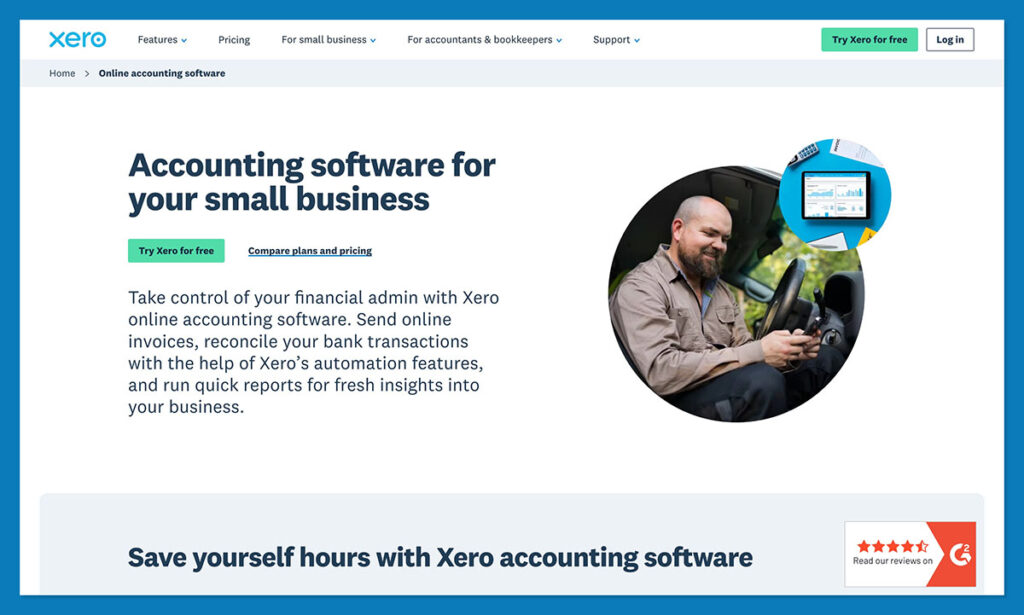
For the vast majority of e-commerce sellers, particularly those in the small to medium-sized enterprise (SME) bracket, Xero emerges as the more compelling initial choice. Its affordability, intuitive interface, and strong emphasis on connecting with the multitude of tools already utilized by online businesses make it a natural fit. A testament to this is Xero’s dedicated Shopify app, which facilitates synchronization of sales, fees, payouts, and taxes, offering daily summaries for quick overviews.
Sage, conversely, offers a tiered product line, starting with Sage Accounting and extending to more comprehensive solutions like Sage 50, Sage Intacct, and Sage 200. While Sage 50 is positioned for smaller businesses, it typically comes with a higher price tag and a steeper learning curve compared to Xero. However, Sage’s strength lies in its capacity to handle intricate financial rules, provide greater control for businesses with demanding governance needs, or those operating within highly specialized industries.
| Category | Xero | Sage |
|---|---|---|
| Best Fit | E-commerce SMEs, marketplace sellers, app-led teams | Stock-heavy businesses, finance-led teams, job costing needs |
| US Pricing (approx.) | $25, $55, or $90/month | Sage 50 starts at $128.67/month |
| Users | No per-user license fees | Sage 50 Pro is 1 user; higher plans add more users |
| E-commerce Connections | Stronger fit for Shopify and connected sales apps | Works better when e-commerce is part of a wider accounting setup |
| Inventory | Fine for basic stock, better with apps | Stronger native stock tools |
| Reporting | Easier for owners and operators | Better for formal finance review |
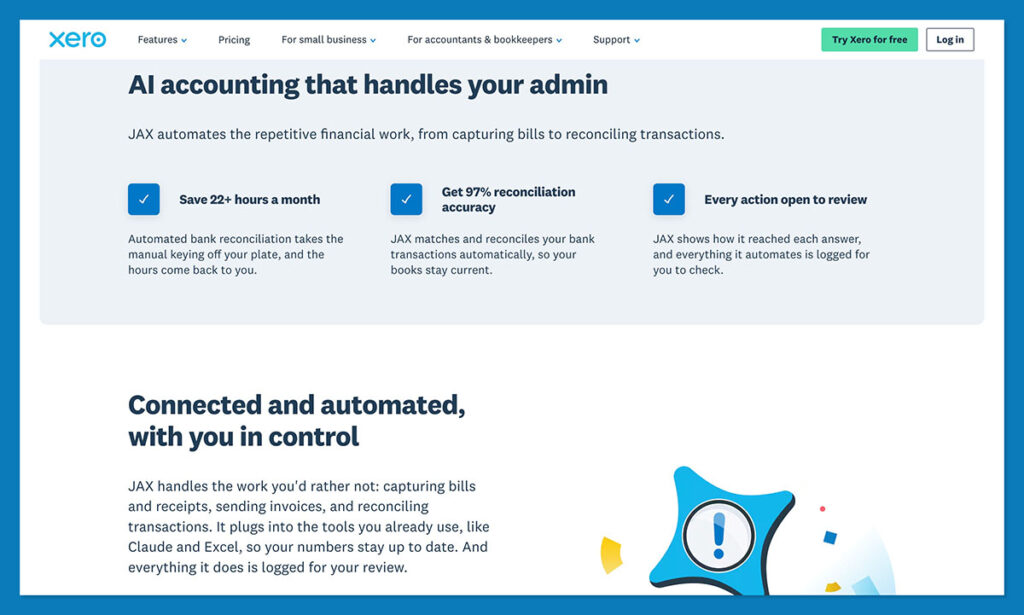
| AI and Automation | JAX, smart document capture, auto-reconcile beta | Sage Copilot, document capture, duplicate checks |
| Author’s Verdict | Start here unless you’ve outgrown simple accounting | Choose it when the finance workload justifies the cost |
Xero vs. Sage: Pricing and Total Value Proposition
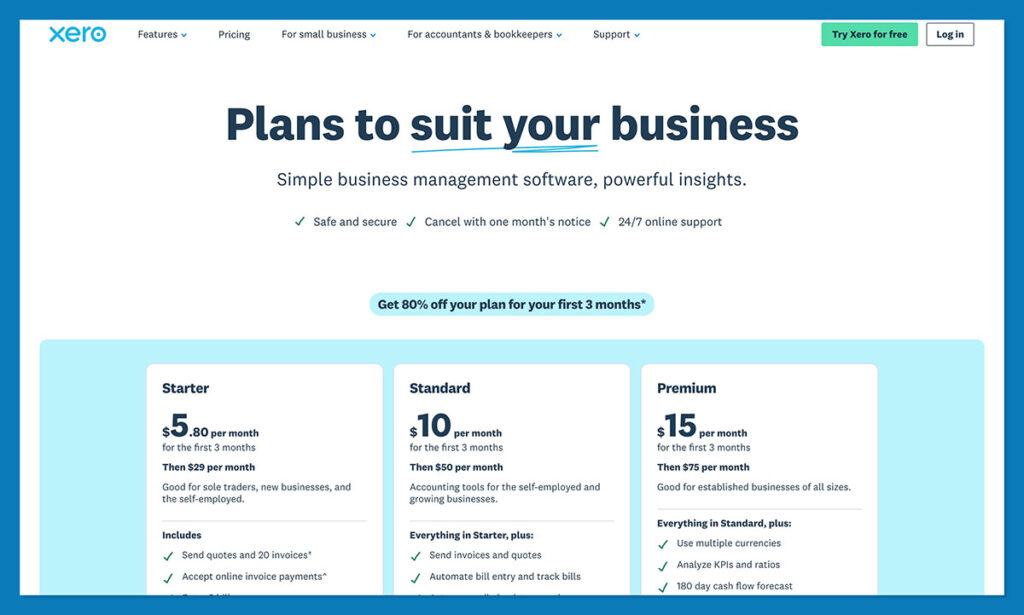
When considering the financial investment, Xero presents a more straightforward and accessible pricing structure, making it an easier sell for most e-commerce businesses. While pricing can vary by region, Xero typically offers several plans, all designed to be remarkably affordable. For instance, a substantial introductory discount of 90% off for the first six months is often available, further lowering the barrier to entry.
The Xero Early plan, generally starting at $25 per month, provides essential features such as quote generation, online invoice payments, bill tracking, bank transaction reconciliation, smart document capture, real-time reporting, and W-9/1099 management. This tier is ideal for nascent businesses or those with a lower volume of transactions.
The Xero Growing plan, priced around $55 per month, removes invoice limits and extends cash flow forecasting to 60 days, alongside customizable dashboards. For businesses requiring more advanced functionalities, the Established plan, at approximately $90 per month, includes multi-currency support, time tracking, and employee expense claim management, catering to growing and more complex operations.
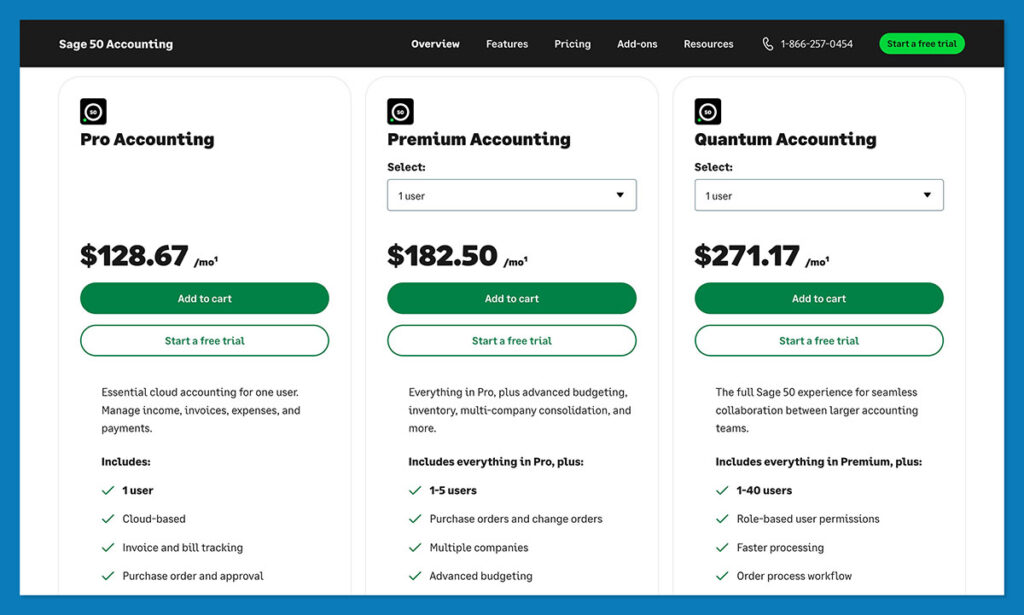
Sage’s pricing strategy is inherently more complex due to its tiered product lineup. Focusing on Sage 50 as a comparable option for smaller to medium businesses, the Pro plan commences at approximately $128.67 per month. While it offers features akin to Xero’s standard plans, it also integrates job management, real-time collaboration, and unlimited invoicing as standard.
Higher-tier Sage 50 plans escalate in price and functionality. The Premium plan, costing around $182.50 per month for up to five users, introduces advanced budgeting, enhanced reporting, and serialized inventory tracking. The Quantum plan, priced at approximately $271.17 per month, further bolsters capabilities with workflow management and more.
The Winner: Pricing
For the majority of online sellers, Xero undoubtedly offers superior value, especially if advanced, complex tools are not an immediate necessity. Its transparent pricing and feature set are well-aligned with the needs of growing e-commerce ventures. Sage, conversely, justifies its higher cost for businesses that require its specialized, high-performance features.
Xero vs. Sage: Core Accounting Features for E-commerce
While a deep dive into every feature of both platforms would be extensive, a comparative overview highlights their distinct strengths and target markets. It becomes evident that one platform is tailored for smaller e-commerce sellers grappling with day-to-day accounting, while the other is engineered for larger corporations managing increasingly complex financial operations.
Invoicing, Expenses, Bills, and Everyday Accounting
Xero excels for e-commerce operators who need to manage financial tasks efficiently amidst daily operational demands. Its day-to-day tools are exceptionally user-friendly, encompassing quotes, invoices, bill tracking, receipt capture, bank reconciliation, online file storage, and real-time reporting. Crucially for US-based businesses, Xero includes W-9 and 1099 management, integrated sales tax capabilities via Avalara, and free ACH bill payments across all its plans. Higher-tier plans further enhance efficiency with automated bill entry.
Sage, even at its foundational level, offers a more comprehensive suite. The Sage 50 Pro Accounting plan includes robust invoice and bill tracking, expense management, automated bank reconciliation, purchase order approval workflows, cash flow management, job management, and payroll. Real-time collaboration and a dedicated Sage Security Shield are also standard. While these features are impressive, they may represent overkill for many smaller e-commerce stores. However, for businesses with a wholesale component or non-standard sales strategies, Sage’s depth can be invaluable.
E-commerce Channels, Marketplaces, and Payout Reconciliation
Xero gains a significant advantage in this domain due to its seamless integration capabilities. Its dedicated Shopify app is a prime example, offering flexibility in how sales data is synced, from daily summaries to per-transaction details. Beyond Shopify, Xero boasts an extensive marketplace of over 1,000 third-party applications, allowing businesses to connect with platforms like Etsy and other marketplaces, as well as specialized inventory management tools. This ecosystem approach ensures Xero can adapt to almost any e-commerce setup.
Sage is also designed to handle e-commerce operations, but its strength lies in integrating e-commerce as part of a broader, more integrated accounting system. For businesses heavily reliant on a diverse stack of e-commerce tools like Shopify, Etsy, Stripe, PayPal, and multiple inventory applications, Xero often presents a more natural and less integration-intensive solution. Sage’s built-in advanced HR and accounting features contribute to its higher price point but may necessitate more effort to bridge with a typical e-commerce seller’s existing app ecosystem.
Inventory, Stock, and Product Margins
Xero provides sufficient inventory management tools for businesses with basic stock tracking needs. It allows for the assignment of tracked and untracked items, with automatic stock level updates. Features like average cost tracking, automated purchase order generation, and profitability reports are standard. For businesses requiring more advanced inventory capabilities, Xero’s integration with external inventory management apps offers a scalable solution.
Sage, on the other hand, offers a more robust and comprehensive suite of native inventory management tools. These include automated reordering with low stock alerts, multi-warehouse management, batch tracking, detailed stock valuations, flexible item types, and real-time tracking. Advanced job costing, audit trails, and comprehensive budgeting features further enhance its inventory capabilities.
The Winner: Inventory
Sage likely takes the lead for businesses with exceptionally complex inventory requirements, offering more advanced native features. However, Xero remains a strong contender if inventory is managed within a well-integrated e-commerce ecosystem, where external apps can supplement its built-in functionalities.
Tax, Sales Tax, 1099s, and Multi-Currency
For e-commerce sellers operating in the United States and globally, Xero addresses fundamental tax requirements. It handles sales tax, provides real-time reports, facilitates online payments, and includes document management for W-9 and 1099 forms. Support for VAT management in the EU and UK is also available. Xero integrates with Avalara for sales tax calculations and reporting. While Xero supports payments in over 160 currencies, the multi-currency feature is typically unlocked on the Established plan, which is priced at $90 per month.
Sage offers a more immediate advantage for international sellers. Many of its plans incorporate features such as automated exchange rates and real-time revaluation. Sage 50 even includes a foreign trader module specifically for supplier accounts. Additionally, Sage provides comprehensive audit trails, role-based permissions, advanced departmental reporting, and granular job costing. While these features are powerful, their utility is contingent on the business actually needing them. For a small Etsy or Shopify seller, the extensive capabilities of Sage might be more than necessary.
Reporting, Analytics, and Security
Xero is designed to provide reports that are easily understandable by business owners and operators, without the need for a financial professional. Even its entry-level plan includes real-time reports, sales tax summaries, basic graphs, and a 30-day cash flow forecast. Higher plans progressively offer more sophisticated forecasting, performance graphs, custom dashboards, and financial health scorecards.
Sage 50’s reporting capabilities are more extensive and, consequently, can appear more intimidating to users without accounting backgrounds. The Pro plan offers standard financial statements, cash flow reports, general ledger reporting, and advanced reporting groups. More expensive plans unlock features like workflow and project management.
On the security front, both platforms are highly robust, as expected for financial software. Xero employs a JAX permissions model, which also governs data access for AI models, alongside comprehensive data protection and SOC 2 compliance. Sage also offers extensive security features, including AI and data protections, comprehensive access controls, and certifications for major global standards like PCI and GDPR. Both companies provide strong customer support for security-related inquiries.
AI and Automation
Xero’s AI and automation efforts are primarily focused on enhancing user experience and efficiency. Smart bank feeds simplify reconciliation and allow for custom categorization rules. Xero’s JAX feature, available at no extra cost, provides accounting insights and automates administrative tasks without compromising security. Additional automation features include smart document and bill capture, with auto-reconciliation available on higher plans.
Sage is adopting a more integrated AI approach across its product family. Sage Copilot acts as an AI assistant for finance workflows, offering task assistance, monitoring, contextual search, and more. The platform also includes smart invoice processing, error detection, and intelligent finance analysis capabilities.
The Winner: AI and Automation
While both platforms demonstrate strong capabilities in AI and automation, Xero appears to be the more practical choice for everyday acceleration of accounting tasks. Sage’s AI features seem geared towards providing deeper insights for larger enterprises.
Should You Choose Xero or Sage?
There is no single "right" answer when choosing between Xero and Sage, as the optimal choice is dictated by the specific needs and scale of an e-commerce business. Sage stands out as a powerful platform for large enterprises requiring advanced accounting tools and robust native inventory management, especially as businesses scale and the need for integrated solutions grows. Its higher cost is offset by its comprehensive functionality, potentially reducing reliance on numerous third-party integrations.
For the majority of e-commerce companies, particularly those in their growth phase, Xero presents a more compelling initial option. Its affordability, intuitive design, and seamless integration with the existing e-commerce technology stack, from platforms like Shopify to payment processors like PayPal, make it an accessible and efficient solution. Xero is designed to simplify the accounting process for users who may not have extensive financial expertise, reducing the time spent on complex reports and data analysis.
Sage remains the preferred choice for businesses prioritizing deep inventory management and requiring enterprise-level performance. Conversely, Xero is the more readily recommended solution for the vast majority of e-commerce SMEs seeking a user-friendly and cost-effective accounting platform.
Xero vs. Sage: Frequently Asked Questions
Is Xero better than Sage for e-commerce?
For most online sellers, Xero is the preferred choice. It is generally more affordable, quicker to learn, and designed to integrate seamlessly with the applications e-commerce businesses commonly use, including Shopify, Stripe, and PayPal. While Sage is a more powerful platform overall, many of its advanced features, such as job costing by phase and departmental reporting, are not typically utilized by smaller stores.
Which is cheaper, Xero or Sage?
Xero is significantly cheaper, particularly at the entry-level. Xero’s Early plan starts at $25 per month, with the top-tier Established plan at $90 per month, and no per-user licensing fees. Sage 50 Pro Accounting begins at approximately $124 per month for a single user, with its Premium and Quantum tiers increasing in price for multi-user capabilities. Both vendors frequently offer promotional pricing, so it is advisable to check current offers.
Does Xero connect to Shopify?
Yes, Xero offers an official Shopify app that synchronizes sales, fees, payouts, and taxes. Users can choose between daily summaries or per-sale transaction data for detailed ledger entries. Xero also provides access to a marketplace with over 1,000 third-party apps, allowing integration with platforms like Etsy and Amazon, as well as various inventory connectors.
Can Sage handle e-commerce sales and marketplace payouts?
Sage can handle e-commerce sales and marketplace payouts, but it is not typically the primary choice for standalone e-commerce operations. Sage is most effective when e-commerce is integrated into a broader accounting framework that includes stock management, payroll, and job costing. For businesses that primarily consist of Shopify or Etsy stores with a few connected applications, integrating Sage may require more effort than using Xero.
Is Xero or Sage better for inventory management?
Sage is superior for businesses with genuinely complex inventory needs. It provides native features such as automated reordering with low-stock alerts, multi-warehouse management, batch tracking, and real-time stock valuations. Xero offers basic inventory management, including tracked and untracked items, average cost tracking, and automated purchase orders, which is adequate for many businesses. For more advanced requirements, Xero relies on integrations with dedicated inventory apps.
Do Xero and Sage support multi-currency?
Both platforms support multi-currency transactions, but Sage offers this functionality across more of its plans. Xero supports payments in over 160 currencies, though multi-currency features are typically enabled on the Established plan ($90/month). Sage often includes automated exchange rates and real-time revaluation in its plans, and Sage 50 features a foreign trader module for supplier accounts.
Which one is easier to learn?
Xero is generally considered easier to learn. Its interface is designed for business owners and operators, and its reports are presented in a more accessible format. Sage 50 offers greater depth but can be more intimidating, particularly its reporting features, for users without an accounting background.
Can you migrate from Sage to Xero?
Yes, migration from Sage to Xero is possible, but it requires careful planning. Both platforms support the export and import of essential data, including the chart of accounts, contacts, and transaction history. Xero also partners with conversion specialists who can manage larger or more complex migrations. The most reliable method is to initiate the migration at the start of a financial period, keeping the old system accessible in read-only mode until the first full reconciliation is complete.
Does Xero handle US sales tax and 1099s?
Yes, Xero includes W-9 and 1099 management, sales tax handling through Avalara, and free ACH bill payments on all its plans. It also supports VAT management for businesses operating in the UK and EU.
Which should a small Shopify or Etsy seller choose?
A small Shopify or Etsy seller should start with Xero. Its Early plan is suitable for businesses sending fewer than 20 invoices monthly, with the Growing plan accommodating increased transaction volumes. Moving to Sage is advisable when the finance workload genuinely warrants it, such as for extensive stock management, job costing, stringent governance requirements, or when a finance team necessitates formal reporting capabilities beyond dashboards.








