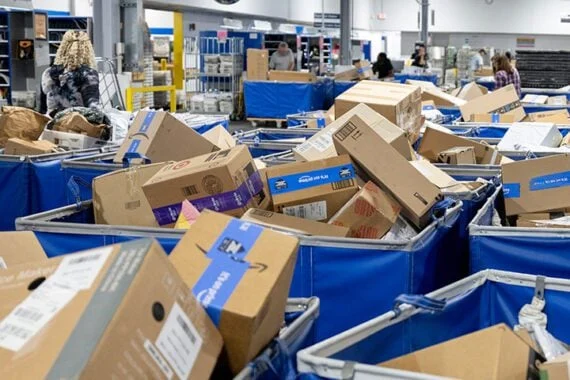
The United States Postal Service, grappling with an ongoing liquidity crisis, is signaling a strategic shift towards prioritizing revenue generation over package volume, a move that could lead to increased parcel prices even at the expense of handling fewer packages overall. This recalibration comes as the quasi-governmental agency reported a significant net loss in its third quarter of fiscal year 2026, underscoring the urgent need for financial stabilization.
A Shift in Pricing Philosophy: Revenue Maximization Takes Precedence
During an open session of the USPS Board of Governors on August 7, 2026, Postmaster General and CEO David Steiner articulated this new strategic imperative. "The results this quarter show the strong leverage that pricing can have on results, and pricing is one lever that we have to use now to grow revenue," Steiner stated, directly linking recent financial outcomes to the impact of pricing adjustments. This statement marks a departure from a long-held assumption that increasing parcel volume was the primary, if not sole, pathway to offsetting declining mail revenue.
The Postal Service’s recent financial performance provides a stark illustration of this emerging trend. For the third quarter ending June 30, 2026, the USPS reported operating revenue of $19.9 billion, a respectable 6.1% increase compared to the same period in the previous year. While this revenue growth is encouraging, it was achieved alongside a narrowed net loss of $2.5 billion, down from $3.1 billion in the prior year’s quarter. This indicates that despite revenue gains, the agency continues to operate at a substantial deficit.
Digging deeper into the revenue streams, shipping and packages emerged as a significant contributor, generating $8.25 billion in revenue during the quarter. This represents a year-over-year increase of $588 million, or 7.7%. Crucially, this revenue growth was not driven by an expansion in the number of packages handled. In fact, package volume declined by a notable 55 million pieces, or 3.4%. This divergence between revenue and volume underscores Steiner’s assertion: the USPS is now making significantly more money from fewer shipments.
Factors Driving Revenue Growth Amidst Declining Volume
Several factors contributed to this counterintuitive outcome. The growth of the Ground Advantage service, a key offering for e-commerce shippers, played a role. Additionally, a temporary transportation-related price increase, implemented in April 2026 for certain parcel services, demonstrably boosted revenue. This suggests that higher prices are effectively compensating for, and even exceeding, the revenue lost from reduced package volumes.
Steiner emphasized that the current pricing strategy is not only sustainable but also necessary. "All of the statistics and results show that we have yet to cross the point that we should be changing our pricing strategy, and that we have more price [increases] to take in the marketplace," he asserted. "It would be financially irresponsible of us not to do so." This sentiment extends beyond just parcel services. Even in market segments where the Postal Service holds a near-monopoly, such as First-Class Mail, revenue increased by 4.3% during the quarter, despite a 3.5% decline in volume.
Navigating Regulatory Constraints and Industry Comparisons
The Postal Service operates under a unique regulatory framework that limits its ability to raise prices aggressively on its monopoly mail products. However, compared to private sector carriers, the USPS enjoys a degree of protection and flexibility. Steiner drew a parallel between USPS pricing strategies and those employed by airlines and grocery stores, where businesses often adjust prices to maximize financial returns rather than simply pursuing the highest possible sales volume.
"Thus far, applying those basic principles has favored raising prices even though there has been a modest decrease in volumes," Steiner observed, implicitly positioning the USPS as operating with a similar business logic to private industry, even while acknowledging the different regulatory environments. This approach, he argued, is financially prudent given the agency’s persistent liquidity challenges.
The Evolving Role of E-commerce in the USPS Landscape
For many years, the burgeoning growth of e-commerce packages was viewed as a lifeline for the Postal Service, a crucial avenue to offset the relentless decline in First-Class Mail volume and its associated revenue. Many merchants also perceived the USPS as an indispensable partner, particularly for lightweight residential shipments and for deliveries to remote areas where private carriers might impose surcharges. The logic was compelling: e-commerce packages could fill existing delivery trucks, processing facilities, and routes that the USPS was legally mandated to maintain, making its inclusion a natural and cost-effective proposition.
However, Steiner’s recent pronouncements challenge this long-held paradigm. He contends that maximizing parcel volume, or even mail volume, is not necessarily synonymous with maximizing revenue. The financial results from the June 30 quarter serve as a potent example. By handling 55 million fewer packages but collecting $588 million more in revenue from those shipments, the USPS demonstrated that a more profitable outcome can be achieved with a reduced workload.
From the Postal Service’s perspective, this trade-off is demonstrably favorable. This shift in focus creates a new incentive structure that could have significant implications for e-commerce shippers. While the USPS still requires package business, its latest financial data suggests it does not necessarily need more packages at any cost. Postmaster General Steiner has made it clear that if the agency can generate more revenue while transporting fewer parcels, that is the preferred outcome.
This evolving strategy does not inherently diminish the attractiveness of services like Ground Advantage for e-commerce merchants. However, it does signal a potential transformation in how the Postal Service operates and prices its services, moving away from a volume-driven model towards one that prioritizes profitability.
An Unsustainable Business Model and the Call for Congressional Action
Beyond immediate pricing strategies, Steiner also highlighted the deeply ingrained structural issues plaguing the Postal Service. He asserted that even with enhanced price-setting authority and revenue boosts, these measures alone cannot rectify a fundamentally unsustainable business model.
"As things stand, the Postal Service is expected to be self-sustaining while, at the same time, fulfilling mandates that are inherently unsustainable and do not cover their costs," Steiner stated. He directly linked the persistent financial imbalance to the agency’s operational framework. "We need to fix the business model that has produced the 17-year-long imbalance in costs and revenue – and that is going to require Congressional involvement."
This call for Congressional intervention underscores the belief that legislative reform is necessary to address the systemic challenges that have led to a prolonged period of financial deficits. The USPS is burdened by obligations that, according to leadership, are not adequately funded or commercially viable in the current operating environment.
Implications for E-commerce Shippers and the Road Ahead
The immediate implication for e-commerce merchants is clear: they should anticipate further increases in postal package rates. With the holiday peak season on the horizon, the Postal Service’s strategic focus on revenue maximization suggests that price adjustments are likely to continue. Businesses that rely on USPS services, particularly for last-mile deliveries and shipments to rural areas, will need to factor these potential cost increases into their pricing and logistics strategies.
This shift by the USPS represents a significant adjustment for the e-commerce ecosystem. For years, the Postal Service’s extensive network and often lower price points made it a go-to option. However, as the agency prioritizes financial stability through increased pricing, businesses may need to re-evaluate their shipping partnerships and explore alternative carriers or absorb higher costs. The long-term viability of the Postal Service hinges on its ability to balance its universal service obligations with financial solvency, a challenge that appears to be increasingly leaning on pricing power as a primary tool in the interim. The coming months will be critical in observing how these strategic shifts unfold and their broader impact on the shipping landscape.