
 rifanmuazin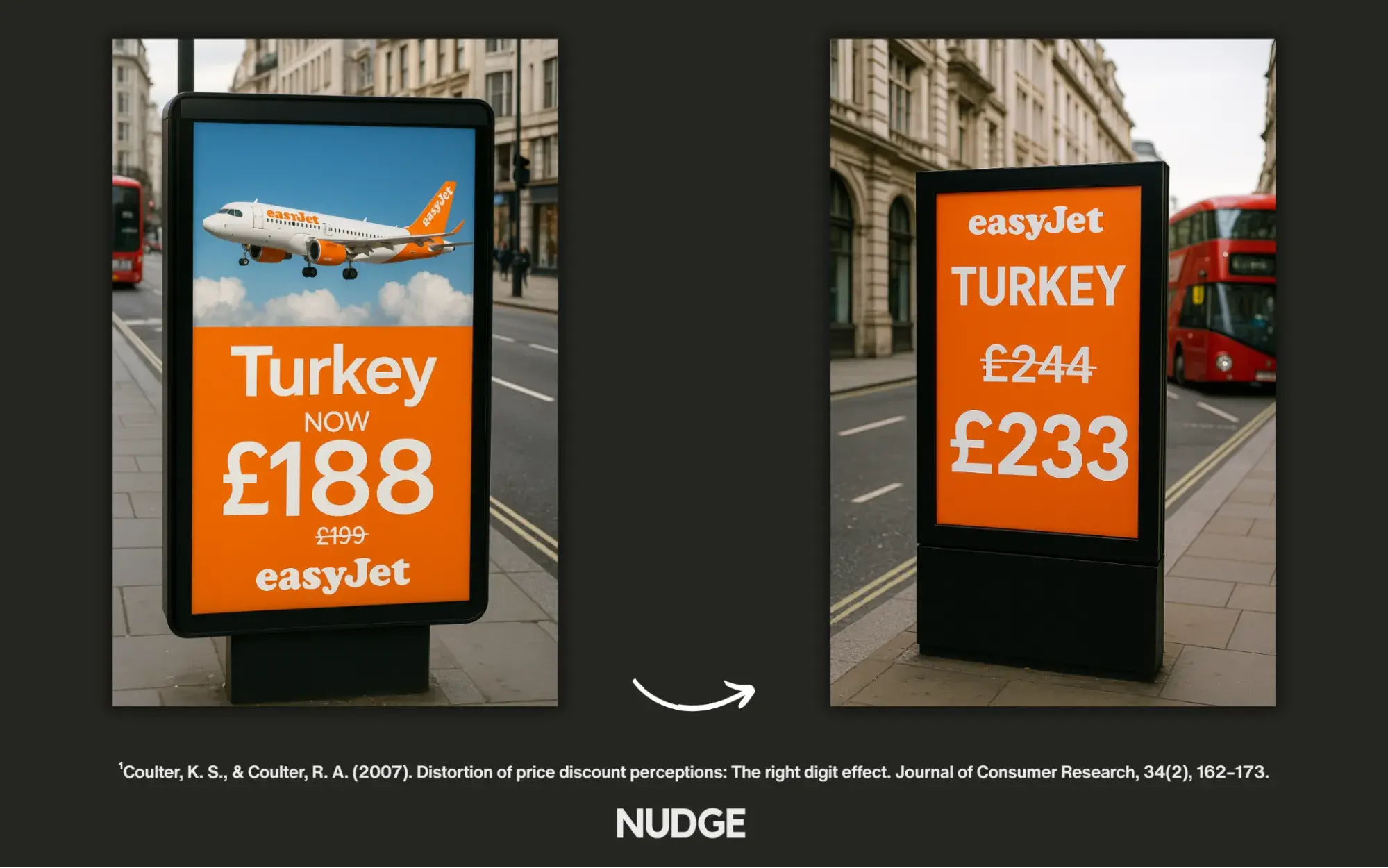
In 2007, a pivotal study by Coulter and Coulter unveiled a fascinating aspect of consumer psychology, demonstrating that the presentation of a discount can significantly alter perceived value, irrespective of the actual saving. This research, among others, highlights a burgeoning field where behavioral economics intersects with marketing strategy, revealing that minor adjustments in how prices are displayed can lead to substantial shifts in purchasing behavior. These findings underscore the profound impact of psychological pricing on consumer decision-making, moving beyond simple arithmetic to tap into deeper cognitive processes.
The Counterintuitive Effect of “Small Numbers” in Discounts
The 2007 study by Coulter and Coulter involved two random groups of customers, each presented with advertisements for flights to Turkey offering a £10 discount. One advertisement listed the final ticket price at £188, while the other displayed a higher price of £233. Counterintuitively, customers perceived the cheaper tickets (priced at £188) as a worse value compared to the £233 option. This perplexing outcome was attributed to a cognitive bias known as “cognitive fluency” and the “left-digit effect.” Researchers posited that individuals find it easier to differentiate between smaller numbers. For instance, the perceived difference between 4 and 3 feels more significant or “salient” than the difference between 9 and 8. Consequently, consumers were more inclined to purchase when the discounted prices ended in smaller digits (e.g., from £244 to £233, where the last digits changed from 4 to 3) than when they ended in higher digits (e.g., from £199 to £188, where the last digits changed from 9 to 8).
This phenomenon suggests that when consumers process a price reduction, their perception of the “deal” is not solely based on the absolute monetary saving but also on the visual and cognitive ease of processing the numbers involved. A discount that results in a price ending in a lower digit feels like a more substantial drop, even if the actual saving is identical. For marketers and retailers, the implication is clear: when running a promotional discount, strategically setting the sale price to end in a digit below five can significantly enhance its perceived attractiveness and conversion rates. This principle extends beyond travel, finding applications in various retail environments, from clothing sales to electronics, where price points are often carefully calibrated to exploit such psychological nuances.
Deconstructing Cost: The Power of Unit Price Framing
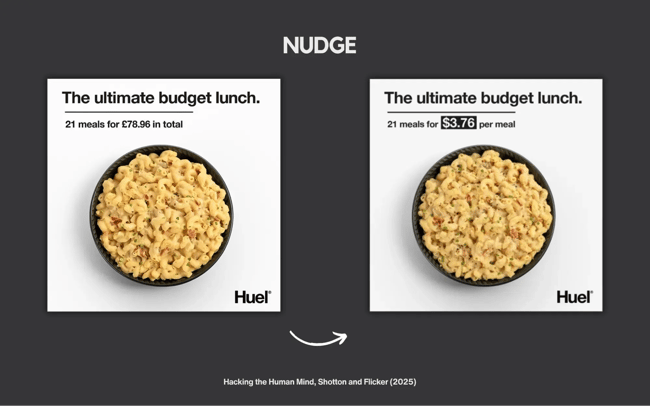
Another potent psychological pricing tactic involves breaking down the total price into smaller, more digestible units. This strategy leverages the human tendency to perceive smaller numbers as more affordable and less daunting. Consider the case of Huel, a budget meal replacement company. Advertisements comparing a total cost for 21 meals (£78.96) against a per-lunch price ($3.76) consistently show that the latter performs better. By presenting a lower numerical value, shoppers are led to perceive a superior deal.
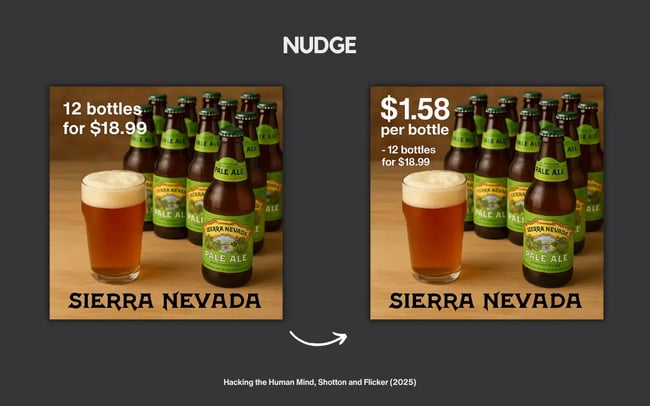
This finding is further corroborated by research from Richard Shotton and Michael Aaron Flicker, detailed in their book Hacking the Human Mind. In one study, 282 shoppers were divided into groups to assess their perception of Sierra Nevada Pale Ale. Half saw the price as $18.99 for 12 bottles, while the other half were informed of the per-bottle price: $1.58. The results were striking: 28.6% of those shown the per-bottle price rated it as “good or very good value,” more than double the 13.7% from the group who only saw the total price. This demonstrates that framing the cost per unit makes the purchase feel more reasonable, accessible, and ultimately, a better value proposition.

This approach is particularly effective for products sold in bulk, subscription services, or multi-item packages. By shifting the focus from a potentially intimidating lump sum to an easily justifiable daily, weekly, or monthly cost, businesses can lower the psychological barrier to purchase. This strategy taps into the concept of “mental accounting,” where consumers categorize and evaluate financial transactions differently based on their presentation. A small, recurring charge often feels less impactful than a large, upfront payment, even if the cumulative cost is the same.
Strategic Upselling: Framing the Price Difference for Premium Adoption
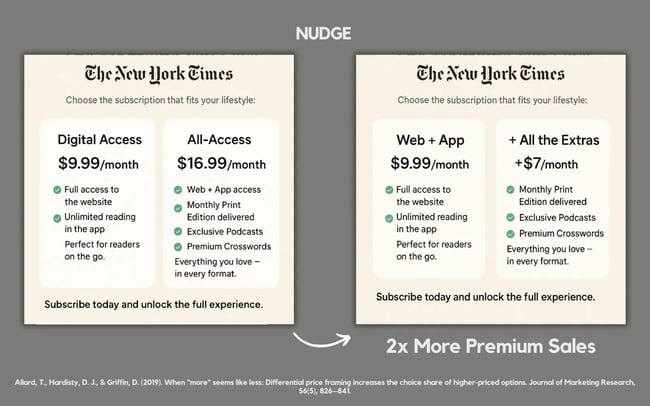
When aiming to encourage customers to upgrade or opt for premium versions of a product or service, the way price differences are presented is critical. A 2019 experiment by David Hardisty at the University of British Columbia, focusing on New York Times subscriptions, provides a compelling illustration. Two groups were presented with subscription options. Group A saw two distinct plans: “Web + App” for $9.99/month and “Web + App + All the Extras” for $17/month. Group B, however, saw the first plan (“Web + App”) at $9.99/month, but the premium option was framed as “+ All the Extras” available for an additional $7/month.
Despite both groups being presented with the same underlying pricing structure (a $9.99 base plan and an upgrade option costing $7 more), Group B chose the premium plan twice as often. This phenomenon, known as “differential price framing,” works because an additional $7 feels far easier to justify than an entire $17 total. The cognitive burden of evaluating a new, higher total price is greater than that of assessing a small, incremental surcharge.
This strategy is invaluable for businesses employing tiered pricing models, such as software-as-a-service (SaaS) providers, streaming services, or even car dealerships offering upgrades. By highlighting the incremental cost of added features or benefits rather than the full price of the higher tier, companies can significantly increase the uptake of premium offerings. It leverages the psychological principle of “anchoring,” where the initial price serves as a reference point, making subsequent, smaller additions seem less significant in comparison. This method subtly guides consumers towards more profitable options without making them feel pressured by a seemingly large jump in cost.
Building Trust Through Transparency: The Unveiling of Costs
In an era of increasing consumer scrutiny and a demand for authenticity, price transparency has emerged as a powerful tool. A LinkedIn post by Phill Agnew, which went viral, showcased two ads for chicken soup: one priced at $7.99, and another detailing the cost breakdown of ingredients, production, and profit margin before arriving at the same final price. The surprising outcome, based on a 2020 Harvard study, revealed that the transparent approach significantly boosted sales.
The Harvard study, conducted in a university canteen, meticulously tracked actual soup purchases. When the cost breakdown was made visible, soup sales surged by an impressive 21%. This compelling evidence suggests that when consumers understand what goes into making a product – the cost of raw materials, labor, and even the profit margin – they are more willing to pay the asking price. Transparency builds trust, fosters a sense of fairness, and helps customers rationalize the value proposition. It counters the common perception that businesses might be overcharging by demystifying the pricing structure.
This approach aligns with broader trends in ethical consumerism and corporate social responsibility. Brands that are open about their supply chains, production costs, and pricing policies often resonate more deeply with conscious consumers. For businesses, adopting price transparency can differentiate them in competitive markets, cultivate customer loyalty, and even command a premium, as consumers perceive greater integrity and value in the product. It shifts the focus from merely buying a product to understanding and appreciating the effort and resources invested in its creation.
Overcoming Decision Paralysis: The Power of Subtle Differentiation
Decision paralysis, a state where individuals struggle to make a choice when faced with too many or seemingly identical options, is a significant barrier to purchase. A South Korean study illuminated how even minor price differences can dramatically alleviate this paralysis. Participants were given ₩1,000 and asked to choose between two identical packs of gum, both priced at ₩630. Only 46% made a purchase, with more than half walking away due to the inability to choose between identical options.
However, when researchers introduced a small price variation – one pack at ₩620 and the other at ₩640 – the purchase rate soared to 77%. A minuscule 20-won difference resulted in a 31-percentage point increase in sales. This highlights a crucial insight: when options appear identical, consumers often default to inaction. By introducing a subtle, non-significant difference, decision-making becomes easier, as it provides a rational (even if arbitrary) basis for choice.
This finding has broad implications for product differentiation and merchandising. In crowded markets where products are functionally similar, even a slight variation in price, packaging, or a minor feature can serve as a “nudge” to facilitate a purchase. Businesses can apply this by subtly varying price points for slightly different product configurations, offering exclusive bundles at marginally different costs, or even highlighting a minor feature that differentiates one item from an otherwise identical competitor. The goal is not to create a massive disparity but merely enough of a distinction to break the deadlock of indifference and empower consumers to make a choice.
Broader Implications and the Future of Psychological Pricing
The aforementioned studies collectively underscore a fundamental truth in contemporary commerce: pricing is not merely an accounting function but a sophisticated psychological tool. The findings presented, spanning over a decade of behavioral economics research, demonstrate that human decision-making is profoundly influenced by cognitive biases, emotional responses, and the context in which information is presented. These “small nudges,” as highlighted in various experiments, do not alter the intrinsic value or utility of a product but dramatically change how that value is perceived and acted upon by the consumer.
The field of behavioral economics, which integrates insights from psychology and economics, continues to evolve, providing marketers and business strategists with an increasingly refined toolkit. Experts in this domain emphasize that moving beyond traditional cost-plus or competitor-based pricing models is no longer an option but a necessity for competitive advantage. Companies that invest in understanding these psychological triggers – from cognitive fluency and anchoring to decision fatigue and trust-building transparency – are better positioned to optimize their pricing strategies, enhance customer satisfaction, and ultimately drive higher sales volumes and profitability.
Furthermore, the digital age, with its abundance of data and A/B testing capabilities, offers unprecedented opportunities for businesses to experiment with and refine these psychological pricing tactics in real-time. This allows for a continuous feedback loop, enabling companies to quickly identify which presentation styles resonate most effectively with their target demographics.
In conclusion, the journey through these psychological pricing strategies reveals that success in the marketplace often hinges on the nuanced art of presentation rather than drastic product overhauls or aggressive price wars. By understanding and ethically applying these scientifically-backed principles, businesses can empower consumers to make decisions that feel right to them, while simultaneously achieving their commercial objectives. The message is clear: small shifts in framing, carefully considered and strategically deployed, can indeed lead to profound commercial success. Businesses are encouraged to delve into their own data, conduct targeted experiments, and continually refine their pricing communications to unlock these powerful psychological advantages.









