
The landscape of search engine optimization is in constant flux, but a recent seismic event has provided unprecedented clarity on what truly drives a website’s visibility on Google. The May 2024 leak of Google’s internal Content Warehouse API exposed over 14,000 proprietary attributes, offering SEO professionals a definitive look under the hood of Google’s ranking algorithms. This disclosure has allowed experts to move beyond speculation and identify the core metrics Google’s sophisticated systems are actively measuring, which are expected to remain paramount through 2026.
For over fifteen years, observing the daily shifts in search results has been the cornerstone of my SEO practice. This insider perspective, now bolstered by the concrete data from the Content Warehouse leak, allows for a comprehensive breakdown of the most critical Google ranking factors. Understanding these elements is not just about improving search engine rankings; it’s about creating a more valuable, authoritative, and user-centric online presence.
Unpacking the Google Ranking Factor Revelation
The question of what truly influences Google’s search rankings has long been a subject of intense debate and myriad theories within the SEO community. While numerous articles list potential ranking factors, their actual impact and validity often remained elusive. The May 2024 leak, however, has provided a level of validation previously unattainable. This event, stemming from Google’s ongoing antitrust legal battles, has brought to light internal documentation that precisely names the attributes Google’s ranking systems utilize.
This leak is considered a pivotal moment, offering direct evidence that corroborates and refines existing SEO best practices. It allows for a more precise identification of how Google interprets and values different aspects of a website and its content. Independent analyses of the leak, such as those by Mike King at iPullRank and Shaun Anderson at Hobo SEO, have been instrumental in translating this technical data into actionable insights for businesses and marketers.
To further demystify the intricacies of the leak, a comprehensive interactive glossary was developed. This tool serves as a working reference for the attributes surfaced, allowing users to filter by module or evidence tier and search by attribute or keyword. The methodology behind this glossary synthesizes information from the leaked API documentation, Pandu Nayak’s testimony during the DOJ antitrust case, and analyses by independent researchers.
The Five Pillars of Google’s Ranking System
The wealth of information gleaned from the Content Warehouse API leak coalesces into five fundamental categories that dictate a website’s performance in Google search results. These are: Domain Authority, Topical Authority, Document Quality, Freshness, and Engagement. Each of these pillars is comprised of specific internal attributes that Google employs to evaluate and rank web pages.
Domain Authority: The Foundation of Trust
Domain Authority, mapping to internal attributes like siteAuthority and chromeInTotal, represents the overarching credibility and trustworthiness of a website. siteAuthority is a site-wide score reflecting link popularity, essentially a modernized PageRank applied at the domain level. chromeInTotal, on the other hand, aggregates data from the Chrome browser, likely indicating user interactions and site performance observed across millions of users.
What Google is Measuring: Google assesses the overall authority and trustworthiness of your domain. This includes the quantity and quality of backlinks pointing to your site, as well as signals of user trust and engagement derived from Chrome browser data. A high siteAuthority score suggests that the domain is a reputable source of information, recognized and linked to by other authoritative entities on the web.

Is This an Issue for Your Site? A potential negative impact on your rankings from this factor might be evident if your branded search volume is stagnant or declining, if competitors with superior link velocity are consistently outranking you, or if your overall website traffic is diminishing relative to your competitors within the same search result pages (SERPs). Examining metrics such as your site’s backlink profile strength, the number of referring domains, and the authority of those domains, compared to your primary competitors, can provide valuable insights.
How to Optimize for Authority: There are no quick “hacks” or simple on-page or technical SEO adjustments that can directly boost siteAuthority or Chrome metrics. Instead, building domain authority is a long-term strategy that involves cultivating genuine trust and recognition. Key actions include:
- Digital PR: Engaging in activities like responding to HARO (Help a Reporter Out) queries, utilizing platforms like Qwoted, and proactively seeking media mentions can earn valuable editorial links.
- Data-Led Link Bait: Creating unique, data-driven content, such as original research, comprehensive studies, or insightful infographics, can naturally attract links from other websites eager to cite your findings.
- Traditional Link Earning: Focusing on creating exceptional content and user experiences that naturally encourage others to link to your site, rather than pursuing aggressive or low-quality link-building tactics.
It is crucial to avoid risky link-building schemes or purchasing traffic, as these practices can lead to negative consequences, including high bounce rates and a proliferation of low-quality links, ultimately harming your site’s standing more than helping it.
Topical Authority: Becoming a Go-To Resource
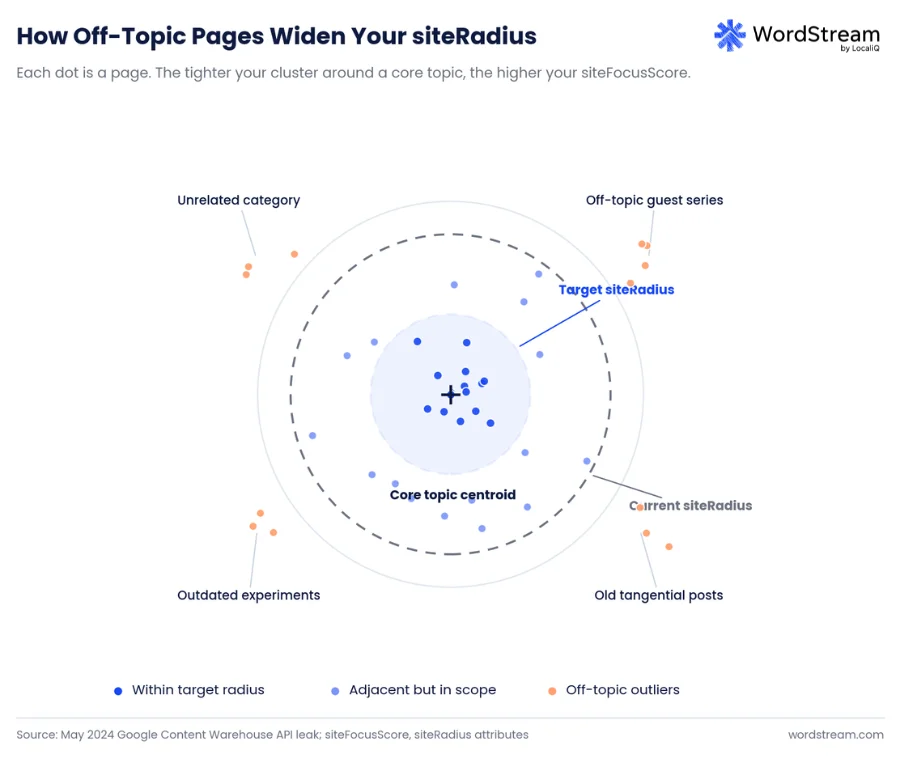
Topical Authority, represented by siteFocusScore and siteRadius, measures how well a website covers a specific subject or niche. siteFocusScore likely quantifies the concentration of content around a primary topic, while siteRadius might define the breadth of related topics a site covers. Google aims to rank sites that are recognized experts in their fields.
What Google is Measuring: Google evaluates the depth and breadth of your website’s coverage within a particular subject area. A high siteFocusScore indicates that a significant portion of your content is dedicated to a core topic, establishing you as a specialist. siteRadius could measure how comprehensively you explore related sub-topics, demonstrating a well-rounded understanding of the broader subject.
Is This an Issue for Your Site? Assessing topical authority can be more challenging than measuring domain authority. While tools exist to map vector embeddings and identify content overlap or a lack of topical focus, their effectiveness can vary based on site size and the number of topics covered. Precisely measuring this against competitors at scale can be difficult. However, if you publish content across many unrelated topics, a large percentage of your pages receive very few visits quarterly, or your most impactful content falls outside your primary area of focus, topical authority may be a concern.
How to Optimize for Topical Authority: The most effective strategy for building topical authority is to establish a clear core focus and consistently create content within that niche.
- Define Your Core Topic: Identify the primary subject matter your website aims to dominate.
- Lean Into Your Niche: Develop a comprehensive content strategy that deeply explores this core topic and its related sub-topics.
- Prune Off-Topic Content: Review underperforming pages that are outside your core topical focus. Consider noindexing or redirecting these pages to tighten your
siteRadiusand enhance yoursiteFocusScore. By doing so, you signal to Google that your website is a dedicated authority on its chosen subject.
Document Quality: Crafting Exceptional Content
Document Quality, mapped to attributes like title and body match, contentEffort, titlematchScore, and pandaDemotion, focuses on the intrinsic value and quality of individual pieces of content. contentEffort is particularly significant, as it uses an LLM to estimate the human effort and originality behind a page. titlematchScore assesses the relevance and effectiveness of a page’s title tag in relation to its content and target query. pandaDemotion likely relates to historical signals from Google’s Panda algorithm, which targeted low-quality content.
What Google is Measuring: Google scrutinizes the quality, depth, originality, and expertise demonstrated within each page. High contentEffort signifies content that goes beyond generic information, incorporating unique insights, proprietary data, multimedia, and authoritativeness. titlematchScore ensures that the page’s title accurately reflects its content and is optimized for search queries. Signals related to pandaDemotion suggest that historical low-quality content can still negatively impact a page’s visibility.
Is This an Issue for Your Site? A key test for document quality is to ask: “Could AI have generated this content?” Even if human-written, content that lacks expertise, proprietary data, custom visuals, or unique functionality may not be perceived as “high effort” by Google. The concept of “information gain” is crucial: does your page offer something new or unique that a user cannot find elsewhere, especially on competing pages in the search results? If your content reads as generic or easily replicable by an LLM, or if you lack first-party evidence or demonstrated expertise, this could be a ranking impediment.
How to Optimize for Document Quality: To enhance document quality, focus on embedding “content effort” and “information gain” into your content:
- Add Proprietary Data: Incorporate original research, unique statistics, or internal data that cannot be found elsewhere.
- Showcase Named Authors and Expertise: Feature author bylines with clear credentials and expertise related to the content. Include expert quotes and interviews.
- Incorporate Custom Visuals and Multimedia: Utilize custom infographics, original photography, embedded videos, and interactive elements that enhance understanding and engagement.
- Demonstrate First-Person Expertise: Write from a place of direct experience and unique perspective, offering insights that are not merely aggregations of existing information.
- Clearly Outline Methodology: For research or testing-related content, clearly explain your methodology to build credibility.
- Optimize Title Tags: Ensure your title tags are descriptive, keyword-rich, and accurately reflect the content of the page. Tools like the Title Tag Match Score Checker can help evaluate and improve these.
Freshness: Keeping Content Current and Relevant
Freshness, primarily indicated by the lastSignificantUpdate attribute, pertains to how recently content has been updated and whether those updates are considered substantial by Google. Google prioritizes up-to-date information, especially for queries where recency is critical.
What Google is Measuring: Google tracks the last time a page was significantly updated. The lastSignificantUpdate attribute suggests that Google can differentiate between superficial edits (like changing a date without substantive content changes) and genuine content enhancements. Pages that are consistently updated with new information, data, or perspectives are more likely to be favored.
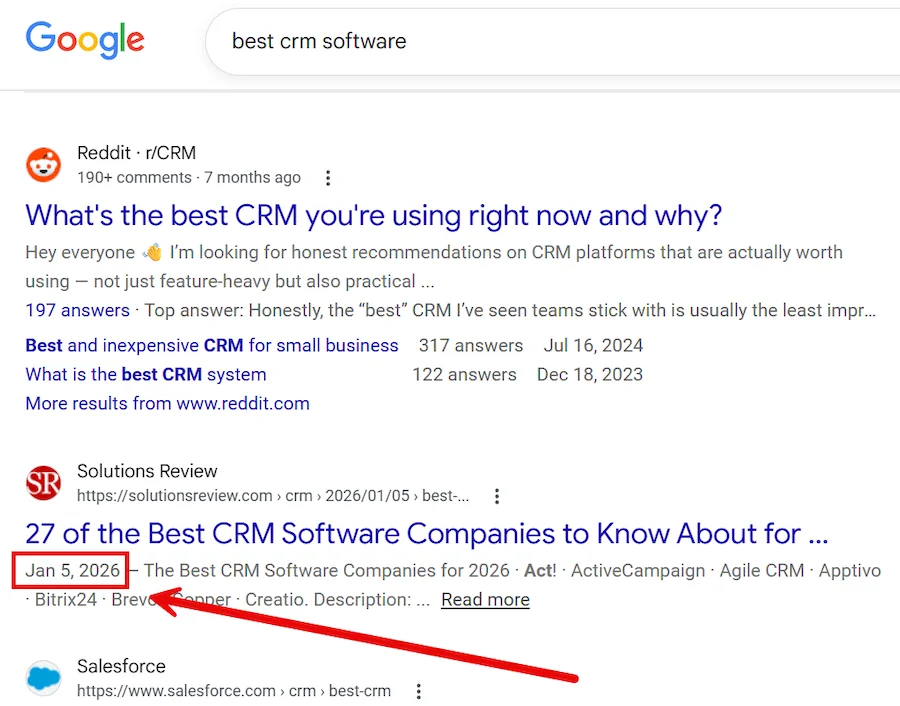
Is This an Issue for Your Site? Observing the dates displayed in Google search results can offer clues about freshness. If competitors with more recent publication or update dates are consistently outranking your content, it suggests that freshness may be a contributing factor. If your site has made updates that are not reflected in the search results’ displayed dates, it indicates that Google may not have recognized those changes as “significant.”
How to Optimize for Freshness: To ensure your content remains fresh and relevant:
- Implement the 30% Rule: Aim to update approximately 30% of a page’s content during each refresh. This includes adding new sections, updated statistics, fresh examples, expert quotes, and relevant news.
- Establish a Quarterly Refresh Cadence: For your most important pages, schedule regular updates. This ensures that content remains current and addresses evolving user needs and information landscapes.
- Resubmit for Indexing: After making significant updates, use Google Search Console to submit your pages for re-indexing, which can help Google discover and evaluate your changes more quickly.
- Focus on Information Gain: Each refresh should aim to add new value and insights that weren’t present before, ensuring the update provides tangible benefits to the reader.
Engagement: User Interaction and Experience
Engagement, linked to attributes such as navBoost, clutterScore, and violatesMobileInterstitialPolicy, measures how users interact with your website and the overall quality of their experience. navBoost is a click-driven re-ranking system that uses user behavior to refine search results. clutterScore likely penalizes pages with excessive advertising or distracting elements, while violatesMobileInterstitialPolicy targets sites that display intrusive pop-ups on mobile devices.
What Google is Measuring: Google evaluates how users interact with your website after clicking through from search results. High engagement signals, such as longer dwell times, lower bounce rates, and multiple page views, suggest that users found your content valuable and relevant. Conversely, poor engagement, indicated by users quickly returning to the search results (pogo-sticking), suggests the content did not meet their needs. clutterScore and mobile interstitial policies directly address user experience, penalizing sites that are difficult to navigate or consume content on.
Is This an Issue for Your Site? While directly measuring engagement metrics against competitors can be challenging, a good approach is to benchmark your own performance and strive for continuous improvement. Key metrics to monitor include bounce rate, time on site, pages per session, and conversion rates. If these metrics are consistently poor, particularly on your most critical pages, or if your site is difficult to use on mobile devices due to intrusive elements, user engagement is likely a significant factor negatively impacting your rankings.
How to Optimize for Engagement: To improve user engagement, focus on making your pages more useful, interactive, and sticky:
- Enhance User Experience: Ensure your website is fast, mobile-friendly, and easy to navigate. Remove intrusive pop-ups and excessive advertising.
- Increase Interactivity: Incorporate interactive elements such as filters, calculators, comparison tools, quizzes, and embedded videos that encourage users to spend more time on your site and explore its offerings.
- Improve Content Readability: Use clear headings, subheadings, bullet points, and short paragraphs to make content easy to scan and digest.
- Optimize for Conversions: Ensure your calls to action are clear and compelling, guiding users towards desired outcomes.
- Leverage
navBoostInsights: Understand that satisfied clicks, where users spend significant time on a page and don’t immediately return to the SERP, positively impactnavBoost. Conversely, “bad clicks” or pogo-sticking signals dissatisfaction.
Prioritizing Your SEO Efforts
With a clearer understanding of Google’s core ranking factors, it’s essential to identify where to focus your initial optimization efforts. A structured approach can help diagnose and address the most pressing issues.
- Domain Authority: If your branded search is flat or declining, competitors with stronger link velocity are outranking you, or your overall traffic is shrinking against the same SERP set, prioritize building your domain authority through digital PR and quality link earning.
- Topical Authority: If you publish across many unrelated topics, a large share of your pages get very few visits, or your strongest content sits outside your core focus, it’s time to pick a core topic, prune off-topic pages, and concentrate new content and link-building efforts there.
- Document Quality: If competitors with weaker links are outranking you, your content reads as if generated by an LLM, or you lack first-party evidence, focus on adding proprietary data, named authors, custom visuals, and demonstrating first-person expertise.
- Freshness: If pages are decaying in rank after months of stability, Google’s displayed date lags your republishing, or recently updated competitors are surfacing above you, implement the 30% update rule and consider a quarterly refresh cadence for priority pages.
- Engagement: If you rank but traffic doesn’t convert, dwell time is short, or bounce rates are climbing on your most important pages, add interactive filters, calculators, and comparison selectors, and audit your site for clutter and intrusive pop-ups.
The Broader Implications of the Google Leak
The May 2024 leak of the Content Warehouse API has profound implications for the SEO industry. It moves the field away from reliance on indirect signals and theoretical models towards a more data-driven, evidence-based approach. For businesses, this means a renewed focus on fundamental principles: creating high-quality, authoritative content, building genuine trust and authority, and providing exceptional user experiences.
The confirmation that Google uses click data via NavBoost, the detailed understanding of content effort, and the precise mapping of domain and topical authority all underscore Google’s commitment to serving users with the most relevant, trustworthy, and engaging information available. As Google continues to refine its algorithms, those who align their strategies with these core principles will be best positioned for long-term success in organic search.
The attributes revealed, such as siteAuthority (a site-wide link-popularity score), navBoost (click-driven re-ranking), contentEffort (LLM-estimated page effort), siteFocusScore and siteRadius (topical authority), and chromeInTotal (aggregated Chrome browser data), represent a significant shift in how SEO performance can be understood and optimized. The leak also confirmed the existence and use of signals that Google had previously downplayed or denied, such as direct reliance on click data for ranking.
In conclusion, the insights provided by the May 2024 Google Content Warehouse API leak offer a clear roadmap for navigating the complexities of search engine optimization in the years to come. By focusing on the five core pillars of Domain Authority, Topical Authority, Document Quality, Freshness, and Engagement, businesses can build a robust online presence that resonates with both search engines and users alike. For those seeking further assistance in refining their SEO strategy based on these critical factors, expert guidance is readily available.