

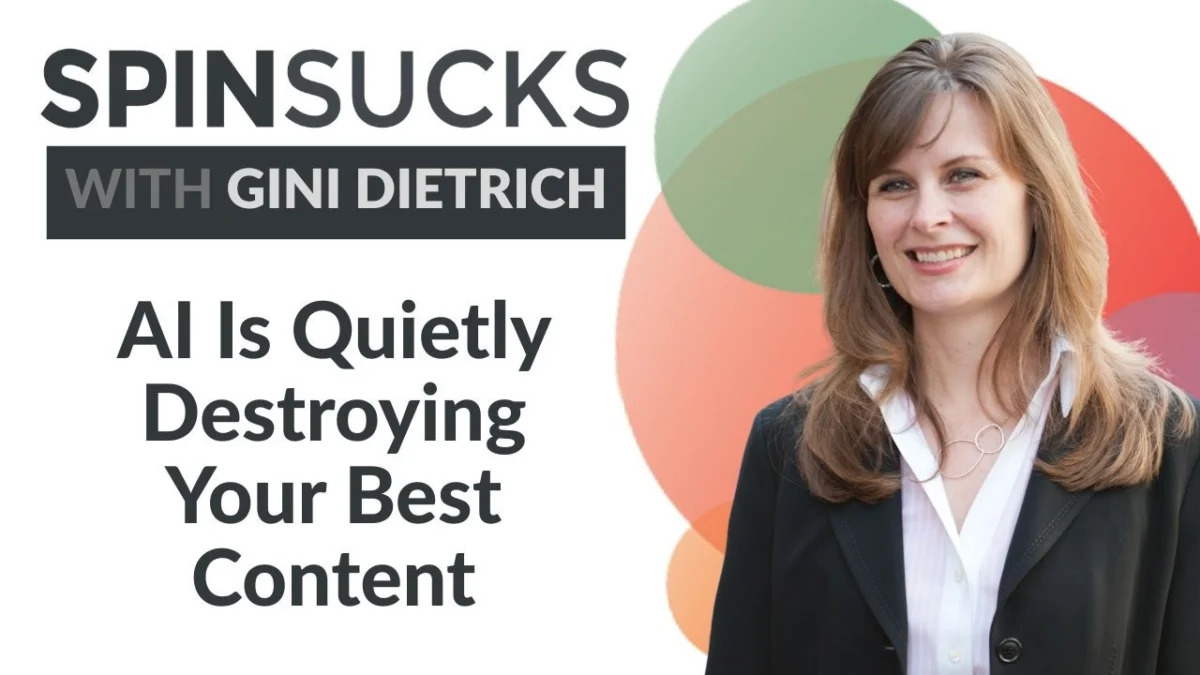
The rapid integration of generative artificial intelligence into the marketing and communications landscape has created a paradox of efficiency: while the cost of content distribution has plummeted, the cost of content dilution has reached a critical threshold. As organizations increasingly rely on large language models (LLMs) to repurpose flagship research into multi-channel campaigns, a phenomenon known as the “digital telephone game” is beginning to strip original insights of their specificity, evidentiary weight, and unique brand voice. This erosion of quality does not merely affect reader engagement; it fundamentally threatens a brand’s visibility within the emerging ecosystem of AI-driven answer engines.
The Mechanics of Content Dilution
The current marketing workflow often involves a “cascade” effect. A primary piece of content—such as a data-driven white paper or a proprietary case study—is fed into an AI tool to generate a blog post. That blog post is then summarized for a newsletter, which is subsequently distilled into social media threads and sales enablement scripts. With each successive generation of AI-assisted rewriting, the core argument undergoes a process of “homogenization.”
AI models are trained to predict the most likely next word based on vast datasets of existing human language. In practice, this creates a bias toward the “mean.” When tasked with making a sentence “punchier” or “shorter,” the AI often removes the very friction that makes the content valuable: the specific numbers, the nuanced timelines, and the original attributions. By the fourth or fifth iteration, a highly differentiated strategic insight is frequently transformed into “beige soup”—content that is grammatically correct but factually hollow and indistinguishable from competitor output.
Chronology of the Generative Content Shift
The transition from manual to AI-automated repurposing has occurred in three distinct phases over the last several years:
- The Manual Era (Pre-2022): Content repurposing was a high-touch, labor-intensive process. A digital marketer might spend several days reshaping a flagship report into various formats. Because this required human cognitive effort, the “claims” and “proof points” generally remained intact, as the creator understood the significance of the data.
- The Proliferation Phase (2023): With the mass adoption of tools like ChatGPT and Claude, the speed of distribution increased by orders of magnitude. Marketing teams began producing forty or fifty variants of a single idea in minutes. During this phase, the volume of content became the primary metric of success, often at the expense of editorial oversight.
- The Dilution Crisis (2024–Present): As the internet became saturated with AI-generated summaries of summaries, brands began to notice a decline in “information gain.” Search engines and answer engines (such as Perplexity and Google’s Search Generative Experience) started prioritizing “source authority” over “content volume,” penalizing brands that produced generic, laundered versions of their own insights.
The Telephone Game: A Comparative Analysis of Claims
To understand the impact of this dilution, one must examine how a specific, defensible claim evolves through multiple AI-assisted drafts.
Original Flagship Claim: “Our integrated communications program reduced churn by 34% across 50 mid-market customers over an 18-month period.”
This sentence provides three critical anchors: a specific percentage (34%), a sample size (50 customers), and a timeframe (18 months). It is a verifiable, authoritative statement that provides “information gain” to the reader.
Second Generation (LinkedIn Post): “Our integrated approach has significantly reduced churn for our mid-market customers.”
In the pursuit of brevity and “punchiness,” the AI removes the data points. The claim remains true but loses its defensibility. It no longer offers a benchmark for the reader to evaluate.
Fourth Generation (Sales Deck/Partner Slide): “Many organizations have found success with integrated communications strategies.”
At this stage, the claim has been fully “laundered.” The original source (the brand’s proprietary study) has been disconnected from the insight. The statement is now a generic industry platitude. When this content is indexed by AI search engines, it is treated as “common knowledge” rather than “proprietary authority,” leading the engine to attribute the insight to the category at large rather than the specific brand that conducted the research.
Supporting Data: The Rise of Generative Engine Optimization (GEO)
Recent industry reports highlight the growing importance of maintaining content integrity. According to the G2 2026 AI Search Insight Report, answer engines are now responsible for a meaningful share of how B2B buyers and journalists find information. Unlike traditional search engines, which provide a list of links, answer engines synthesize a single response.
These engines operate on the principle of corroboration. They are programmed to trust a brand more when independent sources and multiple high-quality, consistent citations reinforce a specific claim. When a brand dilutes its own claims through AI repurposing, it creates “noise” rather than “signal.” If a brand’s LinkedIn post says one thing, its white paper says another, and its sales deck provides a generic version of both, the AI engine perceives a lack of consistency and may categorize the brand as a non-authoritative source.
Furthermore, “Information Gain” scores—a concept increasingly used by search algorithms—measure how much new information a piece of content provides compared to what already exists in the index. AI-diluted content typically scores near zero on this scale, as it merely echoes existing generic sentiments.
The Repurposing Rule: A Strategic Framework
To combat the “beige soup” effect, communications experts are advocating for a strict “Repurposing Rule.” This framework dictates that while the format, length, and tone of content may adapt to different platforms, three elements must remain non-negotiable and constant across every iteration:
- The Claim: The central argument or thesis must not be softened or generalized.
- The Evidence: Specific data points, statistics, and proof of work must be preserved.
- The Attribution: The source of the insight must remain clearly linked to the brand or the specific study.
Operationalizing this rule requires a shift in how AI is managed within the organization. Rather than viewing AI as an autonomous content creator, it must be treated as a “junior professional.” In this model, the AI is responsible for the “labor” of adaptation—cutting length or changing a tone from formal to conversational—but it is never given the authority to make structural calls on the claim or the evidence.
Implications for the PESO Model and Brand Visibility
The dilution of content has significant implications for the PESO Model (Paid, Earned, Shared, and Owned media), which serves as the industry standard for integrated communications. As the model evolves into a more disciplined “operating system,” the role of editorial oversight has become the primary differentiator between an AI-discoverable brand and an invisible one.
In an AI-driven search environment, Earned and Owned media must work in perfect lockstep. If a PR team secures a high-authority media placement (Earned) that cites a specific 34% churn reduction, but the brand’s own social media channels (Shared) are pumping out diluted, generic versions of that same story, the “consistency signal” is broken.
Industry analysts suggest that “Generative Engine Optimization” (GEO) will eventually supersede traditional SEO. GEO rewards “density of fact”—the number of specific, verifiable truths contained within a piece of content. Dilution is the mathematical opposite of density; it spreads the value of an insight so thin that it becomes invisible to the sensors of the LLMs that now mediate the relationship between brands and their audiences.
Implementation and Future Outlook
For organizations looking to protect their intellectual property from the erosion of AI repurposing, the following steps are recommended:
- Establish Editorial Guardrails: Create a “source of truth” document for every major campaign that lists the specific claims and data points that cannot be altered by AI.
- The “ChatGPT Test”: Periodically prompt AI tools to describe what the organization stands for and what differentiates it from competitors. If the response is generic, it is a leading indicator that the brand’s content is being diluted at the source.
- Human-in-the-Loop Verification: Ensure that the final stage of any AI-assisted repurposing workflow involves a human editor whose sole task is to “re-insert” the specifics that the AI likely removed for the sake of “flow.”
The ease of AI-driven distribution has created a “race to the bottom” in terms of content specificity. However, the brands that maintain the discipline to keep their claims sharp, their evidence intact, and their voice unique will be the ones that survive the transition to an AI-mediated world. In the age of the answer engine, authority is not measured by how much you say, but by how much of what you say is worth quoting. Organizations must ensure that their best work does not become the very “slop” that the next generation of AI will eventually ignore.









