The conventional wisdom in business growth often equates expansion with increased revenue, which in turn, is frequently linked to a larger workforce. However, a closer examination of highly profitable e-commerce businesses reveals a different narrative, one where operational efficiency and strategic financial management often outperform aggressive marketing campaigns and inflated payrolls. This analysis delves into the often-overlooked strategies employed by top-performing online retailers to maximize profitability, focusing on two critical, yet frequently ignored, levers: lean operations and sophisticated tax planning.

A compelling case study illustrating this principle comes from a small business owner who, despite solid revenue, grappled with consistently thin profit margins and overwhelming stress. Managing a team of 35 employees proved to be a significant drain on both time and financial resources. The owner’s strategic pivot involved a series of decisive actions: transitioning to a remote work model, outsourcing fulfillment to a third-party logistics (3PL) provider, and restructuring the workforce by replacing many full-time employees with freelancers and independent contractors. The outcome was transformative: the business now operates with a lean team of one full-time employee and eight contractors. This operational overhaul resulted in unprecedented profit levels and a dramatic reduction in the owner’s stress, directly challenging the assumption that scaling necessitates a proportional increase in headcount.
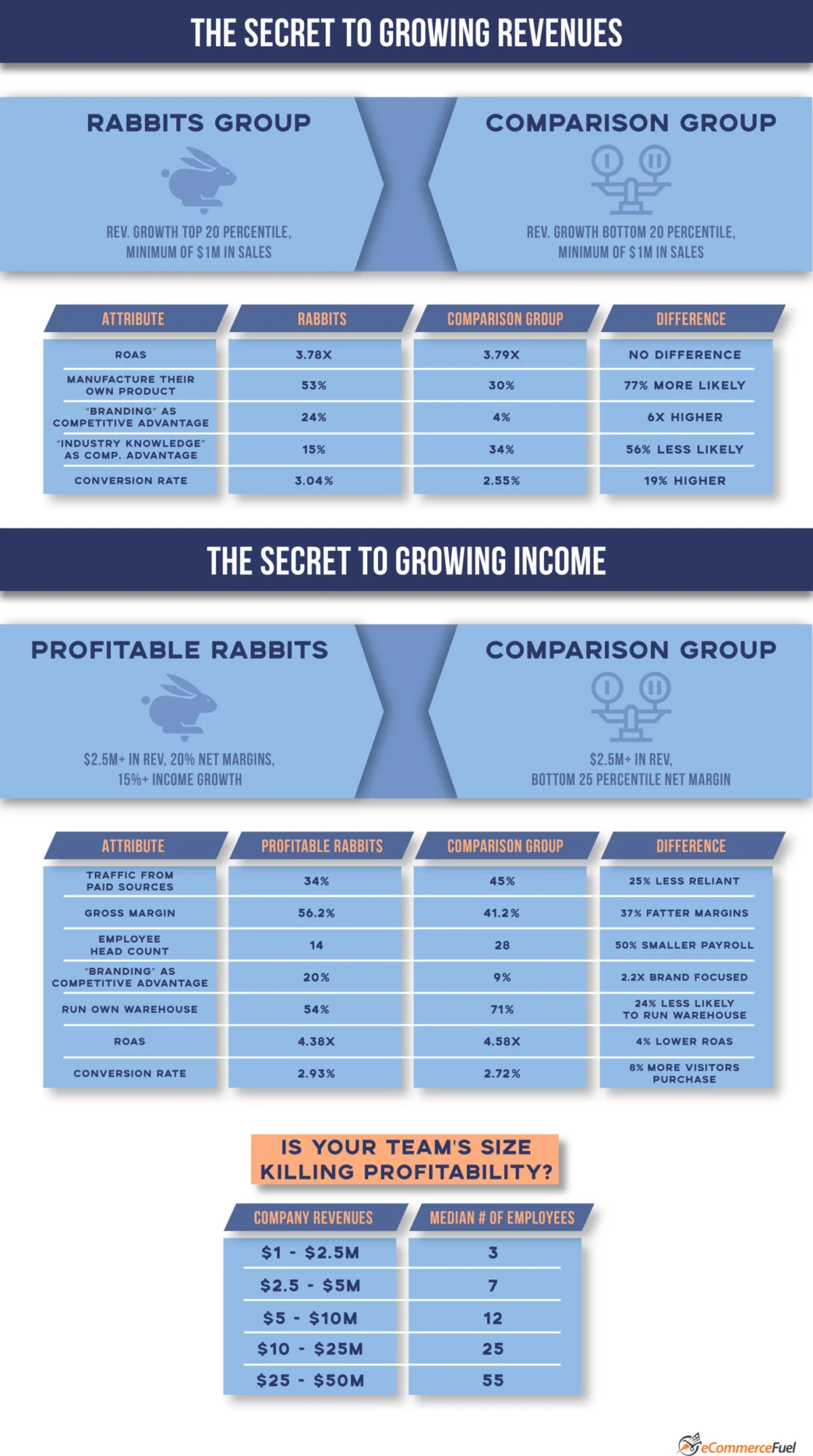
This anecdote is not an isolated incident but reflects a broader trend identified through extensive research into the e-commerce landscape. A comprehensive study examining hundreds of e-commerce businesses revealed that the primary differentiator between highly profitable ventures and those struggling was not marketing prowess. The research found negligible differences in Return on Ad Spend (ROAS) between top and bottom performers, indicating that superior marketing tactics were not the key to exceptional profitability. Instead, the data pointed to operational leanness as the crucial factor. Top-performing stores exhibited, on average, half the payroll of their less profitable counterparts. Furthermore, these successful businesses were 25% more likely to outsource their warehouse operations and 25% less reliant on paid traffic for customer acquisition. This suggests that operational efficiency and strategic outsourcing can consistently outperform marketing sophistication.

The notion of "lean" operations extends far beyond merely reducing headcount. It encompasses a holistic review of all business overheads. This includes scrutinizing expenses such as underutilized office spaces, which became particularly apparent following the widespread adoption of remote work. Similarly, the cost of maintaining in-house warehousing can often be significantly higher than partnering with a 3PL, which can offer economies of scale, specialized expertise, and often, a more cost-effective solution for order fulfillment. Recurring software-as-a-service (SaaS) subscriptions, even seemingly small monthly fees, can accumulate into substantial annual expenses if not regularly reviewed and optimized.
A critical framework for evaluating operational leanness involves identifying core competencies that are fundamental to a brand’s unique value proposition. For instance, if a brand’s competitive advantage lies in its distinctive product design, investing in in-house design talent might be justified. However, if the primary differentiator is not the intricate process of packing and shipping boxes, then outsourcing these functions to a specialized 3PL provider becomes a more logical and profitable decision. Successful business owners are not cutting costs indiscriminately; rather, they are making deliberate choices about where to allocate resources, focusing on activities that genuinely contribute to their brand’s competitive edge.

The ability to maintain operational leanness often hinges on the willingness to engage in "hard conversations" – those difficult discussions about roles, responsibilities, and resource allocation that many business leaders tend to postpone. Proactive engagement with these conversations, rather than reactive measures taken under duress, is a hallmark of profitable businesses. This proactive approach involves critically assessing the necessity of each role, questioning whether hires were made out of genuine need or simply to accommodate a perception of busyness. It also extends to evaluating the continued relevance and cost-effectiveness of existing tools and subscriptions, and identifying potential areas for significant cost reduction if market conditions necessitate it. By conducting these evaluations intentionally and implementing necessary adjustments before crises emerge, these businesses build resilience and maintain a healthy profit margin.
Beyond operational efficiency, the second "unsexy" but highly impactful lever for enhancing profitability is strategic tax planning. Many business owners, much like the initial profile described, view taxes as a fixed cost, a percentage of income paid regardless of specific strategies. However, a deeper understanding of tax law and proactive engagement with tax professionals can lead to significant savings. This is not about tax evasion or employing illicit offshore schemes, but rather about leveraging legitimate tax planning strategies to reduce the overall tax burden.

Consider a comparative scenario between two hypothetical e-commerce owners, both generating $2.5 million in revenue and $250,000 in profit, with identical salaries and family situations. Owner A, who has not engaged in proactive tax planning, might pay approximately $75,000 in annual taxes. Owner B, however, who has intentionally implemented a range of tax-saving strategies, could see their tax liability reduced to as low as $21,000, representing a staggering annual saving of $54,000. This substantial difference is achieved through a series of well-executed, legal tax strategies:
- Profit Sharing for Retirement: Owner B contributes significantly to retirement accounts through profit-sharing plans, exceeding standard 401(k) limits. This strategy allows for substantial pre-tax deductions, effectively reducing taxable income. Based on a marginal tax rate of approximately 30%, a $45,000 contribution could yield savings of around $13,500.
- Donating Appreciated Stock: Instead of donating cash to charities, Owner B donates stock that has increased in value. This approach allows the owner to avoid capital gains tax on the appreciated asset while still receiving a full deduction for its fair market value, potentially saving an estimated $3,500.
- Maximizing Health Savings Accounts (HSAs): Owner B fully utilizes the family contribution limit for HSAs, which offers triple tax advantages: contributions are tax-deductible, growth is tax-free, and qualified withdrawals are also tax-free. For a family plan, contributing the maximum of $8,500 could result in tax savings of approximately $2,550.
- Employing Children: Owner B’s three children perform legitimate work for the business, earning a salary of $7,000 each. These payments are deductible business expenses for Owner B, and for the children, these earnings can be invested in Roth IRAs, offering long-term, tax-free growth. The estimated tax savings for Owner B in this scenario amount to approximately $6,300.
- Donating Excess Inventory: A significant opportunity often overlooked in e-commerce is the donation of slow-moving or obsolete inventory to charities. Owner B donated $60,000 worth of such inventory, receiving a deduction at fair market value instead of liquidating at a loss. This single strategy can yield substantial tax savings, potentially around $18,000.
The invisibility of these tax-saving opportunities often stems from the fragmented nature of tax reporting. Personal returns, business filings, brokerage statements, and payroll tax reports are handled separately, preventing a holistic view of an individual’s or business’s total tax liability. Without a consolidated perspective, it becomes difficult to identify potential savings. While Owner A might have a competent accountant who ensures accurate filing, a "decent" accountant typically focuses on processing existing information rather than proactively identifying and recommending tax-saving strategies.

A simple yet effective test for the proactiveness of one’s tax advisor is to reflect on the last time they initiated a conversation about potential tax-saving opportunities. If the primary interaction is limited to responding to questions or accurately filing returns, it may indicate that the accountant is providing adequate service but not exceptional, value-adding advice. The substantial financial differences observed between strategically minded owners and their less proactive counterparts are not the result of complex financial maneuvers but of intentionality and a commitment to exploring all available legal avenues for tax optimization.
In conclusion, while marketing efforts like optimizing ROAS, CAC, and LTV are undeniably important for business growth, they are not the sole determinants of profitability. The owners who consistently achieve superior financial results often do so by focusing on two less glamorous but highly effective levers: cultivating operational leanness and engaging in sophisticated tax planning. By streamlining operations, strategically outsourcing non-core functions, and proactively managing their tax liabilities, businesses can retain a significantly larger portion of their earnings. This approach prioritizes keeping more of what is already earned, which can often be a more direct and impactful path to enhanced profitability than solely chasing increased revenue through marketing. For e-commerce businesses aiming for sustainable and robust financial health, a dual focus on operational efficiency and astute financial management is paramount.