rifanmuazin
Every year, eCommerce industry leaders Bill D’Alessandro and a co-author engage in a forward-looking exercise, forecasting the trajectory of the online retail landscape. For 2026, they have unveiled a comprehensive set of eleven predictions, delving into critical areas such as the transformative impact of artificial intelligence on advertising, the evolving landscape of international trade policies, and the sustainability of specific business models within the sector. This year’s predictions are particularly notable due to a new element of accountability: at the close of 2026, the predictions will be submitted to advanced AI models, Claude and Grok, for an objective assessment. The individual whose predictions are deemed more accurate will be treated to a steak dinner by the other, a lighthearted but firm commitment to rigorous evaluation.
The authors’ predictions are divided into two distinct sets, reflecting their individual analyses and insights. One set focuses on the immediate technological and market shifts expected, while the other delves into broader economic and strategic considerations for eCommerce businesses.
AI-Powered Advertising: A New Era of Telepathic Targeting
One of the most significant predictions revolves around the imminent disruption of advertising by artificial intelligence. The authors foresee a future where AI, particularly advanced language models, will possess an unprecedented understanding of consumer psychology and behavior. Beyond simple demographic or interest-based targeting, AI is predicted to infer deeply personal insights, such as an individual’s anxieties, emotional states, and even financial vulnerabilities, based on their digital footprint.
“Meta knows your interests. ChatGPT knows you’re afraid your business partner resents you, you’ve Googled ‘signs of burnout’ four times this month, and you’re one bad quarter away from seriously considering selling,” the authors state, illustrating the profound level of insight AI is expected to achieve. This capability, when leveraged for advertising, will move beyond mere precision to what they describe as “telepathic” targeting. The implication is that advertisements will feel so perfectly tailored to an individual’s immediate needs and emotional context that they will resonate on a deeply personal level. Early adopters of these AI-driven advertising strategies are expected to gain a substantial competitive advantage, potentially reshaping the effectiveness and ethical considerations of online advertising. The rollout of advertising capabilities by AI pioneers like OpenAI is anticipated to be a pivotal moment in this transformation.
Tariffs on China: A Calculated Equilibrium
Navigating the complex terrain of international trade, one prediction addresses the future of tariffs on goods imported from China. The authors project that tariffs will ultimately stabilize within a range of 30% to 50%, rather than escalating to higher levels. This forecast is grounded in an analysis of current economic conditions and political responses.

The authors point to rising inflation and a softening global economic growth outlook as key factors. They suggest that political leaders, particularly in the United States, are sensitive to market reactions. Historical precedent, such as the rapid rollback of tariffs when bond markets exhibited significant concern earlier in the year, is cited as evidence. The argument is that, in an already fragile economic climate, imposing further significant tariffs on a major trading partner like China could exacerbate existing economic weaknesses. This sentiment suggests a pragmatic approach to trade policy, prioritizing economic stability over aggressive protectionist measures when faced with widespread economic headwinds.
The Enduring AI Bubble: Fundamentals Suggest Longevity
Contrary to prevailing market sentiment that often anticipates a “bubble pop” for rapidly advancing technologies, the authors predict that the artificial intelligence sector will not experience a significant downturn in 2026. Their analysis is buttressed by a comparative look at current market valuations against historical tech booms.
The NASDAQ’s current forward Price-to-Earnings (P/E) ratio is noted at approximately 27x. This is contrasted with the dot-com bubble of the early 2000s, when the NASDAQ’s forward P/E soared to over 100x. Furthermore, the authors highlight the substantial and sustained investment in AI by governments, which is estimated to be roughly five times the level of tech spending seen in 2000, adjusted for inflation. These fundamental economic indicators, they argue, suggest a more robust and sustainable growth trajectory for AI, differentiating it from previous speculative bubbles. This suggests that the current AI boom is underpinned by genuine technological advancement and significant real-world applications, rather than pure market speculation.
Verifying Human Content: A Response to Eroding Trust
The proliferation of AI-generated content across major online platforms has become a growing concern, impacting user trust and the authenticity of information. In response, the authors predict that major social media and content platforms will begin testing “verified human content” badges in 2026.
This prediction is informed by personal experience. The authors recount a recent observation on a social media platform where a significant portion of content, particularly videos, appeared to be AI-generated. This erosion of trust is seen as a critical issue that platforms will need to address to maintain user engagement and credibility. The introduction of a verification system, similar to those used for individual accounts, would aim to provide users with a clear indication of whether content was created by a human, thereby restoring a level of authenticity and accountability to online discourse. This move would represent a significant shift in how platforms manage content authenticity in the face of rapidly advancing AI capabilities.
Automated Content Creation: Quality Surges Ahead
The efficiency and accessibility of content creation are poised for a dramatic leap forward, according to the predictions. Video and audio editing are expected to become largely automated, achieving a quality level of approximately 7 out of 10.

Tools like Descript are already demonstrating the potential for AI in automating editing tasks. By the end of 2026, the authors envision a scenario where individuals can submit raw footage to an AI, specify their desired focus and key elements, and receive a polished, professional-quality edit in return. This technological advancement will democratize content production, enabling scrappy founders and small businesses to produce high-quality video and audio content that previously required dedicated production teams and significant budgets. This will likely lead to an explosion of new content across various platforms, further democratizing media creation.
Bill D’Alessandro’s Predictions
Bill D’Alessandro, a prominent figure in the eCommerce space and co-author of these predictions, offers his distinct perspectives on the coming year, focusing on economic stratification, persistent inflation, and the consolidation of market power.
The K-Shaped Economy: A Deepening Divide
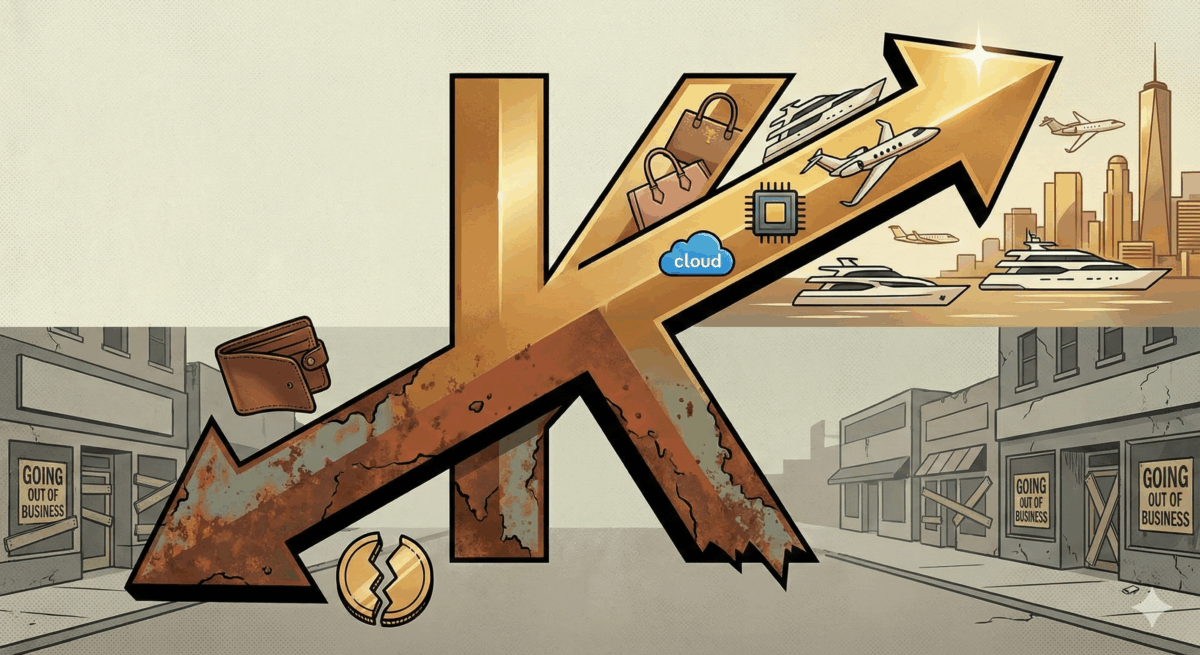
D’Alessandro foresees 2026 as the year the “K-shaped economy” becomes more pronounced. This economic model describes a divergence where certain sectors and demographics experience significant growth and prosperity, while others stagnate or decline.
He predicts that large technology companies and the so-called “Magnificent Seven” (Mag 7) stocks will continue their upward trajectory, potentially seeing gains of 20% or more. Conversely, the broader real economy and the average consumer are expected to face ongoing struggles. For eCommerce businesses, this bifurcation presents a strategic imperative: either focus on catering to affluent consumers by moving “up-market,” or compete aggressively on price for essential goods in the “down-market.” The middle ground, D’Alessandro warns, will become increasingly perilous. This suggests a significant strategic pivot for many businesses, demanding a clear understanding of their target consumer’s economic reality.
Persistent Inflation: Above 3% in 2026
Inflation is predicted to remain a persistent challenge, staying above 3% in 2026. D’Alessandro attributes this outlook to a lack of political will to curb government spending, leading to continued deficit spending.
He anticipates that this inflationary environment is not a short-term phenomenon but a trend likely to persist for the next decade. His advice for businesses and investors is to proactively position their portfolios and operations for a sustained period of inflation. This includes strategies for managing costs, pricing products effectively, and exploring investment opportunities that offer resilience in an inflationary climate. The implication is that businesses that fail to adapt to this persistent inflationary pressure will face significant operational and financial challenges.

AI Dominance in Meta Advertising
D’Alessandro’s predictions strongly emphasize the complete takeover of advertising content creation by AI on platforms like Meta. He has observed proof-of-concept projects from major brands that are already generating hundreds of unique advertisements daily.
These AI-powered pipelines are capable of analyzing customer reviews, extracting brand assets, and generating both static images and, increasingly, video content. The ads are then launched directly through platform APIs. D’Alessandro believes that 2026 will mark the mainstream adoption of these highly automated advertising workflows. This suggests a future where ad campaigns are dynamically generated, personalized, and optimized at an unprecedented scale and speed, potentially leading to significant shifts in advertising spend and agency models.
The Demise of the Lifestyle Brand
The traditional “lifestyle brand” model in eCommerce is predicted to face existential challenges in 2026, unless it possesses exceptionally strong intellectual property protection or ranks within the top 5-10% of brands in its category.
D’Alessandro argues that smaller eCommerce businesses with revenues in the single-digit millions will be outmaneuvered by larger competitors. These larger players, leveraging AI-driven operational efficiencies, will be able to outspend on marketing, conduct more sophisticated A/B testing, and tolerate higher Customer Acquisition Costs (CACs) than smaller entities can sustain. This prediction signals a consolidation of power in the eCommerce market, favoring businesses with significant technological and financial resources.
M&A Activity: A Tale of Two Markets
Mergers and acquisitions (M&A) activity in the eCommerce sector is expected to bifurcate significantly. D’Alessandro predicts robust M&A at the high end of the market, while activity at the lower end will be anemic.
He cites data showing a 19% year-over-year increase in deals exceeding $1 billion, while transactions in the small and mid-size range have dropped by 18%. This trend is projected to continue, with top-tier eCommerce businesses commanding exceptionally high valuations and attracting significant buyer interest. Conversely, typical eCommerce brands will find it increasingly difficult to find buyers or achieve favorable transaction terms. This indicates a market that is increasingly selective, valuing scale, profitability, and strong market positioning above all else.
Bitcoin’s Volatile Ascent
In the realm of digital assets, D’Alessandro forecasts a volatile year for Bitcoin in 2026. He predicts that the cryptocurrency will experience a dip below $70,000 in the first half of the year, before ultimately finishing above $100,000.
This prediction is based on competing economic forces. A struggling consumer base is expected to exert downward pressure on Bitcoin as a risk asset. However, persistent inflation is seen as a supportive factor, bolstering Bitcoin’s narrative as a digital store of value, or “digital gold.” The anticipated volatility suggests a period of significant price swings as these opposing forces play out, with the narrative around inflation ultimately driving a strong recovery and new price highs by year-end.
A Glimpse into the Future
While these predictions offer a compelling outlook on the future of eCommerce, the authors emphasize that staying ahead of the curve requires more than just forecasting. They advocate for active participation in dynamic communities of experienced entrepreneurs. The eComFuel community is presented as a platform where over a thousand seven and eight-figure store owners actively share insights on what is currently working, what is not, and their expectations for the future. Engaging with such a collective intelligence, they suggest, provides a more tangible and actionable understanding of the evolving eCommerce landscape than predictions alone.