A/B testing has long been heralded as the gold standard of digital marketing, offering a rare opportunity to apply rigorous scientific principles to business growth through randomized controlled trials. By splitting traffic between a control group and one or more variants, organizations aim to establish a causal relationship between specific design changes and user behavior. However, as the field of Conversion Rate Optimization (CRO) matures, industry experts are sounding the alarm regarding a widening gap between common marketing practices and the modern statistical standards utilized in fields such as medicine, genetics, and physics. While digital experimentation is technically a form of clinical trial, the statistical methodologies frequently employed by practitioners are often decades behind contemporary scientific requirements, leading to a phenomenon known as "statistical debt."
The Integrity Crisis in Modern Optimization
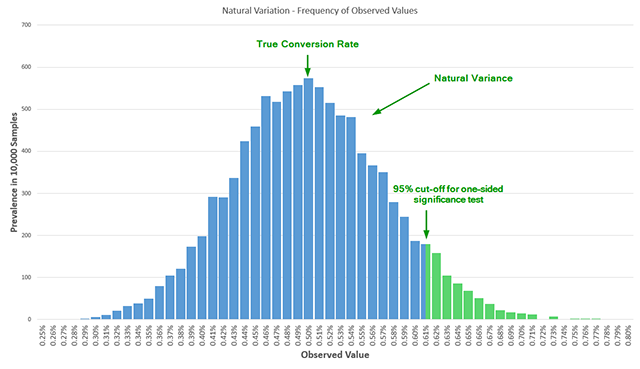
The primary friction point in modern A/B testing lies in the misuse of classical statistical significance tests. Most practitioners rely on the Student’s T-test or similar frequentist models to determine if a "lift" in conversion rates is genuine or merely the result of random variance. In a standard Bernoulli distribution—the mathematical foundation for conversion testing—natural variance can frequently produce results that appear significant at first glance but revert to the mean over time.
The fundamental constraint of these classical tests is the requirement for a fixed sample size determined in advance. To maintain the integrity of a p-value, a researcher must decide to observe a specific number of users—for instance, 20,000 per variant—and perform exactly one evaluation at the conclusion of that period. However, the reality of the digital business environment often contradicts this requirement. Stakeholders, under pressure to deliver results or mitigate losses, frequently monitor dashboards daily. This leads to "data-peeking" or "optional stopping," where a test is terminated early because the results look "good enough" or "conclusively bad."
Statistical analysis reveals that this behavior dramatically inflates the False Positive Rate (Type I error). Research dating back to 1969, and reaffirmed by modern simulations, shows that peeking at data just five times during a trial increases the actual error rate to 3.2 times the reported nominal error. If a practitioner peeks ten times, the actual probability of a false positive is five times higher than the 5% they believe they are maintaining. This "Garbage In, Garbage Out" (GIGO) cycle results in companies implementing changes that provide no real value, or worse, inadvertently harming their long-term conversion rates based on illusory data.
Chronology of Statistical Experimentation
The current state of A/B testing is the result of a century of mathematical evolution that has only partially been adopted by the tech industry:
- 1908: William Sealy Gosset, writing under the pseudonym "Student," develops the T-test to monitor the quality of stout at the Guinness brewery. This becomes the bedrock of fixed-sample testing.
- 1920s–1930s: Ronald Fisher and Jerzy Neyman formalize the concepts of significance testing and hypothesis testing, which remain the dominant frameworks in digital marketing today.
- 1940s: Abraham Wald develops Sequential Analysis during World War II to allow for the testing of munitions with smaller sample sizes, though these methods remain niche for decades.
- 1960s–1970s: Medical researchers realize that fixed-sample trials are often unethical; if a new drug is clearly saving lives, it is wrong to continue the trial until the fixed end-date. This leads to the development of Group Sequential Trials.
- 2008–2014: A/B testing becomes a mainstream digital marketing tool. However, a review of seven influential books on the topic during this period found that only one mentioned "statistical power," and none addressed the dangers of data-peeking in a rigorous way.
- 2017–Present: The introduction of the AGILE statistical method and similar Bayesian or sequential frequentist frameworks begins to bridge the gap between clinical rigor and digital speed.
Statistical Power: The Missing Metric
While much of the industry’s focus is on avoiding false positives, the "silent killer" of experimentation is the lack of statistical power, or "test sensitivity." Statistical power is the probability that a test will detect a true effect of a certain size. In many free A/B testing calculators, the power is silently set at 50%, which is essentially a coin toss.
Running an underpowered test means that even if a variant is superior, the test is unlikely to confirm it. This results in "false negatives," where winning ideas are discarded. For a business, this represents a massive waste of resources; weeks of design, engineering, and data collection result in an appraisal that lacks the sensitivity to detect meaningful improvements. To achieve a power of 90% at a 95% confidence level, the required sample sizes are often much larger than practitioners anticipate. For example, detecting a 10% relative lift on a 2% baseline conversion rate requires approximately 88,000 users per variant—a volume of traffic that many medium-sized websites cannot reach in a reasonable timeframe.
The Inefficiency of Classical Models
The rigid nature of classical tests creates a financial and operational burden. If a test is planned for 88,000 users but the actual lift is significantly higher than expected (e.g., 15% instead of 10%), a classical test still requires the full sample to be collected to remain valid. This prevents the business from "capturing" the win early and moving on to the next experiment.
Conversely, classical tests lack a formal "futility" rule. If a variant is performing dismally, a practitioner using a fixed-sample test is technically required to keep the losing variant live until the sample size is reached, potentially costing the company thousands in lost revenue. This inefficiency has led to a growing demand for a "clinical" approach to digital data—one that allows for interim monitoring without sacrificing statistical validity.
The AGILE Statistical Approach
In response to these systemic issues, the AGILE statistical method has been proposed as a hybrid solution inspired by medical randomized controlled trials. The framework introduces several key innovations to the A/B testing workflow:
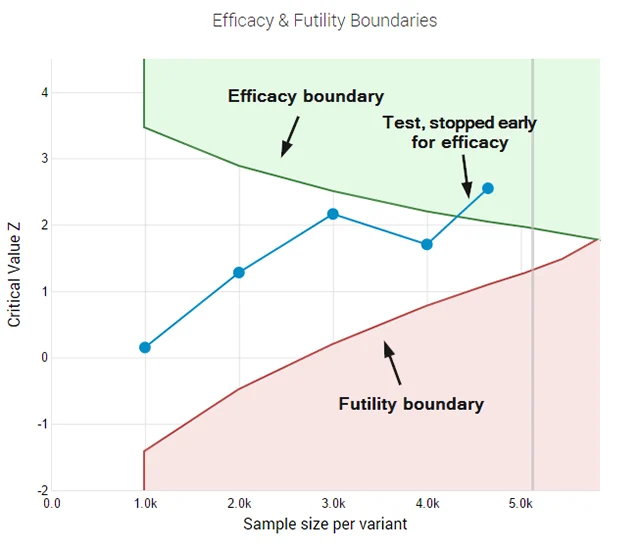
- Error-Spending Functions: Instead of requiring a single look at the end of a test, AGILE utilizes alpha and beta "spending" functions. This allows for multiple interim analyses of the data. Each time the data is "peeked" at, a small portion of the allowable error rate is "spent," adjusting the significance threshold accordingly to ensure the overall false positive rate remains controlled at 5%.
- Early Stopping for Efficacy: If a variant shows a massive, statistically significant lead early in the process, the AGILE method provides the mathematical justification to stop the test and declare a winner immediately.
- Futility Stopping Rules: One of the most significant advantages of the AGILE framework is the ability to "fail fast." If the data indicates that a variant has a negligible chance of reaching the required lift, the test can be terminated for futility. This protects the company from the opportunity cost of running a doomed experiment.
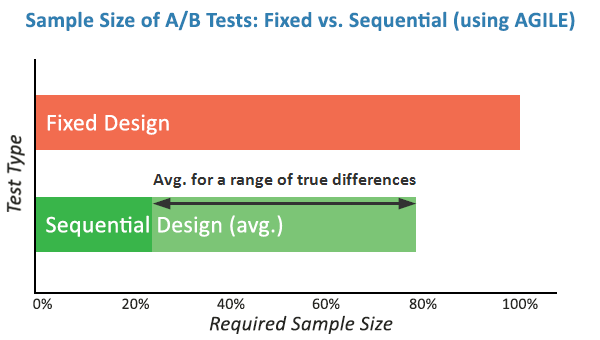
- Efficiency Gains: Simulations of the AGILE method show that it can reduce the required sample size by 20% to 80% depending on the true magnitude of the lift. This allows growth teams to run more experiments in the same calendar year, compounding the potential for revenue growth.
Industry Implications and Future Outlook
The shift toward more sophisticated statistical models like AGILE marks a turning point for the CRO industry. As privacy regulations like GDPR and CCPA make data collection more complex, and as the cost of digital advertising increases, the efficiency of every user in an experiment becomes paramount.
Industry analysts suggest that the adoption of these methods will separate high-performing growth teams from those relying on "voodoo statistics." For agencies, adopting AGILE provides a layer of professional defensibility; it ensures that the "wins" reported to clients are statistically robust and not the result of aggressive data-peeking. For internal teams, it offers a way to balance the aggressive timelines of product managers with the scientific integrity required by data scientists.
Ultimately, the transition to the AGILE method represents the professionalization of digital marketing. By aligning with the standards of bio-statistics and clinical trials, A/B testing can move away from being a "best guess" mechanism and toward becoming a truly reliable engine for scientific business growth. The future of experimentation lies in the ability to be both fast and accurate—a balance that classical statistics was never designed to maintain, but which the AGILE framework was built to master.