In the modern digital economy, A/B testing has emerged as the cornerstone of data-driven decision-making, providing a framework for companies to optimize user experiences and maximize revenue through randomized controlled trials. These experiments, which involve splitting traffic between a control version and one or more variants, are fundamentally similar to the clinical trials used in physics, medicine, and genetics. However, a growing consensus among data scientists suggests that the methodologies currently employed by many digital marketing practitioners are lagging significantly behind modern scientific standards. While other fields have adopted sophisticated statistical frameworks over the last several decades, the common practice in conversion rate optimization (CRO) remains tethered to classical approaches that are often misapplied, leading to illusory results and inefficient resource allocation.
The disconnect between theory and practice in A/B testing is primarily driven by three systemic issues: the misuse of statistical significance tests, a widespread lack of consideration for statistical power, and the inherent rigidity of classical statistical models. To bridge this gap, experts are increasingly pointing toward the “AGILE” statistical approach—a methodology inspired by medical research that allows for interim data monitoring and early stopping without compromising the integrity of the results.
The Mathematical Trap: Misunderstanding Statistical Significance
The most prevalent issue in contemporary A/B testing is the fundamental misunderstanding of what a statistical significance test represents and the constraints under which it must operate. In a standard experiment, such as a Student’s T-test, the goal is to estimate the probability of observing a result due to natural variance rather than a genuine improvement. This probability, often expressed as a p-value, assumes a fixed sample size determined before the experiment begins.
In the reality of a fast-paced business environment, however, this “fixed-horizon” rule is frequently ignored. Stakeholders, eager to see results, often engage in “data peeking”—the practice of checking the results daily or weekly and making decisions based on fluctuating numbers. When a variant appears to be performing exceptionally well or poorly in the first few days, the temptation to stop the test early is immense.
Statistically, this practice is catastrophic. Classical significance tests do not account for multiple evaluations over time. Every time a practitioner “peeks” at the data and considers stopping the test, they introduce a new dimension into the sample space, effectively inflating the false positive rate. Research dating back to 1969, and verified repeatedly since, shows that peeking just five times during a test can result in an actual error rate more than three times higher than the reported nominal error rate. If a marketer claims 95% confidence but has peeked ten times, their actual confidence level may be closer to 75%. This phenomenon leads to “Garbage In, Garbage Out” (GIGO) scenarios, where companies implement changes based on “winners” that are merely the result of statistical noise.
The Hidden Risk of Underpowered Experiments
While the industry fixates on significance (avoiding false positives), it largely ignores statistical power (avoiding false negatives). Statistical power, or “test sensitivity,” is the probability that a test will detect a true effect of a certain magnitude. Despite its importance, a review of influential A/B testing literature published over the last decade found that the majority of texts failed to mention power in a meaningful context.
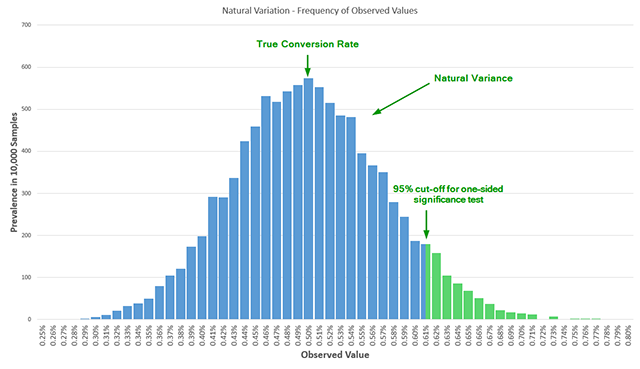
Running a test with low power is akin to using a low-resolution microscope to look for bacteria; even if the bacteria are there, the tool isn’t sensitive enough to see them. In a business context, an underpowered test means that a variant providing a genuine 5% lift might be discarded as a “failure” simply because the sample size was too small to distinguish the lift from the baseline noise.
This leads to a double loss for the organization. First, the time and engineering resources spent developing the variant are wasted. Second, the company may erroneously conclude that a specific strategy (such as a new pricing model or checkout flow) does not work, effectively closing the door on future iterations that could have yielded significant long-term gains. Many free online calculators exacerbate this issue by defaulting to 50% power—essentially a coin toss—without informing the user of the risks involved.
Chronology of Statistical Development in Testing
The journey from classical experimentation to the modern AGILE framework follows a clear historical trajectory.
- The Classical Era (Early 20th Century): Figures like Ronald Fisher developed the foundations of hypothesis testing for agriculture and laboratory settings where data collection happened in discrete batches.
- The Clinical Evolution (1960s-1970s): Medical researchers realized that waiting for a fixed sample size was often unethical. If a new drug was clearly saving lives, it was wrong to keep half the patients on a placebo until the end of the year. This led to the development of “Sequential Analysis” and “Group Sequential Designs.”
- The Digital Explosion (2000s-2010s): A/B testing became a standard feature of the web. Early tools adopted Fisher’s classical methods because they were simple to code, despite the fact that digital data flows continuously, unlike agricultural batches.
- The Modern Realignment (2017-Present): Data scientists began advocating for the adoption of medical-grade statistics in marketing. This shift recognizes that digital business needs the flexibility to “fail fast” or “scale winners” without sacrificing the mathematical rigor required for accurate reporting.
The AGILE Statistical Framework: A Solution for the Modern Era
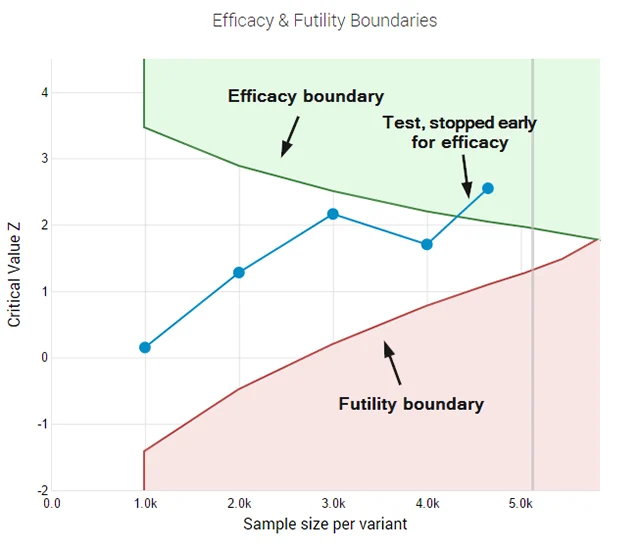
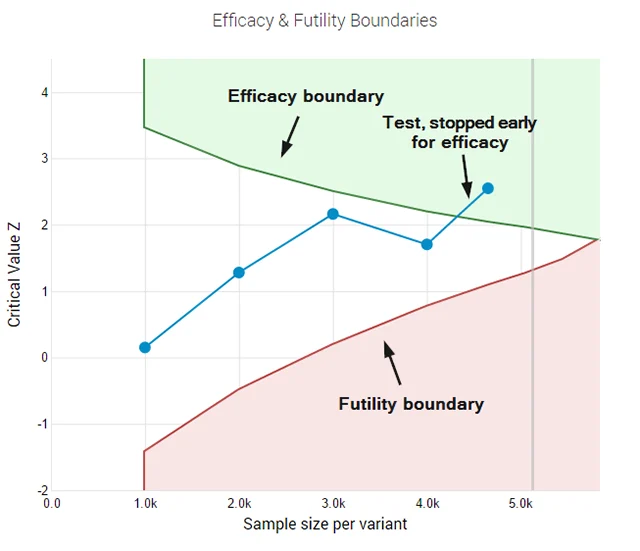
The AGILE statistical method addresses the shortcomings of classical testing by incorporating “error-spending functions.” This approach, widely used in clinical trials for pharmaceuticals, allows practitioners to perform interim analyses while the data is still accruing.
The core innovation of the AGILE method is its ability to adjust the significance threshold at each “peek.” Instead of a static 95% threshold, the method “spends” a portion of the allowed error rate at each look. This ensures that the overall probability of a false positive remains at the desired level (e.g., 5%) regardless of how many times the data is analyzed.
Furthermore, the AGILE approach introduces “futility stopping rules.” In a classical test, if a variant is performing poorly, the practitioner is technically supposed to wait until the end of the test to declare it a loser. Under the AGILE framework, if the data suggests that the variant has a negligible probability of eventually reaching significance, the test can be terminated early for futility. This “fail fast” mechanism saves companies from continuing to show a sub-optimal experience to their users, thereby protecting revenue during the testing phase.
Supporting Data and Efficiency Gains
The primary argument for adopting an AGILE framework is efficiency. Simulations conducted on historical A/B testing data demonstrate that the AGILE method can provide efficiency gains ranging from 20% to 80% compared to fixed-sample tests.
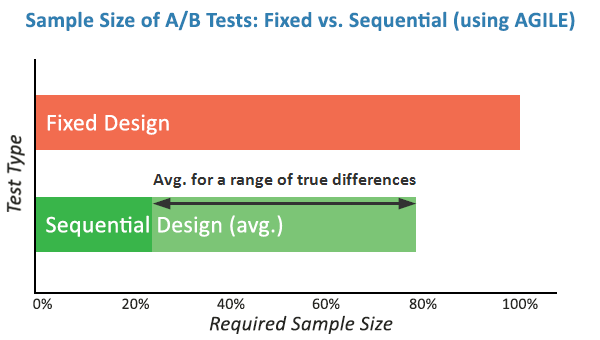
For instance, consider a test designed with 90% power to detect a 10% relative lift. In a classical setup, this might require 100,000 users per variant. If the actual lift of the variant is 20% (much higher than anticipated), an AGILE test would likely reach significance and allow for early stopping after only 30,000 or 40,000 users. Conversely, if the variant is causing a 10% drop in conversions, the futility rules would trigger an early stop, preventing thousands of lost conversions.
| Metric | Classical (Fixed) | AGILE Framework |
|---|---|---|
| Early Stopping for Success | Not permitted without error inflation | Supported via Error-Spending |
| Early Stopping for Failure | Often done informally (unscientific) | Supported via Futility Rules |
| Sample Size | Rigid, determined at start | Flexible, with a defined maximum |
| Actual Error Rate | Often higher than reported due to peeking | Controlled and mathematically sound |
| Resource Efficiency | Low (waits for full sample) | High (stops as soon as data is sufficient) |
Industry Reactions and Broader Implications
The shift toward more rigorous statistical methods has met with mixed reactions in the digital marketing community. On one hand, data scientists and statisticians have championed the move, noting that the “wild west” era of marketing analytics has led to a crisis of reproducibility similar to the one seen in social sciences. Many professionals argue that the industry’s reliance on “vanity metrics” and flawed p-values has cost companies billions in “phantom” gains that never actually materialized in the bottom-line revenue.
On the other hand, some marketing managers express concern over the complexity of these modern methods. The AGILE approach requires more sophisticated software and a deeper understanding of parameters like power and minimum effect size. However, the rise of specialized A/B testing platforms that build these calculations into their back-end is beginning to lower the barrier to entry.
The broader implications of this shift are profound. As businesses become more reliant on artificial intelligence and automated optimization, the quality of the data fed into these systems becomes paramount. An AI optimized on the results of flawed A/B tests will inevitably make flawed decisions. By adopting the AGILE statistical method, organizations can ensure that their experimentation program is not just a performative exercise in data-gathering, but a rigorous scientific process that provides a genuine competitive advantage.
Ultimately, the move to AGILE is a move toward maturity in the digital sector. It acknowledges that while digital marketing moves at the speed of light, the laws of mathematics and probability are immutable. Aligning business practices with these scientific realities is the only way to ensure that the “scientific” part of data science remains intact. Adopting such frameworks will contribute to a significant decrease in illusory results and allow companies to innovate with a level of certainty and speed that was previously unattainable.