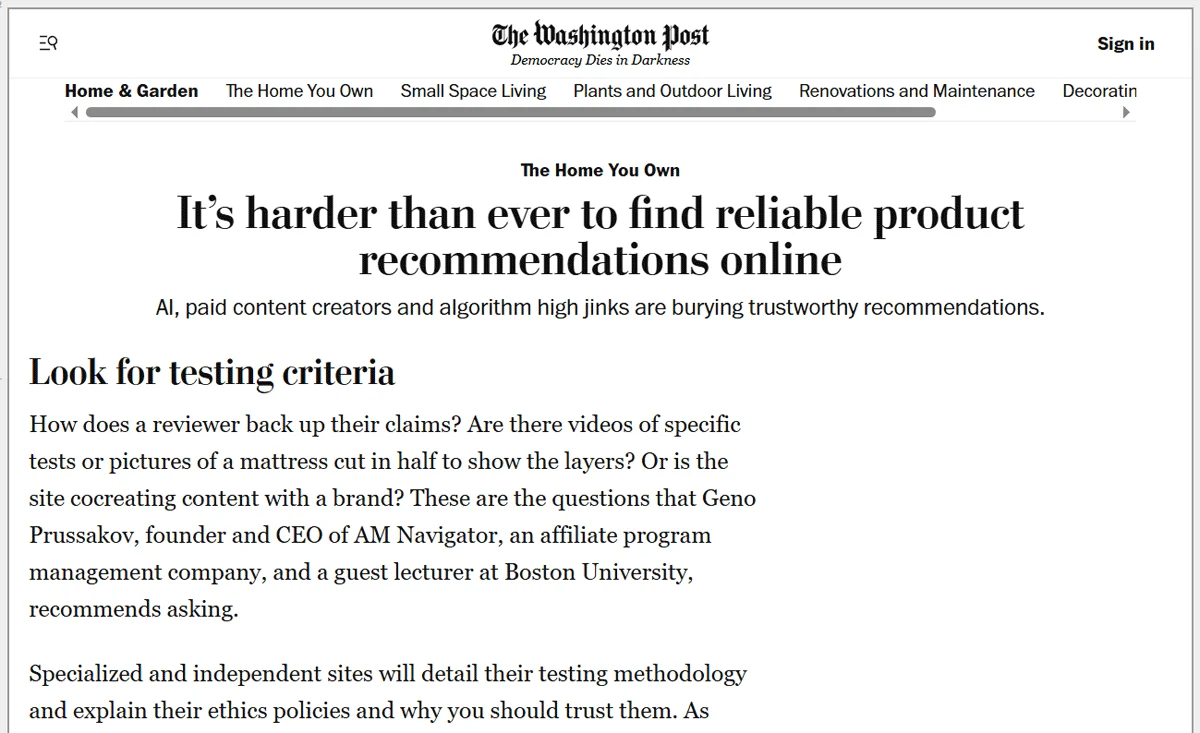
The landscape of digital journalism has undergone a profound transformation over the last decade, shifting from a primary reliance on display advertising to a sophisticated ecosystem of commerce-driven content. This evolution was recently brought to the forefront of public discourse when The Washington Post consulted industry experts to dissect the reliability of online product recommendation lists published by major media outlets. The core of the investigation centers on a critical question for the modern consumer: can the product rankings found on high-authority media sites be trusted, or are they merely the result of the highest bidder securing a favorable placement? As legacy media organizations increasingly monetize their search engine authority, the boundary between objective journalism and affiliate marketing has become increasingly porous, necessitating a deeper understanding of the mechanics behind digital endorsements.
The Economic Drivers of Commerce Content
To understand why major media outlets have pivoted toward product recommendations, one must look at the broader economic shifts in the publishing industry. For decades, newspapers and magazines relied on a "church and state" separation between editorial content and advertising. However, the decline of print circulation and the volatility of the digital display ad market—driven by the rise of ad-blockers and the dominance of Google and Meta—forced publishers to seek more stable revenue streams.
Affiliate marketing emerged as a primary solution. In this model, publishers earn a commission for every sale generated through a link in their content. According to industry data from the Performance Marketing Association, affiliate marketing spending in the United States has grown consistently, surpassing $8.2 billion in recent years. For major publishers, "commerce content"—articles specifically designed to drive sales—can account for 25% to 40% of their total digital revenue. This financial necessity has led to the creation of dedicated "shopping" verticals within outlets like The New York Times (Wirecutter), New York Magazine (The Strategist), and CNN (CNN Underscored).
A Chronology of the Commerce Content Shift
The rise of media-driven product recommendations did not happen overnight. It followed a distinct timeline of institutional adoption and strategic acquisitions.
- The Early 2010s: The Rise of the Niche Reviewer: Independent sites like Wirecutter (founded in 2011 by Brian Lam) began to gain traction by applying rigorous, scientific testing to consumer electronics. These sites proved that consumers were willing to trust expert advice over traditional brand advertising.
- 2016: The Watershed Moment: The New York Times acquired Wirecutter for approximately $30 million. This acquisition signaled to the entire industry that "service journalism" was a viable and prestigious business model.
- 2017–2019: Mass Adoption: Major media conglomerates, including Hearst, Condé Nast, and Dotdash Meredith, began aggressively expanding their commerce departments. They started leveraging their high domain authority to dominate search engine results pages (SERPs) for lucrative "best of" keywords.
- 2020–2022: The Pandemic Surge: As e-commerce exploded during global lockdowns, publishers saw record-breaking affiliate revenues. This period also saw Google introduce "Product Review Updates" to its search algorithm, aimed at rewarding high-quality, original research over thin, curated lists.
- 2023–Present: The Trust Crisis and Regulatory Scrutiny: As the market became saturated, concerns regarding the influence of "placement fees" and "commission rates" on rankings grew, leading to increased scrutiny from both consumers and the Federal Trade Commission (FTC).
The Mechanics of Maintaining Editorial Integrity
Despite the inherent conflict of interest in earning commissions from recommended products, many major media players have established rigorous protocols to protect their brand authority. Industry experts, including those at AM Navigator, note that reputable publishers typically employ four primary strategies to ensure the quality of their recommendations.
First, the most respected outlets maintain a strict "firewall" between their editorial teams and their business development or affiliate departments. In this model, the writers and editors who test products do not know the commission rates associated with the items they are reviewing. Their goal is solely to identify the best product for the consumer, while the affiliate team handles the monetization of those choices after the fact.
Second, the investment in physical testing infrastructure has become a hallmark of high-tier commerce content. Outlets like Dotdash Meredith and Wirecutter operate multi-million dollar testing labs where products are subjected to standardized stress tests, chemical analysis, and long-term durability assessments. This move from "curation" (summarizing existing reviews) to "original testing" is a key differentiator in maintaining consumer trust.
Third, the vetting process for merchant partners has become more stringent. Before a brand is included in a recommendation list, publishers often evaluate the brand’s shipping reliability, customer service reputation, and return policies. This ensures that the publication’s brand is not tarnished by a poor post-purchase experience.
Finally, publishers are diversifying their revenue streams within commerce content. Instead of relying solely on affiliate commissions, they may use "flat-fee" sponsorships or "hybrid models." While this introduces more financial complexity, it can also reduce the pressure to recommend only the products with the highest commission rates.

The Influence of Financial Arrangements on Rankings
While many outlets strive for objectivity, it is an open secret in the performance marketing industry that financial incentives can, and do, influence product rankings. This influence often manifests in several ways.
Placement fees are a common practice where a brand pays an upfront fee to be included in a "gift guide" or a "top 10" list. While these are often labeled as "sponsored" or "featured," the distinction can sometimes be lost on the average reader. Furthermore, affiliate commission rates can vary wildly. A brand offering a 15% commission is inherently more profitable for a publisher than a brand offering 2%, creating a subtle but persistent pressure to favor the more lucrative partner.
Another sophisticated metric used by publishers is "Earnings Per Click" (EPC). This represents the average revenue generated every time a reader clicks a link. If Product A has a lower commission rate but a much higher conversion rate than Product B, Product A will yield a higher EPC. Publishers often optimize their lists based on EPC to maximize revenue, which may prioritize "popular" or "easy-to-sell" products over those that are objectively higher in quality but more expensive or niche.
Supporting Data and Market Impact
The impact of big media’s entry into the affiliate space is reflected in search engine data. A study of "best [product category]" search results reveals that legacy media domains now occupy the majority of the top five positions on Google, often displacing smaller, independent review blogs. This "authority bias" in search algorithms has created a feedback loop where big media outlets receive the most traffic, generate the most sales, and thus have the most data to further optimize their commerce content.
According to a survey by HubSpot, 81% of consumers conduct online research before making a major purchase. However, a separate study by Adobe found that only about one-third of consumers fully trust the content they read on brand websites. This "trust gap" is what big media outlets exploit; they provide a third-party "stamp of approval" that carries more weight than a brand’s own marketing.
Regulatory Responses and Consumer Safeguards
The Federal Trade Commission (FTC) has updated its "Endorsement Guides" to address the nuances of affiliate marketing. The guidelines require that any material connection between a reviewer and a seller—including affiliate links—must be "clearly and conspicuously" disclosed. However, the implementation of these disclosures varies. Some publishers use a small, grayed-out disclaimer at the top of the page, while others are more transparent about how they make money.
For consumers navigating this complex environment, experts suggest a multi-pronged approach to verifying recommendations. First, consumers should look for a clear disclosure of affiliate relationships. Second, they should investigate the credentials of the author and the testing methodology described in the article. Third, it is essential to cross-reference recommendations across multiple, unaffiliated sources. If a product is ranked #1 on five different major sites, its quality is more likely to be legitimate than if it only appears on one site with a high commission structure. Finally, checking user-generated reviews on platforms like Reddit or specialized forums can provide a "real-world" counterpoint to the professional reviews found in big media.
Broader Implications for the Digital Ecosystem
The monetization of media authority through product recommendations has broader implications for the future of journalism. On one hand, affiliate revenue provides a lifeline for newsrooms, funding investigative reporting and local news that might otherwise be insolvent. On the other hand, the shift toward commerce content can lead to "content homogenization," where every major outlet reviews the same trending products, neglecting niche or innovative items that don’t have established affiliate programs.
Furthermore, as AI-generated content becomes more prevalent, the value of human-led, lab-based testing will likely increase. Consumers will seek out brands they trust to curate the noise of the internet. The challenge for big media will be to maintain that trust in the face of mounting financial pressure to prioritize short-term affiliate gains over long-term editorial integrity. The Washington Post’s inquiry into this matter highlights a pivotal moment in consumer culture: the realization that in the digital age, "authority" is not just a measure of expertise, but a valuable commodity that must be managed with extreme care.