
 rifanmuazin
Email, a cornerstone of digital communication for decades, is far from obsolescence; rather, its strategic importance is intensifying. However, a significant and widening chasm is emerging between organizations that meticulously invest in measurement, deliverability, and optimization, and those that continue to operate on mere assumptions. This pivotal insight forms the core of Sinch Mailgun’s comprehensive 2026 Email Impact Report, released on April 17, 2026. The report, a robust analysis derived from a global survey of over 1,200 email senders and an unprecedented examination of more than 400 billion real emails transmitted through Sinch Mailgun’s infrastructure in 2025, offers a critical roadmap for email senders navigating the evolving digital landscape in the latter half of 2026 and beyond.
The 2026 Email Impact Report is segmented into five crucial chapters, meticulously dissecting the multifaceted world of email marketing. These chapters delve into the intricate aspects of Return on Investment (ROI), offer crucial industry benchmarks derived from real-world data, provide an in-depth look at deliverability trends, assess the burgeoning adoption and impact of Artificial Intelligence (AI), and analyze prevailing investment patterns. The report’s findings are not merely descriptive; they serve as a clarion call for businesses to re-evaluate their email strategies, emphasizing the imperative of data-driven decision-making and continuous technological integration.
The Enduring Power of Email and the ROI Imperative
Email’s foundational role in organizational communication and marketing strategies is unequivocally affirmed by the report. A striking 78% of senders categorize email as “very” or “extremely” important to their respective organizations. This level of intrinsic belief in a marketing channel is exceptionally rare, reflecting email’s unique capacity for direct, personalized, and scalable communication. From customer acquisition and nurturing to vital transactional alerts, email continues to be a high-impact channel for businesses across sectors.
Despite this overwhelming organizational conviction, a significant disconnect persists between belief and empirical evidence. Fewer than half of senders actively measure the ROI of their email programs, with promotional emails seeing only 46% measurement and transactional emails lagging slightly behind at 43%. This data suggests that a majority of teams are operating on intuition and conviction rather than tangible, measurable outcomes. Industry analysts frequently underscore the critical role of robust ROI measurement not only for optimizing campaign performance but also for securing necessary budget allocations and demonstrating strategic value to executive stakeholders. Without clear metrics, even the most effective email programs risk being undervalued and under-resourced.
For those organizations that do undertake ROI measurement, the returns are demonstrably impressive. A substantial 60% of senders measuring promotional email ROI report returns exceeding $10 for every $1 spent. This figure rises even higher for transactional emails, with 62% of senders reporting the same $10:1 threshold. Furthermore, an elite 13% of senders across both categories claim an astounding return of over $40 for every dollar invested. While these figures highlight email’s immense potential, Sinch Mailgun’s research introduces a provocative counter-narrative: such exceptionally high returns might, in certain instances, signal underinvestment rather than peak efficiency. This suggests that organizations achieving these extreme ROIs may be missing opportunities to scale their email programs further, potentially leaving significant revenue on the table by not allocating additional resources to a clearly profitable channel.
The primary impediment to increasing email investment, as cited by 43% of senders, is budget constraints. This highlights a classic Catch-22: budgets are hard to secure without data, yet data collection often requires initial investment. The report judiciously recommends an actionable intermediate step: initiating tracking with simpler metrics like revenue per campaign. Even with an imperfect attribution model at the outset, this foundational data provides a tangible starting point for building a compelling business case for increased investment, paving the way for more sophisticated ROI tracking over time.
Unveiling Industry Benchmarks: Data-Driven Insights from 400 Billion Emails

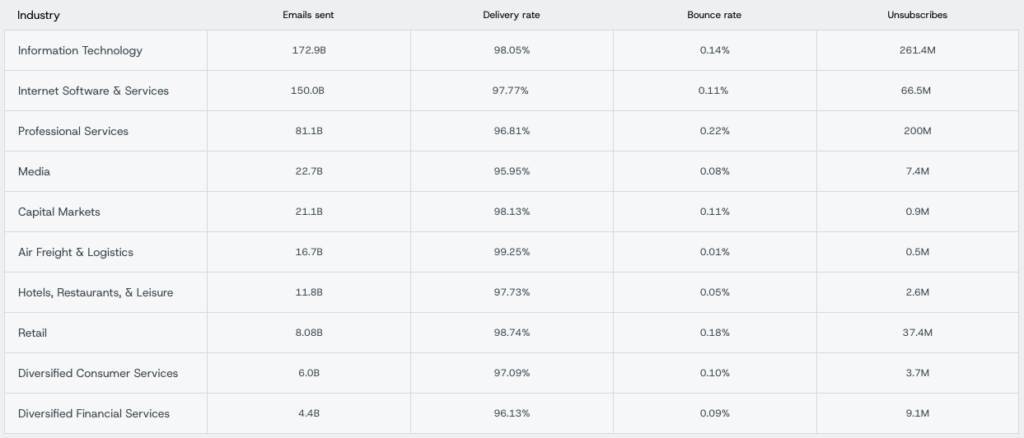
One of the most groundbreaking contributions of the 2026 Email Impact Report lies in its approach to industry benchmarks. While much of the existing benchmark data relies on self-reported estimates and surveys, Chapter 2 of this report leverages actual sending data from Sinch Mailgun’s infrastructure, analyzing performance across the top 10 industries by email volume in 2025. This real-world dataset, encompassing 400 billion emails, offers an unparalleled, objective view of email performance metrics.
The industry-specific data reveals significant variances. Air Freight & Logistics leads with an impressive 99.25% delivery rate and an exceptionally low 0.01% bounce rate. This superior performance is largely attributable to the nature of their email sends: predominantly transactional communications such as shipping confirmations and tracking updates, which are highly anticipated and desired by recipients. Conversely, the Media industry registers the lowest delivery rate among the top 10, at 95.95%. This can be explained by the high volumes and broad promotional audiences characteristic of the media sector, which naturally exert downward pressure on overall delivery metrics due to factors like varying engagement levels and more frequent list churn.
However, the report critically cautions against relying solely on delivery rate as a performance indicator. An email technically "delivered" to a spam folder still counts towards the delivery rate, providing a misleading picture of actual inbox reach. The report emphatically argues for the necessity of pairing delivery rate tracking with comprehensive inbox placement testing. This crucial distinction ensures that senders understand not just if their emails were accepted by the server, but where they actually landed – a vital metric for determining true audience engagement and campaign effectiveness.
The analysis of unsubscribe rates further underscores the importance of context. Information Technology recorded the highest raw number of unsubscribes, at 261 million. Yet, when contextualized against its colossal send volume of 172.9 billion emails, this translates to a relatively low unsubscribe rate of approximately 0.15%. In contrast, the Retail sector generated 37.4 million unsubscribes from a significantly smaller volume of 8.08 billion sends, resulting in a substantially higher unsubscribe rate per email. This comparison clearly demonstrates that raw unsubscribe volume, devoid of send volume context, is statistically meaningless and can lead to erroneous conclusions about list health and audience engagement.
The Evolving Landscape of Email Deliverability and Persistent Knowledge Gaps
Deliverability, the ability of an email to successfully reach a recipient’s inbox, remains a paramount concern for email senders, with 89% citing its importance to their organization. Encouragingly, 43% of senders report an improvement in their inbox placement over the preceding 12 months. This positive trend is largely attributed to substantial infrastructure advancements and a collective industry push towards better email authentication.
A significant driver of this improvement is the accelerating adoption of DMARC (Domain-based Message Authentication, Reporting & Conformance). Mandates and strong recommendations from major Internet Service Providers (ISPs) like Gmail, Yahoo, and Microsoft have compelled organizations to strengthen their email security protocols. The report highlights a crucial milestone: for the first time in Sinch Mailgun’s research, DMARC enforcement policies (quarantine or reject) are outpacing passive monitoring, with over half of DMARC adopters now implementing these more stringent policies. DMARC, alongside SPF (Sender Policy Framework) and DKIM (DomainKeys Identified Mail), forms a robust trifecta of authentication standards designed to prevent email spoofing and phishing, thereby safeguarding sender reputation and enhancing inbox placement.
Despite these technological strides, a concerning knowledge gap persists among email senders. A notable 36% of senders claim to monitor their "email deliverability rate," a metric that, as the report clarifies, does not technically exist. This confusion underscores a fundamental misunderstanding of core deliverability concepts. The delivery rate simply indicates server acceptance, while true inbox placement measures whether an email actually bypasses spam filters and lands in the primary inbox. Alarmingly, only 25% of senders actively conduct inbox placement tests to ascertain their actual reach, and a significant 27% of DMARC users are unaware of the specific policy they have implemented. This disparity between tool improvement and user literacy presents a critical challenge. Organizations are investing in advanced deliverability tools, yet many lack the fundamental understanding required to effectively utilize them and interpret the resulting data, potentially negating the benefits of these essential security measures.
AI Adoption is Wide. AI Impact is Uneven.
The transformative potential of Artificial Intelligence (AI) has permeated the email marketing landscape, with 79% of senders either currently utilizing or planning to integrate AI into their email programs. This widespread interest underscores the perceived value of AI in enhancing efficiency and effectiveness. However, the report reveals that actual regular use of AI sits at a modest 27%, indicating that a substantial portion of adopters are still in the experimental phase, rather than systematically embedding AI into their daily workflows.
The most prevalent application of AI is for copy generation, cited by 41% of senders, followed closely by content personalization (36%), dynamic content creation (29%), send time optimization (27%), and data analysis (27%). This pattern illuminates a crucial insight: AI delivers its most significant value when deeply integrated into decision-making processes, rather than being confined to superficial content production tasks. Teams that leverage AI for sophisticated applications like personalization, optimal send timing, and A/B testing report compounding returns, experiencing a synergistic effect where AI augments strategic choices. In stark contrast, teams that primarily use AI for basic tasks such as drafting subject lines observe only limited impact, highlighting a disparity in strategic implementation.
The report presents compelling statistical evidence of AI’s differential impact. A noteworthy 54% of senders who have actively implemented AI report a moderate or significant improvement in their email programs year-over-year. This contrasts sharply with only 37% of senders who are not using AI reporting similar improvements within the same timeframe. This 17-point performance gap is a powerful indicator that AI is indeed beginning to stratify email programs into distinct performance tiers. While the report carefully notes that this does not definitively prove causation, the consistent directional trend strongly suggests that strategic AI integration is becoming a significant competitive differentiator. For the 23% of AI users who report no tangible benefits, the issue is not the tool itself, but rather the depth and strategic intent of its integration into their email ecosystem.
Where Email Investment is Heading
Looking ahead to 2026, the strategic priorities for email senders are clear: "taking advantage of AI" and "increasing email engagement" are tied as the top priorities, each cited by 40% of senders. This alignment of priorities underscores a recognition within the industry that leveraging advanced technology, particularly AI, is crucial for fostering deeper audience connection and driving better performance.
Regarding financial commitments, the outlook for email investment remains robust. A significant 31% of organizations plan to increase their email investment in the coming year, reflecting continued confidence in the channel’s ROI potential. The largest segment, 48%, intends to maintain their current spending levels, indicating stability and sustained commitment. Only a small minority, 7%, anticipates decreasing their email investment. This overall positive investment outlook suggests that email marketing is viewed not as a declining channel, but as a dynamic and evolving platform requiring ongoing strategic resource allocation.
The Sinch Mailgun 2026 Email Impact Report culminates with a clear and actionable conclusion: email not only works, but it continues to be a high-performance channel, as evidenced by consistent ROI, reliable benchmarks, and improving deliverability trends. However, the future success of email programs will hinge on a deliberate, simultaneous investment in three interconnected areas: measurement, deliverability, and optimization.
- Measurement: This involves moving beyond assumptions to rigorously prove ROI with real, attributable data, enabling informed decision-making and justifying further investment.
- Deliverability: This entails a consistent, proactive approach to ensuring emails consistently reach the inbox, achieved through robust authentication protocols (like DMARC, SPF, DKIM), meticulous list hygiene, and continuous monitoring of inbox placement.
- Optimization: This refers to the strategic utilization of advanced tools and techniques, including AI and rigorous A/B testing, to continuously refine and improve campaign performance at scale.
Crucially, the report emphasizes that none of these strategic imperatives necessitate an immediate, massive budget outlay. They are, instead, compounding investments. Starting small, with foundational data collection, basic authentication, and experimental AI applications, can initiate a virtuous cycle of improvement. Over time, these incremental efforts accumulate, leading to increasingly sophisticated, data-driven, and high-performing email programs that consistently outperform those operating on outdated assumptions. The deepening divide identified by Sinch Mailgun serves as both a warning and an opportunity: for those willing to adapt and invest strategically, email’s enduring power promises significant competitive advantage.









