


The persistent friction between sales and marketing departments has evolved from a simple communication hurdle into a significant operational bottleneck for small and mid-sized businesses (SMBs), according to the 2026 Anatomy of Aligned Go-to-Market Teams report. Published by Unbounce and based on a comprehensive survey of over 500 go-to-market (GTM) professionals, the data reveals a stark disconnect between the perceived value of alignment and its actual implementation. While 87% of GTM teams expect improved sales and marketing alignment to significantly lift organizational performance, only 56% of respondents currently describe their teams as highly aligned. This 31-point gap suggests that while the strategic importance of cooperation is universally recognized, the tactical execution remains elusive for nearly half of the industry.
The misalignment rarely manifests as a singular, catastrophic failure. Instead, it presents as a series of subtle operational inefficiencies: marketing teams delivering "qualified" leads that sales representatives do not trust, marketing campaigns launched without sales’ awareness, and a revenue pipeline that appears robust until the actual closed-won figures begin to stagnate. As businesses face a more competitive and data-driven landscape in 2026, the cost of this "soft" misalignment is becoming an increasingly heavy burden on bottom-line growth.
The Perception Gap: Strategic Vision vs. Tactical Reality
One of the most striking findings in the report is the disparity in how alignment is perceived across different levels of the corporate hierarchy. According to the data, 69% of executives report strong sales and marketing alignment within their organizations. In contrast, only 47% of non-executive staff—those responsible for the day-to-day execution of campaigns and sales calls—agree with that assessment.
This "perception gap" highlights a structural information lag within SMBs. Executives often view alignment through the lens of high-level strategy decks and the existence of recurring cross-departmental meetings. However, staff members on the front lines experience the breakdown of these strategies through data inconsistencies, limited communication, and leadership silos. Specifically, the report found that non-executives are more likely to flag data inconsistencies (28% vs. 22% of execs) and limited communication (33% vs. 28%) as primary barriers to success.

Furthermore, a functional split exists between the two departments themselves. Approximately 62% of sales professionals feel highly aligned with their marketing counterparts, whereas only 53% of marketers share that sentiment. This suggests that marketing teams often feel their contributions are undervalued or misunderstood by the sales arm, particularly regarding lead quality and attribution.
The Financial and Cultural Cost of Misalignment
Misalignment is frequently dismissed as a "culture problem," but the 2026 report quantifies it as a tangible operational cost. When asked about the consequences of poor alignment, GTM professionals identified several key areas of concern:
- Employee Frustration (29%): Misalignment leads to internal friction, reduced morale, and higher turnover as staff members feel they are working at cross-purposes.
- Delayed Lead Follow-up (28%): A lack of clear handoff protocols results in leads cooling off before sales can reach them. Marketers feel this more acutely, with 32% flagging it as a major issue compared to 22% of sales reps.
- Duplicated Work (24%): Without shared visibility, teams often create redundant content or conduct overlapping outreach, wasting both time and budget.
- Unclear Target Customers (23%): When teams do not agree on the Ideal Customer Profile (ICP), marketing spends budget on audiences that sales cannot close.
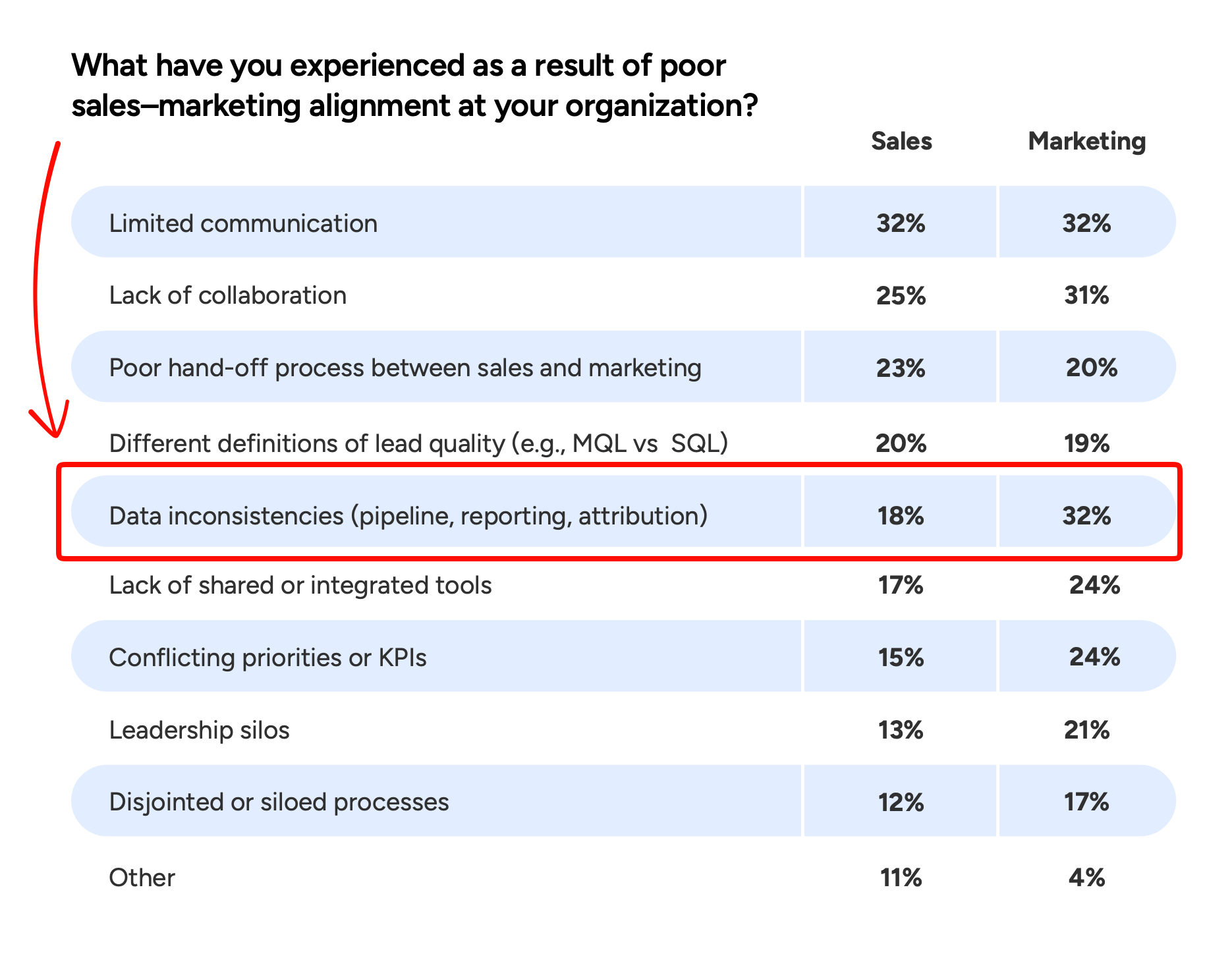
The revenue implications are most visible in the "closed-won" metrics. When sales cycles drag or win rates fall, the two departments often point fingers in different directions. Sales teams frequently cite "low lead quality" as the primary reason for missed targets, while marketing teams point to "poor sales execution" or a failure to follow up on generated demand. This blame cycle is perpetuated by a lack of shared definitions: 20% of sales and 19% of marketing professionals admit they do not agree on what constitutes a Marketing Qualified Lead (MQL) versus a Sales Qualified Lead (SQL).
The Evolution of the GTM Operating Model (2020–2026)
To understand the current state of misalignment, it is necessary to look at the chronology of GTM strategies over the last several years. In the early 2020s, the "growth at all costs" mentality led many SMBs to over-invest in lead volume, often at the expense of lead quality. Marketing was incentivized to fill the top of the funnel, while sales was left to sift through high volumes of low-intent prospects.
By 2024, the shift toward "efficient growth" began to take hold. Companies started prioritizing Revenue Operations (RevOps) to bridge the gap between departments. However, as the 2026 report suggests, many organizations only adopted the veneer of alignment—such as shared Slack channels or weekly syncs—without fixing the underlying data structures.

In 2026, the focus has shifted toward "Unified GTM," where the distinction between sales and marketing is increasingly blurred by AI-driven insights and shared customer data platforms. However, those who have failed to consolidate their tech stacks or unify their data are finding themselves left behind.
The Tech Stack Paradox: Tool Bloat and Under-utilization
A significant barrier to alignment identified in the report is the mismanagement of technology. For years, the instinctual response to misalignment was to "buy a solution." This has resulted in a phenomenon known as tool bloat.
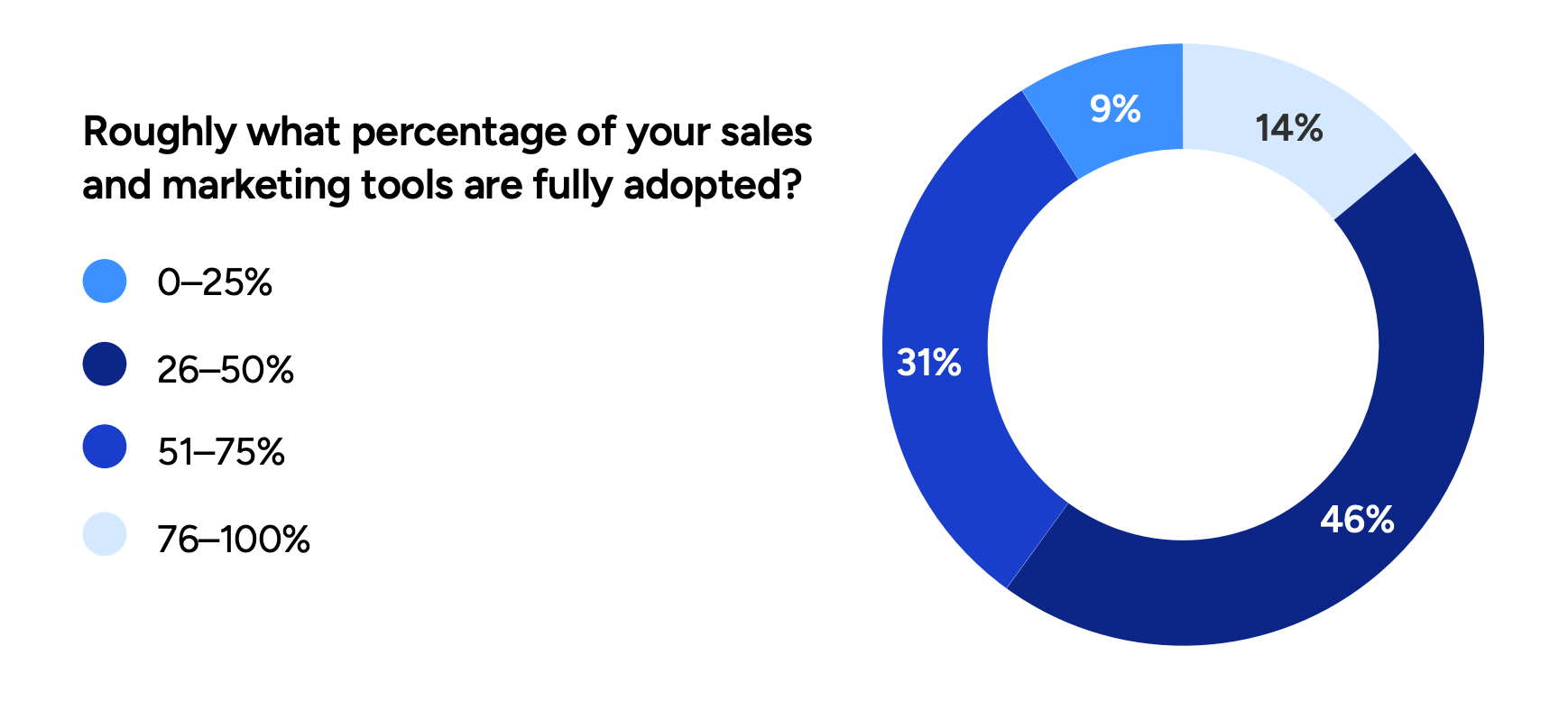
The data reveals that 56% of GTM professionals believe tool bloat is a major issue at their organization. Shockingly, 60% of respondents admit they use less than half of the tools available in their tech stack. Specifically, 14% of teams use only 0-25% of their software, and 46% use between 26-50%.
This fragmentation creates data silos. When marketing automation platforms do not communicate seamlessly with the CRM, or when sales teams work out of spreadsheets while marketing uses a centralized dashboard, the "source of truth" disappears. Marketing teams feel this gap most sharply: 32% of marketers cite data inconsistencies as a barrier to alignment, compared to just 18% of sales professionals.
The report offers a clear counter-intuitive solution: consolidation. Teams that significantly consolidated their tech stacks were found to be twice as likely to rate their lead quality as "excellent" (55% vs. 20%). A leaner, better-integrated stack ensures that both teams are looking at the same numbers, reducing the time spent debating data accuracy and increasing the time spent on revenue-generating activities.
Root Causes: Why Alignment Breaks Down
The Unbounce report categorizes the root causes of misalignment into four distinct pillars:
- Operational (53%): Broken handoff processes, lack of Service Level Agreements (SLAs), and inconsistent lead routing.
- Goal and Incentive (43%): Marketing being rewarded for lead volume while sales is rewarded for revenue. This creates a structural incentive for marketing to prioritize quantity over quality.
- Cultural (40%): A "us vs. them" mentality fostered by a lack of shared mission or leadership transparency.
- Structural (34%): Reporting lines that keep the departments isolated until they reach the CEO level.
Industry analysts suggest that the "Goal and Incentive" pillar is often the most difficult to resolve. As one GTM consultant noted in response to the data, "Show me the incentive, and I’ll show you the outcome. If a CMO’s bonus is tied to MQLs, they will produce MQLs, even if they are garbage. Until both leaders are tied to a ‘Revenue’ or ‘Pipeline’ metric, true alignment is just a pipe dream."
The Path Forward: Best Practices of Highly Aligned Teams
The 56% of teams that describe themselves as "highly aligned" provide a blueprint for success. These high performers prioritize three specific operating moves:
1. Unified Data and Shared Source of Truth
Aligned teams are 3.5 times more likely to have strong cross-functional data sharing (59% vs. 16%). They move beyond "discussing data" in meetings to "sharing data" through integrated systems. This includes using shared dashboards for Customer Acquisition Cost (CAC), conversion rates, and pipeline velocity.
2. Integrated Lead Qualification and Handoffs
Rather than viewing the handoff as a one-time event, aligned teams treat it as a continuous process governed by a strict SLA. This agreement defines exactly what information marketing must provide with a lead and how quickly sales must act upon it. According to the report, 36% of professionals believe that improving the lead qualification and handoff process is the single most impactful action a company can take.
3. Messaging Consistency Across the Buyer Journey
Highly aligned teams report significantly fewer messaging inconsistencies (17% vs. 28% for misaligned teams). They ensure that the promises made in marketing advertisements are the same ones addressed in sales discovery calls. This is achieved through shared buyer personas and sales rep reviews of marketing campaigns before they go live.
Broader Impact and Economic Implications
The findings of the 2026 report have significant implications for the broader SMB economy. In an era where capital is more expensive and customer acquisition costs are rising, internal efficiency is no longer a luxury—it is a survival trait. Organizations that master sales and marketing alignment are better positioned to weather economic volatility by maximizing the value of every lead and reducing the waste associated with departmental friction.
As AI continues to automate the "top of the funnel" activities, the human element of alignment—the strategic agreement on who the customer is and how to serve them—becomes the primary differentiator. The 2026 data suggests that the winners of the next fiscal cycle will not be the companies with the most tools, but those with the most cohesive operating models. For SMBs, the message is clear: stop buying more software and start fixing the process. True alignment is built in the operating model, not the meeting room.







