The landscape of digital marketing is currently undergoing a silent but profound transformation as practitioners seek to align conversion rate optimization (CRO) with the rigorous standards of established scientific disciplines. While A/B testing is fundamentally a randomized controlled trial—a methodology used extensively in physics, medicine, and genetics—the common practices within the marketing industry have historically lagged behind the sophisticated statistical frameworks utilized in clinical research. For decades, digital marketers have relied on classical statistical approaches that are increasingly viewed as inadequate for the fast-paced, high-stakes environment of modern e-commerce. The emergence of the AGILE statistical approach represents a significant leap forward, offering a solution to the systemic issues of statistical significance misuse, the neglect of statistical power, and the inherent inefficiencies of fixed-sample testing.
The Crisis of Rigor in Modern A/B Testing
As digital platforms become the primary battlefield for consumer attention, the reliance on A/B testing has surged. However, this growth has not always been accompanied by mathematical precision. Analysts have identified three primary systemic failures in contemporary testing: the misuse of significance tests, the disregard for statistical power, and the rigid nature of classical models that fail to account for the realities of business decision-making.
In the current paradigm, many practitioners apply the Student’s T-test or similar frequentist models without adhering to their core requirement: a pre-determined, fixed sample size. In a traditional scientific setting, a researcher decides on a sample size before the experiment begins and only analyzes the data once that threshold is reached. In the corporate world, however, the pressure to deliver results leads to “data peeking”—the practice of monitoring results daily and stopping the test as soon as a “significant” result appears. This practice, while intuitive to a business manager, is a violation of the mathematical assumptions underlying the test, leading to a dramatic inflation of false-positive results.
Chronology of Statistical Evolution and the Peeking Problem
The tension between theoretical statistics and practical experimentation is not new. To understand the current shift toward the AGILE method, one must look at the timeline of statistical development. In the early 20th century, pioneers like Ronald Fisher and the duo of Jerzy Neyman and Egon Pearson laid the groundwork for hypothesis testing. These models were designed for agriculture and physics, where data collection was often discrete and delayed.
By 1969, statisticians like Peter Armitage had already begun documenting the dangers of repeated significance tests. Armitage demonstrated that if a researcher peeks at data multiple times without adjusting the significance threshold, the probability of finding a “significant” result purely by chance (the Type I error rate) increases substantially. For example, if a test is designed with a 5% error rate but is checked five times during the data collection process, the actual error rate climbs to over 16%. If checked ten times, the error rate exceeds 25%.
Despite this knowledge being available for over half a century, the digital marketing boom of the 2000s largely ignored these warnings. Popular A/B testing software in the early 2010s often featured real-time dashboards that encouraged users to “call a winner” the moment a p-value dropped below 0.05. This created a generation of marketers who inadvertently practiced “data-driven optional stopping,” leading to what many industry experts call the “reproducibility crisis” in CRO, where “winners” identified in tests fail to produce any actual revenue lift once implemented.
The Role of Statistical Power and the Cost of Sensitivity
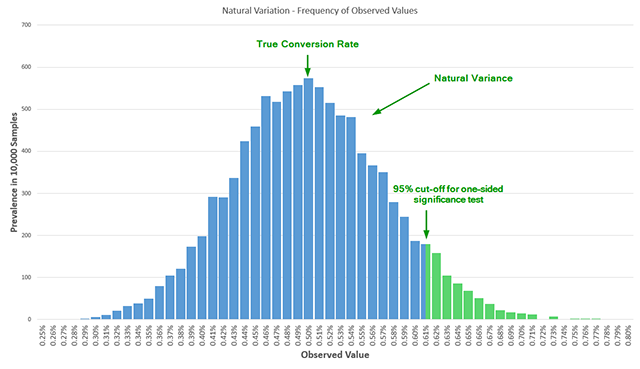
The second pillar of the current methodological crisis is the widespread neglect of statistical power, also known as test sensitivity. In statistical terms, power is the probability that a test will correctly identify a true effect when one exists. A test with low power is akin to a blurry lens; even if there is a significant improvement to be found, the test may fail to detect it.
Data suggests that a significant portion of the literature and tools used by marketers between 2008 and 2014 failed to mention statistical power entirely. In a review of seven influential books on A/B testing from that era, only one discussed power in a proper context, and even then, only superficially. This lack of awareness has led to the proliferation of “under-powered” tests.
When a test is under-powered, it requires a massive effect to trigger a significant result. If a marketing change produces a modest but valuable 2% lift, an under-powered test might conclude there is “no difference,” leading the company to abandon a profitable strategy. The trade-offs are stark: to increase power, one must increase the sample size, which requires more time and more traffic. Many free calculators used by practitioners default to a power level of 50%—essentially a coin toss—leaving the success of the experiment to chance rather than scientific measurement.
Inefficiency and the Economic Reality of Testing
The third issue is the sheer inefficiency of classical models in a business context. In clinical trials for new drugs, researchers face ethical and financial imperatives to stop a trial early if a drug is found to be either exceptionally effective or dangerously harmful. Digital marketing faces a similar economic imperative. If a new website redesign is causing a 20% drop in conversions, waiting three weeks to reach a pre-determined sample size is financially irresponsible. Conversely, if a change is performing twice as well as expected, a company loses money every day it does not deploy that change to its entire user base.
Classical fixed-sample tests do not allow for this flexibility. They are “all or nothing” models. The AGILE statistical approach seeks to bridge this gap by importing “group sequential” designs from the field of biostatistics into the world of digital commerce.
The AGILE Statistical Method: A New Framework
The AGILE method is proposed as a comprehensive solution to these three systemic failures. Inspired by the rigorous protocols of medical randomized controlled trials, the method introduces several key innovations:
1. Error-Spending Functions
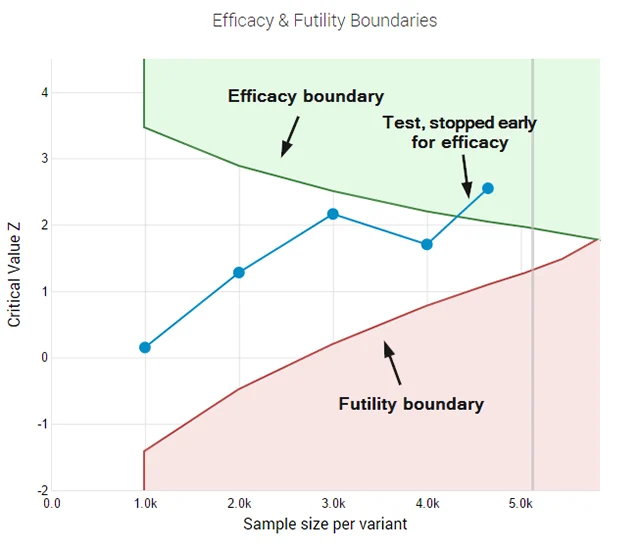
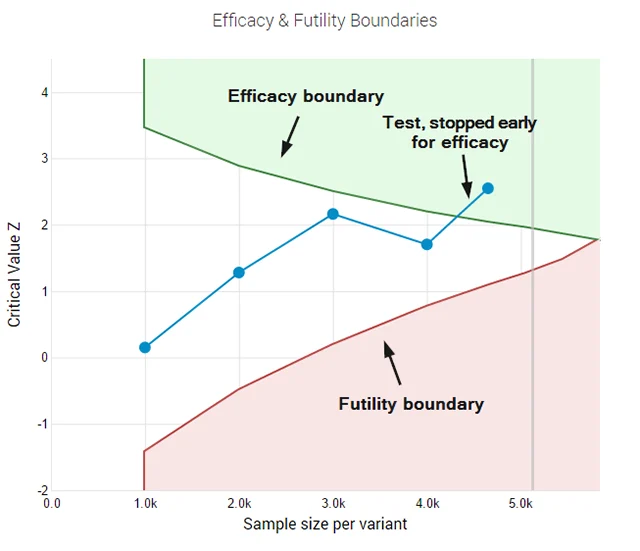
To solve the “peeking” problem, AGILE utilizes error-spending functions. Instead of using a static significance threshold, the method “spends” a portion of the allowed error rate at each interim analysis. If a practitioner wants to check the results four times, the AGILE framework adjusts the required significance level for each check so that the total probability of a false positive remains at the desired 5%. This allows for the flexibility of interim monitoring without compromising the integrity of the results.
2. Early Stopping for Efficacy
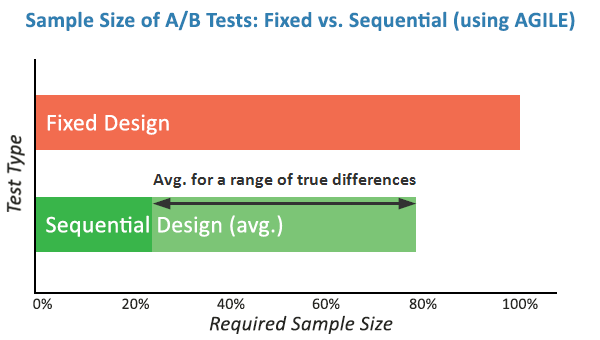
AGILE allows for the early termination of a test if the results are overwhelmingly positive. By setting “upper boundaries” based on the accumulated data, the method can identify a winner much faster than a fixed-sample test. Simulations indicate that if the true lift of a variant is significantly higher than the minimum effect of interest, the AGILE method can reach a conclusion 20% to 80% faster than traditional methods.
3. Futility Stopping Rules
Perhaps the most innovative aspect of the AGILE approach for marketers is the “futility rule.” This allows a practitioner to stop a test early if it becomes statistically improbable that the variant will ever achieve a significant positive result. “Failing fast” is a core tenet of modern business, and the AGILE method provides a mathematical basis for doing so, ensuring that resources are not wasted on lackluster experiments.
Industry Implications and Analysis
The adoption of the AGILE method represents a shift from “marketing intuition” to “data engineering.” For organizations, the implications are significant. Marketing teams can run more tests in the same amount of time, increasing the velocity of innovation. Furthermore, the reduction in false positives ensures that the “lifts” reported to stakeholders are genuine, building trust in data-driven departments.
However, the transition is not without challenges. The AGILE method requires more sophisticated software and a higher level of statistical literacy among staff. It also demands a shift in mindset: practitioners must accept that some tests will require more users than the “average” in exchange for the ability to stop other tests early.
Expert Reactions and Future Outlook
While some traditionalists argue that the complexity of sequential testing may be overkill for minor website changes, the consensus among data scientists is that as the “easy wins” in CRO disappear, the need for precision grows. Leaders in the field suggest that the AGILE method is not just a tool for optimization, but a safeguard against the “garbage in, garbage out” cycle that has plagued digital analytics.
As the industry moves toward 2025, the integration of AGILE principles into mainstream A/B testing platforms is expected to become a competitive standard. Companies that continue to rely on antiquated, misused statistical models risk making decisions based on illusory data, while those adopting the AGILE approach will benefit from a more efficient, accurate, and truly scientific methodology. The marriage of clinical-grade statistics and digital marketing is no longer a luxury—it is the next frontier of the digital economy.