The evolution of consumer and business inquiries has undergone a profound transformation, from direct interactions with salespeople to keyword-driven searches on traditional engines, and now, into the realm of artificial intelligence. As AI-powered platforms like ChatGPT, Gemini, Perplexity, and Google’s AI Overviews increasingly mediate information discovery, the critical question for businesses is not just if their brand appears in these AI-generated answers, but how to measure the tangible return on investment (ROI) from such visibility. This paradigm shift necessitates a robust and adaptable measurement framework to quantify the business impact of a brand’s presence in AI search results, connecting AI touchpoints to real-world outcomes such as website traffic, sales pipeline generation, and ultimately, closed revenue.
The Emergence of AI Search and Its Disruptive Potential
For decades, the digital marketing landscape has been dominated by Search Engine Optimization (SEO), focusing on algorithms designed for keyword matching and link authority. However, the advent of generative AI has introduced a new dimension: Answer Engine Optimization (AEO). Unlike traditional search, which presents a list of links, AI search often provides a synthesized answer, potentially citing various sources. This fundamental difference creates both immense opportunity and significant challenges for marketers. According to a recent report by HubSpot, U.S. organic search traffic experienced a 2.5% year-over-year decline in January 2026, while AI referral traffic to retail sites surged by an astonishing 693% during the same period. This stark contrast underscores a monumental shift in how buyers initiate their research journeys, making AI visibility an imperative, not an option.
However, the impact of AI search is far from straightforward. The opaque nature of AI algorithms, coupled with a lack of standardized referral data from many AI platforms, renders traditional attribution models insufficient. This ambiguity can lead to significant blind spots in understanding marketing effectiveness and misallocation of resources. The core problem lies in the difficulty of tracing a user’s journey from an AI-generated answer back to a specific brand interaction or conversion, often leading to a credit deficit for AI touchpoints.
The Attribution Conundrum: Why AI Search Defies Traditional Metrics
The journey influenced by AI is often circuitous and difficult to track using last-click attribution models. Consider a typical scenario: A prospective buyer asks an AI assistant for recommendations on a particular product or service. The AI system mentions Brand X. Three days later, the buyer directly searches for "Brand X" on Google, clicks on a paid advertisement, and eventually converts. Under a conventional last-click model, the conversion would be attributed solely to paid search, leaving AI with zero credit, despite its pivotal role in initiating the buyer’s interest.

This challenge is compounded by the fact that many AI search engines do not consistently pass referral data, making it nearly impossible to directly link AI interactions to website visits in standard analytics platforms. Industry experts, such as Dr. Anya Sharma, a prominent digital marketing analyst, emphasize, "The disconnect between AI influence and measurable outcomes is the single biggest hurdle for marketers today. We’re operating in an environment where a significant portion of the buyer’s journey is invisible to our current attribution tools." This invisibility can lead to undervaluation of AI initiatives, hindering investment in a rapidly growing channel.
A Three-Layer Measurement Framework for AI Search ROI
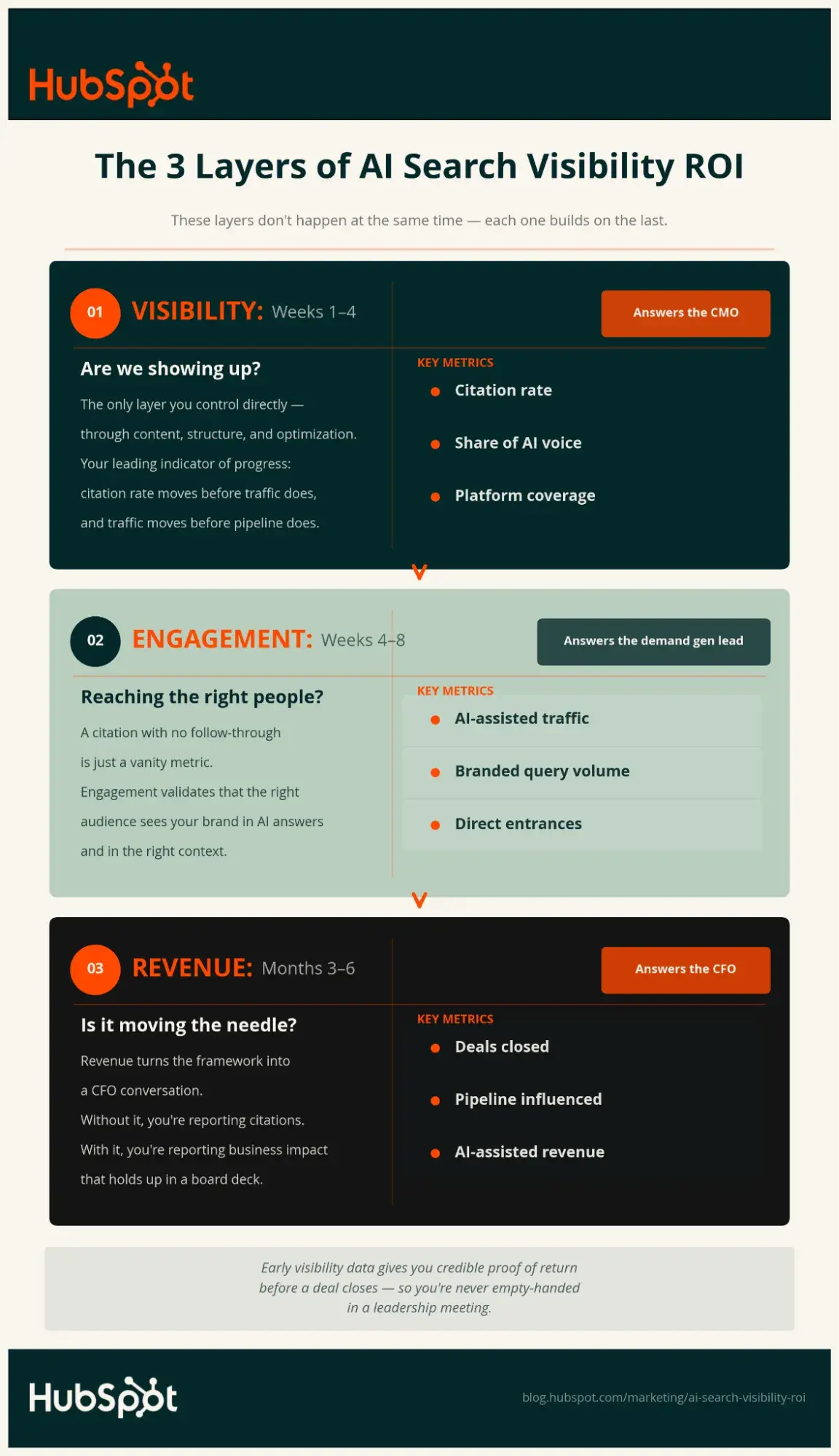
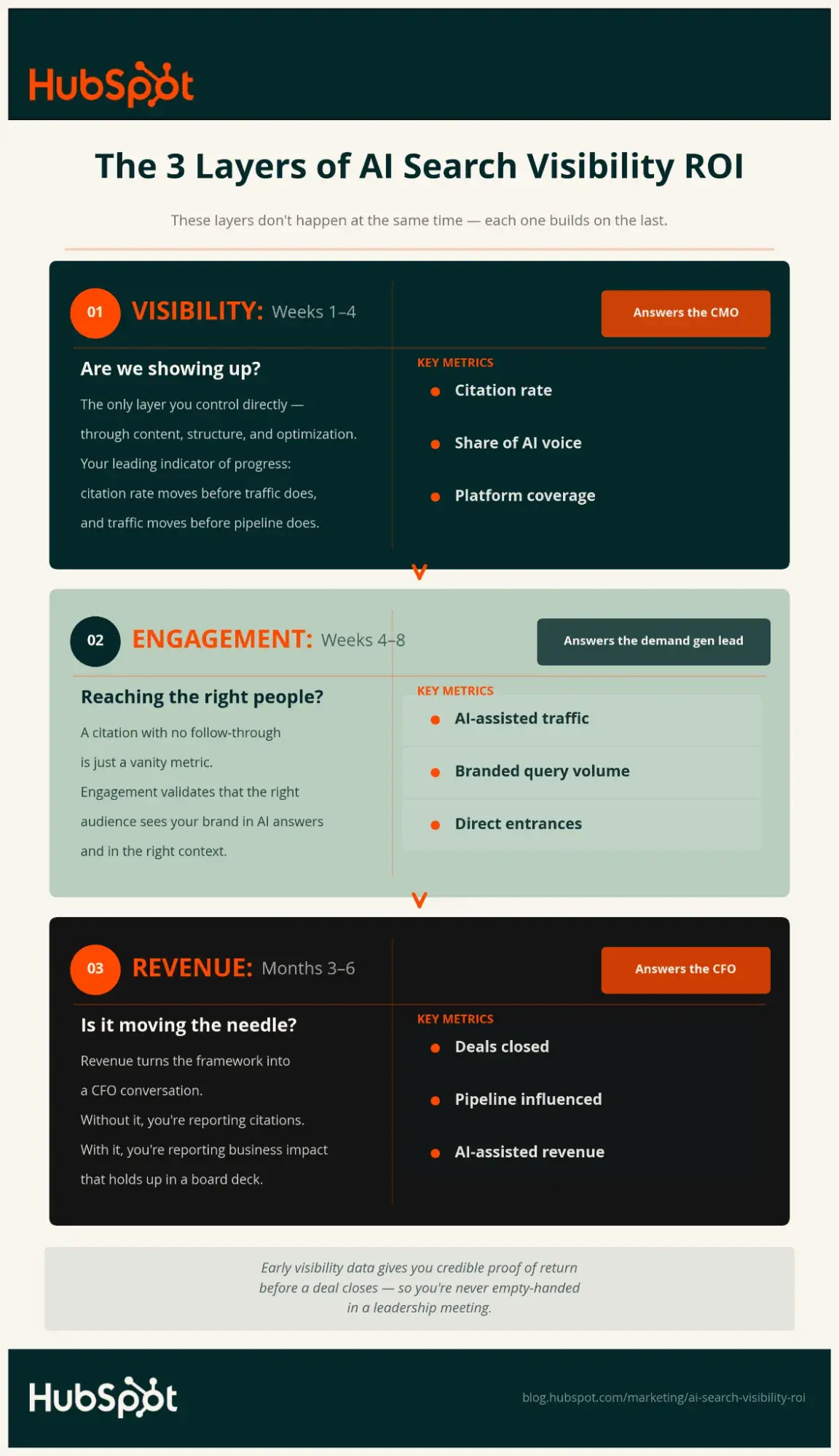
To overcome these attribution challenges, a comprehensive, multi-layered measurement framework is essential. This framework categorizes metrics into three distinct but interconnected layers: Visibility, Engagement, and Revenue. These layers form a delayed funnel, meaning their impact manifests sequentially over time, providing a holistic view of AI search performance.
-
Visibility Metrics: Tracking Share of AI Voice and Citations
- Definition: Visibility measures how often a brand appears in AI-generated answers and, more importantly, how frequently it is cited as an authoritative source.
- Key Metrics:
- Share of AI Voice (SAIV): The percentage of tracked prompts where a brand appears in the AI answer. This indicates a brand’s presence in the conversational landscape.
- Citation Tracking: Measures whether a brand’s content is explicitly linked or mentioned as a source by AI systems. A citation signifies that the AI recognizes the content as highly relevant and authoritative.
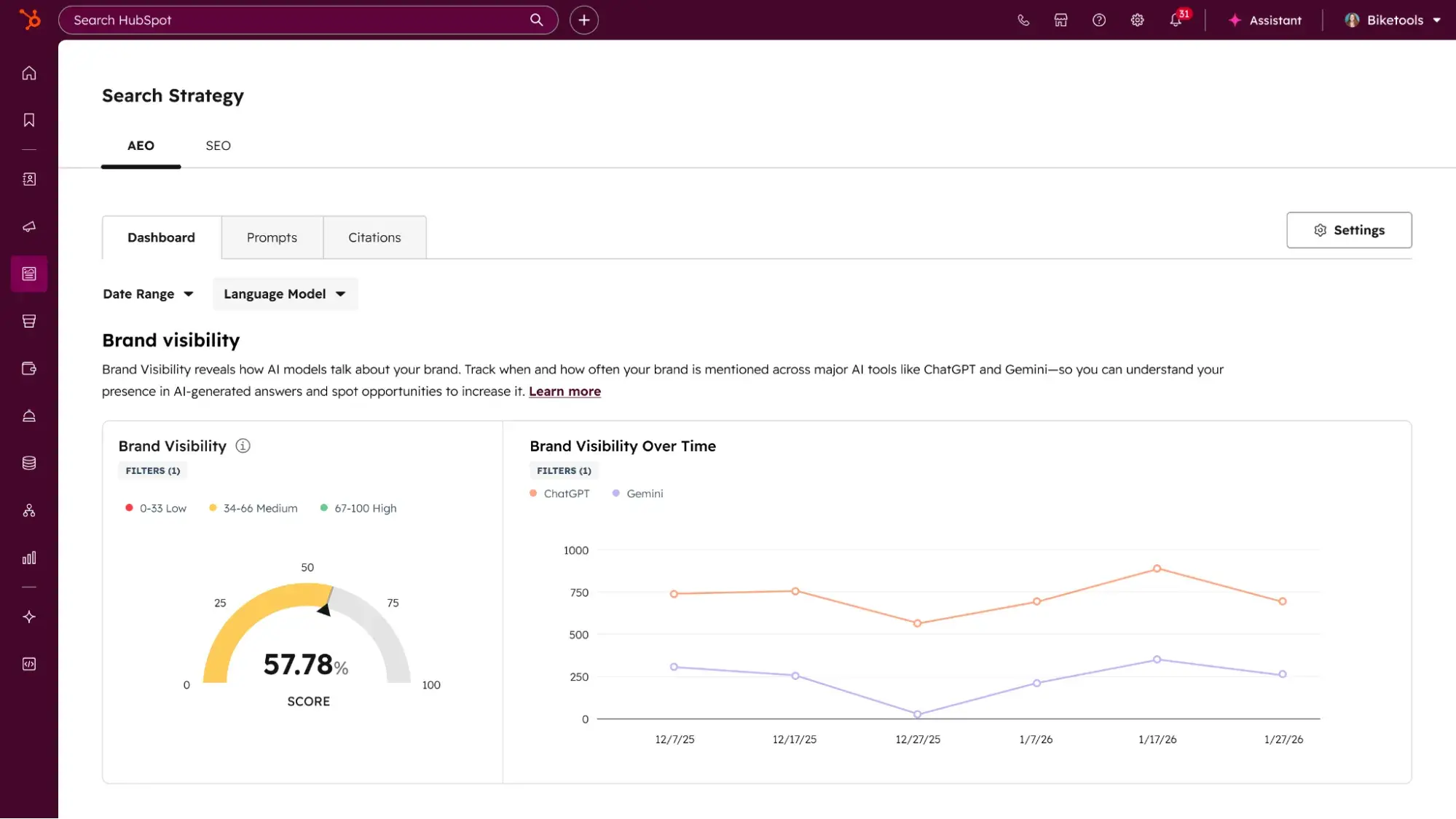
- Calculation and Tools: Brands can define a specific set of buyer-centric prompts and manually query various AI platforms (ChatGPT, Gemini, Perplexity, Google AI Overviews). Specialized tools, such as HubSpot AEO, automate this process, tracking Brand Visibility Scores across multiple platforms, monitoring competitor mentions, identifying content gaps, and connecting this data to a CRM.
- Implications: High visibility and citation rates indicate that a brand’s content is well-structured, authoritative, and aligned with AI’s understanding of user intent. This is the foundational layer, providing early indicators of success even before direct engagement.
-
Engagement Metrics: Unpacking Branded Search Lift and Direct Traffic
- Definition: Engagement measures the indirect, post-AI interaction behaviors that indicate user interest sparked by AI exposure.
- Key Metrics:
- Branded Search Lift: An increase in search queries for a brand’s name or specific branded terms in traditional search engines (e.g., Google, Bing). This suggests that users, after encountering the brand in an AI answer, are actively seeking more information.
- Direct Traffic: An increase in direct website visits (typing the URL directly or using bookmarks). This often occurs when users learn about a brand from an AI answer and navigate to its site independently, bypassing traditional search or direct referral links.
- Calculation and Tools: These metrics can be monitored using Google Search Console and Google Analytics 4 (GA4). A sustained rise in branded search volume or direct traffic, absent other major marketing campaigns, serves as a strong signal of AI-driven awareness.
- Implications: Engagement metrics bridge the gap between AI exposure and initial user action. They provide concrete evidence that AI visibility is translating into active interest, even without direct clicks from AI platforms.
-
Revenue Metrics: Attributing Pipeline Influence in Your CRM
- Definition: Revenue metrics aim to quantify the financial impact of AI search by identifying and crediting AI touchpoints in the sales pipeline.
- Key Metrics:
- AI-Assisted Revenue: Revenue generated from deals where AI search was identified as an influential touchpoint in the buyer’s journey.
- AI-Influenced MQL Rate: The rate at which marketing-qualified leads (MQLs) are generated from contacts who have had an AI touchpoint.
- Deal Velocity: The speed at which deals close when AI search has played a role.
- Calculation and Tools: Achieving perfect AI attribution is challenging. The goal is assisted attribution, building a model within a Customer Relationship Management (CRM) system that accounts for AI touchpoints. This involves:
- Tagging Contacts: Identifying contacts who engaged with AI-influenced content or were exposed to AI mentions.
- Custom Fields in CRM: Creating fields to track AI touchpoints and their stages.
- Multi-Touch Attribution Models: Using CRM capabilities to distribute credit across various touchpoints, including AI.
- Implications: HubSpot’s January 2026 survey of over 3,000 CRM purchase decision-makers revealed that AI search was the single strongest predictor of purchase intent, surpassing demos, review sites, and sales calls. Buyers who used AI search were 36% more likely to purchase. This data underscores the profound influence of AI in the decision-making process, making its measurement critical for proving ROI. By integrating visibility data directly into the CRM, marketers can automate multi-touch attribution and report AI citation share alongside other key marketing metrics.
Benchmarking for Strategic Advantage

Effective measurement extends beyond internal tracking; it demands a competitive perspective. Benchmarking AI visibility provides crucial context, revealing a brand’s standing relative to competitors and indicating whether optimization efforts are yielding results over time.
-
Identify Your Answer Competitors: In the AI landscape, "competitors" are not limited to direct product rivals. AI answers often cite industry media sites, analyst blogs, review platforms (like G2 or Yelp), and niche content aggregators. Mapping this full citation landscape reveals who AI systems consider authoritative for specific topics. Understanding whether a media site or a direct competitor is winning citations informs content strategy—it might be a content gap, not a product deficiency.
-
Build a Share of Citations Chart: Regular (e.g., monthly) tracking of a comprehensive prompt set, aggregating cited sources by topic cluster, creates a clear view of competitive performance. For example, if a brand is cited in 6 out of 20 prompts for "Sales Pipeline Management" compared to a competitor’s 14 out of 20, this highlights a critical gap requiring immediate content investment. Conversely, a strong lead in "Email Marketing Tools" (15 vs. 5) signifies a position to defend.
-
Interpret Trends: A rising citation share in a topic cluster could stem from improved content, a competitor’s decline, or an AI model update. Given the frequent updates to models like GPT, Gemini, and Perplexity, it’s crucial to establish fresh baselines after major releases. The trend line over several months offers a more reliable indicator of strategy effectiveness than any single snapshot.
Operationalizing AI Search Visibility Measurement
Implementing an AI search measurement strategy requires a structured approach:
-
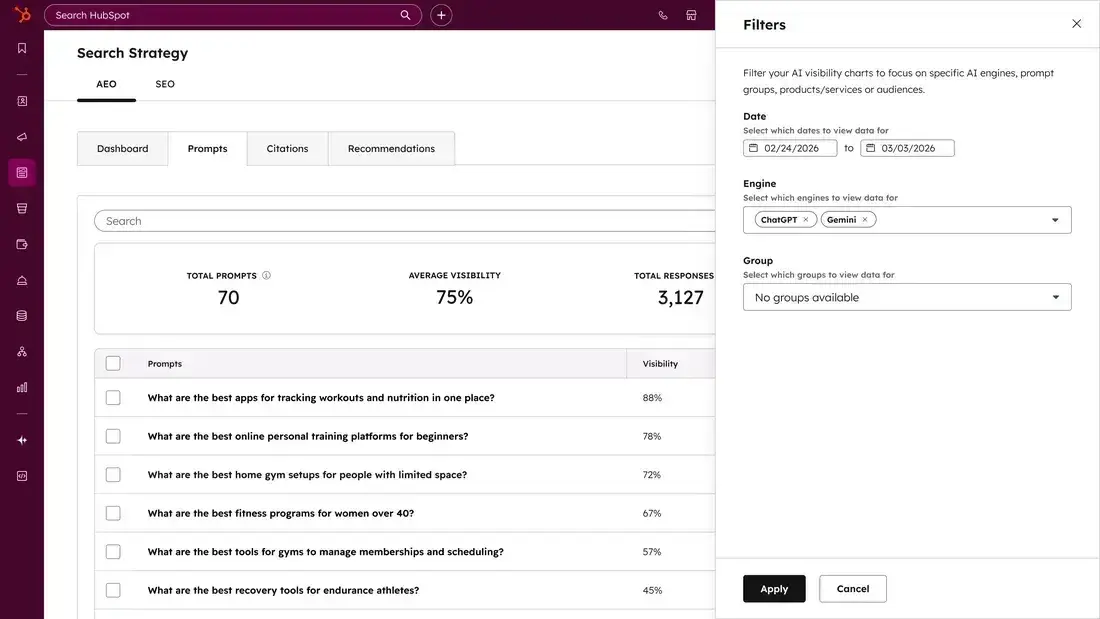
Define Your Prompt Set: Select 20-30 prompts that reflect genuine buyer research queries across all funnel stages (awareness, consideration, decision). Prioritize specificity and align prompts with sales call recordings, customer support tickets, and existing keyword research.
-
Input Prompts into Your AI Visibility Tool: Leverage tools like HubSpot AEO for automated, daily tracking across multiple AI platforms (ChatGPT, Perplexity, Gemini). Multi-platform tracking is vital, as Goodie’s 2026 Wave 2 report indicated a significant shift in B2B AI referral shares, with ChatGPT dropping from 89% to 63% in eight months, while Claude and Gemini gained traction.
-
Record Your Brand Visibility Score: Score each prompt (not mentioned, mentioned, cited, recommended) and aggregate these into an overall Brand Visibility Score. This establishes a baseline and is rerun regularly to track movement.
-
Audit Existing Content: Utilize tools like HubSpot’s free AI Search Grader to identify areas where your brand is visible and where competitors are claiming answers. This audit should guide content optimization efforts, focusing on clarity, direct answers, and E-E-A-T (Expertise, Experience, Authoritativeness, Trustworthiness) signals.
-
Repeat and Refine: Consistent tracking and analysis (weekly or bi-weekly) are crucial for continuous improvement and adaptation to the dynamic AI environment.
Calculating AI Search Visibility ROI
While direct attribution remains elusive, a defensible ROI can be calculated using the formula:
ROI (%) = (AI-Assisted Revenue – AI Costs) ÷ AI Costs × 100
- AI-Assisted Revenue: This requires building an assisted revenue model in the CRM. For instance, if a team identifies $30,000 in pipeline influenced by AI touchpoints over a quarter and applies a 25% assisted credit, AI-assisted revenue would be $7,500.
- AI Costs: These typically include expenditures on AI visibility tools, content creation and optimization, and staff time dedicated to AEO. For example, $2,000/month on tools and content amounts to $6,000 over a quarter.
Using the example figures: ROI (%) = ($7,500 – $6,000) ÷ $6,000 × 100 = 25% ROI. This provides a concrete figure for leadership.
Making the Leadership Case for AI Search
Securing organizational buy-in for AI search initiatives requires a compelling argument centered on three pillars:
-
Opportunity Cost: Emphasize that AI-referred leads convert at significantly higher rates (e.g., 3x traditional search leads, per HubSpot data). Inaction means forfeiting high-intent buyers.
-
Competitive Risk: Highlight that brands actively optimizing for AI search are already outperforming peers (e.g., HubSpot customers saw 170% more MQLs and 82% more deals). The gap is widening, making early investment a competitive necessity.
-
Measurement Plan: Present a clear, phased roadmap (30/60/90-day) with defined baselines, prompt sets, metric frameworks, and CRM attribution models. Leadership needs assurance that the investment will be transparently measured.
Expected Timeline and Leading Indicators
It is crucial to set realistic expectations regarding the timeline for AI search visibility ROI. Unlike paid media, results build in layers:
- Days 1-30: Baseline visibility score and competitive benchmarks established.
- Days 30-60: Initial citation data emerges, branded search trends begin to shift.
- Days 60-90: AI-influenced contacts appear in the CRM, MQL rates begin to show influence.
- Days 90-180: Pipeline influence data matures, and the revenue model becomes more robust, showing AI-assisted close rates and deal velocity.
While waiting for full pipeline data, leading indicators offer credible interim reporting: rising share of AI voice, increased direct traffic, improved brand sentiment in AI answers, and higher click-through rates on AI citations. A positive trend in two or more of these within 60 days provides a strong narrative that the strategy is working.
Strategic Implications and Future Outlook
The shift towards AI search is not merely a technological upgrade; it represents a fundamental change in information consumption and buyer behavior. For marketers, this means moving beyond traditional SEO mindsets to embrace Answer Engine Optimization (AEO) and Generative Engine Optimization (GEO). Content must be structured for direct answers, prioritizing clarity, conciseness, and demonstrable expertise. Reputation management also takes on new significance, as AI systems often draw from third-party authoritative sources.
The landscape of AI search platforms is dynamic, with new models and features constantly emerging. A successful strategy must be agile, continuously monitoring platform updates and adapting content to evolving retrieval logic and citation behaviors. The future of digital commerce will undoubtedly be shaped by AI, and brands that proactively measure and optimize their AI search visibility will be best positioned to capture market share and drive sustainable growth. The question is no longer if AI will impact your business, but how you will measure and leverage its undeniable influence.