The integration of Artificial Intelligence (AI) into business-to-business (B2B) marketing strategies is rapidly evolving, presenting both unprecedented opportunities and complex challenges. As AI solutions proliferate, marketing teams are actively exploring practical applications to enhance efficiency, deepen data insights, and optimize customer engagement. This article delves into real-world implementations of AI in B2B marketing, examining successful use cases in data enrichment, knowledge management, and the delicate balance between speed and quality, drawing on observations and experiences from the field.
The AI Imperative in B2B Marketing
The landscape of B2B marketing is in constant flux, driven by technological advancements and evolving buyer behaviors. Artificial Intelligence has emerged as a transformative force, promising to revolutionize how marketers operate. While a wealth of theoretical information exists regarding AI’s potential, the true value lies in understanding its practical deployment. From sophisticated agent-based systems to pure generative models and advanced data analytics, AI offers a diverse toolkit for marketers. However, realizing its full potential requires a nuanced approach, grounded in real-world application and continuous learning.
Tom Swanson, Senior Engagement Manager at Heinz Marketing, highlights this evolving dynamic. “As a B2B agency guy, I see a lot of AI implementations from a diverse array of companies, teams, and organizations,” Swanson notes. “Today, in this post, I am going to share some lessons learned and stories from the field. Some of these were AI implementations I was involved in, some of them I just observed from afar.” This firsthand perspective underscores the importance of practical insights derived from active engagement with AI technologies.
Overcoming Data Limitations with Custom AI Solutions
A significant hurdle in B2B marketing, particularly for companies targeting niche markets or smaller businesses, is the availability and accessibility of accurate data. Traditional data providers, while robust for enterprise-level clients, can exhibit diminishing returns when applied to segments with less publicly available information. This is where custom AI solutions are proving to be invaluable.
One compelling example involves a company focused on local businesses. For such organizations, the extensive databases of platforms like ZoomInfo, while effective for larger corporations, often fall short in providing the granular detail needed for effective outreach. The challenge of accessing timely and relevant information about smaller, localized enterprises became a critical bottleneck.
To address this, the company leveraged Claude’s coding capabilities to develop a bespoke AI script. This automated workflow was designed to scan public records weekly for businesses meeting specific criteria. Once identified, the AI would then conduct targeted web searches to gather additional information, systematically filling in details within a pre-defined template. This process, automated and scheduled to run weekly on a cloud server, significantly amplified data acquisition capabilities. Reports indicate that this AI-driven approach yielded double the amount of actionable data compared to traditional methods like ZoomInfo in this specific context. This demonstrates that while enterprise-level tools serve a strategic purpose, AI can provide tailored, high-impact solutions for specialized marketing needs.
Streamlining Demand Generation with AI-Powered Intake
Ineffective request management can plague marketing teams, especially those serving multiple stakeholders across different business units. This was the scenario faced by a demand generation team that served a variety of internal clients. The core issues stemmed from inconsistent request formats and a lack of standardized information, leading to delays, misunderstandings, and an inability to accurately forecast project timelines.

The team implemented an AI solution to address these intake inefficiencies. Instead of imposing rigid briefing documents on requestors, the AI was designed to interpret and structure unstructured data. By processing incoming requests in various formats, the AI could standardize the information, ensuring all necessary details were captured. This structured data was then confirmed with both the requestor and the actioning team, effectively eliminating ambiguity at the outset of the workflow.
The implications of this AI intervention were multifaceted. Firstly, it drastically improved the team’s ability to queue projects, accurately assess the required time and resources, and provide reliable delivery timelines. This directly addresses a common pain point in marketing operations: the unpredictability of project completion.
Secondly, by resolving “garbage in, garbage out” issues at the front of the workflow, the team gained clearer visibility into other potential bottlenecks. When the initial input is consistently high-quality and well-defined, underlying process inefficiencies become more apparent, allowing for targeted improvements elsewhere. This iterative enhancement of operational workflows is a critical benefit of AI adoption. The demand generation team’s experience underscores AI’s capacity to not only automate tasks but also to fundamentally improve the integrity and efficiency of core marketing processes.
The Art and Science of Chunking for Knowledge Management
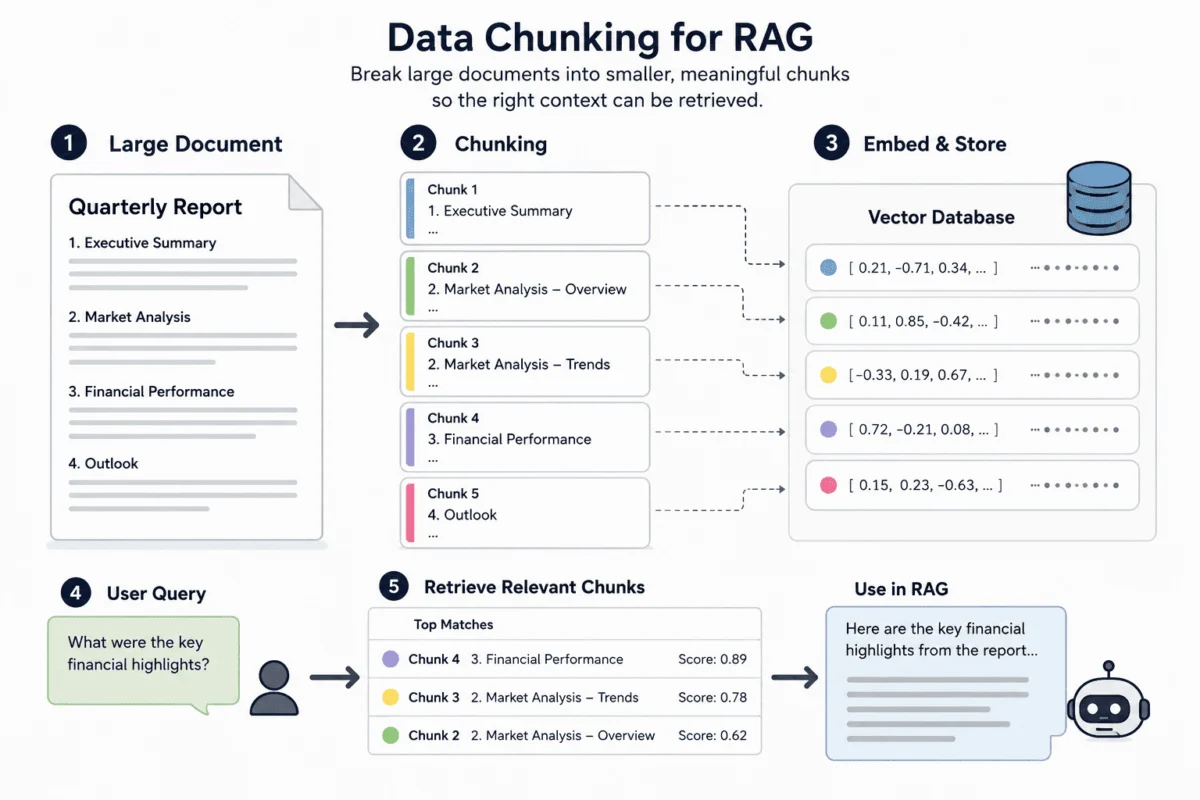
The concept of “chunking” is proving to be a critical, yet often misunderstood, component in leveraging AI for enhanced knowledge management, particularly within the framework of Retrieval Augmented Generation (RAG). RAG systems aim to improve the accuracy and relevance of Large Language Models (LLMs) by providing them with access to specific, curated knowledge bases, moving beyond generic internet information.
However, a common pitfall encountered during the development of RAG systems is the inefficient handling of large knowledge bases. Simply feeding an entire repository of information to an LLM can lead to significant increases in processing time and token usage, especially when relying on API-based services. This translates into higher operational costs and slower response times, negating some of the intended benefits of AI.
One project manager learned this lesson firsthand. After building an extensive knowledge base, the team observed execution times and token consumption far exceeding expectations. The solution lay in effective chunking. This process involves breaking down large documents into smaller, manageable segments or “chunks.” These chunks are then vectorized, a process that assigns numerical representations (embeddings) based on their semantic characteristics. This allows the AI to efficiently retrieve the most relevant pieces of information when a query is made, rather than processing the entire knowledge base.
The implications of proper chunking are profound for any RAG implementation:
- Efficiency Gains: Reduced processing time and lower token consumption directly translate to cost savings and faster query responses.
- Improved Relevance: By retrieving specific, contextually relevant chunks, the LLM can generate more accurate and nuanced answers.
- Scalability: Well-chunked knowledge bases are more scalable, allowing for the integration of larger and more diverse datasets over time.
While the technical intricacies of vectoring and chunking can be complex, the underlying principle is straightforward: organize information in a way that AI can most effectively access and utilize. For B2B marketers looking to build RAG tools, understanding and implementing effective chunking strategies is paramount for achieving optimal performance and ROI.
The Critical Nexus: Speed, Quality, and Human Oversight
The pursuit of speed in AI-driven marketing campaigns is a common objective, particularly in an era where rapid iteration and agile execution are prized. Many clients have sought to leverage AI to drastically reduce the time from campaign ideation to launch. While AI excels at standardizing briefs, shortening service level agreements (SLAs), and ensuring output consistency, a crucial question arises: does increased speed always equate to improved performance?
In the realm of B2B marketing, where customer acquisition costs (CAC) are often substantial and deal cycles are longer, a pure volume play can be less effective than in B2C. The market is already saturated with advertisements and content, and the addition of AI-generated material further amplifies this noise. While AI can generate compelling content, if it all begins to sound the same, it risks becoming indistinguishable to human buyers.
One client successfully accelerated their campaign ideation and execution using AI, achieving significant gains in efficiency. However, they observed that while the output was consistent, the actual campaign performance did not improve. The AI was proficient at generating content, but it lacked the strategic nuance and creative spark required to truly resonate with a human audience. Buyers are still individuals who need to be convinced, trust a brand, and ultimately decide to engage.
This led to a revised strategy: integrating human oversight at critical junctures where strategic creativity and nuanced understanding are essential. The AI tooling was retained for its efficiency in research, standardization, and initial content generation. However, human marketers were brought in to inject creativity, assess strategic risks, and refine brand messaging to ensure genuine connection.
This approach acknowledges that AI serves two distinct needs in marketing:
- Efficiency and Scale: AI can handle repetitive tasks, process vast amounts of data, and generate content at scale, freeing up human marketers for higher-value activities.
- Strategic Insight and Creativity: Human marketers bring unique perspectives, emotional intelligence, and the ability to make calculated risks that are currently beyond the capabilities of AI.
The ideal AI workflow, therefore, should harmonize the strengths of people, processes, and tools. This symbiotic relationship ensures that AI-driven efficiency is coupled with the strategic vision and creative flair that are indispensable for impactful B2B marketing. As AI continues to mature, the ability to effectively blend artificial intelligence with human ingenuity will be a key differentiator for success.
Conclusion: Embracing the AI-Enhanced Future
The integration of AI into B2B marketing is a dynamic and ongoing journey. The examples discussed—custom data solutions for niche markets, AI-powered demand generation intake, and the strategic application of chunking for knowledge management—illustrate the tangible benefits that AI can deliver when thoughtfully implemented. While AI’s ability to generate content at speed is undeniable, the critical lesson emerging from real-world applications is that quality and human insight remain paramount.
The future of AI in marketing lies not in replacing human strategists and creatives, but in augmenting their capabilities. By leveraging AI for efficiency and scale, while preserving human judgment for strategic decision-making and creative innovation, B2B marketers can unlock new levels of performance and achieve more meaningful engagement with their target audiences. As the technology continues to evolve, staying abreast of these practical applications and fostering a culture of continuous learning will be essential for navigating the AI-enhanced marketing landscape successfully.