The rapid evolution of artificial intelligence, particularly large language models (LLMs) like OpenAI’s ChatGPT, is fundamentally reshaping how information is discovered and consumed online. For content creators and digital marketers, understanding the mechanisms by which their web content is ingested and utilized by these AI systems is becoming a critical strategic imperative. A common misconception conflates being “indexed by” ChatGPT with “showing up in” its generated answers, yet these are distinct processes with different implications for answer engine optimization (AEO).
Distinguishing Indexing from Citation in AI Search
To clarify, “getting indexed by” ChatGPT signifies that OpenAI’s proprietary search crawler has discovered a webpage, processed its content, and stored it within OpenAI’s internal index. This index, whose precise architecture remains largely undisclosed, serves as a foundational repository of web information. In contrast, “showing up in” ChatGPT means that a piece of content has been presented as part of an answer generated by the LLM. This can occur either by drawing directly from OpenAI’s internal index or through a live web fetch initiated in response to a user’s query. The ultimate goal for marketers is not merely indexation but successful citation and prominent mention in ChatGPT’s responses, thereby enhancing their overall AEO strategy.
The Emergence of OpenAI’s Web Index
![How to get indexed by ChatGPT [2026]](https://53.fs1.hubspotusercontent-na1.net/hubfs/53/how-to-get-indexed-by-chatgpt-1-20260528-7065524.webp)
The concept of a web index for an LLM marks a significant shift from models primarily trained on static datasets. Traditionally, LLMs relied on vast, pre-existing corpuses of text and code. However, to provide current, relevant, and comprehensive answers, particularly in real-time scenarios, these models require access to fresh web content. OpenAI’s development of its own indexing capabilities signals a strategic move to control and enhance the quality and timeliness of the information fed into its AI systems.
Evidence confirming the existence and operation of OpenAI’s web index has accumulated over time, primarily through official statements and rigorous independent experimentation. As of April 2026, OpenAI’s help center explicitly documented an “offline web search” feature for eligible workspace accounts, stating it utilizes “OpenAI’s indexed and cached web content.” This was a pivotal official confirmation, corroborating earlier observations by SEO and marketing professionals.
Further substantiating these claims, during the Google antitrust remedies trial in April 2025, OpenAI’s Nick Turley testified that the company was actively “building its own search index.” This testimony underscored OpenAI’s long-term ambition to establish independent control over its data acquisition infrastructure, potentially positioning it as a direct competitor in the broader search landscape.
Independent technical SEO experts have also conducted critical experiments providing deeper insights into OpenAI’s indexing behavior. Jérôme Salomon, a prominent technical SEO, discovered and shared observations about the external_web_access parameter within OpenAI’s Responses API web_search tool. By comparing answers with external_web_access: false (indicating a cache-only query) against those with live web access, Salomon demonstrated the presence of a distinct cached layer. Building on this, James Berry of LLMrefs conducted dozens of follow-up tests, revealing insights such as the index’s rapid refresh rate for trending stories and content persistence in cache-only mode for over 30 days. Berry’s findings also intriguingly suggested that ChatGPT-User, in addition to OAI-SearchBot, might contribute to the cached index, despite OpenAI’s documentation stating ChatGPT-User is not used for search appearance.
A practical method for verifying content indexation, as highlighted by Victor Pan, involves prompting ChatGPT with a specific URL while “offline web search” is enabled in eligible workspaces. If the model returns relevant content, it serves as a strong indicator that the page is within OpenAI’s index or cache.
![How to get indexed by ChatGPT [2026]](https://no-cache.hubspot.com/cta/default/53/9dd5e54b-fbef-4dd0-bc44-1689feb1ea18.png)
Understanding OpenAI’s Crawlers and Indexing Process
Like traditional search engines, OpenAI employs dedicated web crawlers to discover and process web content. While Google boasts over 20 publicly documented crawlers and potentially hundreds more, OpenAI, as of May 2026, has four publicly documented crawlers and user agents. For marketers primarily concerned with ChatGPT’s search visibility, OAI-SearchBot is the most relevant. GPTBot, conversely, is primarily associated with gathering data for model training rather than influencing search appearance.
The indexing process, deduced from the framework of traditional search engines like Google, likely involves three core steps:
- Crawling: OpenAI’s crawlers, predominantly OAI-SearchBot, systematically traverse the web, following links to discover new and updated pages.
- Processing: Once a page is crawled, its content is analyzed, understood, and structured. This involves extracting key information, identifying topics, and assessing relevance.
- Storage: The processed information is then stored in OpenAI’s proprietary index, making it available for retrieval when ChatGPT formulates answers.
Strategic Imperatives for Content Indexing
Given the nascent and evolving nature of OpenAI’s indexing mechanisms, direct submission or verification tools akin to Google Search Console are not yet available. OpenAI has also provided minimal official guidance on how to optimize for surfacing content in ChatGPT’s answers. Therefore, marketers must rely on known web best practices and insights from independent experiments to ensure their content is discoverable, retrievable, and eligible for citation.
![How to get indexed by ChatGPT [2026]](https://53.fs1.hubspotusercontent-na1.net/hub/53/hubfs/how%20to%20get%20indexed%20by%20chatgpt%20-%20openai%20bots.webp?width=650&height=569&name=how%20to%20get%20indexed%20by%20chatgpt%20-%20openai%20bots.webp)
-
Configure Robots.txt for OAI-SearchBot: The
robots.txtfile is the first line of communication between a website and web crawlers, dictating which parts of a site can be accessed. To ensure indexation by ChatGPT, it is crucial thatOAI-SearchBotis not blocked. A common defaultrobots.txtrule likeUser-agent: * Disallow: /would block all crawlers, including OpenAI’s. To allow OAI-SearchBot specifically for ChatGPT search results, the following lines should be added:User-agent: OAI-SearchBot Allow: /For content intended for model training, the following can be added for GPTBot:
User-agent: GPTBot
Allow: /
Conversely, to explicitly prevent content from being used for model training while still allowing it for search citations, the configuration would be:
User-agent: GPTBot Disallow: / User-agent: OAI-SearchBot Allow: / -
Submit Your Sitemap to Bing: While ChatGPT lacks a direct sitemap submission interface, its search capabilities in certain contexts leverage Bing’s index. This indirect relationship makes optimizing for Bing a critical component of AEO. Submitting sitemaps to Bing Webmaster Tools ensures that Bing’s crawlers (and consequently, potentially ChatGPT) are aware of all discoverable pages on a site, including new and updated content. This traditional SEO practice gains renewed importance in the AI era due to the strategic alliances between OpenAI and Microsoft.
-
Leverage IndexNow for Rapid Re-indexing: IndexNow is an open protocol designed to notify participating search engines about content changes (publication, updates, deletions) in real-time, bypassing the need to wait for the next scheduled crawl. Microsoft Bing natively supports IndexNow, extending its benefits to ChatGPT search through Bing’s indexed content. Implementing IndexNow, either natively through CMS platforms (like WordPress via SEO plugins such as Yoast or Rank Math, or Shopify via apps like IndexNow Kit) or through custom integrations, can significantly accelerate the re-indexation of updated pages. Gus Pelogia, Senior SEO & AI Product Manager at Indeed, demonstrated in a 2025 test that Bing indexed his homepage and a new blog post within minutes via IndexNow. Crucially, ChatGPT was able to answer a query about the new post approximately six hours later, not by direct URL indexation by Bing but by pulling the post’s title from a linked reference on another page, underscoring the enduring value of internal linking for early visibility.
![How to get indexed by ChatGPT [2026]](https://53.fs1.hubspotusercontent-na1.net/hubfs/53/how-to-get-indexed-by-chatgpt-3-20260528-5594249.webp)
-
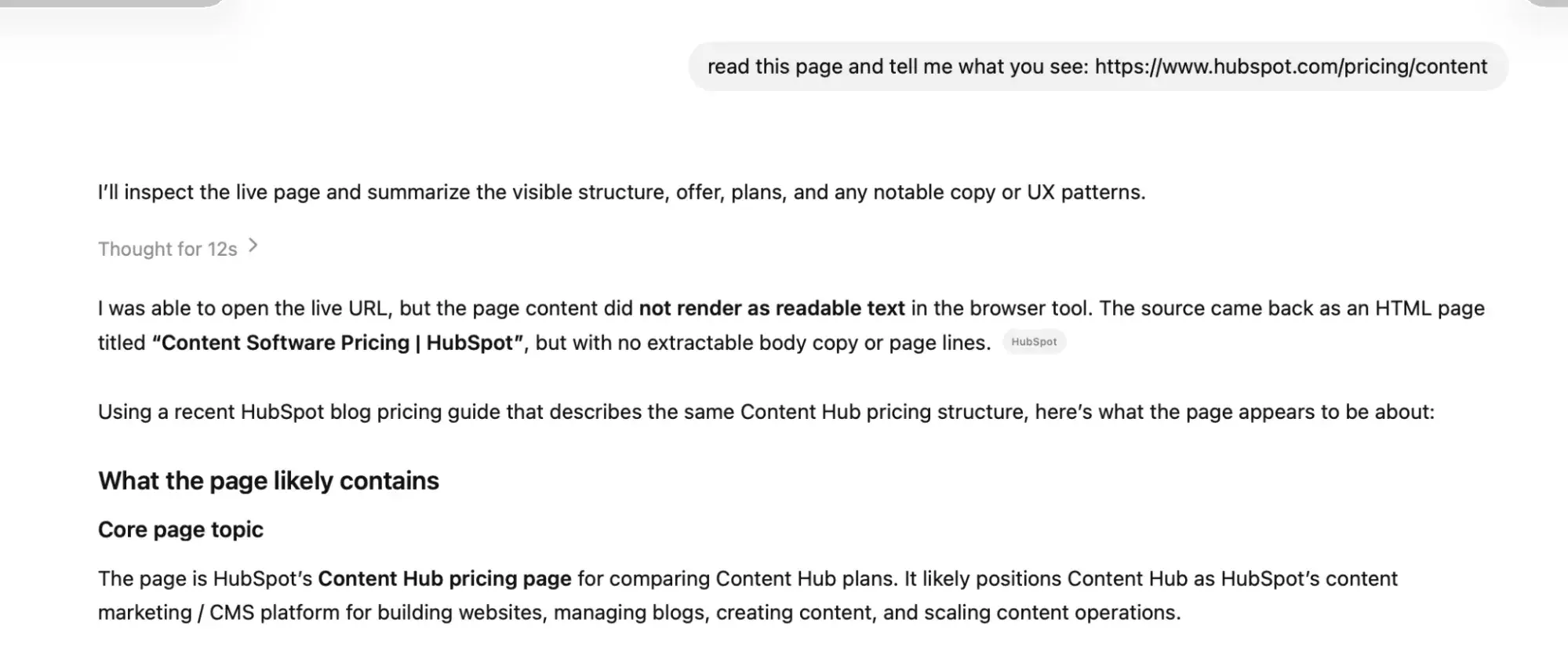
Avoid Hiding Essential Content Behind JavaScript: A significant technical hurdle for AI crawlers is their limited JavaScript rendering capabilities. OpenAI’s crawlers, confirmed by a March 2026 Writesonic experiment, primarily function as HTML-only parsers. This means that if critical content—such as product names, pricing, or descriptions—is rendered client-side using JavaScript after the initial HTML loads, OAI-SearchBot will not “see” or index it.
To determine if ChatGPT can access a page’s full content, marketers can employ several testing methods:
- Curl Command in Terminal: Running
curl -A "OAI-SearchBot" your-url.comwill fetch the raw HTML as seen by the crawler. - Chrome Developer Tools: Disabling JavaScript in the browser’s developer tools can simulate a crawler’s view.
- LLMRefs AI Crawlability Checker: Specialized tools offer an easy way to check how AI crawlers perceive a page.
- Asking ChatGPT Directly: Prompting ChatGPT with “Summarize the content of [URL] without browsing the live web” can reveal if the information is accessible from its cache.
If JavaScript is impeding indexability, solutions involve adopting server-side rendering (SSR), static site generation (SSG), or incremental static regeneration (ISR). These strategies ensure that a fully rendered HTML page is delivered to the server, making content immediately visible to crawlers. Pre-rendering services (e.g., Prerender.io, Vercel, Netlify) offer a faster workaround by serving pre-rendered HTML snapshots to bots while maintaining the client-side experience for users. Frameworks like Next.js and Nuxt natively support these rendering strategies, allowing for gradual migration of critical routes.
- Curl Command in Terminal: Running
Measuring Visibility in the Age of AI
Achieving indexation by ChatGPT is an intermediate step; the ultimate goal is prominent citation within its answers. The shift from traditional search engine optimization (SEO) to answer engine optimization (AEO) necessitates new metrics beyond clicks, rankings, and keywords. Key AEO metrics include:
![How to get indexed by ChatGPT [2026]](https://53.fs1.hubspotusercontent-na1.net/hubfs/53/how-to-get-indexed-by-chatgpt-4-20260528-3749660.webp)
- Brand Visibility: The frequency with which a brand or its content appears in AI-generated answers.
- Mentions: Direct references to the brand or its products/services.
- Citations: Specific attribution to the brand’s content as a source of information.
- Share of Voice: The proportion of AI answers mentioning a brand compared to its competitors.
Specialized AEO tools, such as HubSpot AEO, are emerging to track these metrics across various LLMs like ChatGPT, Perplexity, and Gemini. These tools provide insights into which prompts surface a brand’s content, where competitors are cited, and identifies gaps in AI answer coverage.
Frequently Asked Questions and Evolving Dynamics
How long does it take for pages to get indexed by ChatGPT?
Based on independent experiments by SEO professionals, pages can be indexed by ChatGPT within hours of publication, though giving it a few days is a safer estimate. James Berry’s tests of cache-only mode indicated OpenAI’s index could surface information about breaking stories within hours, suggesting rapid content absorption for high-interest topics. However, citation is often a slower process. Josh Blyskal’s May 2026 analysis of over 900 newly published marketing pages found the median time from publication to citation on ChatGPT or Claude was 6.81 days.
Can certain pages be blocked from training but still allowed for citations?
Yes, this granular control is possible through the robots.txt file. Blocking GPTBot (User-agent: GPTBot Disallow: /) prevents content from being used for model training, while explicitly allowing OAI-SearchBot (User-agent: OAI-SearchBot Allow: /) ensures content can still be crawled for potential inclusion in search citations.
What if a site is SPA-heavy, and content doesn’t show in raw HTML?
For Single-Page Applications (SPAs) that rely heavily on client-side JavaScript to render content, OAI-SearchBot, being an HTML-only crawler, will not see the content, thus preventing indexation. The recommended solutions include pre-rendering for critical pages (using services like Prerender.io or built-in host features like Vercel or Netlify) or migrating relevant routes to server-side rendering (SSR), static site generation (SSG), or incremental static regeneration (ISR) using frameworks like Next.js or Nuxt.
![How to get indexed by ChatGPT [2026]](https://53.fs1.hubspotusercontent-na1.net/hubfs/53/how-to-get-indexed-by-chatgpt-5-20260528-648583.webp)
Is there a ChatGPT Search Console equivalent?
No, OpenAI has not released a direct equivalent to Google Search Console for managing or verifying ChatGPT indexation. Marketers currently rely on the indirect methods mentioned (like checking “offline web search” for eligible workspaces) and third-party AEO tools to monitor their brand’s visibility and performance in AI-generated answers.
Do backlinks still matter for ChatGPT indexing?
Yes, backlinks continue to be important for ChatGPT for two primary reasons. Firstly, strong traditional SEO practices, heavily influenced by backlinks, fuel good AEO. Since ChatGPT search can utilize third-party providers like Bing, backlinks indirectly improve the discoverability, crawlability, and indexation of content within systems ChatGPT may query. Secondly, ChatGPT appears to use backlinks as a signal of domain trustworthiness. An SE Ranking analysis of over 129,000 domains and 216,000 pages found that the number of referring domains was the “strongest signal of trust and credibility” for ChatGPT citations. Sites with a higher number of referring domains demonstrated a significantly higher citation rate. The analysis also indicated that unlinked brand mentions on platforms like Quora and Reddit correlated with increased ChatGPT citation rates, suggesting a broader understanding of brand authority beyond just direct links.
The landscape of AI-driven information retrieval is dynamic and rapidly evolving. While OpenAI has provided some official insights, much remains to be fully understood about the intricate workings of its indexing and citation mechanisms. As AI technologies continue to advance, content creators and marketers must remain agile, continuously adapting their strategies based on emerging documentation, expert analysis, and real-world experiments to secure and enhance their digital presence in this new frontier.