

A recent in-depth analysis of leading e-commerce marketing platforms, Klaviyo and Privy, reveals distinct strengths that position each tool uniquely in the competitive landscape. While Klaviyo emerges as a powerhouse for sophisticated email and SMS automation, driving data-centric revenue and retention, Privy stands out as a superior solution for initial list growth and on-site engagement. The divergence in their core competencies suggests a compelling opportunity for businesses to strategically integrate both platforms for a comprehensive marketing stack that addresses both pre- and post-capture customer journeys.
Before implementing any marketing technology, understanding the nuanced capabilities of each tool is paramount. Extensive testing, conducted over two and a half days, meticulously compared Klaviyo and Privy across critical facets including their primary applications, pricing structures, list-growth functionalities, automation prowess, and more. This detailed examination aims to provide e-commerce operators with the insights necessary to make informed decisions regarding their marketing technology investments.
Key Differentiators: A Quick Overview
![Klaviyo vs. Privy: Which Is Better in 2026? [Comparison]](https://www.omnisend.com/blog/wp-content/uploads/2026/08/1.-Privys-display-library-1.png)
Businesses are advised to opt for Klaviyo when their primary need revolves around advanced email and SMS marketing, particularly when paired with fundamental pop-up capabilities. Conversely, Privy is the preferred choice for those prioritizing robust list-growth tools and streamlined marketing functions. For e-commerce enterprises with the requisite budget and a desire for a highly advanced marketing infrastructure, a dual deployment leveraging both platforms can create a potent pre- and post-capture strategy.
Klaviyo’s core focus lies in data-driven revenue generation and customer retention, offering deep analytical capabilities. Privy, in contrast, specializes in list growth and on-site pop-ups, serving as a powerful top-of-funnel conversion engine. The ease of use, based on hands-on testing, leans towards Privy, which received a higher rating. In terms of pop-up and form builders, Privy outshines Klaviyo with over 240 templates, a wider array of formats including interactive spin-to-win wheels and quizzes, and more granular on-site triggers. Klaviyo, while offering 120+ templates and drag-and-drop functionality, focuses more on CRM-based targeting.
For email marketing depth, Klaviyo is the clear winner, boasting extensive one-time, omnichannel, and automated flows, alongside over 160 templates and critical A/B testing capabilities. Privy offers one-time and automated flows with 50+ templates but lacks omnichannel campaign options. Automation and flows are another area where Klaviyo takes the lead, providing over 80 flow templates, advanced triggers like price-drop and low-inventory alerts, predictive filters, and the innovative Composer AI for flow generation. Privy offers 12 named triggers and two-tier filtering, including back-in-stock notifications, but with fewer email flow templates.
Segmentation is a significant strength for Klaviyo, which features predictive segments, real-time updates, AI-powered building and auditing, and the crucial ability to edit segments post-creation. Privy offers custom and smart segments but restricts editing once they are built. In SMS marketing, Klaviyo supports over 20 countries and offers two-way conversational messaging, whereas Privy is limited to the U.S. and Canada and integrates email and SMS within a single flow. Klaviyo also boasts a vastly larger integration ecosystem with over 350 connections compared to Privy’s 20+. Support availability is more extensive with Klaviyo, offering 24/7 email and 24/5 live chat on paid plans, while Privy provides email and live chat during business hours. For cost-conscious users, Klaviyo offers a free plan for up to 250 contacts, while Privy provides a 15-day trial. Regarding pricing models, Privy generally offers cheaper email plans at most contact tiers, charging per mailable contact, while Klaviyo charges per active contact.
![Klaviyo vs. Privy: Which Is Better in 2026? [Comparison]](https://www.omnisend.com/blog/wp-content/uploads/2026/08/2.-Privys-classic-display-library.png)
Industry Context: The Evolving Landscape of E-commerce Marketing
The modern e-commerce landscape demands increasingly sophisticated marketing strategies to capture, engage, and retain customers. As competition intensifies, businesses are continuously seeking tools that not only drive immediate sales but also foster long-term customer relationships and lifetime value. Email and SMS marketing remain cornerstone channels due to their directness and high ROI, making the choice of platform critical. The market has seen a rise in all-in-one solutions, but specialized tools continue to thrive by excelling in specific areas. The integration of artificial intelligence (AI) and predictive analytics is also rapidly transforming the capabilities of these platforms, pushing the boundaries of personalization and efficiency.
Customer Sentiment: Voices from the Front Lines
Customer reviews provide invaluable insights into the real-world performance and user experience of these platforms. As of August 2026, Privy matches Klaviyo’s overall review score on G2, both standing at 4.6/5. However, Klaviyo maintains a higher average rating on Capterra (4.6/5 vs. 4.4/5) and the Shopify App Store (4.7/5 based on 2,927 reviews vs. 4.5/5 based on 3,973 reviews). While Privy has more reviews on the Shopify App Store, Klaviyo’s higher average indicates a slightly more satisfied user base on that platform.
![Klaviyo vs. Privy: Which Is Better in 2026? [Comparison]](https://www.omnisend.com/blog/wp-content/uploads/2026/08/3.-Privys-modern-email-editor.png)
Klaviyo users frequently laud its robust integration capabilities, streamlined setup process, powerful automation flows, and comprehensive analytics. IMBIBE, a Shopify App Store reviewer, praised Klaviyo’s "rich feature set" and long-term utility. Despite this acclaim, common pain points for Klaviyo users include escalating price increases and the "active-profile" billing model, which can lead to unexpected costs. The platform’s complexity also surfaced as a concern, with users like Glen Lyon noting the need for "tech-savviness" to fully leverage its advanced features.
Privy’s positive reviews often highlight its excellent customer service, with many users commending named representatives for their responsiveness and eagerness to resolve issues. Mill Creek Apiary’s feedback, "The customer service is very easy to reach, responsive, and eager to resolve any issues. I highly recommend Privy," is representative of this sentiment. Users also appreciate Privy’s ease of use and the depth of its pop-up functionalities. Conversely, some Privy customers have reported issues with unexpected usage and profile fees, charges continuing post-cancellation, and, in some instances, poor customer service experiences. Collecto, a Shopify App Store reviewer, cited a significant price jump from $15/month to $45/month due to contact count, despite primarily using the platform for a simple pop-up.
In summary, pricing transparency and predictability remain a shared challenge for both platforms, with users expressing concerns about cost escalation. Klaviyo’s advanced capabilities, while powerful, come with a steeper learning curve, whereas Privy’s simplicity is generally well-received for its specific use case.
Core Philosophies: Different Problems, Different Solutions
![Klaviyo vs. Privy: Which Is Better in 2026? [Comparison]](https://www.omnisend.com/blog/wp-content/uploads/2026/08/4.-Privys-classic-editor.png)
The fundamental difference between Klaviyo and Privy lies in their architectural design and intended primary use cases. Privy is engineered as a list-growth and pop-up-first tool, complemented by email and SMS capabilities. Klaviyo, conversely, is built as a data-first platform focused on revenue generation and customer retention through email and SMS. Klaviyo’s sophisticated segmentation, multi-tiered automation flows, and predictive analytics offer a depth unmatched by Privy for post-capture e-commerce strategies. Conversely, Privy’s extensive suite of list-building tools provides a superior experience for lead capture at the top of the funnel.
This distinction presents a strategic choice for businesses: should they adopt two specialized tools, each excelling at a particular stage of the customer funnel, or opt for a single platform that covers the entire journey but may not offer the deepest functionality in every area?
Pricing Dynamics: A Detailed Financial Comparison
When it comes to pricing, Privy generally offers more budget-friendly email plans across most contact tiers, making it a strong contender for businesses sensitive to cost. Its SMS bundles also tend to include a higher volume of credits for the same monthly investment.
![Klaviyo vs. Privy: Which Is Better in 2026? [Comparison]](https://www.omnisend.com/blog/wp-content/uploads/2026/08/5.-Klaviyos-form-template-library.png)
For email plans, Privy consistently undercuts Klaviyo at various contact thresholds. For example, at 1,500 contacts, Privy charges $30/month compared to Klaviyo’s $45/month. This trend largely continues up to 25,000 contacts, where Privy charges $390/month against Klaviyo’s $400/month. Notably, Klaviyo is only cheaper at the 10,000-contact tier, priced at $150/month versus Privy’s $165/month.
A significant distinction in their pricing models lies in how contacts are counted. Privy’s "mailable contact" model means only individuals who have explicitly opted in count towards the quota. Non-mailable contacts, such as those who provide an email at checkout without subscribing, do not contribute to the monthly bill until they opt-in. Klaviyo, however, employs an "active contact" model, which includes anyone the business can email, encompassing both subscribers and general engagement contacts. This necessitates proactive list management on Klaviyo to prevent unexpected cost escalations, particularly for stores that collect many non-subscriber emails at checkout.
Both platforms start their SMS pricing at $15/month. However, Privy typically offers more SMS credits for the same monthly spend. At $15/month, Privy provides 1,250 credits compared to Klaviyo’s 1,000. This pattern continues, with Privy offering 10,000 credits for $90/month against Klaviyo’s 7,000. While Klaviyo’s rates start slightly lower per send (e.g., $0.011 per send plus provider fees, where applicable), Privy’s larger credit bundles often result in better value for high-volume SMS users.
Privy also offers a dedicated "Pop-Ups & Displays Only" plan, priced from $24/month for up to 10,000 page views, catering specifically to businesses that only require its advanced list-growth functionalities without the integrated email marketing. Klaviyo, on the other hand, provides a free plan for up to 250 contacts and 500 emails/month, offering a valuable entry point for new or very small businesses.
![Klaviyo vs. Privy: Which Is Better in 2026? [Comparison]](https://www.omnisend.com/blog/wp-content/uploads/2026/08/6.-Klaviyos-form-builder-1.png)
List Growth and On-Site Engagement: Privy’s Domain
Privy excels in list growth due to its superior display builder, which offers a broader range of design elements, formats, and advanced on-site triggers. Privy’s interface includes both a modern and a classic editor. The classic editor, while legacy, unlocks access to over 200 templates, including unique formats like spin-to-win wheels and mini-quizzes—gamified elements that Klaviyo does not natively offer. These interactive tools are highly effective for engaging visitors and increasing opt-in rates. Privy also supports landing pages with pre-built templates for webinars and sales.
The modern editor features 43 pre-built designs across various formats (fullscreen, pop-up, flyout, bar) and allows filtering by specific goals such as collection, abandonment reduction, order value increase, back-in-stock notifications, and announcements. Privy’s settings page provides a significantly wider array of triggers and visibility controls, including time on page, show on scroll, exit intent, and out-of-stock product triggers. Its audience targeting leverages customer attributes, shopping activity, and website behavior, allowing for highly specific conditional logic (match-all or match-any).
Klaviyo’s list-building tools, while competent, offer fewer options. Its form template library comprises over 120 designs across pop-ups, full page, flyouts, embedded forms, and banners. The form builder supports drag-and-drop for elements and fields, but its usability can be less intuitive compared to Privy. Klaviyo’s triggers include exit intent, time delay, scroll depth, and pageview count. Its targeting capabilities are more deeply integrated with its CRM, allowing forms to be shown or hidden based on subscription status, profile data, or segment membership, with real-time updates.
![Klaviyo vs. Privy: Which Is Better in 2026? [Comparison]](https://www.omnisend.com/blog/wp-content/uploads/2026/08/7.-Klaviyo_s-email-templates.png)
Email Marketing: Klaviyo’s Command
Klaviyo’s email marketing capabilities are substantially more advanced, offering a comprehensive suite for campaign management, automation flows, and reporting. It supports both one-time and omnichannel campaigns, enabling businesses to send coordinated, multi-path message series to diverse audiences. While Privy offers one-time campaigns and automated flows, it lacks an equivalent for omnichannel campaigns. However, Privy’s February 2026 acquisition of Sendlane is poised to significantly enhance its email and SMS automation, and reporting features, aiming to bridge some of these gaps.
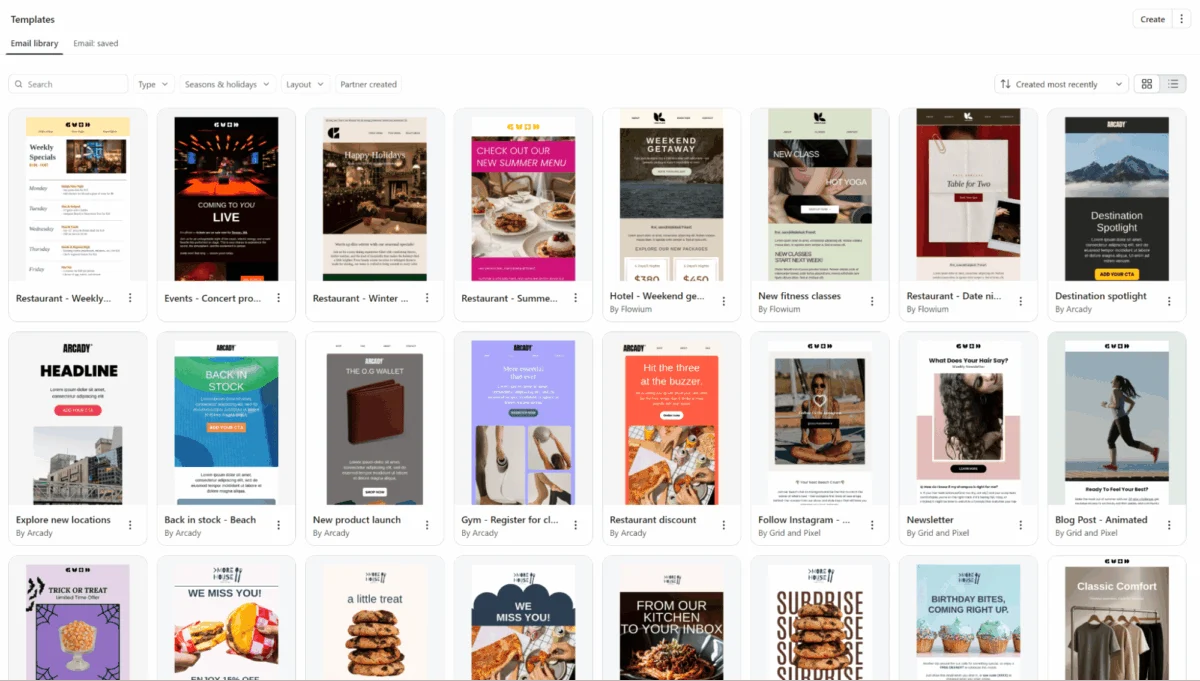
Klaviyo boasts a more extensive library of over 160 pre-built email templates, categorized by season, holiday, layout, and campaign type (deals, outreach, sales). This rich selection allows for quick deployment of visually appealing and goal-oriented emails. Privy offers over 50 email templates, but its library lacks the detailed filtering options of Klaviyo, making template selection more time-consuming.
Both platforms feature drag-and-drop email builders with pre-built blocks. Klaviyo’s builder provides greater creative control with more advanced sections and blocks like Split, Dropdown, and Spacer. Its dynamic product block can showcase best-sellers, new arrivals, recently viewed items, or category picks, leveraging live product feeds and personalization. Privy’s dynamic product block also displays recently added, most-viewed, and best-selling products. Privy’s builder is more minimalistic and arguably easier for beginners, and uniquely offers an integrated image library sourcing royalty-free images. A significant drawback for Privy is the absence of A/B testing for emails, a core feature in Klaviyo that allows for continuous optimization of campaign performance.
![Klaviyo vs. Privy: Which Is Better in 2026? [Comparison]](https://www.omnisend.com/blog/wp-content/uploads/2026/08/8.-Privys-email-templates.png)
Automation Depth: Klaviyo’s Predictive Edge
Klaviyo’s automation capabilities are notably deeper, offering over 80 pre-built automations and leveraging its Composer AI (currently in beta) to generate flows on demand. These cover standard e-commerce journeys such as welcome series, abandoned cart/checkout, browse abandonment, win-back, and follow-up sequences. Klaviyo’s six trigger types, including "added to list," "added to segment," "date property," "price drop," "low inventory," and "metric trigger" (for checkout started, viewed product, placed order, added to cart), provide granular control. The Composer AI significantly reduces setup time, capable of building complex flows based on simple natural language prompts, such as "Build me a flow for U.S. customers who purchased over $100 in the last six months."
Privy offers 11 email flow templates and 12 distinct triggers, including "order placed and received," "product added to cart," "started checkout," "viewed product," "back in stock," and "subscribed to marketing." While it features a back-in-stock flow, it lacks Klaviyo’s price drop or low-inventory triggers, which proactively alert shoppers. Both platforms allow for two-level filtering to narrow down recipients based on event characteristics and contact attributes. Klaviyo’s second-level filtering extends to predictive analytics like churn risk and predicted next order date, offering advanced targeting capabilities for mature e-commerce businesses with sufficient historical data.
Segmentation: Real-time and AI-Powered Targeting
![Klaviyo vs. Privy: Which Is Better in 2026? [Comparison]](https://www.omnisend.com/blog/wp-content/uploads/2026/08/9.-Klaviyos-email-editor.png)
Klaviyo’s segmentation capabilities are more robust, featuring 25 pre-built segments and the Composer AI for on-demand segment creation and auditing. Its segments update in near real-time, drawing data from every contact in the CRM, not just subscribers. Unlike Privy, Klaviyo allows for editing segment conditions after creation, providing flexibility for refinement. Its segmentation conditions include shopping activity, location, and engagement, augmented by predictive elements such as churn risk, predicted lifetime value, and expected next order date (available to stores meeting specific data thresholds). The AI segment audit further assists in optimizing audience groupings.
Privy’s segmentation is divided into "Custom Segments" and "Smart Segments." Custom segments allow users to combine conditions across shopping activity, website behavior, customer attributes, and engagement. Smart Segments are pre-built for common groups like "engaged," "unengaged," "current customers," and "potential customers." Privy’s segment builder offers conditions for cart value, lifetime spend, order count, first/last order, and purchase history. However, a key limitation is the inability to edit segment conditions once they are built.
SMS Marketing: Global Reach and Conversational AI
Klaviyo offers a more advanced SMS platform with broader global coverage and sophisticated conversational automation. Its SMS capabilities span over 20 countries, including the United States, Canada, United Kingdom, Australia, and New Zealand, with country-specific compliance handling. Klaviyo supports various number formats, including toll-free, 10DLC, and short codes, catering to different business needs. It can trigger and personalize texts based on any customer profile data, and crucially, saves customer replies to their profiles, which can then trigger subsequent automation steps.
![Klaviyo vs. Privy: Which Is Better in 2026? [Comparison]](https://www.omnisend.com/blog/wp-content/uploads/2026/08/10.-Privy_s-email-builder.png)
Privy’s SMS offering, while functional for campaigns and flows, is limited to the U.S. and Canada, requiring a verified toll-free number. Its pre-built SMS flows cover standard e-commerce scenarios like welcome series, abandoned carts, and purchase follow-ups. Both platforms provide initial SMS credits, with additional bundles available. However, Klaviyo’s focus on two-way conversational automation and global compliance positions it as the more comprehensive SMS solution for businesses with international aspirations or complex engagement strategies.
Integration Ecosystem and Support Services
Klaviyo boasts a significantly larger integration ecosystem, connecting with over 350 tools, compared to Privy’s 20+. Both offer native apps for major e-commerce platforms like Shopify, BigCommerce, Squarespace, and Wix. Notably, Privy provides a native Klaviyo integration, enabling businesses to capture subscribers via Privy and seamlessly sync that data to Klaviyo for further marketing initiatives. Klaviyo’s extensive integrations make it a better fit for businesses operating with complex tech stacks, while both platforms support Zapier for broader data transfer when native integrations are absent.
Regarding customer support, Klaviyo’s paid plans include 24/7 email support and 24/5 live chat. Its free plan offers 60 days of email support. Klaviyo also provides premium support tiers (Professional and Enterprise) with enhanced services, including weekend live chat and faster email response times, albeit at an additional cost. Privy’s Email plan includes email and live chat support during business hours (Monday to Friday, 9 am–6:30 pm EST for email, 10:30 am–6:00 pm EST for live chat). Outside chat hours, messages are converted into support tickets. Klaviyo’s broader support availability, particularly outside standard business hours and with premium options, positions it as more accessible for businesses requiring constant assistance.
![Klaviyo vs. Privy: Which Is Better in 2026? [Comparison]](https://www.omnisend.com/blog/wp-content/uploads/2026/08/11.-Klaviyos-flow-builder.png)
Strategic Synergy: Deploying Klaviyo and Privy Together
A common and highly effective strategy involves using Klaviyo and Privy in conjunction. By opting for Privy’s "Pop-Ups & Displays Only" plan and integrating it with a Klaviyo Email plan, businesses can leverage Privy’s superior list-growth tools while benefiting from Klaviyo’s advanced marketing automation and data capabilities. The native integration ensures that contacts captured through Privy’s forms seamlessly flow into Klaviyo’s CRM, feeding into sophisticated segmentation and automation workflows.
This dual-platform approach, while incurring higher monthly costs and requiring management of two subscriptions, offers a "best of both worlds" scenario. The most economical combination would be Klaviyo’s free plan (up to 250 active contacts) paired with Privy’s $24/month Displays-Only plan. However, businesses should be mindful of Klaviyo’s pricing structure, as costs increase once the active contact threshold is exceeded. Combining both platforms’ email plans is generally not recommended due to conflicting capabilities and potential data attribution issues.
The Sendlane Acquisition: Privy’s Strategic Evolution
![Klaviyo vs. Privy: Which Is Better in 2026? [Comparison]](https://www.omnisend.com/blog/wp-content/uploads/2026/08/12.-Klaviyos-Composer.png)
In a significant move to enhance its marketing automation capabilities, Privy acquired Sendlane in February 2026. This strategic acquisition aimed to integrate Sendlane’s robust email and SMS automation features into Privy’s existing platform. The objective is to combine Privy’s strengths in on-site conversion and list growth with Sendlane’s depth in email, SMS, automation, and reporting. This integration is expected to address some of Privy’s competitive gaps against all-in-one platforms like Klaviyo, offering users a more comprehensive solution and potentially reducing the operational maintenance associated with managing multiple tools. The acquisition signals Privy’s ambition to evolve beyond a pure list-growth tool into a more holistic e-commerce marketing automation provider.
Alternative Solutions: The Broader Market
For businesses seeking a comprehensive solution that blends the strengths of both Klaviyo and Privy, Omnisend emerges as a compelling alternative. Omnisend offers a robust suite of list-growth tools, including pop-ups and gamified elements, combined with extensive email and SMS marketing capabilities across campaigns and multichannel flows. Its e-commerce depth in flows, segmentation, and reporting is often compared favorably to Klaviyo’s, with the added benefit of being perceived as more user-friendly.
Omnisend also offers multi-store support with one-click store switching and shared assets, a valuable feature for merchants managing multiple online shops. All Omnisend plans include 24/7 email and live chat support. For businesses with over 250 contacts, a complimentary migration service is available to facilitate the transition from platforms like Klaviyo. Omnisend’s pricing model is designed to offer flexibility, with a Standard plan that provides all core email marketing features without SMS, potentially offering significant cost savings compared to Klaviyo. Its Pro plan includes global SMS coverage across more than 190 countries, surpassing both Privy’s (U.S. and Canada only) and Klaviyo’s (20+ countries) SMS reach.
![Klaviyo vs. Privy: Which Is Better in 2026? [Comparison]](https://www.omnisend.com/blog/wp-content/uploads/2026/08/13.-Adding-triggers-to-custom-flows-in-Privy.png)
Strategic Recommendations: Choosing the Right Path
The choice between Klaviyo and Privy, or a combination thereof, depends entirely on a business’s specific needs, budget, and strategic priorities.
- Choose Privy if: The primary goal is to maximize visitor capture and aggressively grow your email and SMS lists. Its diverse display formats, gamified options (spin-to-win, quizzes), and extensive on-site triggers are unparalleled for top-of-funnel conversion. This is suitable for businesses that are content with more streamlined email and SMS marketing features and do not require predictive analytics.
- Choose Klaviyo if: The focus is on advanced e-commerce segmentation, sophisticated automation, and comprehensive revenue and retention reporting. Klaviyo excels in creating deep customer journeys, leveraging predictive data, and managing complex multi-channel campaigns for a mature customer base. This is ideal for scaling businesses that prioritize data-driven marketing and customer lifetime value.
- Choose both if: A business requires the absolute best in both lead capture and post-capture customer lifecycle management. By pairing Privy’s Pop-Ups & Displays Only plan with a Klaviyo Email plan, companies can achieve superior list growth and then leverage Klaviyo’s robust data and automation for highly personalized and effective retention strategies.
Privy vs. Klaviyo: Frequently Asked Questions
Is Privy or Klaviyo better?
Privy excels in growing your contact list through advanced pop-ups and sign-up forms, offering more templates and interactive formats. Klaviyo is superior for comprehensive email and SMS marketing, providing deeper automation, segmentation, and reporting capabilities for engaging and retaining customers.
![Klaviyo vs. Privy: Which Is Better in 2026? [Comparison]](https://www.omnisend.com/blog/wp-content/uploads/2026/08/14.-Lifetime-spend-in-Privy.png)
Can you use Privy and Klaviyo together?
Yes, it is a common and recommended setup. Privy offers a native integration with Klaviyo, allowing contacts collected through Privy’s forms to be synced directly into your Klaviyo account. This is typically achieved by using Privy’s Pop-Ups & Displays Only plan alongside a Klaviyo Email plan.
Does Klaviyo have popups?
Yes, Klaviyo includes a comprehensive pop-up library with over 80 templates. These forms feature a drag-and-drop editor and can be configured with multiple steps for various collection goals.
What’s cheaper, Klaviyo or Privy?
Privy generally offers cheaper email plans across most comparable contact tiers. Additionally, Privy’s SMS add-ons typically include more credits for the same monthly price, often with inclusive carrier fees, making it more cost-effective for SMS usage.
What’s the connection between Privy and Sendlane?
Privy acquired Sendlane in February 2026. This acquisition was a strategic move to integrate Sendlane’s robust email and SMS automation, as well as its advanced reporting capabilities, into Privy’s platform. The aim is to create a more comprehensive marketing automation solution by combining Privy’s strengths in on-site conversion and list growth with Sendlane’s deeper engagement functionalities.








