rifanmuazin
For e-commerce businesses navigating the complex digital landscape, the choice of a Customer Relationship Management (CRM) system can be a pivotal decision, capable of either significantly amplifying sales or becoming a considerable drain on resources and time. A well-integrated CRM streamlines operations by consolidating leads, email communications, and sales data into a unified platform. Conversely, a poorly chosen or implemented system can lead to fragmented workflows, missed follow-ups, and a general sense of disorganization. This comprehensive analysis delves into a comparative examination of two prominent CRM solutions, HubSpot CRM and ActiveCampaign, evaluating their capabilities, particularly for growing e-commerce brands. While ActiveCampaign offers robust marketing automation, HubSpot CRM consistently demonstrates a superior ability to unify data, streamline workflows, and provide a holistic view of the customer journey, ultimately positioning it as the preferred choice for sustained e-commerce growth.
A Snapshot: HubSpot vs. ActiveCampaign Feature Comparison
Before diving into the nuances of each platform, a concise overview of their key features highlights their differing strengths and target audiences.
| Feature | HubSpot Marketing Hub | ActiveCampaign |
|---|---|---|
| Setup & Onboarding | Guided onboarding, free CRM available in minutes, unified workspace designed for immediate data integration. | Rapid campaign setup, but requires CRM integration for comprehensive tracking and unified customer data. |
| AI Tools | Breeze AI Agents (Content, Social, Prospecting), AI CPQ, Data Hub Intelligence, offering broad AI-driven assistance across multiple business functions. | Predictive Sending, Content Optimization, Active Intelligence agents, focusing AI on email optimization and audience engagement. |
| Marketing Automation | Comprehensive inbound engine encompassing email, ads, SEO, landing pages, and intricate workflows, designed for end-to-end customer engagement. | Powerful email automation and branching capabilities, with solid CRM layering for targeted marketing sequences. |
| Omnichannel Messaging | Email, social media, advertising platforms, and SMS (via integration), with an expanding suite of communication channels. | Native support for email, SMS, WhatsApp, and transactional emails, providing a direct and integrated messaging experience. |
| CRM & Pipeline Management | Native Smart CRM with a unified view of customer interactions. Pipeline capacity is plan-dependent. | Integrated CRM with unlimited pipelines available on all plans, offering flexibility for diverse sales processes. |
| Reporting & Analytics | Advanced multi-touch attribution, customizable dashboards, and Data Hub warehouse integration for deep, cross-channel insights. | Campaign-level analytics with excellent detail for email flows; limited cross-channel reporting capabilities. |
| Integrations & Ecosystem | Over 2,000 apps with deep, two-way data synchronization (e.g., Shopify, Slack, Stripe) for seamless data flow. | Approximately 1,000 apps, with strong email integrations and a greater reliance on third-party connectors like Zapier for advanced functionality. |
| Pricing & Cost | Free CRM, tiered hubs (based on users and features), with costs scaling with added functionality and user count. | Contact-based pricing, offering a lower initial entry point but scaling rapidly with list growth. |
| Onboarding & Support | Extensive resources including HubSpot Academy, comprehensive documentation, a partner network, and optional paid migration services. | Free 1:1 migration (for Pro+ plans), robust support tailored for email marketing teams. |
| Deliverability & Localization | Strong deliverability rates and web content translation via DeepL integration. | Excellent deliverability and native support for 75 languages, facilitating global reach. |
| Best For | Growing e-commerce or B2B brands requiring unified data, comprehensive automation, and an integrated ecosystem. | Email-centric teams seeking rapid, powerful marketing automation solutions on a budget. |
Understanding the Core Philosophies: HubSpot vs. ActiveCampaign
At their core, HubSpot and ActiveCampaign approach CRM from distinct perspectives, each catering to different business needs and priorities.
HubSpot Marketing Hub is an integral part of HubSpot’s expansive smart CRM ecosystem. Its fundamental design principle is to ensure all customer-facing operations—emails, advertisements, sales deals, and even payment processing—work in concert within a single platform. This unified architecture is where HubSpot’s true strength lies. When a potential customer completes a form, HubSpot automatically logs the interaction, scores the lead based on predefined criteria, and triggers automated workflows. These workflows can range from sending a personalized email to assigning a follow-up task for a sales representative. This seamless data flow, augmented by AI tools like Breeze AI, transforms raw activity data into actionable insights, providing a clear, chronological narrative from the initial ad click to the final purchase. For e-commerce businesses, this creates an unparalleled clarity of the entire customer journey.
ActiveCampaign, conversely, operates with a more focused and agile approach, particularly emphasizing marketing automation, with a strong bias towards email marketing. It is designed for rapid deployment and execution of marketing campaigns. Businesses can quickly set up a campaign, define branching logic within automation sequences, and launch personalized automations within an hour. ActiveCampaign excels in scenarios where precise timing is critical, such as post-purchase follow-ups, nurturing sequences, and time-sensitive promotional offers. Its Predictive Sending and Active Intelligence features are sophisticated tools that have seen significant enhancements in recent years, offering intelligent ways to optimize email delivery and content.
The Crucial First Steps: Setup and Ease of Use
The initial setup of any CRM can be a significant hurdle, often deterring even the most motivated users. The experience can range from an overwhelming labyrinth of configurations to an intuitive, guided process.
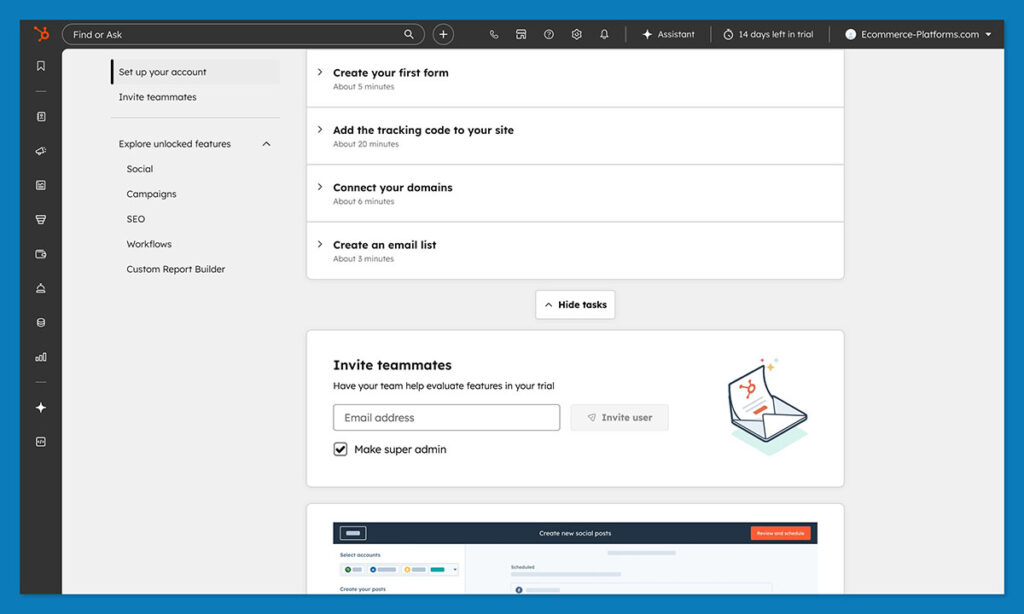
HubSpot’s onboarding process is designed to feel less like a traditional setup and more like an integration. Upon creating a free account, users can connect their e-commerce store, email marketing tools, and advertising platforms. The system then automatically begins consolidating this data, revealing patterns in lead generation, sales conversion points, and customer return behavior. The onboarding steps are practical, allowing users to immediately engage in useful tasks like building their first automation workflow or customizing their sales pipeline. The workspace is highly adaptable, enabling users to tailor their dashboards to display key metrics such as average order value and abandoned cart recovery rates, rather than solely focusing on traditional email engagement metrics. Crucially, each HubSpot hub—Marketing, Sales, and Commerce—shares data seamlessly, eliminating the need for cumbersome data exports and imports between disparate systems.
ActiveCampaign adopts a more streamlined approach to initial setup. Users can typically launch a campaign and begin building automations within minutes, with an intuitive automation builder that is easy to grasp. However, the platform’s ease of use begins to taper when deeper e-commerce data integration is required. Mapping store fields, synchronizing purchase history, and ensuring that specific triggers fire correctly can involve a degree of trial and error, demanding more manual verification to guarantee the integrity of the automated processes.
The Intelligence Edge: AI and Automation Showdown
Artificial intelligence is rapidly becoming an indispensable component of modern business operations, and CRMs are no exception. Both HubSpot and ActiveCampaign incorporate AI, but with different strategic emphases.
In HubSpot, AI is woven into the fabric of daily tools rather than being a separate add-on. While drafting campaign content, the platform offers suggestions for more effective subject lines or concise paragraph structures. The Breeze AI tools are integrated directly into the content editor, allowing users to refine tone or translate messages without leaving the current interface. Similarly, the Social Media AI Agent provides recommendations for optimal timing and wording for social media posts, learning and adapting to your brand’s style over time, effectively acting as a junior marketing assistant.
The power of HubSpot’s AI is amplified by its Data Hub, which consolidates customer interactions into a single, unified record. This enables the creation of sophisticated automations, such as identifying a customer who has repeatedly viewed a specific product. The system can then automatically increase their lead score, assign a task to a sales representative for personalized outreach, and trigger a follow-up communication. This operates seamlessly in the background, freeing up valuable time for strategic campaign planning.
ActiveCampaign’s AI capabilities are more narrowly focused but highly effective within their domain. The Predictive Sending feature analyzes individual contact engagement patterns to determine the optimal time to send emails, maximizing the likelihood of opens. Predictive Content can dynamically alter headlines or call-to-action buttons based on past performance data. While these tools are powerful for email optimization, HubSpot’s AI extends across a broader spectrum of business functions, offering a more comprehensive strategic advantage for e-commerce operations.
Crafting Campaigns: Marketing Automation and Building Blocks
The process of building marketing campaigns reveals the distinct operational philosophies of HubSpot and ActiveCampaign. Both platforms offer robust automation features, but their approach and user experience differ significantly.
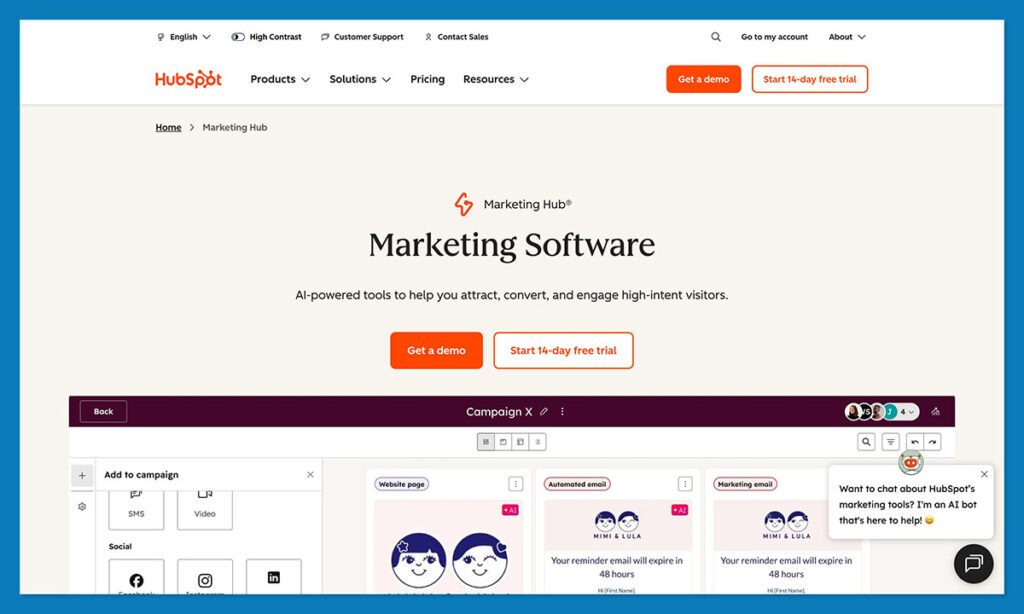
HubSpot’s campaign building process adopts a holistic perspective. It focuses on designing the intricate connections between all marketing touchpoints. For instance, a workflow can be established where a customer who views a product multiple times without purchasing receives a targeted email generated by Breeze AI, a sales follow-up task is assigned, and a retargeting ad is initiated on platforms like Facebook if no engagement occurs. This entire sequence is visualized on a single screen, allowing users to observe the interconnectedness of each step. The recent update to Marketing Studio further enhances this by enabling users to drag and drop actions onto a visual map, illustrating customer journeys. Features like Living Segments ensure that audience lists update dynamically based on real-time customer behavior. Creating supporting content, such as landing pages or blog posts, is integrated through the Content Hub, eliminating the need for manual tracking code implementation or separate analytics configurations.
ActiveCampaign offers a more streamlined and familiar automation builder, particularly well-suited for email-centric strategies. It allows for the rapid creation of sequences, such as sending a discount to customers who open a campaign and click a product link, while non-openers receive a gentler reminder. This visual builder is quick to learn and highly effective for single-channel marketing. However, its scope is primarily confined to email. For advertising, landing pages, or comprehensive SEO reporting, businesses typically need to integrate additional tools. While this can be manageable for businesses heavily reliant on email marketing, HubSpot’s integrated approach significantly reduces the need for constant tab-switching and app management, especially as e-commerce operations scale and customer interactions become more diverse.
The Backbone of Business: Sales and CRM Integration
The true differentiator for growing e-commerce businesses often lies in the integration of marketing efforts with robust sales and CRM functionalities. This is where HubSpot’s architecture truly excels.
HubSpot’s Smart CRM is designed from its inception to be the central nervous system of customer data. A contact record provides a complete historical view, tracing back to the initial ad click, the first website visit, every email exchanged, every sales deal, and even payment transactions via Commerce Hub. This data is updated in real-time, allowing for dynamic deal management, task assignment, and seamless progression of customers through sales stages, from “interested” to “won,” without any loss of context. The ability to send quotes and process payments directly within the CRM further streamlines operations, saving considerable time and reducing the potential for errors. While the number of customizable pipelines is tied to specific plans, this limitation is rarely an issue for most e-commerce teams.
ActiveCampaign’s CRM capabilities, while functional, often feel like an extension rather than a core component. It allows for basic pipeline management, note-taking, and deal tracking. However, achieving a comprehensive integration with deeper e-commerce data, such as full order histories or granular site behavior, often requires additional integrations, potentially through third-party connectors like Zapier. This can result in a less cohesive view of the customer journey compared to HubSpot’s native integration.
Illuminating Performance: Reporting, Analytics, and Data
The effectiveness of a CRM is ultimately measured by its ability to provide clear, actionable insights through reporting and analytics.
HubSpot delivers an effortless data experience. All customer interactions, campaign performances, and sales figures are consolidated within unified dashboards, eliminating the need for extensive data mining. Users can access Marketing Hub reports to directly ascertain which campaigns generated revenue, which landing pages converted visitors, and which emails led to purchases rather than just clicks. The recent enhancements to the Data Hub allow for seamless integration with platforms like Shopify and Google Ads, ensuring data remains perpetually synchronized. Features such as drag-and-drop dashboards, multi-touch attribution models, and AI-powered trend summaries provide a level of clarity that renders manual CSV exports obsolete.
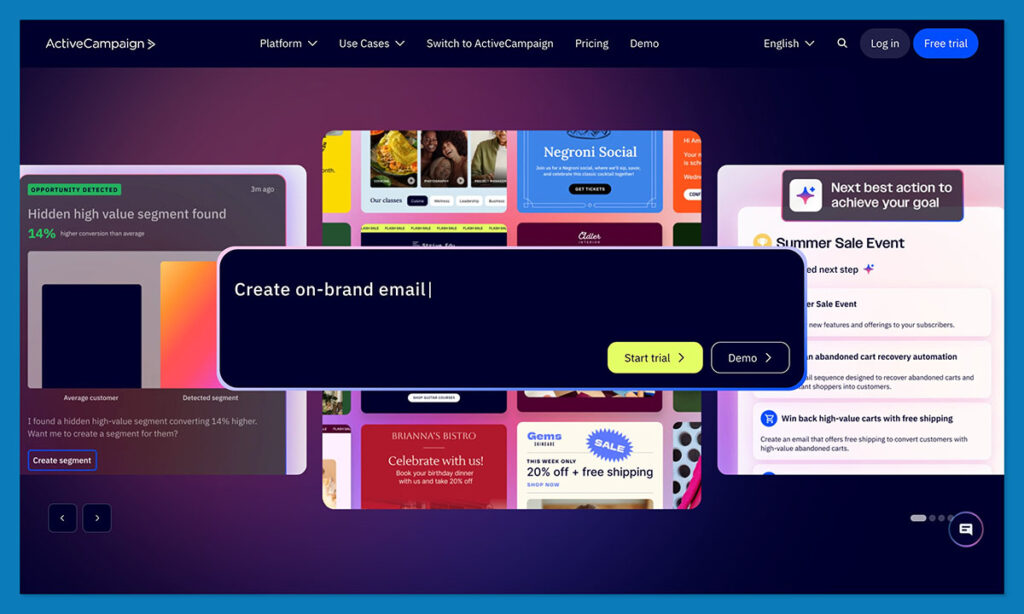
ActiveCampaign provides strong analytics at the campaign level, offering clear insights into opens, clicks, and goal completions. However, its ability to connect this data directly to sales performance or repeat purchase behavior is limited. While sufficient for marketers who prioritize email performance metrics, it does not offer the same unified view of a customer’s complete journey as HubSpot. For a holistic understanding of customer engagement across all touchpoints, additional analytical tools are often necessary.
Expanding Horizons: Integrations and Ecosystem
The integration capabilities of a CRM are critical for building a connected and efficient business technology stack.
HubSpot boasts an extensive ecosystem of over 2,000 integrations, encompassing major platforms like Shopify and Slack, which connect with minimal effort. What distinguishes HubSpot is the “native” feel of these integrations. Rather than appearing as disjointed add-ons, they seamlessly integrate data. For instance, connecting QuickBooks ensures invoices are automatically logged within the CRM timeline, and integrating Meta Ads automatically attributes conversions to specific campaigns. This creates a tidy, interconnected system that minimizes manual data manipulation.
ActiveCampaign offers approximately 1,000 integrations, including essential platforms like Shopify and WooCommerce. While these basic integrations function well, achieving deeper data synchronization often necessitates the use of connectors like Zapier or manual field mapping. While not inherently problematic, this requires additional setup and ongoing maintenance. For businesses prioritizing simplicity and primarily focusing on email-driven triggers, ActiveCampaign’s integration capabilities may suffice. However, for those seeking a unified system that effortlessly orchestrates various tools, HubSpot’s ecosystem provides a more stable and less labor-intensive solution.
Reaching Your Audience: Email and Messaging Performance
Email remains a cornerstone of e-commerce marketing, but customer communication increasingly spans multiple channels.
ActiveCampaign was developed with a strong emphasis on email deliverability. Campaigns are sent efficiently, consistently reach inboxes, and are less prone to triggering spam filters. Behind the scenes, the platform manages list cleaning, bounce handling, and engagement tracking, contributing to consistently high open rates. In testing, ActiveCampaign messages demonstrated slightly more reliable inbox placement, particularly for high-volume sends. The platform also offers an advantage in omnichannel messaging, with native support for SMS and WhatsApp within its automation builder. Integration with services like Postmark for transactional emails ensures that order confirmations and shipping updates are managed separately from marketing communications, a significant benefit for brands relying on rapid follow-ups and notifications.
HubSpot approaches messaging with a long-term strategy, prioritizing smarter targeting. Its CRM’s extensive context on purchase data, lead scores, and service interactions allows for audience segmentation based on behavior rather than just engagement metrics. This often leads to fewer, but more impactful, communications, resulting in higher click-through rates by avoiding mass, undifferentiated outreach. While HubSpot’s SMS and WhatsApp capabilities are primarily accessed through integrations, all customer conversations are unified within a shared inbox. This provides a singular thread for every customer interaction, even if the initial outbound messaging isn’t as instantaneous as ActiveCampaign’s native offerings.
The Financial Equation: Pricing and Total Cost of Ownership
The financial implications of adopting a CRM are a critical consideration for businesses of all sizes.
HubSpot offers a genuinely free CRM, providing essential functionalities like contact management, basic email capabilities, and deal tracking without any initial cost. The paid tiers, organized into distinct “hubs” (Marketing, Sales, Service), scale based on user count and feature depth. Starter tiers for Marketing and Sales Hub are competitively priced, typically around $20-$30 per user per month, providing core automation and reporting. However, the significant value of HubSpot is realized in its Professional and Enterprise tiers, which unlock advanced automation, AI capabilities, and in-depth analytics. While the upfront cost for these tiers can appear substantial, the consolidation of multiple software subscriptions into a single platform often leads to a lower total cost of ownership over time. The initial investment is offset by the elimination of redundant tools and the efficiency gains derived from a unified system.
ActiveCampaign employs a contact-based pricing model. This offers an attractive entry point, with plans starting around $39 per month for approximately 2,500 contacts. This model is cost-effective for businesses with smaller contact lists. However, as a company’s contact database grows, the pricing escalates rapidly, quickly surpassing the cost of comparable HubSpot plans. Furthermore, ActiveCampaign’s reliance on external tools for functionalities like landing pages, advanced CRM features, or deeper analytics means these additional subscription costs must be factored into the overall expenditure.
From a total cost of ownership perspective, a single, integrated platform like HubSpot often proves more economical in the long run. By replacing multiple specialized tools, it streamlines operational costs and simplifies vendor management. While HubSpot’s initial investment may be higher for advanced features, its comprehensive nature and the elimination of supplementary software costs make it a more sustainable and cost-effective solution for scaling e-commerce businesses.
Conclusion: The Enduring Advantage of HubSpot CRM
While ActiveCampaign is a formidable tool, particularly for businesses with a primary focus on email marketing automation, HubSpot CRM ultimately emerges as the superior choice for growing e-commerce brands. ActiveCampaign’s strengths lie in its speed, ease of use for email campaigns, and budget-friendly starting point. However, its limitations become apparent as businesses require more integrated sales pipelines, broader marketing channel management, and deeper, cross-functional analytics. In these areas, ActiveCampaign begins to rely on external applications, complicating workflows and increasing overall costs.
HubSpot, in contrast, is architected as a comprehensive business operating system. Its central Smart CRM acts as a nexus, seamlessly connecting marketing, sales, customer service, and e-commerce operations. This integration ensures that data flows unimpeded, providing a unified view of the customer journey and eliminating the need for constant data reconciliation. The platform’s robust automation capabilities, AI-driven insights, and extensive integration ecosystem empower businesses to operate with greater efficiency and strategic clarity. The ability to manage all customer touchpoints within a single, cohesive platform translates into significant time savings, reduced operational complexity, and a more profound understanding of customer behavior.
For e-commerce teams aiming for sustained growth and operational excellence, HubSpot CRM offers a scalable, integrated, and ultimately more efficient solution. Its ability to unify disparate data streams, automate complex workflows, and provide actionable insights across the entire customer lifecycle makes it the clear leader for businesses looking to not just manage, but truly optimize their e-commerce operations. The initial investment in HubSpot’s more comprehensive features often yields a greater return by consolidating functionality and streamlining processes, making it the platform of choice for long-term success. Businesses can explore its capabilities firsthand by setting up a free HubSpot CRM account, experiencing the unified approach that makes it a standout solution in the competitive CRM landscape.