
 rifanmuazin
In the contemporary landscape of corporate communication and digital publishing, the barrier to entry for producing content has never been lower, yet the threshold for capturing human attention has never been higher. As generative artificial intelligence (AI) becomes a staple tool for communicators, a paradoxical crisis has emerged: the proliferation of “empty prose.” While AI can generate grammatically flawless and tonally confident essays, it often fails to provide the specific, authoritative, and timely hooks necessary to engage seasoned editors and discerning readers. For executives and thought leaders aiming for placement in prestigious publications like Harvard Business Review, MIT Technology Review, or Fast Company, the opening paragraph has become the ultimate filter. In an era of infinite content, the first few sentences function as a binary switch: they either earn the reader’s time or trigger an immediate exit.
The Rise of Generative Mediocrity in Business Communication
The advent of Large Language Models (LLMs) has standardized a specific type of introductory style that editors now recognize—and often reject—within seconds. These openings typically follow a predictable cadence: they acknowledge a broad trend, assert its importance without evidence, and offer a vague promise of future insight. Common patterns include phrases like “In today’s rapidly evolving digital landscape” or “As organizations grapple with the complexities of AI, one thing is certain.”
While these sentences are structurally sound, they are intellectually hollow. They fail to provide a “claim”—a specific, debatable, or novel assertion that demands further reading. According to content analysts, this “empty prose” is the result of AI’s tendency to regress to the mean, pulling from the most common linguistic structures available in its training data. For publications that receive hundreds of submissions weekly, these patterns serve as a signal of low-value content. Editors at top-tier outlets report that the decision to reject a byline often occurs before the reader reaches the second sentence, simply because the lead fails to answer the fundamental question: why does this matter right now?

The Three Pillars of a High-Impact Lead
To move beyond the “AI-generated” feel, a strong op-ed lead must perform three functions simultaneously. First, it must establish the urgency of the topic (Why does this deserve attention?). Second, it must justify its relevance to the specific publication and its audience (Why now, and why here?). Third, it must validate the author’s unique perspective (Why is this person the right one to speak on it?).
Expert communicators argue that the traditional method of establishing authority—listing years of experience or titles—is no longer sufficient. In a saturated market, authority is earned through the quality of observation. A specific anecdote, an unexpected data point, or a counterintuitive historical parallel carries more weight than a standard biography. The most successful thought leadership pieces earn their conclusions through the lead, rather than simply stating the conclusion at the outset and hoping the reader stays for the explanation.
Case Studies in Effective Lead Construction: 2024-2026
Recent editorial successes from 2024 through 2026 highlight five distinct techniques that successfully bypass the “empty prose” trap. These examples demonstrate how specificity and structural subversion can capture professional interest.
1. The Historical Parallel with a Known Outcome
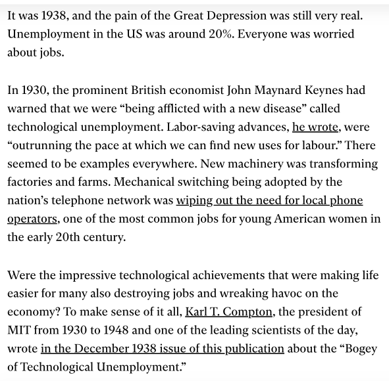
In a January 2024 piece for MIT Technology Review, David Rotman opened his discussion on AI and labor by transporting readers to 1938. By describing an era where U.S. unemployment was at 20% and John Maynard Keynes had just coined “technological unemployment,” Rotman leveraged the reader’s existing knowledge of history. Because the reader knows how the 20th-century economic story ended, they are more likely to trust the author’s analysis of modern AI. The technique here is to use history as a mirror, making the reader’s own knowledge a part of the persuasive argument.
2. The Credential Reversal
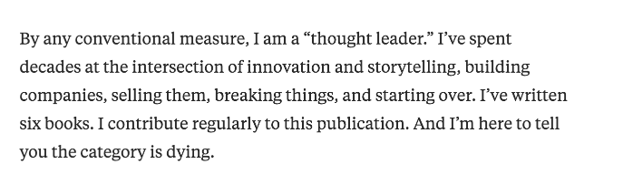
John Winsor, writing for Harvard Business Review in March 2026, utilized a “setup and subversion” tactic. He spent the first four sentences establishing his deep roots in the innovation sector and his history as a published author. Then, in the fifth sentence, he declared that the very category of “thought leadership” he inhabits is dying. This reversal creates immediate tension. It signals to the editor that the author is willing to challenge their own industry, which is a hallmark of high-value, original thinking.
3. The Accumulation of Counterintuitive Evidence
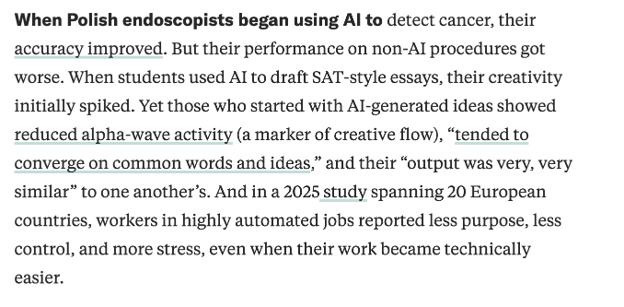
In December 2025, Rebecca Hinds and Robert I. Sutton published an analysis in Harvard Business Review that avoided summary entirely. Instead, they “stacked” three disparate examples: Polish endoscopists whose performance dropped without AI, students who lost creative momentum after using AI essay tools, and European workers reporting increased stress despite automation. By placing these side-by-side without immediate explanation, they forced the reader to ask “Why?”—the most powerful psychological hook available to a writer.
4. Naming an Emerging Phenomenon
Kate Niederhoffer’s September 2025 article, “The Rise of Workslop,” illustrates the power of nomenclature. By identifying a trend that many were experiencing but few had named—the flood of low-value AI output that creates the illusion of productivity—she created an instant “recognition hook.” The lead focused on the disparity between a 100% increase in AI adoption and a near-zero return on investment (ROI). This data-driven recognition makes the content feel personal to the reader’s daily professional struggles.
The Economic Cost of “Workslop”: Supporting Data
The necessity for better writing is not merely an aesthetic concern; it is an economic one. Research from the MIT Media Lab and various 2025 industry reports indicates a growing gap between AI utilization and organizational value. A study of 20 European countries found that while AI technically simplified tasks, it often led to a measurable decrease in “work purpose” and an increase in cognitive load.
Furthermore, an MIT report cited in 2025 revealed that 95% of organizations reported no measurable ROI from their initial generative AI investments. This lack of return is frequently attributed to “Workslop”—the creation of content, reports, and communications that fulfill a requirement but do not move the needle on strategy or engagement. For the professional communicator, the “opening paragraph” is the first line of defense against Workslop. If the lead is generic, the internal and external cost of the content becomes a net negative for the organization.
Chronology of the Shift in Thought Leadership Standards
The standards for what constitutes a “good lead” have shifted significantly over the last decade:
- 2010–2018 (The SEO Era): Leads were optimized for keywords and search engine rankings. Clarity and directness were prioritized over narrative flair.
- 2019–2022 (The Personal Branding Era): The focus shifted to “voice” and personal anecdotes. Authors were encouraged to be “vulnerable” to build a following on platforms like LinkedIn.
- 2023–Present (The Post-AI Authenticity Era): In response to the flood of automated content, the market now prizes “high-signal” writing. Specificity, unique data, and intellectual risk-taking have become the primary markers of human-led thought leadership.
Implications for Corporate Strategy and Executive Presence
The implications of this shift extend beyond the PR department. For executives, the ability to write—or oversee the writing of—a compelling lead is a matter of strategic influence. When an executive publishes a byline that starts with a generic AI-templated paragraph, it signals a lack of original vision to investors, employees, and competitors.
Conversely, a lead that uses a specific observation—such as a moment when a long-held industry belief failed—demonstrates active leadership and “boots-on-the-ground” intelligence. This is particularly critical in sectors like technology and finance, where the pace of change is so rapid that “standard” advice becomes obsolete within months.
Conclusion: The Five-Question Framework for Communicators
To ensure a lead survives the editorial “five-second rule,” communicators are encouraged to audit their opening sentences against a rigorous framework. Before finalizing a piece, authors should ask:
- When did something stop making sense? Start the piece at the moment of confusion or failure.
- Is there a new name for this? If a phenomenon is occurring but remains unnamed, name it in the lead.
- Which industry “truth” is now a lie? Challenge a common phrase that no longer holds up under scrutiny.
- What is the most specific detail available? Move a date, a number, or a location from the body of the text to the very first line.
- Why am I the only one who could write this? Ensure the lead reflects a perspective that an LLM could not replicate through statistical probability.
The difference between a lead that earns a reader’s attention and one that is ignored has little to do with linguistic polish. In the current media environment, polish is a commodity. The true value lies in the author’s ability to be specific, surprising, and substantively grounded from the very first sentence. As generative AI continues to fill the world with “structurally correct” noise, the human element of writing—characterized by specific observation and the courage to make a claim—remains the only reliable way to ensure the rest of the article is ever read.










