Google has unveiled a significant expansion of its AI Mode within Google Search, integrating three new travel-centric features designed to streamline the trip planning and booking process. The new functionalities empower users to track flight prices, view loyalty points or miles rates for travel, and book hotels directly through conversational queries, marking a strategic enhancement of Google’s presence in the competitive online travel market. This development positions AI Mode as a more comprehensive personal travel assistant, moving beyond information retrieval to transactional capabilities.
The rollout underscores Google’s ongoing commitment to leveraging generative artificial intelligence to deliver more intuitive and efficient user experiences, particularly in complex domains like travel planning. By integrating these features directly into the search interface, Google aims to reduce the friction traditionally associated with researching and booking travel across multiple platforms.
Background: Google’s Evolving Role in Travel and AI
Google’s foray into the travel sector is not new. Over the past two decades, the tech giant has steadily built a formidable ecosystem of travel tools, starting with Google Maps, then expanding to dedicated services like Google Flights, Google Hotels, and the overarching Google Travel hub. These platforms aggregate vast amounts of data from airlines, hotels, and online travel agencies (OTAs), offering users comparison tools and booking links. The introduction of AI Mode’s new travel features represents a natural evolution of this strategy, deeply integrating these capabilities within its flagship Search product, powered by advanced generative AI.
This move comes amidst a broader industry shift towards conversational AI. Following the introduction of its Search Generative Experience (SGE), which integrates AI-powered overviews into search results, Google has been actively exploring how AI can transform user interaction beyond traditional keyword searches. The travel sector, characterized by its data-intensive nature and frequent need for comparison and personalization, presents an ideal application for these advanced AI capabilities. Consumers increasingly seek personalized, seamless experiences, and AI-driven conversational interfaces are poised to meet this demand by simplifying complex tasks.
The online travel market, valued at hundreds of billions of dollars annually, is intensely competitive, with established players ranging from large OTAs like Expedia and Booking.com to metasearch engines and direct airline/hotel booking platforms. Google’s enhanced AI Mode is designed to provide a more unified and intelligent interface, potentially capturing a larger share of the booking journey and further cementing its position as a primary gateway for travel planning.
Hotel Booking: Conversational Convenience
One of the cornerstone features of this update is the ability to book hotels directly within AI Mode. Users can articulate their hotel preferences through natural language prompts, such as "Find me a pet-friendly hotel in downtown Chicago for under $200 a night with a pool," and AI Mode will respond with a visual list of options. This list is enriched with critical information, including guest reviews, pricing, and key comparative factors, enabling users to make informed decisions without navigating away from the search interface.
Once a user identifies a suitable hotel, the booking process is streamlined by selecting "Continue on Google," which facilitates the transaction using Google Pay. This integration significantly reduces the steps involved in booking, enhancing user convenience and encouraging completion within the Google ecosystem. The initial rollout of this feature is concentrated in the U.S. in English, with support from a broad network of prominent travel partners. These include major hotel chains like Choice Hotels International, Hilton, IHG Hotels & Resorts, Marriott International, and Wyndham Hotels & Resorts, alongside leading OTAs such as Booking.com, Expedia, Hotels.com, Priceline, and Trip.com. This extensive partnership network ensures a wide array of choices for users, from budget-friendly accommodations to luxury resorts, all accessible through a single conversational interface. The strategic selection of partners reflects Google’s aim to offer comprehensive coverage while collaborating with established industry players.
Flight Price Tracking: Intelligent Alerts for Savvy Travelers
Understanding the dynamic nature of airfare pricing, Google AI Mode now incorporates a robust flight price tracking system. Travelers can utilize AI Mode to not only find flight prices but also to set up intelligent alerts for specific routes and dates. This feature transforms AI Mode into a proactive AI agent, monitoring price fluctuations and notifying users when fares align with their target budget. Given that flight prices can change multiple times a day, often influenced by factors such as demand, season, and booking lead time, this tracking capability offers significant value to consumers seeking to optimize their travel expenses.
Google leverages data from over 300 partner airlines and travel sites globally to power this feature, ensuring comprehensive coverage and accurate, real-time pricing information. The system is designed to provide alerts via preferred communication channels, potentially including email notifications or direct alerts within the Google Search app, empowering users to book at the most opportune moment. The global availability of this feature, spanning more than 180 countries and territories, underscores Google’s ambition to cater to a worldwide audience of travelers, making intelligent flight price monitoring accessible regardless of geographical location. This widespread availability is crucial for international travelers who often contend with more complex pricing structures and volatile markets.

Points and Mile Rates: Maximizing Loyalty Program Value
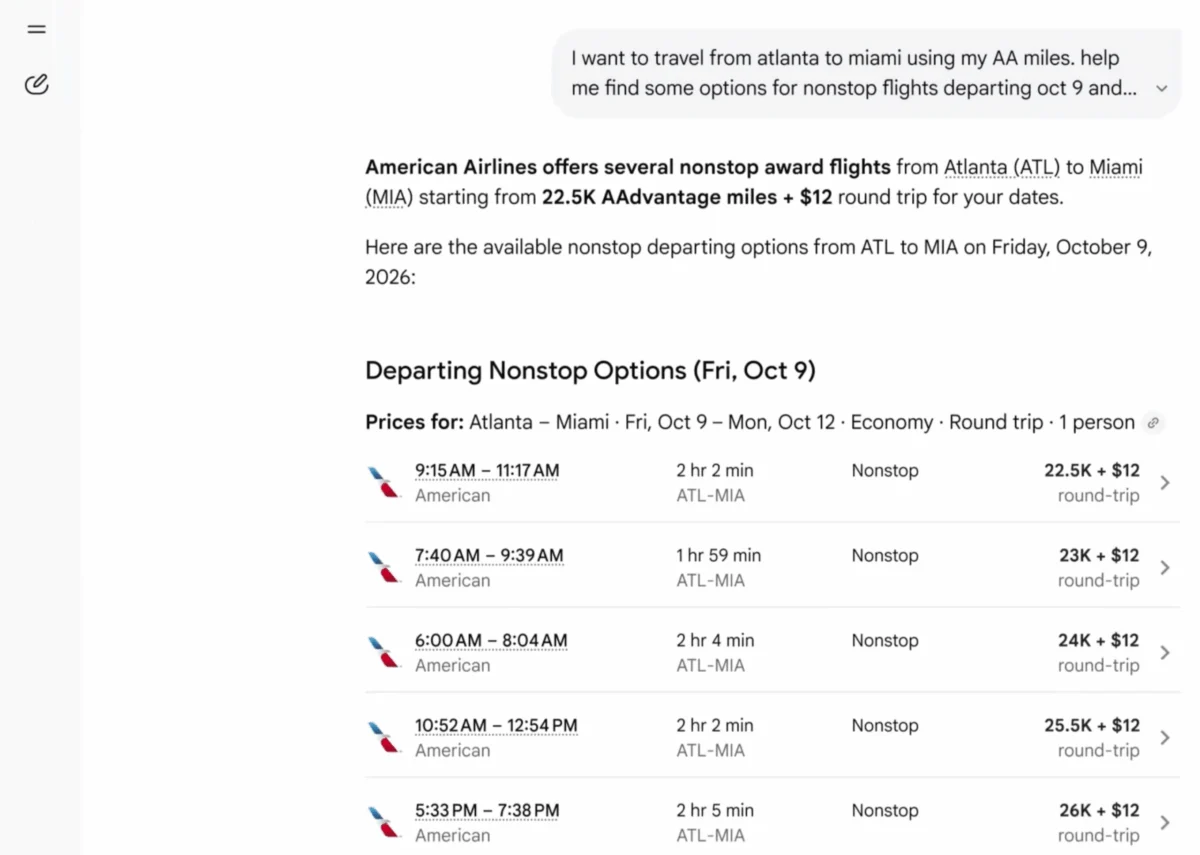
A particularly valuable addition for frequent travelers and loyalty program enthusiasts is the integration of points and mile rates directly into AI Mode. This feature allows users to view the cost of flights and hotels not just in monetary terms but also in loyalty points or miles, drawing data from Google’s extensive network of partners. Users can specify their preferred loyalty program, and AI Mode will display the required number of miles or points for matching flights and hotel stays. This functionality addresses a common pain point for loyalty program members who often struggle to ascertain the best use of their accumulated rewards across different platforms and fluctuating redemption rates.
Initially, this feature is globally available for several key loyalty programs, including Alaska Airlines/Hawaiian Airlines (partnerships for flight redemption), American Airlines, Choice Hotels International, Hilton, and Wyndham Hotels & Resorts. Google has announced plans to expand support in the coming weeks to include Accor, Flying Blue, Hyatt, LATAM Airlines, and Lufthansa Group, further broadening the utility for a diverse range of loyalty members.
Rajan Patel, a key figure at Google, emphasized the personal utility of this feature via a post on X (formerly Twitter). He stated, "I’m big into optimizing my airline miles and using them at the right time, so I’m excited about today’s launch, where we’re making that much easier in Search! You can now pull up the live cost in points or miles for flights and hotels directly in AI Mode." Patel highlighted the ability to describe desired travel and specific rewards programs to see real-time rates, with AI Mode providing direct links to airline or hotel sites for booking completion. This functionality directly caters to a segment of travelers who are highly engaged with rewards programs and constantly seeking to maximize their value.
Implications and Future Outlook
The integration of these advanced travel features into Google AI Mode carries significant implications for various stakeholders within the travel ecosystem.
For Consumers: The primary benefit for users is enhanced convenience and potential cost savings. By centralizing key travel planning functionalities within a single, conversational AI interface, Google reduces the need to visit multiple websites or apps. This streamlined experience saves time and effort, making travel research more efficient and less daunting. The flight price tracking and points/miles redemption features empower travelers to make more informed and economically advantageous decisions, potentially leading to substantial savings over time. The personalized nature of AI Mode also promises a more tailored travel planning experience, adapting to individual preferences and historical data.
For Google: This move solidifies Google’s position as an indispensable platform for discovery and transaction, especially in the high-value travel sector. By deepening transactional capabilities within AI Mode, Google enhances user engagement with its generative AI offerings and reinforces the value proposition of its search product. While the immediate revenue model for these specific AI Mode features isn’t explicitly detailed as taking a commission, increasing user retention and deepening integration within the Google ecosystem can lead to indirect revenue benefits through advertising and data insights, further strengthening Google’s market dominance. It also serves as a crucial differentiator in the rapidly evolving landscape of AI-powered search, distinguishing Google from competitors.
For Travel Partners (Airlines, Hotels, OTAs): The implications for Google’s travel partners are multifaceted. On one hand, the integration into AI Mode offers increased visibility and a new channel for customer acquisition, potentially driving more qualified leads to their direct booking platforms. Google’s extensive reach ensures that these partners are presented to a vast global audience. On the other hand, deeper integration within Google’s ecosystem raises questions about disintermediation. As more of the discovery and decision-making process occurs within Google’s interface, partners may find their direct customer relationships evolving, potentially relying more heavily on Google for traffic, which could affect their marketing strategies and cost of acquisition. However, the direct links to partner sites for final booking suggest a collaborative approach, aiming to maintain the partner’s brand presence and transactional control.
Competitive Landscape: This update intensifies competition within the online travel aggregation and booking space. While Google has always been a significant player, these new AI-driven capabilities directly challenge specialized travel apps, loyalty program trackers, and traditional OTAs that rely on their own platforms for discovery and booking. The ability to seamlessly compare monetary costs with loyalty point redemption options within a single interface provides a unique value proposition that few competitors currently match comprehensively.
Future Outlook: The expansion of AI Mode’s travel features is likely just the beginning. The foundational technology of generative AI opens doors for even more sophisticated travel planning functionalities. Future iterations could include dynamic itinerary generation based on user preferences and real-time conditions, predictive analytics for optimal travel times and destinations, and even integrated virtual travel assistants capable of handling complex multi-leg journeys and unforeseen changes. As AI models become more adept at understanding context and user intent, Google’s AI Mode could evolve into a truly holistic travel concierge, capable of managing every aspect of a trip from initial inspiration to post-travel feedback.
In conclusion, Google’s latest enhancements to AI Mode in Search represent a strategic and significant step in its efforts to redefine online travel planning. By weaving together flight price tracking, loyalty points redemption, and direct hotel booking into a seamless, conversational experience, Google is not only making travel more accessible and efficient for consumers but also reshaping the competitive dynamics of the global travel industry, all powered by its advanced artificial intelligence capabilities.