

Google Ads is set to implement a significant shift in how its Smart Bidding strategies operate, fundamentally altering the relationship between campaign budgets and performance efficiency. Beginning August 17, 2026, campaigns utilizing Target CPA and Target ROAS bidding strategies will no longer allow budget limitations to artificially inflate apparent efficiency. This change, detailed in official Google Ads documentation, aims to decouple the budget constraint from the efficiency lever, promising more predictable scaling for advertisers. While some in the PPC community have expressed concern over the potential loss of "cheap conversions," the long-term implications point towards a more stable and reliable foundation for campaign growth.
The historical challenge for many Pay-Per-Click (PPC) managers has been the delicate dance of scaling successful campaigns. A common scenario involves a campaign performing exceptionally well, consistently exceeding its target CPA at a lower-than-expected cost. For instance, a campaign with a $50 target CPA might be delivering conversions at a remarkably low $35. When such a campaign is capped at a daily budget of $100, clients and stakeholders are often pleased with the cost-effective results. The natural inclination, therefore, is to increase the budget to capture more of this apparent success. However, this is where the historical flaw in Google Ads’ Smart Bidding algorithm would manifest.
Upon raising the daily budget to $500, managers would frequently witness performance destabilize in real-time. The algorithm, accustomed to operating within a strict budget constraint, would struggle to adapt to the expanded inventory. This led to the bidding mechanics becoming unpredictable, causing the actual CPA to skyrocket, often far exceeding the initial $50 target. For years, budget-limited campaigns employing target-based bid strategies were essentially throttled by their daily budgets. This artificial ceiling forced Smart Bidding to aggressively pursue only the most readily available, lowest-cost conversions. When this "valve" was opened, the algorithm’s bidding behavior would shift dramatically and unpredictably, disrupting the carefully established performance baseline.
The Historical Flaw: How Budget Constraints Masked True Performance
To fully appreciate the significance of the upcoming August 17 change, it is crucial to understand how Smart Bidding historically handled campaigns operating under budget constraints. When a campaign was flagged as "Limited by budget," Smart Bidding did not merely cap the spend. Instead, it significantly restricted its bidding behavior to ensure it captured only the cheapest, highest-intent conversions possible within that limited dollar amount. This created a misleading performance picture. A campaign delivering conversions at a $35 CPA against a $50 target was not necessarily "overperforming" in a sustainable way; it was primarily capitalizing on a small, capped segment of available inventory. By avoiding broader auction pools due to budget limitations, the algorithm wasn’t truly tested on its ability to find more conversions at the target CPA across a wider range of opportunities.
The core issue was that once the budget was increased, unlocking access to a broader inventory, the Smart Bidding algorithm was compelled to reassess its bidding parameters within these new, larger auction pools. This recalibration was often outside the campaign’s initial learning phase, leading to significant CPA spikes and prolonged periods of performance instability as the algorithm re-learned. This meant that what appeared to be a highly efficient campaign was, in reality, a campaign operating at its perceived maximum efficiency within an artificially constrained environment. Scaling this perceived efficiency often led to unintended consequences and a loss of control over performance metrics.
The August 17 Shift: Decoupling Budget and Efficiency for Predictable Scaling
The forthcoming change on August 17, 2026, marks a pivotal moment in the evolution of Google Ads’ Smart Bidding. From this date forward, Google is mandating that Smart Bidding will optimize strictly towards the target set within the campaign settings, irrespective of whether the campaign is budget-constrained or fully funded. This means that if a campaign has a $10 Target CPA but has been historically delivering at $5 due to budget limitations, the post-August 17 algorithm will strive to deliver conversions closer to the $10 target.
While this might initially be perceived as an efficiency penalty, it is, in fact, a crucial stabilization fix. Google is achieving this by separating the budget lever from the efficiency lever. Previously, these two were inextricably linked. When a campaign was budget-limited, the algorithm would aggressively bid for the cheapest conversions to stay within that limit. If the budget was increased, the algorithm would then attempt to find more conversions, but its bidding logic would shift, leading to unpredictable CPA fluctuations.
With the new system, when these two levers operate independently, scaling becomes a far more linear and predictable process. If an advertiser increases the budget on a campaign that is locked into a $35 target CPA, the algorithm will now be empowered to capture more volume at that $35 target. Instead of wildly shifting its bidding parameters in response to the increased budget, it will maintain its focus on the established efficiency target. This fundamental change is designed to eliminate the performance instability that has plagued budget scaling efforts for years, providing advertisers with greater confidence in their growth strategies.

Understanding the Scope: Which Campaigns Will Be Impacted?
It is important for advertisers to recognize that this change will not affect every campaign across their Google Ads accounts. Understanding the boundaries of this update is key to focusing audit efforts on the most relevant campaign structures.
| Campaign Type / Category | Bidding Strategies Impacted | Post-August 17 Behavior |
|---|---|---|
| Search, Shopping, Performance Max, Demand Gen, Travel | Target CPA, Target ROAS, Target CPC (Demand Gen) | Changes: Will strictly deliver toward the stated target, eliminating budget-cap overperformance. |
| Display & Hotel | Target CPA, Target ROAS | No Change: Already operate under this strict target behavior. |
| App Campaigns, Video Reach, Video View (VVC) | Target CPA, Target ROAS / Cost-Per-View | Retain historical bidding behavior. |
| Manual Bidding, Max Conversions, Max Value | Manual CPC, Target Impression Share | Unaffected by target-based bidding changes. |
The campaigns most directly impacted are those utilizing Target CPA and Target ROAS on Search, Shopping, Performance Max, Demand Gen, and Travel platforms. These are the areas where the historical disconnect between budget and efficiency was most pronounced. Campaigns on Display and Hotel platforms, as well as those using Manual Bidding or Maximize Conversions/Value strategies, will remain unaffected by this specific change. App Campaigns and certain Video campaigns will also retain their existing bidding behaviors.
Preparing for the Transition: Maximizing the Upside
While the shift might initially cause concern about the loss of what appeared to be exceptionally cheap conversions, the long-term benefits of more predictable scaling present a significant growth opportunity. The crucial point is that Google will not automatically adjust bid targets upwards to reflect past "overperformance." Therefore, taking no action means actively allowing CPAs to trend upwards towards whatever legacy targets are currently set in the campaign settings. To leverage this update as a scaling opportunity, advertisers are advised to follow a structured transition framework, utilizing Google’s Bid Target Adjustment Tool, which became available in accounts from July 6, 2026.
1. Accessing the Bid Target Adjustment Tool:
Advertisers can access this tool directly from notifications within their Google Ads accounts. The tool automatically populates with any campaign that has experienced a "Limited by budget" constraint over the preceding 12 months. This eliminates the need for manual digging through historical status logs. For those wishing to perform a manual cross-check, filtering campaign tables by "Search Lost IS (budget) > 0%" over a 12-month period will provide similar insights. It is also recommended to compare this historical data with the last 30 days of performance to ensure the chosen target CPA is realistic and achievable.
2. Evaluating and Adjusting Current CPA/ROAS Bids:
This is the critical step where advertisers must make informed decisions about their target CPA or ROAS. The primary recommendation is to review the actual performance metrics over the past 12 months, particularly the period when campaigns were budget-constrained. If a campaign consistently delivered at a $35 CPA against a $50 target, the most sensible approach might be to lower the target CPA to $35. This aligns the target with the actual, efficient performance achieved. However, if the goal is to scale and capture more volume, and the $35 CPA was indeed due to budget limitations rather than an unsustainable bidding strategy, then setting the target slightly higher than the $35 but still below the original $50 target might be a prudent approach. The key is to set a target that reflects the desired efficiency level for the increased budget.
3. Respecting the Conversion Cycle Window:
Smart Bidding strategies require time to learn and stabilize after significant changes. Advertisers should anticipate that it will take approximately 1-2 conversion cycles for the algorithm to re-stabilize after bid adjustments are made. For accounts with longer sales cycles, such as a week, it is essential to implement bid changes in advance of crucial periods. This ensures that the campaign’s performance is stable and aligned with the new targets by the time those conversions are attributed. Understanding the typical conversion lag time for your specific business is paramount to successful implementation.
4. Incremental Reality Check and Value Assessment:
The shift provides an opportune moment to re-evaluate the incremental value generated by campaigns that were previously overperforming at a much lower CPA. Often, campaigns that appear to be delivering exceptionally cheap conversions are primarily capturing low-hanging fruit, such as branded search terms. By setting a more realistic target CPA that reflects broader inventory access, advertisers can better assess whether the campaign is generating truly incremental value beyond what would have been achieved organically or through less optimized efforts. This necessitates a deeper analysis of campaign performance beyond just the CPA, considering factors like customer lifetime value and the contribution to overall business objectives.
Broader Implications and the Future of Scalable Advertising
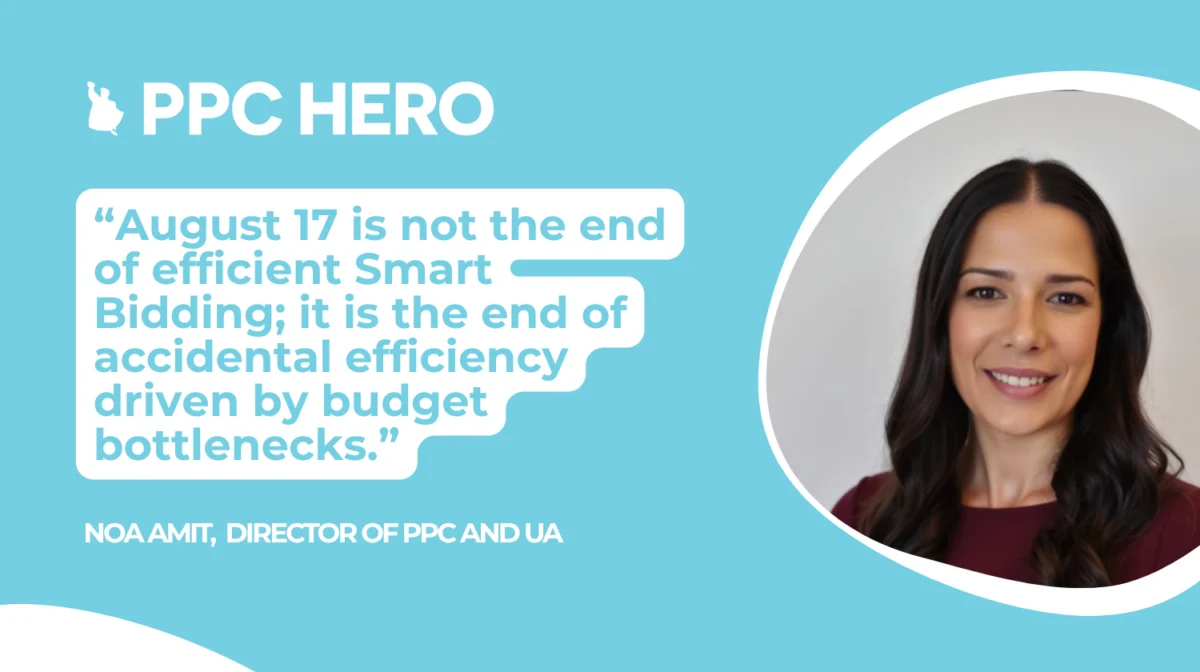
The August 17 change represents not an end to efficient Smart Bidding, but rather an end to accidental efficiency derived from artificial budget bottlenecks. By recalibrating stale targets to align with current, actual performance, PPC managers can effectively eliminate the risk of unwanted CPA drift when scaling. More importantly, this foundational change sets accounts up for a future where increasing a budget reliably does what it was intended to do all along: scale results predictably without compromising the performance that made the campaign successful in the first place.
This evolution in Google Ads’ algorithm reflects a broader industry trend towards more transparent and predictable performance management. For years, the PPC community has grappled with the inherent tension between aggressive scaling and maintaining cost efficiency. The decoupling of budget and efficiency levers addresses a long-standing pain point, promising a more robust and trustworthy environment for advertisers looking to grow their businesses through paid search. While the transition will require careful planning and execution, the ultimate outcome is a more stable and scalable advertising ecosystem, empowering businesses to invest with greater confidence in their digital growth strategies. This strategic shift by Google Ads signals a commitment to providing advertisers with the tools and predictability needed to navigate an increasingly competitive digital landscape.









