A comprehensive new report, based on the insights of 300 e-commerce business owners representing a combined $3.5 billion in revenue, has unveiled a series of significant shifts and counter-intuitive findings that are reshaping the landscape of online retail. The sixth annual Trends Report, compiled by eComFuel, challenges long-held conventional wisdom on critical aspects of the industry, from the reliance on paid advertising to the perceived decline of Amazon and the actual return on investment from artificial intelligence. The findings suggest a move away from established playbooks and a growing emphasis on operational efficiency, robust margins, and strategic financial management.
The report, which surveyed established players in the e-commerce space, highlights that many deeply ingrained beliefs about what drives success in online retail are either outdated or fundamentally flawed. This year’s analysis, driven by data from members of the eComFuel Community and the Operators Network, aims to provide a clear-eyed view of the current challenges and opportunities facing e-commerce entrepreneurs.
"Something in this report always changes how I think," stated the report’s author. "I’ve spent years side-eyeing heavy paid traffic dependency, convinced it was a margin trap. This year’s data changed my mind. My hope is something in here challenges your thinking, too."
The report is divided into two parts. Part 1, "The New Blueprint," dissects where conventional wisdom in e-commerce is proving incorrect. Key areas examined include the evolving role of paid traffic, the widening gap between gross margins and net profits, the diminishing returns from Amazon as a primary growth engine, the myth of warehouse ownership as a scalability driver, and the current lack of tangible ROI from AI adoption. Part 2, "The Real Landscape," delves into broader trends, including significant shifts in business models, the impact of tariffs, the critical importance of financial intelligence, strategies for capital extraction, and forward-looking perspectives for the near future.
Part 1: The New Blueprint
Paid Traffic: Table Stakes, Not Necessarily a Margin Killer
One of the most striking findings of the report is the re-evaluation of paid traffic’s role. For years, the prevailing narrative suggested that an over-reliance on paid advertising was a precarious strategy, leading to depleted margins and unsustainable growth. The data, however, presents a starkly different picture. A staggering 97% of surveyed stores now utilize paid traffic, with most indicating their business cannot operate without it. Contrary to the "building on a sandcastle" stigma, businesses that aggressively invest in paid channels are not only achieving topline growth but are also demonstrating significantly higher net income growth – 71.7% compared to 18.0% for those with less paid traffic dependency.
This "P&L-defying feat" is attributed not to superior Return on Ad Spend (ROAS), which was actually lower (2.5x) for these high-performing paid traffic experts compared to the survey-wide average of 4.0x. Instead, the success lies in the underlying business model. These leading brands boast robust gross margins (63.7%) and exceptionally lean overhead (16.6%). This contrasts sharply with other businesses, where Cost of Goods Sold (COGS) averages 55.1% of revenue and overhead stands at 21.7%. The report emphasizes that the true competitive edge in the current e-commerce environment is derived from a lean, high-margin operational structure that can effectively absorb advertising costs, rather than solely optimizing ad campaign performance. This finding fundamentally challenges the long-held belief that prioritizing organic traffic was the only path to sustainable profitability.
Amazon’s Shifting Role: From Growth Engine to Supplemental Channel
The report indicates a significant cooling of Amazon’s dominance as a primary growth driver for U.S. sellers. Amazon’s share of community revenue has receded to 20.1%, a level not seen since 2017, despite a record 63% of operators now selling on the platform. This suggests Amazon has transitioned from a primary growth engine to a more supplemental sales channel.
In contrast, Direct-to-Consumer (DTC) models are outperforming Amazon across key metrics. DTC-primary operators are experiencing 65% faster revenue growth (30.2% versus 18.3%) and commanding higher gross margins (52.7% versus 41.9%). The sentiment surrounding Amazon is also increasingly negative, with only 17% of operators expressing positive feelings towards it, while 39% actively dislike the platform. The next generation of e-commerce entrepreneurs appears to recognize this shift, with newer operators being less likely to prioritize Amazon as their main channel, opting instead for DTC-first strategies. This trend is attributed to years of increasing fees and a perceived indifference from Amazon towards seller concerns, prompting brand owners to seek more control and better profitability through their own channels.
Artificial Intelligence: Exciting Technology, Yet to Deliver Tangible ROI
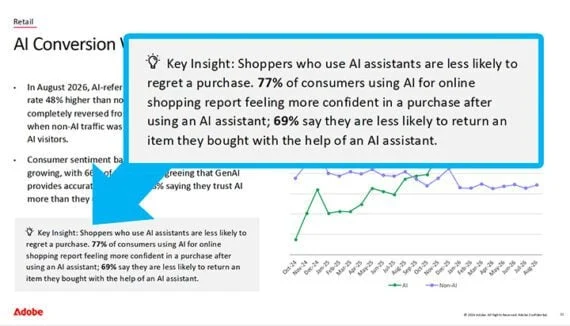
Despite the rapid advancements and widespread adoption of AI tools, the report reveals that these technologies have yet to translate into demonstrable financial gains for most e-commerce businesses. A significant 72% of store owners have embraced AI, leveraging capabilities from conversational AI to code generation and image creation. However, the data shows virtually identical revenue growth rates for AI adopters (26.7%) and non-adopters (27.8%). Net margins and team sizes also show similar trends, with non-adopters even exhibiting faster profit growth (55.3% versus 32.7% for adopters).
The report posits that while the technology is powerful and rapidly evolving, the considerable time and effort required to stay abreast of developments, learn, adopt, and integrate these tools into existing workflows may be currently negating any immediate financial benefits. Interestingly, AI adoption is not confined to younger entrepreneurs. Operators in their 50s are adopting AI at higher rates (80%) than those in their 30s (66%), suggesting that the perceived utility of AI might be more closely tied to solving complex operational challenges rather than simply embracing new technology. While the long-term edge from AI is anticipated, the past twelve months have not yet shown a clear financial return.
The Margin Divergence: Fatter Product Margins, Thinner Profits
A significant paradox has emerged in the e-commerce sector: while gross profit margins have reached record highs of 49.5%, driven by a surge in businesses manufacturing their own products, net profit margins have simultaneously hit an all-time low of 10.6%. This represents a widening gap of nearly 39 percentage points since tracking began in 2017, indicating that increased profitability at the product level is not translating to the bottom line.
The report debunks the notion that rising advertising costs are the sole culprit for this squeeze. When controlling for paid traffic expenditure, profitability remains surprisingly consistent. The primary drivers of this margin erosion are identified as product economics and overhead. Businesses achieving net margins above 20% spend significantly less on COGS (38% less) and fixed costs (30% less) than those operating below 5% profit margins. The escalating costs associated with modern e-commerce, including tariff pressures, intense foreign competition, and the inherent operational complexity of running a brand in 2025, are collectively constricting the profit spread. A notable exception is the $25 million to $50 million revenue tier, which exhibits a profitability sweet spot of 13.8%, attributed to well-managed manufacturers achieving scale without the overwhelming complexity that can afflict larger enterprises.
The Warehouse Myth: Owning Physical Space Slows Growth

The traditional scaling playbook, which often involves acquiring physical warehouse space and building an in-house operations team, is showing its limitations. Businesses that own their warehouses experienced significantly slower revenue growth (3.9%) compared to those that lease (33.5%) or outsource fulfillment entirely (22.2%). This trend holds even when controlling for business size. Warehouse owners tend to carry a larger inventory burden, operate less remote teams, and report lower future optimism.
Reinforcing this observation, the data on remote work indicates a strong correlation between team flexibility and financial performance. Remote-first teams (over 75% remote) achieved 51.8% net income growth, compared to 26.9% for in-office teams, while operating with leaner staff numbers (10.5 employees versus 30.5) and achieving nearly double the median revenue per employee ($1.25 million versus $583,000). While owning a warehouse might offer certain unquantifiable benefits like business durability for niche leaders, the measurable data strongly suggests that businesses with minimal physical real estate ownership are currently achieving greater success.
Part 2: The Real Landscape
A Massive Shift Towards Manufacturing Business Models
The e-commerce industry is undergoing a profound transformation, marked by a significant surge in brands focusing on manufacturing their own products. The proportion of store owners engaged in in-house manufacturing has surged by nearly 50% over the past few years, rising from 41% to 58%. This trend is closely mirrored by the increasing identification of "proprietary product" as the number one competitive advantage, climbing from 26% to 35%. Concurrently, other business models, such as reselling and drop shipping, along with the competitive edge of "lowest cost," are experiencing contraction. The intense competition and rising advertising costs have made it increasingly difficult to compete on price alone with generic products, necessitating higher margins that are best achieved through proprietary manufacturing.
International e-commerce businesses are performing on par with, or even surpassing, their U.S. counterparts across numerous metrics, despite 74% of respondents being based in the U.S. This suggests that while the U.S. offers the world’s largest consumer market, it also presents the most formidable competitive pressures. Smaller businesses, particularly those under $1 million in revenue, are disproportionately struggling, even when accounting for their years in operation. This indicates a structural disadvantage stemming from economies of scale and escalating customer acquisition costs, leaving them vulnerable in a competitive marketplace.
Brands Absorb the Majority of Tariff Costs
In response to global trade dynamics, businesses have largely absorbed the financial impact of tariffs rather than passing the full cost onto consumers. Among brands that reported a decline in income due to tariffs, only 42% implemented price increases, effectively absorbing the remaining 58% of the costs as a direct hit to their profit margins. A significant 40% of U.S. brands chose not to raise prices at all. This proactive absorption of costs, while protecting consumer pricing, has contributed to the overall margin squeeze.
The stated objective of incentivizing domestic manufacturing appears to be achieving slow traction. Of the brands not already manufacturing in the U.S., a mere 4% have initiated plans to relocate their supply chains domestically. Perhaps more telling is the prioritization of challenges: tariffs ranked as the fourth biggest struggle for business owners, trailing behind more persistent issues such as margins and rising costs, growth and scaling challenges, and the perennial difficulty of hiring and retaining talent. While e-commerce brands are demonstrating resilience in navigating tariff-related economic pressures, the inherent difficulties of the e-commerce sector itself remain more pressing concerns.
Financial Fluency: The Underrated Edge in E-commerce
The report underscores the profound impact of financial literacy on e-commerce business success. While often perceived as less glamorous than marketing or product development, a mastery of financial management is proving to be a significant differentiator. Businesses where owners self-rated their financial expertise at the highest level (5/5) demonstrated markedly higher net margins, greater cash reserves, accelerated income growth, and more efficient capital extraction.
The impact of moving from a "good" (4/5) to "great" (5/5) level of financial understanding is substantial. This improvement correlated with a 37% increase in net margins (from 9.4% to 12.9%), nearly doubling financial runway (from 48 months to 109 months), and significantly faster income growth. This pattern persists irrespective of business size, indicating that financial knowledge itself is a predictor of superior outcomes. A notable statistic reveals that 80% of owners rated themselves below a 5/5, suggesting a vast opportunity for improved profitability through enhanced financial education. The eComFuel guide to "Building Financial Mastery as an eCom entrepreneur" is highlighted as a resource for those seeking to capitalize on this potential.
Capital Extraction: Balancing Growth with Owner Returns
The data reveals that most e-commerce owners do not realize substantial financial rewards until their businesses reach mid-seven figures in revenue. A significant 53% of owners report taking modest salaries or no compensation at all, indicating a prioritization of reinvestment in business growth. This challenge is particularly acute for fast-growing companies or those under $1 million in revenue. Among companies experiencing growth of 50% or more, only 13% manage to take significant dividends, and this figure drops to zero for fast-growing businesses under $1 million. Both these groups are channeling all available resources into working capital and infrastructure development.
A "sweet spot" has been identified where owners balance salary with small distributions. This cohort exhibits the highest net income growth in the survey (+45.3%), above-average margins (12.0%), and the highest level of optimism. The findings suggest that small, consistent distributions do not hinder growth but rather serve to diversify wealth, foster operational discipline, and contribute to owner well-being. The report concludes that aggressive capital extraction and rapid growth are mutually exclusive strategies. However, establishing a habit of making modest distributions appears to offer a threefold benefit: enhanced financial stability, operational focus, and sustained owner satisfaction.
The Future: Optimistic, Lean, and Betting on AI
Despite facing headwinds from tariffs, navigating a nascent AI landscape, and experiencing margin pressures, an overwhelming 80% of e-commerce owners remain optimistic about the future of their businesses, with an average hopefulness rating of 7.8 out of 10. The key differentiator for optimistic entrepreneurs is operational leanness. This group consistently runs lower fixed overhead (19% versus 24% of revenue), carries lighter inventory (11.9% versus 14.6% of revenue), and is significantly more inclined to lease rather than own warehouse space.
Looking ahead to 2026, artificial intelligence and automation are identified as the primary investment priorities, cited by more owners than any other category. Marketing and advertising follow as the second most significant investment area, with operational simplification and SKU reduction ranking third. This indicates a clear understanding among operators of the value of maintaining lean operations. Younger founders and larger businesses both exhibit higher levels of optimism, with the former benefiting from fewer entrenched challenges and the latter possessing greater resources and resilience. Nevertheless, the e-commerce community as a whole demonstrates remarkable adaptability and a forward-looking perspective.
The full 55-page Trends Report offers more in-depth analysis, detailed benchmarking charts, and actionable recommendations for businesses seeking to thrive in this evolving e-commerce environment. The insights presented are drawn from a community of seven- and eight-figure store owners who continuously share their real-world experiences and strategies.